

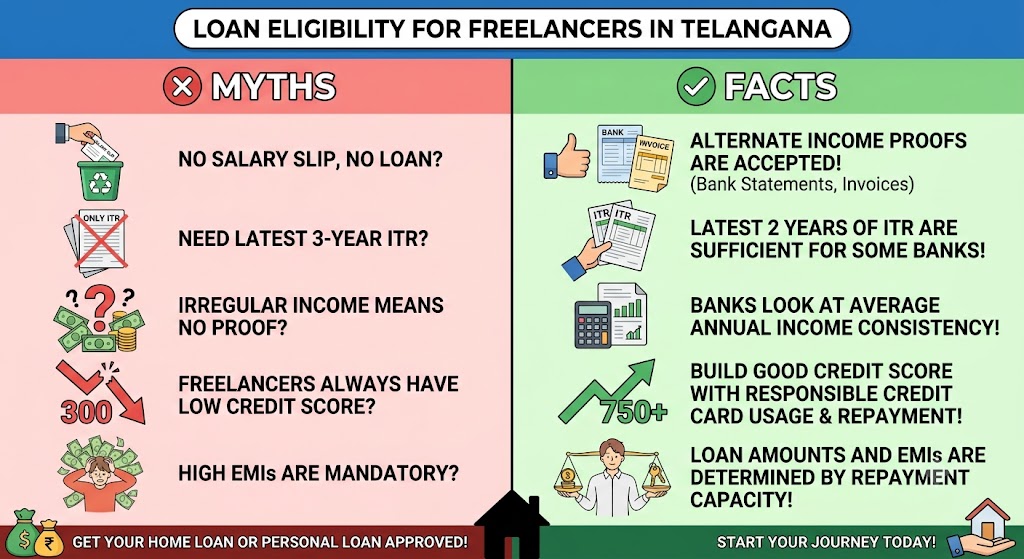
Freelancing is becoming a popular career choice for professionals such as software developers, graphic designers, content writers, digital marketers, consultants and photographers. However, freelancers may face questions when applying for loans because their monthly income can vary from one project to another.
Many people believe that freelancers cannot get personal loans without a salary slip or that irregular income automatically leads to rejection. These assumptions are not always correct.
Loan eligibility for freelancers in Telangana depends on the lender's criteria, documented income, credit history, existing EMIs, KYC and repayment capacity. Understanding the difference between common myths and facts can help freelancers make better borrowing decisions.
What Is Loan Eligibility for Freelancers in Telangana?
Loan eligibility refers to the conditions a lender uses to assess whether an applicant may qualify for a loan and how much they may be able to borrow.
For freelancers in Hyderabad, Warangal, Karimnagar, Nizamabad and other parts of Telangana, lenders may evaluate:
-
Monthly and annual freelance income
-
Income Tax Returns (ITRs), where required
-
Bank statements and payment records
-
Credit history and outstanding debt
-
Existing EMIs and repayment obligations
-
Identity and address verification
-
Professional experience and income stability
-
Requested loan amount and tenure
Requirements differ between lenders and loan products. Meeting basic eligibility conditions does not guarantee approval.
Common Myths and Facts About Freelancer Loans
Myth 1: Freelancers Cannot Get Personal Loans
Fact: Freelancers may qualify for personal loans if they meet the lender's requirements.
A traditional salaried job is not the only possible source of income for a borrower. Lenders may assess self-employed applicants using financial records, credit history and other acceptable documents.
For example, a freelance web developer in Hyderabad who receives payments from multiple clients may demonstrate income through bank statements, invoices and ITRs.
Myth 2: A Salary Slip Is Always Mandatory
Fact: A salary slip may not be required for every freelancer loan application.
Freelancers generally do not receive conventional monthly salary slips. Depending on the lender, alternative documents may include:
-
Bank statements
-
ITRs
-
Client invoices
-
Work contracts
-
Payment receipts
-
Platform payment records
-
GST records, where applicable
Applicants should confirm which documents their chosen lender accepts.
Myth 3: Irregular Income Automatically Causes Loan Rejection
Fact: Variable income can affect the assessment, but it does not automatically mean rejection.
A lender may review income patterns over a period of time to understand whether the applicant can afford repayments.
For instance, a freelancer who earns ₹35,000 in one month and ₹65,000 in another should maintain clear records of both payments. The lender may assess the overall income pattern rather than relying only on the highest-earning month.
Myth 4: A High Credit Score Guarantees Approval
Fact: A strong credit history can help, but it does not guarantee loan approval.
Lenders may also consider income, existing EMIs, employment or professional records, KYC and repayment capacity.
A freelancer with a good credit score but inconsistent documented income or substantial existing debt may still face difficulties.
Myth 5: Freelancers Do Not Need to File ITRs
Fact: ITRs can be useful evidence of income, and some lenders may require them.
Tax filing obligations depend on the applicable tax rules and the individual's circumstances. Freelancers should understand their filing requirements and maintain accurate financial records.
ITRs may help demonstrate declared income, but they are not necessarily the only document considered by every lender.
Myth 6: Freelancers Can Borrow the Maximum Amount Offered
Fact: The maximum eligible amount may not be the amount a freelancer should borrow.
Freelance earnings can change because of delayed client payments, fewer projects or seasonal demand.
Before accepting a loan, calculate the EMI alongside household expenses, business costs, taxes and existing debt. Choose an amount that remains manageable even during a low-income month.
Myth 7: The Lowest Interest Rate Always Means the Cheapest Loan
Fact: The advertised interest rate does not tell the whole story.
Borrowers should compare the Annual Percentage Rate (APR), processing fees, applicable taxes, repayment tenure, other charges and total repayment amount.
A longer tenure may lower the EMI but increase the total interest paid. Always compare the complete cost before accepting an offer.
Myth 8: Instant Approval Means the Loan Is Guaranteed
Fact: An initial approval message may not mean the lender has completed all checks or agreed to disburse the loan.
Final approval may depend on verification, eligibility checks, documentation and the lender's underwriting process.
Read the loan agreement and the applicable Key Facts Statement (KFS) carefully before accepting an offer.
Myth 9: Every Loan App Is Safe
Fact: Freelancers should verify the actual lender behind a digital loan application.
Check whether the bank or non-banking financial company (NBFC) is appropriately regulated, review the lender's official website and read the terms and privacy information.
Never share OTPs, UPI PINs or banking passwords with anyone claiming to guarantee loan approval. Avoid suspicious links and apps that demand unnecessary access to personal information.
Myth 10: Applying to Many Lenders Improves Approval Chances
Fact: Multiple applications within a short period may result in several credit enquiries and can complicate your credit profile.
A better approach is to compare eligibility requirements first, prepare the required documents and apply selectively to suitable lenders.
Documents Freelancers May Need for a Loan
| Document | Why It May Be Needed |
|---|---|
| PAN | Identity and financial verification |
| Aadhaar or other accepted KYC | Identity/address verification |
| Bank statements | Evidence of transactions and income |
| ITRs | Support for declared income |
| Client invoices | Evidence of freelance work |
| Contracts or work agreements | Support for professional activity |
| Payment receipts | Evidence of payments received |
| Existing loan details | Assessment of current obligations |
The exact documentation depends on the lender, loan type and individual application.
How Freelancers Can Improve Loan Eligibility
Freelancers in Telangana can take practical steps to strengthen their financial profile.
-
Maintain clear income records: Keep invoices, contracts and payment receipts organized.
-
Review your credit report: Check for errors, overdue accounts and incorrect information.
-
Manage existing debt: Avoid taking on more EMIs than your income can comfortably support.
-
Maintain bank records: Keep legitimate client payments properly documented.
-
Prepare tax documents: Keep applicable ITRs and supporting records ready.
-
Choose a realistic loan amount: Borrow according to your actual needs and repayment capacity.
-
Compare loan costs: Review APR, fees, tenure, EMI and total repayment.
-
Verify the lender: Read the agreement and check the applicable KFS before accepting an offer.
Example: A Freelancer Applying for a Loan in Hyderabad
Consider Priya, a freelance digital marketer in Hyderabad who earns an average of ₹45,000 per month.
She wants a personal loan to upgrade her work equipment. She has bank statements, client invoices and income-tax records available.
Before applying, Priya reviews her credit history, calculates her existing EMIs and estimates the new EMI she could comfortably manage.
Instead of borrowing the maximum amount offered, she compares the complete cost of different suitable offers and checks the lender's terms.
This example illustrates a sensible approach to borrowing. Priya's eligibility and approval would still depend on the lender's criteria and verification process.
Frequently Asked Questions
Can freelancers in Telangana apply for personal loans?
Yes, freelancers may apply if they meet the chosen lender's eligibility requirements. Approval depends on the applicant's financial profile and the lender's assessment.
Can I get a loan without a salary slip?
Possibly. Some lenders accept alternative income evidence such as bank statements, ITRs, invoices and contracts. Requirements vary.
Does freelance experience affect eligibility?
It may. Some lenders consider the length and consistency of professional activity when assessing income stability.
Can a freelancer apply for a digital loan?
Yes, where eligible. The borrower should verify the actual lender, understand the loan cost and review the agreement before accepting the offer.
What should I check before accepting a loan?
Check the lender, interest rate, APR, fees, EMI, tenure, total repayment, applicable KFS and prepayment terms. Make sure the EMI is affordable even when income falls.
Does loan eligibility guarantee approval?
No. Eligibility estimates and preliminary approval messages do not guarantee final approval or disbursement.
Published on : 11th October 2026
Published by : shibam nath
www.vizzve.com || www.vizzveservices.com
Follow us on social media: Facebook || Linkedin || Instagram
🛡 Powered by Vizzve Financial
RBI-Registered Loan Partner | 10 Lakh+ Customers | ₹600 Cr+ Disbursed