

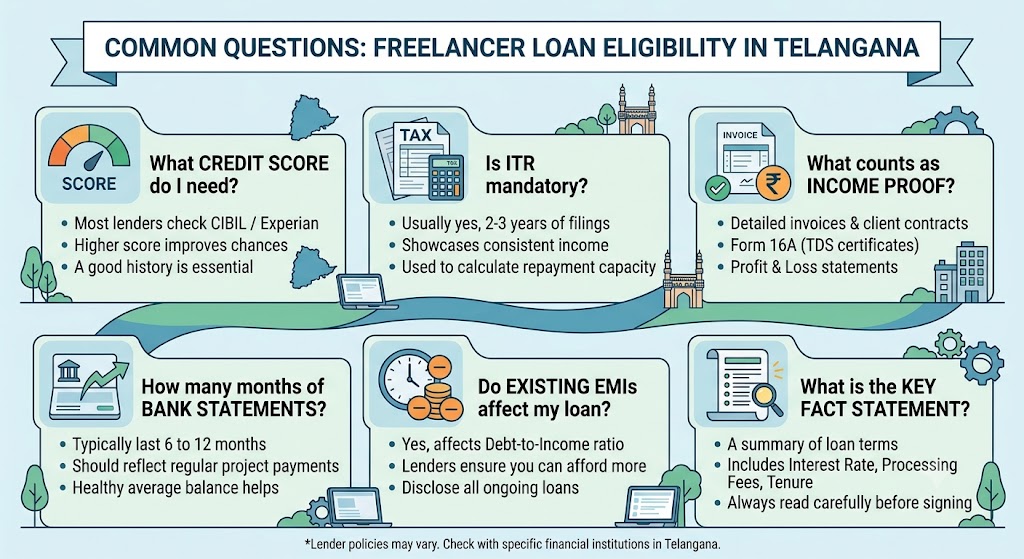
Read the final terms carefully instead of relying only on promotional information.
Quick Freelancer Loan Checklist
Before applying, ask yourself:
-
Is my credit history in good shape?
Freelancers in Telangana may have different income patterns compared with salaried employees. Instead of receiving a fixed monthly salary, freelancers may earn through projects, contracts, consulting assignments, online work or multiple clients.
This can make the loan application process slightly different. Lenders may look at credit history, freelance income, ITR, bank statements, KYC documents, existing EMIs and repayment capacity before making a lending decision.
If you are a freelancer planning to apply for a loan, understanding the answers to common borrower questions can help you prepare better and avoid unnecessary mistakes.
Can Freelancers in Telangana Get a Loan?
Yes. Freelancers can apply for personal loans and other eligible credit products, subject to the lender's requirements.
Approval is not based on profession alone. The lender may assess your overall financial profile, including income, credit history, documentation and ability to repay.
What Factors Affect Freelancer Loan Eligibility?
Common factors that may be considered include:
-
Credit score and repayment history
-
Freelance income and income stability
-
ITR and tax records
-
Bank statements
-
Existing loans and EMIs
-
KYC verification
-
Professional history
-
Requested loan amount
-
Repayment capacity
-
Lender-specific eligibility criteria
Each lender can have different requirements.
Questions Borrowers Ask About Freelancer Loans
1. Is a Salary Slip Required for a Freelancer Loan?
Not necessarily.
Freelancers generally do not receive traditional salary slips. Depending on the lender, alternative income documents may be accepted, such as:
-
ITR
-
Bank statements
-
Client invoices
-
Work contracts
-
Payment records
-
GST records, where applicable
The exact documents required depend on the lender and loan product.
2. How Can a Freelancer Prove Their Income?
Freelancers can use multiple financial records to demonstrate income.
Bank statements can show actual client payments, while ITRs can provide evidence of reported income. Invoices, contracts and payment records can further support the income information provided in an application.
It is important that the information submitted is accurate and consistent across documents.
3. Does ITR Matter for Freelancer Loan Eligibility?
ITR can be an important income-verification document for self-employed and freelance applicants.
It can help demonstrate reported earnings and provide a lender with additional information about your financial position.
However, submitting an ITR does not automatically guarantee loan approval.
4. Does Credit Score Affect Freelancer Loan Approval?
Yes, credit history can be an important part of loan assessment.
Lenders may consider previous repayment behaviour, outstanding credit, existing loans and other credit information.
A good repayment record can support a stronger application, but there is no universal credit-score number that guarantees approval from every lender.
5. Can Irregular Freelance Income Affect Eligibility?
Yes, it can.
Freelance income may vary significantly from month to month. Large fluctuations can make repayment capacity more difficult to assess.
Instead of relying on one unusually high-income month, freelancers should maintain proper financial records that demonstrate their overall income pattern.
6. Do Bank Statements Matter?
Yes. Bank statements can help demonstrate actual cash flow.
A lender may review:
-
Client payments
-
Account activity
-
Existing EMI deductions
-
Returned transactions
-
Income consistency
-
Overall cash flow
Keeping financial transactions organized can make the verification process easier.
7. Can Existing EMIs Reduce Loan Eligibility?
Yes.
Existing financial obligations can affect how much additional debt you can reasonably afford.
A simple calculation is:
Existing EMIs + Proposed New EMI = Total Monthly Debt Obligation
Before applying, compare the total with your dependable income and monthly expenses.
8. Should Freelancers Borrow the Maximum Eligible Amount?
No.
The maximum amount offered by a lender may be higher than what you actually need or can comfortably repay.
A better approach is to calculate your requirement first and then choose a loan amount that keeps the EMI manageable.
9. What Loan Costs Should Freelancers Check?
Do not compare loans only by their advertised interest rate.
Check:
-
Interest rate
-
APR
-
Processing fee
-
Applicable taxes
-
Documentation charges
-
Late-payment charges
-
Penal charges
-
Prepayment or foreclosure conditions, where applicable
-
Total repayment
A loan with a lower advertised rate may still have a higher overall cost because of other charges.
10. What Is a KFS and Why Should I Read It?
The Key Facts Statement (KFS) provides important information about applicable loan costs and terms.
Before accepting a digital loan, borrowers should carefully review the KFS and understand the applicable APR, charges, repayment schedule and other key conditions.
Do not accept a loan simply because the approval is quick.
11. How Can Freelancers Improve Their Loan Eligibility?
Some practical steps include:
-
Pay existing EMIs on time.
-
Maintain a healthy credit profile.
-
Keep ITR records organized.
-
Maintain proper bank statements.
-
Keep invoices and contracts available.
-
Avoid unnecessary debt.
-
Calculate repayment capacity before applying.
-
Choose a realistic loan amount.
-
Avoid submitting multiple unnecessary applications.
-
Compare loan costs before accepting an offer.
12. Can Freelancers Apply for Digital Loans?
Eligible freelancers may apply for digital loans offered through legitimate lending arrangements.
However, borrowers should verify the actual lender and understand the terms before submitting personal or financial information.
Never share confidential credentials such as OTPs, UPI PINs, ATM PINs, card PINs or internet-banking passwords with another person.
13. What Documents Should Freelancers Keep Ready?
The exact requirements vary, but commonly requested documents may include:
Document Purpose PAN Identity and financial verification Aadhaar/Other KYC Identity and address verification Bank Statements Income and cash-flow assessment ITR Income verification Invoices Freelance income evidence Contracts Professional income evidence GST Records Business verification where applicable Existing Loan Details Debt assessment 14. Why Might a Freelancer's Loan Application Be Rejected?
Possible reasons include:
-
Weak credit history
-
Irregular or insufficient documented income
-
High existing EMI obligations
-
Incomplete KYC
-
Insufficient income documents
-
Applying for an amount that is too high
-
Inconsistent information across documents
-
Not meeting lender-specific eligibility criteria
A rejection does not necessarily mean the applicant can never qualify for a loan. Reviewing the reason and improving the financial profile may help in the future.
15. What Should I Check Before Accepting a Loan?
Before accepting a loan, check:
-
Actual lender
-
Loan amount
-
Net amount disbursed
-
Interest rate
-
APR
-
EMI
-
Tenure
-
Processing fee
-
Other applicable charges
-
Total repayment
-
Late-payment and penal charges
-
Prepayment terms
-
KFS and loan agreement
Published on : 8th October
Published by : shibam nath
www.vizzve.com || www.vizzveservices.com
Follow us on social media: Facebook || Linkedin || Instagram
🛡 Powered by Vizzve Financial
RBI-Registered Loan Partner | 10 Lakh+ Customers | ₹600 Cr+ Disbursed
-