

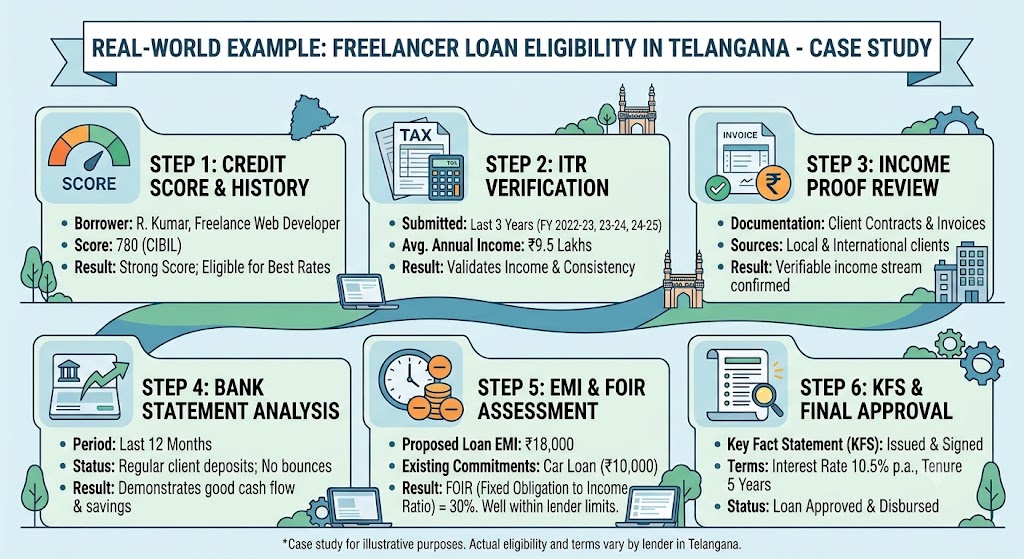
Freelancers often have a different income pattern from salaried employees. Instead of receiving a fixed salary every month, they may earn from multiple clients, projects, contracts or online platforms. This can make the loan eligibility process slightly different.
But does irregular income mean a freelancer cannot get a loan in Telangana? Not necessarily. Lenders may assess factors such as income stability, bank transactions, ITRs, credit history, existing EMIs, KYC and overall repayment capacity.
This real-world example explains how a freelancer in Telangana could prepare for a loan application and what a lender may consider.
Real-World Example: Freelancer Applying for a Personal Loan
Consider Rahul, a freelance graphic designer based in Hyderabad, Telangana.
He has been working independently for around three years. His monthly income changes depending on the number of projects he receives.
Rahul's Financial Profile
| Factor | Example Details |
|---|---|
| Profession | Freelance Graphic Designer |
| Location | Hyderabad, Telangana |
| Freelancing Experience | 3 years |
| Average Monthly Income | ₹55,000 |
| Monthly Income Range | ₹40,000–₹70,000 |
| Existing EMI | ₹8,000 |
| Credit History | Regular repayment history |
| ITR | Available |
| Bank Statements | Available |
| KYC Documents | Available |
| Requested Loan | ₹2,00,000 |
Rahul wants to borrow ₹2 lakh to upgrade his computer equipment and manage some professional expenses.
The figures above are illustrative only. Actual eligibility, interest rates, fees and approval decisions vary by lender and borrower profile.
Step 1: Checking Rahul's Income
The first important question is whether Rahul can demonstrate his freelance income.
A freelancer may not have a traditional salary slip. Instead, supporting documents can include:
-
Income Tax Returns (ITRs)
-
Bank statements
-
Client invoices
-
Payment receipts
-
Contracts or work agreements
-
Platform payment records
-
GST-related documents, where applicable
-
Other legitimate income records
Rahul's average income of ₹55,000 is more useful when supported by consistent bank credits and tax records rather than relying on a single high-income month.
Why Income Consistency Matters
Suppose Rahul earned:
-
January: ₹52,000
-
February: ₹48,000
-
March: ₹60,000
-
April: ₹43,000
-
May: ₹65,000
-
June: ₹62,000
His income varies, but the records demonstrate an ongoing earning pattern.
For a freelancer, documented and reasonably consistent income can help lenders understand repayment capacity, although each lender uses its own underwriting criteria.
Step 2: Reviewing Existing EMIs
Rahul already pays an EMI of ₹8,000 every month.
This matters because a new lender will generally consider his existing financial obligations when assessing whether another EMI is affordable.
For example:
Average monthly income: ₹55,000
Existing EMI: ₹8,000
After considering his regular financial obligations and living expenses, Rahul should determine whether the proposed new EMI comfortably fits his budget.
The objective should not simply be to qualify for the largest possible loan. The better approach is to choose an amount that can be repaid even during a weaker freelance-income month.
Step 3: Credit History Check
Rahul's credit history is another important part of the application.
A good repayment record can support his application, while missed payments, excessive recent applications or high outstanding debt may create concerns.
Before applying, Rahul should check his credit report and review:
-
Active loans
-
Credit-card balances
-
Previous late payments
-
Recent credit enquiries
-
Outstanding dues
-
Errors or incorrect information
If there is an error in the credit report, it is better to address it before making multiple new loan applications.
Step 4: Documents Rahul Keeps Ready
Because Rahul does not receive a conventional monthly salary slip, he prepares alternative income documents.
| Document | Purpose |
|---|---|
| PAN | Identity and financial verification |
| Aadhaar/other accepted KYC | Identity/address verification |
| ITR | Income and tax-related evidence |
| Bank statements | Shows income credits and transactions |
| Client invoices | Supports freelance earnings |
| Contracts | Shows ongoing/project-based work |
| Payment records | Supports received income |
| Existing loan details | Helps assess current obligations |
The exact documents required depend on the lender and loan product.
Step 5: Can Rahul Afford the New EMI?
Suppose Rahul receives an illustrative loan offer of ₹2,00,000.
The actual EMI would depend on the interest rate and tenure offered by the lender.
For example, if a lender offers:
-
Loan amount: ₹2,00,000
-
Illustrative annual interest rate: 15%
-
Tenure: 24 months
the EMI would be approximately ₹9,697 per month.
This is only a mathematical illustration, not a representation of current market pricing or a guaranteed lender offer.
Rahul already has an ₹8,000 EMI. Therefore, his combined EMI obligation would be roughly:
₹8,000 + ₹9,697 = ₹17,697 per month
He should assess this against his actual monthly income, essential expenses, taxes and the possibility of months with lower freelance earnings.
What This Example Shows
Rahul's case demonstrates that freelancer loan eligibility is not necessarily based on a salary slip alone.
Instead, his overall profile can be assessed through several factors:
-
Income: Is the income sufficient and reasonably consistent?
-
ITR: Can reported income be supported through tax records?
-
Bank statements: Do transactions support the declared income?
-
Credit history: Does the borrower have a responsible repayment record?
-
Existing EMIs: How much debt is already being serviced?
-
KYC: Can the borrower's identity be verified?
-
Repayment capacity: Can the new EMI be managed comfortably?
-
Loan amount: Is the requested amount reasonable for the borrower's financial profile?
What If Rahul's Income Falls?
Freelance income can change from month to month.
Suppose Rahul normally earns ₹55,000 but has a slow month and earns only ₹35,000.
A high EMI could become difficult to manage.
Therefore, freelancers should consider income volatility before accepting a loan. Maintaining an emergency fund and avoiding unnecessary borrowing can reduce financial pressure during months with fewer projects.
What Should Freelancers Check Before Accepting a Loan?
Before accepting an offer, freelancers should review the complete cost rather than focusing only on the advertised interest rate.
Check:
-
Interest rate
-
Annual Percentage Rate (APR), where applicable
-
Processing charges
-
Applicable taxes
-
Late-payment or penal charges
-
Foreclosure/prepayment terms
-
Net amount actually disbursed
-
Total repayment amount
-
EMI and tenure
-
Key Fact Statement (KFS), where applicable
For digital lending, RBI guidance emphasizes disclosure of the all-inclusive cost through APR and requires appropriate borrower-consent and data-handling practices.
Digital Loan Safety for Freelancers
Freelancers may be targeted by online advertisements promising instant loans with minimal documentation.
Before using a digital lending platform, borrowers should verify the actual regulated lender behind the service. RBI's financial-awareness guidance advises checking whether a digital lending app is associated with an RBI-regulated bank or NBFC through the lender's website and avoiding suspicious links received through SMS or social media.
Never share:
-
OTPs
-
UPI PINs
-
Internet banking passwords
-
Card PINs
-
Unnecessary confidential information
A legitimate loan application should also clearly explain the lender, loan terms, charges and applicable privacy/data practices.
Quick Eligibility Checklist for Telangana Freelancers
Before applying, a freelancer can use this checklist:
-
Credit report checked
-
Income records organized
-
ITR available
-
Bank statements ready
-
Existing EMIs calculated
-
New EMI estimated
-
KYC documents ready
-
Loan amount based on actual need
-
Interest and APR checked
-
Processing and other charges reviewed
-
KFS reviewed where applicable
-
Actual lender verified
-
Repayment remains affordable during low-income months
Key Takeaways
The real-world example of Rahul shows why loan eligibility for freelancers in Telangana depends on the complete financial profile, not simply whether the borrower receives a monthly salary.
A freelancer can strengthen an application by maintaining clear income records, filing ITRs, keeping bank transactions organized, managing existing debt responsibly and choosing a loan amount that matches genuine repayment capacity.
Most importantly, loan eligibility does not guarantee loan approval. Every lender can apply its own eligibility criteria, underwriting methods, documentation requirements and pricing.
Published on : 8th October
Published by : shibam nath
www.vizzve.com || www.vizzveservices.com
Follow us on social media: Facebook || Linkedin || Instagram
🛡 Powered by Vizzve Financial
RBI-Registered Loan Partner | 10 Lakh+ Customers | ₹600 Cr+ Disbursed