

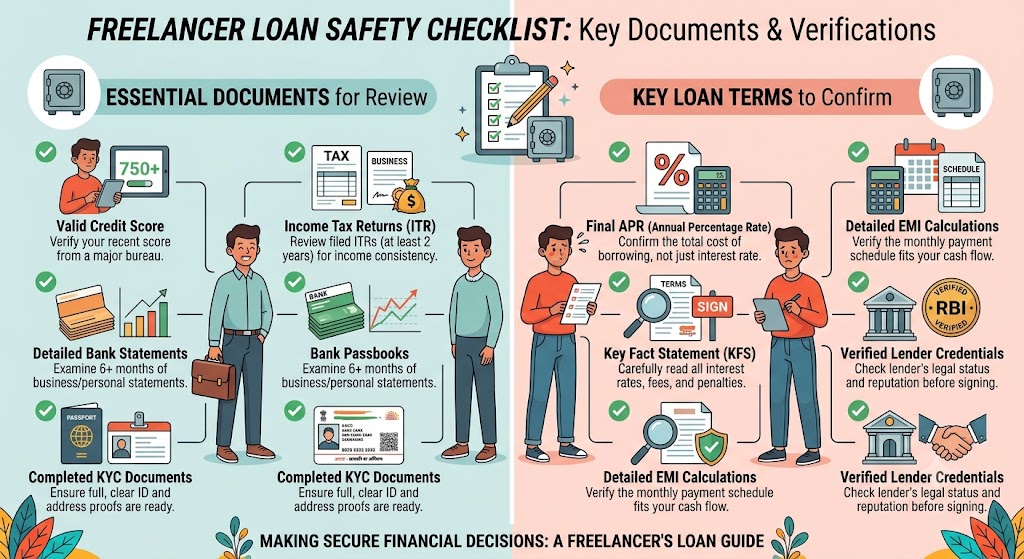
Freelancers in Telangana may be eligible for personal loans and other credit products, but applying for a loan online requires more than checking whether you qualify. Borrowers should also verify the lender, understand the total cost, protect their personal information and make sure the EMI is affordable.
Because freelancers may have variable income and may not receive traditional salary slips, lenders can assess documents such as ITRs, bank statements, invoices, contracts, credit history and other income records.
This safety checklist explains what freelancers in Telangana should check before applying for or accepting a loan.
What Does Loan Eligibility Mean for Freelancers?
Loan eligibility is based on the lender's assessment of your financial profile. While criteria differ between lenders, common factors can include:
-
Credit score and repayment history
-
Freelance income and income stability
-
ITR and tax records
-
Bank statements
-
Existing loans and EMIs
-
KYC documents
-
Professional history
-
Requested loan amount
-
Repayment capacity
Meeting basic eligibility requirements does not guarantee loan approval.
Freelancer Loan Safety Checklist
1. Check Your Credit History
Before applying, review your credit report and repayment history.
Look for:
-
Missed or delayed payments
-
Outstanding credit-card balances
-
Existing loans
-
Incorrect personal information
-
Accounts that you do not recognize
If you find an error, try to get it corrected before making important borrowing decisions.
A good repayment record can help demonstrate responsible credit behaviour, although each lender uses its own assessment criteria.
2. Calculate Your Real Freelance Income
Do not use your highest-earning month to decide how much you can borrow.
Freelancers should look at their income over a reasonable period and estimate a dependable monthly figure.
Useful evidence can include:
-
Bank statements
-
ITRs
-
Client invoices
-
Contracts
-
Payment records
-
GST records, where applicable
Your application should contain accurate information that can be supported by documents.
3. Keep Your ITR and Financial Records Ready
ITRs can help demonstrate reported income for self-employed applicants.
Before applying, organize relevant tax records and make sure the income declared in your application is consistent with your financial documents.
Avoid submitting edited, false or misleading documents.
4. Review Your Bank Statements
Bank statements can show how consistently freelance income enters your account and how you manage existing financial obligations.
Check your statements for:
-
Regular client payments
-
Existing EMI deductions
-
Returned transactions
-
Unusual activity
-
Income consistency
-
Available balances
Well-organized records can make financial verification easier.
5. Calculate Existing EMIs
Never accept a new loan without considering your current debt.
Use this simple calculation:
Existing EMIs + Proposed New EMI = Total Monthly Debt Obligation
Compare the result with your dependable monthly income.
If the new EMI would make your monthly budget difficult to manage, consider a smaller loan amount or postpone borrowing.
6. Check the Complete Loan Cost
A loan's advertised interest rate is not the complete cost.
Before accepting an offer, check:
-
Interest rate
-
APR
-
Processing fee
-
Applicable taxes
-
Documentation charges
-
Late-payment charges
-
Penal charges
-
Prepayment or foreclosure charges, where applicable
-
Total repayment
A lower interest rate does not automatically mean a cheaper loan if other charges are significantly higher.
7. Read the Key Facts Statement
For applicable digital loans, carefully read the Key Facts Statement (KFS) before accepting the loan.
The KFS can help you understand important information about the cost and terms of the loan, including applicable APR and charges.
Do not skip this step simply because the application has already been approved.
8. Verify the Actual Lender
Before uploading your PAN, Aadhaar or financial documents, identify the actual lender.
Check:
-
Lender's name
-
Loan terms
-
Repayment method
-
Applicable charges
-
Privacy and data permissions
-
Customer-support details
Be cautious about platforms promising guaranteed approval, unusually low rates or loans without meaningful verification.
9. Never Share OTP or Banking PINs
This is one of the most important digital loan safety rules.
Never share your:
-
OTP
-
UPI PIN
-
ATM PIN
-
Debit/credit card PIN
-
Internet banking password
These credentials should remain private.
A person claiming to be a loan representative should not need your confidential banking credentials.
10. Check App Permissions
If you are applying through a mobile application, review the permissions it requests.
Be cautious if an application requests unnecessary access to personal information or device functions.
Only provide information that is genuinely required for the legitimate loan process.
11. Verify the Loan Agreement Before Accepting
Before clicking an acceptance button or signing electronically, review:
-
Sanctioned amount
-
Net disbursal amount
-
Interest rate
-
APR
-
EMI
-
Tenure
-
Processing fee
-
Other charges
-
Repayment dates
-
Late or penal charges
-
Prepayment conditions
Do not rely only on promotional messages or verbal promises.
Documents Freelancers Should Prepare
| Document | Purpose |
|---|---|
| PAN | Identity and financial verification |
| Aadhaar/Other KYC | Identity and address verification |
| Bank Statements | Income and cash-flow assessment |
| ITR | Income verification |
| Invoices | Freelance income evidence |
| Contracts | Professional income evidence |
| GST Records | Business verification where applicable |
| Existing Loan Details | Assessment of current obligations |
Requirements vary by lender and loan product.
Common Freelancer Loan Safety Mistakes
Avoid these mistakes when applying:
-
Applying without checking the lender
-
Sharing OTPs or UPI PINs
-
Uploading documents to suspicious websites or apps
-
Ignoring the KFS
-
Comparing only the interest rate
-
Borrowing more than necessary
-
Hiding existing loans
-
Providing incorrect income information
-
Ignoring data and app permissions
-
Accepting verbal promises that are not included in the agreement
Quick Safety Checklist
Before accepting a loan, make sure:
-
I checked my credit history.
-
My freelance income is properly documented.
-
My ITR and bank statements are ready.
-
My KYC information is accurate.
-
I calculated my existing EMIs.
-
I can afford the proposed EMI.
-
I checked the interest rate and APR.
-
I reviewed processing and other charges.
-
I read the applicable KFS.
-
I verified the actual lender.
-
I reviewed app permissions.
-
I will not share OTPs or banking PINs.
-
I read the loan agreement before accepting.
FAQs
Can freelancers in Telangana safely apply for online loans?
Yes, but borrowers should verify the actual lender, review the loan terms, protect confidential credentials and understand the complete cost before accepting credit.
Is ITR important for freelancer loan applications?
ITR can help demonstrate reported income and may be requested by lenders when assessing self-employed applicants.
Can a freelancer get a loan without a salary slip?
Some lenders may accept alternative income documents such as ITRs, bank statements, invoices and contracts, depending on their eligibility requirements.
What is the most important digital loan safety rule?
Never share OTPs, UPI PINs, ATM PINs, card PINs or internet-banking passwords with another person.
Should freelancers check APR?
Yes. APR can provide a broader view of borrowing costs than the advertised interest rate alone.
Why should I read the KFS?
For applicable loans, the KFS provides important information about the loan's cost and key terms before acceptance.
Can existing EMIs affect loan eligibility?
Yes. Existing debt obligations can reduce your repayment capacity and may affect the amount a lender considers affordable.
Published on : 7TH October 2026
Published by : shibam nath
www.vizzve.com || www.vizzveservices.com
Follow us on social media: Facebook || Linkedin || Instagram
🛡 Powered by Vizzve Financial
RBI-Registered Loan Partner | 10 Lakh+ Customers | ₹600 Cr+ Disbursed