

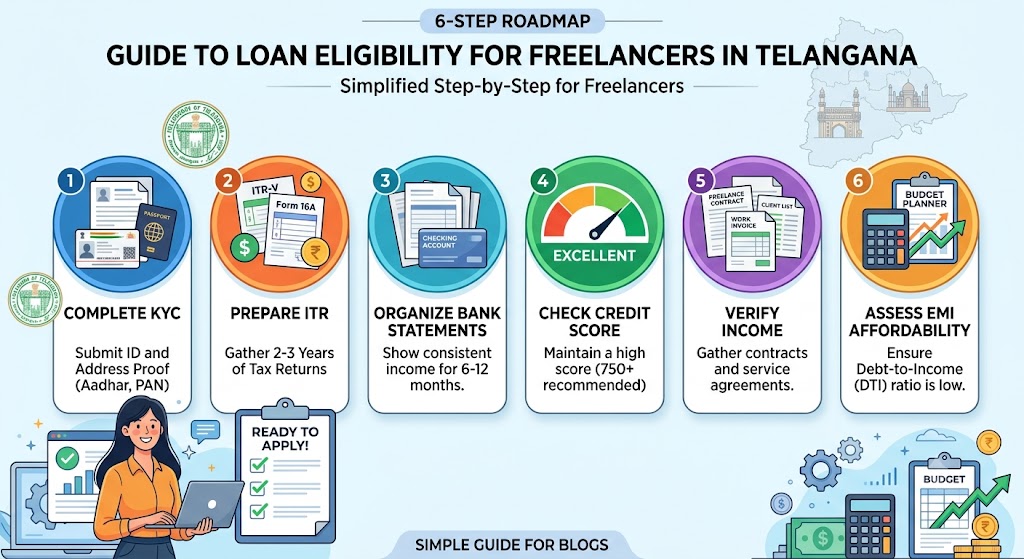
Freelancing gives professionals flexibility, but applying for a loan can sometimes feel more complicated when there is no traditional salary slip.
Freelancers in Telangana—including software developers, graphic designers, consultants, content creators, digital marketers, photographers, tutors and other independent professionals—can apply for loans if they meet the lender's eligibility requirements.
The key difference is that lenders may need to assess documented freelance income, credit history, existing financial obligations and repayment capacity instead of relying on a regular salary certificate.
This step-by-step guide explains how freelancers in Telangana can prepare for a loan application and what lenders may check.
What Is Freelancer Loan Eligibility?
Loan eligibility is the set of conditions a lender considers before deciding whether to approve an application and what loan amount may be suitable.
For freelancers, common factors can include:
-
Credit score and repayment history
-
Freelance income
-
ITR and tax records
-
Bank statements
-
Existing loans and EMIs
-
KYC information
-
Professional or business records
-
Requested loan amount
-
Repayment capacity
-
Lender-specific policies
There is no single eligibility formula that applies to every freelancer or every lender.
RBI guidance requires lenders to properly assess credit applications and creditworthiness.
Step 1: Check Your Credit Profile
Before applying, start by checking your credit history.
Lenders may consider information such as:
-
Previous loan repayment behaviour
-
Credit-card payments
-
Outstanding balances
-
Existing credit accounts
-
Recent credit enquiries
-
Overdue payments or defaults
A healthy repayment history can support your application, but a particular credit score does not guarantee approval.
What You Should Do
Before submitting an application:
-
Check your credit report.
-
Look for incorrect information.
-
Check for overdue payments.
-
Review existing credit-card balances.
-
Avoid unnecessary new credit applications.
Step 2: Calculate Your Freelance Income
Freelance income can change from month to month, so you should understand your average earnings before applying.
For example:
| Month | Illustrative Income |
|---|---|
| January | ₹50,000 |
| February | ₹62,000 |
| March | ₹55,000 |
| April | ₹68,000 |
| May | ₹57,000 |
| June | ₹63,000 |
The six-month average in this example is about ₹59,167 per month.
This is only an illustration. A lender may calculate income differently depending on its internal policy.
Why Average Income Matters
If your best month is ₹80,000 but your income regularly falls to ₹40,000–₹50,000, choosing an EMI based only on the ₹80,000 month could create repayment pressure.
Use a realistic income estimate when planning your borrowing.
Step 3: Keep Your ITR Documents Ready
Income Tax Returns can help demonstrate your declared professional income.
Depending on the lender's requirements, you may be asked for recent ITR-related documents or other financial records.
Keep your:
-
ITR acknowledgements
-
Relevant income records
-
Financial statements, where applicable
-
Tax-related documents
Why ITR Matters
For a freelancer, an ITR can provide documented evidence of income when a traditional salary slip is unavailable.
However, ITR requirements vary by lender, so check the exact documentation required before applying.
Step 4: Organise Your Bank Statements
Bank statements can help demonstrate actual cash flow.
A lender may review:
-
Client payments
-
Regular income credits
-
Existing EMI payments
-
Account activity
-
Returned transactions
-
Other significant financial transactions
Keep your statements accessible and make sure your income transactions are easy to understand.
If you receive payments from several clients, maintaining proper financial records can make it easier to demonstrate your professional income.
Step 5: Prepare Your KYC Documents
KYC is an important part of loan processing.
Depending on the lender, you may need documents such as:
-
PAN
-
Aadhaar or another officially valid document
-
Address proof
-
Bank account details
-
Income-related documents
-
Other supporting records
Check that important details such as your name and date of birth are consistent across documents.
Incorrect or mismatched information can result in additional verification or delays.
Step 6: Calculate Your Existing EMI Burden
Before applying for another loan, list all your current financial obligations.
For example:
| Existing Obligation | Monthly Payment |
|---|---|
| Vehicle Loan | ₹6,000 |
| Personal Loan | ₹5,000 |
| Credit Card | ₹3,000 |
| Total | ₹14,000 |
These figures are only illustrative.
If your current monthly obligations are already high compared with your income, taking another loan may increase financial pressure.
Remember
Loan eligibility ≠ loan affordability.
A lender may approve an amount that you personally may not find comfortable to repay.
Step 7: Estimate the New EMI
Once you know your income and existing obligations, estimate the EMI for the new loan.
Consider:
-
Loan amount
-
Interest rate
-
Tenure
-
Processing fee
-
Other applicable charges
-
Total repayment
For freelancers, it is particularly important to consider months when income may be lower.
A longer tenure can reduce the monthly EMI, but it may increase the total interest paid over the life of the loan.
Step 8: Gather Additional Freelancer Income Proof
A freelancer may not have a salary slip, but other documents can help demonstrate professional activity.
Depending on the lender, these could include:
-
Client invoices
-
Client contracts
-
Payment receipts
-
GST records, where applicable
-
Professional registration
-
Business records
-
Other financial documents
Not every lender accepts every document.
Always follow the verified lender's documentation requirements.
Step 9: Choose the Right Loan Type
Freelancers may come across different borrowing options.
Personal Loan
A personal loan may be suitable for eligible personal financial needs.
Business Loan
A business loan may be more relevant when the purpose is business expansion, equipment, working capital or another professional requirement.
Secured Loan
Some borrowers may also consider loans backed by eligible assets, depending on their circumstances.
The best option depends on the purpose of borrowing, eligibility, cost and repayment ability.
Step 10: Compare the Complete Cost of the Loan
Do not select a loan only because it has a low advertised interest rate.
Check:
-
Interest rate
-
APR, where applicable
-
EMI
-
Tenure
-
Processing fee
-
Other charges
-
Late-payment or penal charges
-
Prepayment terms
-
Total repayment amount
For applicable digital lending products, RBI's framework requires disclosure of the all-inclusive cost through the Annual Percentage Rate (APR), along with other borrower protections.
Step 11: Read the Key Facts Statement
The Key Facts Statement (KFS) can help borrowers understand important loan terms and costs before accepting a loan.
Review the information carefully and compare it with the offer shown in the application.
Do not accept a loan simply because the app displays:
-
"Instant approval"
-
"Guaranteed loan"
-
"Lowest interest rate"
-
"No documents required"
The actual loan terms matter more than promotional language.
Step 12: Verify the Digital Lender
Freelancers may use websites or mobile apps to apply for loans.
Before submitting documents or financial information, verify the actual lender and understand the role of any lending service provider.
RBI's digital lending framework includes requirements around need-based data collection, prior explicit consent and privacy policies.
Never Share
Do not share sensitive banking credentials such as:
-
OTP
-
UPI PIN
-
ATM PIN
-
Card PIN
-
Internet-banking password
A legitimate loan process should not require you to disclose these confidential credentials to another person.
Step 13: Submit the Application Carefully
Once your documents and finances are ready, complete the application accurately.
Check:
-
Name
-
Date of birth
-
Address
-
PAN details
-
Income
-
Employment/profession
-
Bank details
-
Existing loan information
Do not deliberately overstate your income or hide existing financial obligations.
Incorrect information can create verification problems.
Step 14: Review the Final Loan Offer
If your application is approved, don't accept immediately.
First check:
| Check | What to Look For |
|---|---|
| Loan Amount | Is it really required? |
| Interest Rate | Is it competitive? |
| APR | What is the overall annualised cost? |
| EMI | Can you comfortably pay it? |
| Tenure | Does it suit your finances? |
| Fees | Are all charges disclosed? |
| Prepayment | What are the applicable conditions? |
| Total Repayment | How much will you pay overall? |
Only proceed when you understand the terms.
Documents Freelancers in Telangana May Need
The exact list varies by lender, but commonly requested documents can include:
| Document | Purpose |
|---|---|
| PAN | Identity/financial verification |
| Aadhaar or other OVD | KYC |
| Bank Statements | Income and cash-flow assessment |
| ITR | Income documentation |
| Invoices | Professional income evidence |
| Client Contracts | Work/income evidence |
| GST Records | Business/tax information where applicable |
| Existing Loan Statements | Current debt assessment |
| Address Proof | KYC |
Not every applicant needs every document.
What If You Don't Have a Salary Slip?
A salary slip is generally associated with salaried employment, so freelancers may not have one.
Instead, lenders may consider other documents according to their policies.
For example:
Salaried applicant:
Salary slips + salary-account statements
Freelancer:
ITR + bank statements + invoices/contracts + other accepted financial records
Therefore, the absence of a salary slip does not automatically mean a freelancer cannot apply for a loan.
Common Reasons Freelancer Loan Applications Are Rejected
Even after completing the application, approval is not guaranteed.
Common reasons may include:
-
Weak credit history
-
High existing EMI obligations
-
Insufficient documented income
-
Irregular or difficult-to-verify cash flow
-
KYC mismatch
-
Incomplete documents
-
Too many recent credit enquiries
-
Loan amount too high for the applicant's profile
-
Lender-specific eligibility criteria
-
Concerns identified during risk assessment
If your application is rejected, understand the reason before immediately applying elsewhere.
How Freelancers Can Improve Loan Eligibility
Keep Credit Payments on Time
Avoid overdue EMIs and credit-card payments.
Maintain Proper Income Records
Keep ITRs, bank statements, invoices and contracts organised.
Manage Existing Debt
A lower existing EMI burden can make repayment planning easier.
Avoid Unnecessary Applications
Compare suitable options before applying.
Keep KYC Updated
Use accurate and consistent information across documents.
Build an Emergency Buffer
Freelance income can fluctuate. An emergency reserve can help you manage EMIs during slower periods.
Borrow Only What You Need
Don't take the maximum amount simply because it is offered.
Simple Example of Freelancer Loan Planning
Suppose a freelancer earns an average of ₹60,000 per month.
Existing obligations:
-
Existing EMI: ₹8,000
-
Essential monthly expenses: ₹32,000
-
Proposed new EMI: ₹8,000
Illustrative calculation:
₹60,000 − ₹8,000 − ₹32,000 − ₹8,000 = ₹12,000 remaining
This is not a lender's eligibility formula or a recommended EMI ratio. It simply shows why freelancers should consider their complete monthly cash flow before borrowing.
A freelancer with highly variable income should also consider whether the EMI remains manageable during a slow month.
Freelancer Loan Safety Checklist
Before accepting a loan, ask:
-
Is the actual lender clearly identified?
-
Have I checked the lender's official details?
-
Is my income properly documented?
-
Have I checked my credit report?
-
Are my existing EMIs manageable?
-
Have I compared the interest rate?
-
Have I checked the APR?
-
Have I read the KFS?
-
Are all fees clearly disclosed?
-
Do I understand the repayment schedule?
-
Is the loan amount genuinely required?
-
Have I avoided sharing OTPs and banking passwords?
If the answer to these questions is yes, you are better prepared to evaluate a loan offer.
FAQs: Loan Eligibility for Freelancers in Telangana
1. Can freelancers in Telangana apply for personal loans?
Yes. Freelancers can apply for eligible loan products, subject to the lender's credit, income, KYC and repayment requirements.
2. Can I get a freelancer loan without a salary slip?
Possibly. Depending on the lender, ITRs, bank statements, invoices and other financial documents may be accepted.
3. Is ITR compulsory for every freelancer loan?
Not necessarily. Documentation requirements differ between lenders and loan products.
4. Can bank statements help prove freelance income?
Yes. Bank statements can help demonstrate actual income and cash flow, although the lender decides how they are assessed.
5. Does a good credit score guarantee approval?
No. Credit history is one factor among income, debt, KYC, repayment capacity and lender-specific criteria.
6. Can freelancers with irregular income get loans?
They may be eligible, but lenders can assess the consistency and documentation of their income before making a decision.
7. How much can a freelancer borrow?
There is no fixed amount for every freelancer. Eligibility can depend on income, credit profile, existing obligations, repayment capacity and lender policy.
8. What documents should freelancers prepare?
Common documents can include PAN, KYC documents, bank statements, ITRs and other income or professional records requested by the lender.
9. Are online loans safe for freelancers?
Digital lending can be legitimate, but borrowers should verify the actual lender, review loan disclosures and understand how their personal data will be collected and used.
10. Should I accept the maximum loan amount offered?
No. Choose an amount based on your actual financial requirement and realistic repayment capacity.
Published on : 6th October 2026
Published by : Shibam nath
www.vizzve.com || www.vizzveservices.com
Follow us on social media: Facebook || Linkedin || Instagram
🛡 Powered by Vizzve Financial
RBI-Registered Loan Partner | 10 Lakh+ Customers | ₹600 Cr+ Disbursed