

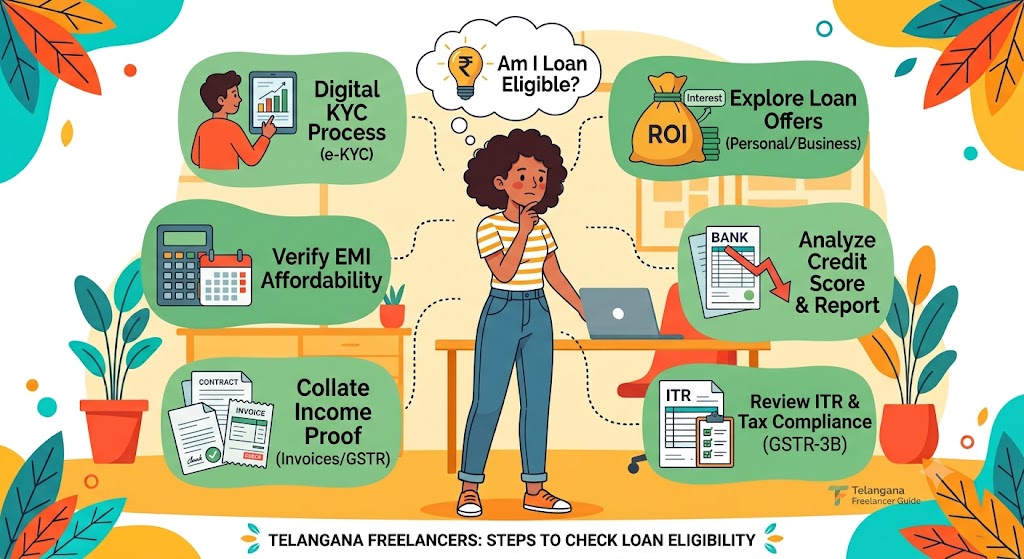
Freelancing is becoming a popular way to earn an income, especially for professionals working in technology, design, content, consulting, marketing and other digital fields. But when a freelancer needs a personal loan, the eligibility process can be slightly different from that of a salaried employee.
Instead of relying mainly on salary slips, lenders may review freelance income, ITR, bank statements, credit history, KYC documents and existing financial obligations.
If you are a freelancer in Telangana planning to apply for a loan, checking these factors in advance can help you understand your financial position and avoid common application mistakes.
What Is Loan Eligibility for Freelancers?
Loan eligibility refers to the criteria a lender uses to determine whether an applicant may qualify for a loan and how much credit may be suitable.
For freelancers, lenders may consider:
-
Credit score and repayment history
-
Average and consistent income
-
ITR and tax records
-
Bank statements
-
Existing loans and EMIs
-
KYC documents
-
Professional or business history
-
Requested loan amount
-
Repayment capacity
-
Lender-specific policies
There is no single eligibility rule that applies to every freelancer. Requirements can differ between lenders and loan products.
1. Check Your Credit History
Before applying, review your credit report and repayment history.
Lenders may consider previous loans, credit-card payments, outstanding balances and repayment behaviour while assessing an application.
A history of timely repayments can support a stronger credit profile, while defaults or repeated missed payments may make approval more difficult.
Tip: Check your credit report for errors before submitting a loan application.
2. Calculate Your Freelance Income
Freelance earnings may change from month to month, so do not estimate eligibility using only your highest earning month.
Instead, look at your income over a reasonable period and identify an amount you can realistically depend on.
Useful records may include:
-
Bank statements
-
Client payments
-
Invoices
-
Contracts
-
Payment receipts
-
ITRs
-
GST records, where applicable
Clear and consistent income records can make verification easier.
3. Keep Your ITR Documents Ready
Income Tax Returns can be important documentation for self-employed and freelance applicants.
ITR records may help demonstrate your reported income and provide a clearer picture of your financial activity.
Before applying, keep relevant tax documents available and make sure the income information you provide in the loan application is consistent with your supporting records.
4. Review Your Bank Statements
Bank statements provide a practical view of your cash flow.
A lender may look at factors such as:
-
Regular client payments
-
Account activity
-
Existing EMI payments
-
Returned or failed transactions
-
Income consistency
-
Overall cash flow
Keeping your financial transactions organized can make the income-verification process easier.
5. Check Your Existing EMIs
Existing loans are an important part of repayment-capacity assessment.
Before taking another loan, calculate your current monthly obligations.
For example:
Existing EMI obligations + Proposed New EMI = Total Monthly Debt Payments
Compare this amount with your dependable monthly income.
If a new EMI would put significant pressure on your budget, consider reducing the loan amount or reconsidering the borrowing requirement.
6. Prepare Alternative Income Proof
Freelancers may not have traditional salary slips. That does not necessarily mean they cannot provide income evidence.
Depending on lender requirements, documents may include:
-
ITR
-
Bank statements
-
Client invoices
-
Work contracts
-
Payment records
-
GST documents, where applicable
-
Professional registration or business records
Always provide genuine and verifiable documents.
7. Check Your KYC Documents
Make sure your identity and address documents are valid and consistent.
Common KYC requirements may include:
-
PAN
-
Aadhaar or another accepted identity document
-
Address proof
-
Bank account details
-
Other documents requested by the lender
Differences in names, addresses or other personal information across documents can sometimes create verification delays.
8. Decide How Much You Actually Need
Do not start with the maximum loan amount you think you might qualify for.
First determine the actual amount required and whether the resulting EMI fits comfortably into your budget.
A larger loan can mean:
-
Higher EMI
-
Greater total interest
-
Higher overall repayment
-
Greater financial pressure
Borrow according to your requirement and repayment capacity rather than the maximum amount offered.
9. Compare the Complete Loan Cost
Before applying, compare more than just the advertised interest rate.
Check:
-
Interest rate
-
APR
-
Processing fee
-
Applicable taxes
-
EMI
-
Total repayment
-
Late-payment charges
-
Penal charges
-
Prepayment or foreclosure conditions, where applicable
Two loans with similar interest rates can have different overall costs because of fees and other terms.
10. Read the Key Facts Statement
For applicable digital loans, carefully review the Key Facts Statement (KFS) before accepting the offer.
The KFS can help you understand important information about the loan, including applicable APR, charges and repayment terms.
Do not accept a loan simply because the approval process is quick.
11. Verify the Actual Lender
Freelancers applying through online platforms should verify who is actually providing the loan.
Before submitting documents:
-
Check the lender's identity.
-
Review the loan terms.
-
Understand the repayment process.
-
Check the permissions requested by the application.
-
Avoid suspicious platforms or unrealistic promises.
Never share confidential information such as OTPs, UPI PINs, ATM PINs, card PINs or internet-banking passwords with another person.
Documents Checklist for Freelancers in Telangana
| Document | Why It May Be Required |
|---|---|
| PAN | Identity and financial verification |
| Aadhaar/Other KYC | Identity and address verification |
| Bank Statements | Income and cash-flow assessment |
| ITR | Income verification |
| Invoices | Evidence of freelance earnings |
| Contracts | Professional income evidence |
| GST Records | Business verification where applicable |
| Existing Loan Details | Assessment of current debt |
Requirements vary by lender and loan product, so check the exact document list before applying.
Common Mistakes to Avoid
Freelancers should avoid:
-
Applying without checking their credit profile
-
Declaring unsupported income
-
Ignoring existing EMIs
-
Using only one high-income month to estimate affordability
-
Borrowing more than necessary
-
Comparing only the interest rate
-
Ignoring processing fees and other charges
-
Accepting a loan without reading the KFS
-
Submitting documents to unverified platforms
-
Sharing OTPs or banking passwords
Quick Pre-Application Checklist
Before applying for a loan in Telangana, ask yourself:
-
Have I checked my credit history?
-
Can I prove my freelance income?
-
Are my ITR documents ready?
-
Are my bank statements available?
-
Are my KYC documents updated?
-
Have I calculated my existing EMIs?
-
Can I comfortably afford the new EMI?
-
Do I actually need the requested loan amount?
-
Have I compared the total borrowing cost?
-
Have I checked the APR and applicable fees?
-
Have I read the KFS?
-
Have I verified the actual lender?
FAQs
Can freelancers in Telangana apply for personal loans?
Yes. Freelancers may apply for personal loans if they meet the lender's eligibility, income, credit and documentation requirements.
Is a salary slip mandatory for freelancers?
Not necessarily. Depending on the lender, ITRs, bank statements, invoices, contracts and other income documents may be accepted.
Does freelance income need to be consistent?
Consistent and well-documented income can make repayment-capacity assessment easier, but the exact requirements depend on the lender.
Does ITR help with freelancer loan applications?
ITR can provide evidence of reported income and may be useful during financial assessment.
Can existing loans affect eligibility?
Yes. Existing EMIs and other financial obligations can affect how much additional repayment a lender considers affordable.
What should I compare before accepting a loan?
Compare the interest rate, APR, processing fees, applicable charges, EMI, total repayment and other important loan terms.
Is KFS important for digital loans?
Yes. For applicable loans, the KFS provides important information about costs and terms that borrowers should review before accepting credit.
Published on : 7TH October 2026
Published by : shibam nath
www.vizzve.com || www.vizzveservices.com
Follow us on social media: Facebook || Linkedin || Instagram
🛡 Powered by Vizzve Financial
RBI-Registered Loan Partner | 10 Lakh+ Customers | ₹600 Cr+ Disbursed