

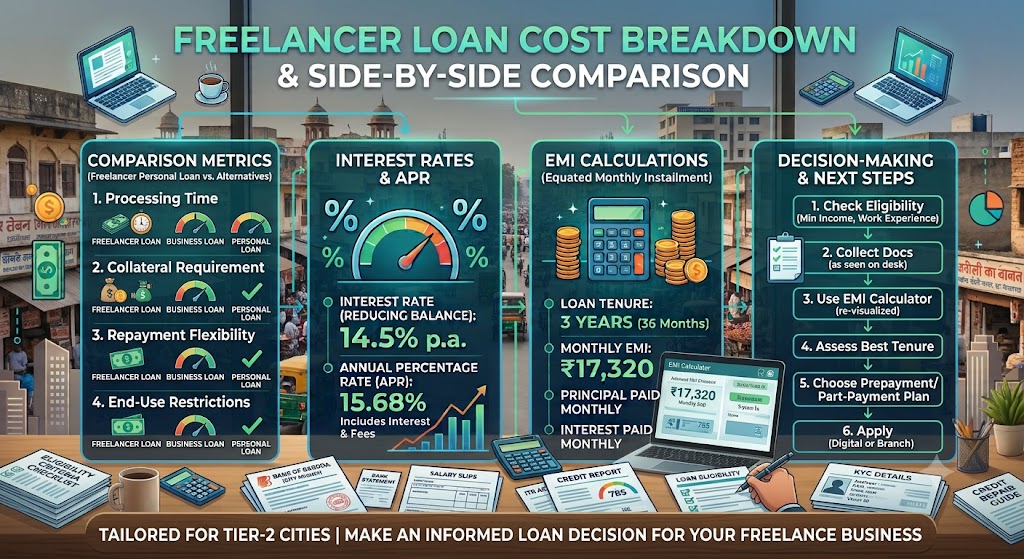
Freelancing is creating new career opportunities across India's Tier-2 cities. Content writers, graphic designers, software developers, digital marketers, consultants and other independent professionals can earn through client projects, online platforms and long-term contracts.
However, freelancers may face different challenges when applying for a personal loan. Unlike salaried employees, they may not receive a fixed monthly salary or have conventional salary slips. Their earnings can vary depending on client payments, project availability and business conditions.
The good news is that some lenders accept applications from freelancers and self-employed professionals. The challenge is understanding the eligibility requirements, preparing the right documents and choosing a loan that fits your financial situation.
In this guide, Vizzve explains the benefits and limitations of loan eligibility for freelancers in Tier-2 cities, along with important factors to consider before applying.
AI Answer Box: What Are the Benefits and Limitations of Freelancer Loans?
Freelancers in Tier-2 cities may be eligible for personal loans if a lender accepts their income profile and supporting documents. Potential benefits include access to funds for personal expenses, flexible loan amounts and digital application options. Limitations may include income fluctuations, additional documentation requirements, lender-specific eligibility criteria and borrowing costs that vary by applicant.
Approval is not guaranteed. Lenders assess creditworthiness, income, existing obligations and other applicable eligibility conditions.
1. Understanding Loan Eligibility for Freelancers
Loan eligibility refers to the conditions a lender uses to determine whether an applicant qualifies for a loan.
For freelancers, lenders may consider several factors:
-
Monthly or annual income
-
Consistency of earnings
-
Credit score and repayment history
-
Existing loans and EMIs
-
Bank statements and income documents
-
Age and other eligibility requirements
-
Requested loan amount and tenure
-
The lender's internal credit policy
Depending on the lender, income evidence may include bank statements, Income Tax Returns (ITRs), client invoices, contracts or other accepted financial records.
The Reserve Bank of India's digital-lending framework requires covered regulated lenders to assess borrowers' creditworthiness using relevant economic-profile information, including age, occupation and income. Requirements for individual loan products can differ. <Cite refs={["turn567330search1","turn567330search0"]} />
2. Benefits of Loan Eligibility for Freelancers in Tier-2 Cities
Freelancers who meet a lender's criteria may benefit from access to formal borrowing. Here are some potential advantages.
A. Access to Funds for Personal Expenses
A personal loan may help eligible borrowers manage planned or unexpected expenses, such as medical bills, education costs, essential household purchases or urgent repairs.
However, borrowing should be considered only after reviewing the need, repayment capacity and total cost. A loan is not always the best solution for an expense that can be managed through savings.
B. Opportunity to Apply Without Traditional Salary Slips
Freelancers generally do not receive salary slips from an employer. Some lenders may accept alternative evidence of earnings, such as:
-
Bank statements
-
ITRs
-
Client invoices
-
Work contracts
-
Payment receipts
-
Other financial documents accepted by the lender
This can make loan applications possible for some independent professionals who do not have conventional salaried employment.
Important: Alternative documents are not accepted by every lender. Confirm the requirements before applying.
C. Convenient Digital Application Options
Some lenders provide online applications that allow eligible applicants to submit information, complete verification and review loan offers digitally.
Digital processes may reduce the need for repeated in-person visits. The actual process, turnaround time and verification requirements depend on the lender.
Before using a loan app, verify the actual bank or Non-Banking Financial Company (NBFC) providing the loan and review the terms carefully.
D. Opportunity to Build a Formal Credit History
Responsible borrowing and timely repayments may help a borrower build or maintain a positive credit history.
Freelancers who use credit should make payments on time, avoid taking on unaffordable EMIs and monitor their credit reports for errors.
Taking a loan solely to improve a credit score is generally unnecessary. Borrow only when there is a genuine need and a realistic repayment plan.
E. More Choice When Comparing Suitable Offers
Depending on their eligibility, freelancers may be able to compare offers from different lenders.
Before choosing an offer, compare:
-
Interest rate
-
Annual Percentage Rate (APR)
-
Processing fees and applicable taxes
-
Monthly EMI
-
Loan tenure
-
Total repayment
-
Late-payment charges
-
Prepayment terms
The lowest advertised interest rate may not represent the lowest overall borrowing cost.
3. Limitations of Loan Eligibility for Freelancers
Although loan access may be possible, freelancers can face several limitations.
A. Irregular Monthly Income
Freelance earnings can fluctuate due to changing workloads, delayed client payments or gaps between projects.
For example, a freelancer may earn ₹60,000 in one month and ₹30,000 in the next. A fixed monthly EMI may become difficult to manage if the borrower plans repayments around their highest-earning month.
How to manage this limitation:
-
Calculate average earnings over a reasonable period.
-
Consider lower-income months.
-
Maintain emergency savings where possible.
-
Account for business expenses and taxes.
-
Choose an EMI that remains manageable when income falls.
B. Additional Income Documentation
Some lenders may request more than basic identity documents to understand a freelancer's financial profile.
Depending on their policies, applicants may need to provide ITRs, bank statements, invoices, client contracts or evidence of work history.
Keeping these records organised can help, but incomplete or inconsistent documents may delay verification.
C. Different Eligibility Criteria Across Lenders
There is no single minimum income or credit score that guarantees a personal loan for every freelancer.
One lender may accept a particular income pattern or document type, while another may apply different conditions. Applicants should therefore review the selected lender's current criteria instead of relying on general claims found in advertisements.
D. Existing Debt Can Reduce Affordability
Freelancers with existing personal loans, vehicle loans, credit-card balances or other repayment obligations may have less money available for a new EMI.
A lender may consider these commitments while assessing repayment capacity.
Before applying, calculate your current debt payments and essential expenses. Avoid taking a new loan if the combined repayments would put pressure on your finances.
E. Borrowing Costs May Vary
The interest rate, fees and loan terms offered to a freelancer can depend on the lender's policies and the applicant's financial profile.
Applicants should not assume that freelance status automatically results in a higher or lower interest rate.
Review the APR, processing fee, applicable taxes, total repayment and other charges before accepting any offer.
F. Approval Is Not Guaranteed
Even if a freelancer meets basic eligibility conditions, a lender may decline the application after reviewing the complete financial profile.
Potential reasons include insufficient acceptable income evidence, existing debt, credit-history issues, incomplete documents or failure to meet product-specific criteria.
If an application is rejected, review the reason and address any issues before applying elsewhere.
4. Benefits vs Limitations: Quick Comparison
| Factor | Potential benefit | Possible limitation |
|---|---|---|
| Income proof | Some lenders accept alternative documents | Requirements vary by lender |
| Digital applications | May reduce in-person visits | Online verification may still be required |
| Access to credit | Can help with planned or unexpected expenses | Creates a repayment obligation |
| Credit history | Timely repayments may support a positive history | Missed payments can harm credit history |
| Loan selection | Eligible borrowers may compare offers | Rates and terms may differ |
| Income pattern | Freelancers can apply to lenders that accept their profile | Irregular earnings can make fixed EMIs harder to manage |
| Loan approval | Multiple product options may exist | Approval depends on the lender's assessment |
5. Documents Freelancers May Need
Documentation requirements differ by lender and product. Commonly requested documents may include:
| Document | Possible purpose |
|---|---|
| PAN | Tax identification and verification |
| Accepted identity proof | Identity verification |
| Address proof | Address verification |
| Bank statements | Review of financial transactions and income |
| ITRs | Supporting evidence of reported income |
| Client invoices | Evidence of work billed to clients |
| Contracts or work orders | Supporting information about freelance engagements |
| Other requested records | Additional checks required by the lender |
Submit only genuine documents through official or authorised channels. Never exaggerate income or alter financial records.
6. How Freelancers Can Improve Loan Readiness
Freelancers can take practical steps before submitting an application.
Maintain Organised Income Records
Save client invoices, contracts, payment receipts and bank statements. Keep financial information accurate and easy to review.
Check Your Credit Report
Review your credit history for overdue accounts, incorrect information or unfamiliar enquiries. Dispute genuine errors with the relevant bureau or lender.
Reduce Unnecessary Debt
Calculate existing EMIs and avoid taking on additional borrowing that could make repayments difficult.
Build an Emergency Buffer
Where possible, maintain savings to cover essential expenses during slow business periods. This can reduce dependence on borrowing when client payments are delayed.
Compare Offers Carefully
Do not select a loan based only on a quick-approval advertisement. Review the interest rate, APR, fees, tenure, EMI and total repayment.
Verify Digital Lenders
Check the actual lender's identity and review its official loan terms. RBI's regulatory framework includes borrower-creditworthiness assessments and disclosure requirements for covered digital-lending activities. <Cite refs={["turn567330search0","turn567330search12"]} />
7. What to Check Before Accepting a Loan
Before accepting an offer, review the Key Facts Statement (KFS), where applicable, and the loan agreement.
Confirm:
-
Sanctioned amount and net disbursal
-
Interest rate and APR
-
Monthly EMI and repayment dates
-
Processing fees and applicable taxes
-
Total repayment amount
-
Late-payment charges
-
Prepayment conditions
-
Grievance redressal details
For digital loans covered by RBI requirements, the applicable KFS and cost disclosures are important parts of the borrowing process. Ask the lender to clarify any term you do not understand before signing.
Never share OTPs, UPI PINs, ATM PINs or internet-banking passwords with loan agents.
FAQs: Loan Eligibility for Freelancers in Tier-2 Cities
1. Can freelancers in Tier-2 cities get a personal loan?
Yes, some lenders accept freelancers and self-employed professionals. Approval depends on the lender's criteria, income evidence, credit history and repayment capacity.
2. What are the main benefits of personal loans for freelancers?
Potential benefits include access to funds for eligible expenses, digital application options and the ability to apply using alternative income documents where the lender accepts them.
3. What are the main limitations of freelancer loans?
Limitations may include fluctuating income, additional documentation, lender-specific eligibility criteria, borrowing costs and the risk of unaffordable repayments.
4. Can freelancers apply without salary slips?
Some lenders may accept bank statements, ITRs, invoices or contracts instead of salary slips. Requirements vary by lender and product.
5. Does a good CIBIL score guarantee loan approval?
No. Credit score is only one part of the assessment. Lenders may also review income, existing obligations, documents and other eligibility conditions.
6. Can irregular income affect loan eligibility?
Yes. Irregular earnings can affect how a lender assesses repayment capacity. Some lenders may review income history and supporting records.
7. Can a personal loan help freelancers build credit history?
Timely repayment of a reported credit account may help establish or maintain a positive credit history. Missed payments can have the opposite effect.
8. Are online loans always faster for freelancers?
Not necessarily. Some digital processes may be convenient, but approval and disbursal times depend on the lender, verification requirements and application details.
9. What should freelancers compare before choosing a loan?
Compare the interest rate, APR, fees, EMI, tenure, total repayment, late-payment charges and prepayment conditions.
10. Does living in a Tier-2 city improve loan eligibility?
Not automatically. Eligibility depends on the lender's criteria and the applicant's financial profile. Location may affect product availability, but it does not guarantee approval.
11. What should a freelancer do after loan rejection?
Review the stated reason, check the credit report, correct document issues and reassess affordability before applying again.
12. How can freelancers avoid fraudulent loan apps?
Verify the actual lender, check the official terms and privacy policy, and avoid apps that hide charges or request sensitive security credentials.
Conclusion
Loan eligibility for freelancers in Tier-2 cities offers potential benefits, including access to credit and the possibility of applying with alternative income documents. However, irregular earnings, documentation requirements, existing debt and lender-specific policies can create challenges.
The best approach is to prepare accurate financial records, understand your repayment capacity and compare the complete cost of borrowing before applying.
Published on : 23rd October 2026
Published by : Shibam nath
www.vizzve.com || www.vizzveservices.com
Follow us on social media: Facebook || Linkedin || Instagram
🛡 Powered by Vizzve Financial
RBI-Registered Loan Partner | 10 Lakh+ Customers | ₹600 Cr+ Disbursed