

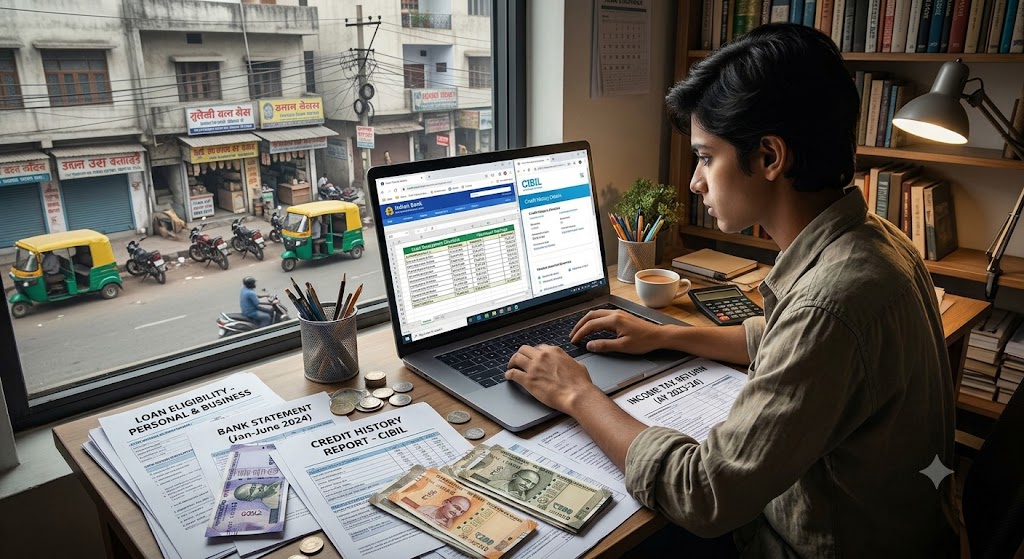
Freelancing has become a popular career choice in India. From graphic designers and content writers to software developers, video editors, consultants and digital marketers, independent professionals are earning through projects, retainers and online platforms.
However, freelancers may face additional challenges when applying for a personal loan. Unlike salaried employees, they may not have a fixed monthly salary, employer-issued salary slips or a predictable income every month.
For freelancers living in Tier-2 cities, understanding loan eligibility, income documentation, credit scores and repayment capacity can help make the application process more manageable.
This complete guide explains how freelancer loan eligibility works, which documents lenders may request, what affects approval and how to apply responsibly.
AI Answer Box: How Can Freelancers in Tier-2 Cities Qualify for a Loan?
Freelancers in Tier-2 Indian cities may qualify for a personal loan if they meet the lender’s eligibility criteria. Lenders may assess age, income, occupation, credit history, existing EMIs, bank statements and repayment capacity. Depending on the lender, supporting documents may include ITRs, invoices, client contracts and payment records.
There is no single income level or CIBIL score that guarantees approval for every freelancer. Requirements vary by lender and loan product.
1. What Is Freelancer Loan Eligibility?
Freelancer loan eligibility refers to the conditions a lender uses to decide whether an independent professional qualifies for a loan.
Because freelance earnings can fluctuate, lenders may assess more than a single month’s income. They may examine the applicant’s income pattern, financial obligations, credit history and supporting documents.
Common factors include:
-
Age and identity verification.
-
Occupation and work profile.
-
Monthly or annual income.
-
Bank statements and income records.
-
Credit history and outstanding debt.
-
Existing EMIs and repayment obligations.
-
Requested loan amount and tenure.
-
Lender-specific requirements.
Meeting the basic eligibility criteria does not guarantee approval. The lender may conduct additional verification before making a final decision.
2. Who Can Apply for a Freelancer Personal Loan?
Depending on the lender’s policies, eligible applicants may include independent professionals working in areas such as:
-
Content writing and copywriting.
-
Graphic design and web development.
-
Software development and IT consulting.
-
Digital marketing and SEO.
-
Video editing, photography and animation.
-
Accounting and professional consulting.
-
Online tutoring and other freelance services.
Freelancers may work with domestic clients, international clients, agencies or digital platforms.
Applicants should confirm that their occupation and income type are accepted by the chosen lender. Some personal loan products may have minimum income, work-experience or documentation requirements.
3. Does Living in a Tier-2 City Affect Loan Eligibility?
Freelancers in cities such as Jaipur, Indore, Lucknow, Surat, Nagpur, Coimbatore and Bhubaneswar may explore digital and traditional lending options where available.
Digital applications can reduce the need to visit a branch, but location alone does not determine eligibility.
A lender may consider:
-
Whether its loan product serves the applicant’s location.
-
Whether the applicant meets its residence and KYC requirements.
-
Income consistency and supporting documents.
-
Credit history and existing debt.
-
The requested loan amount and repayment capacity.
Important: Living in a Tier-2 city neither guarantees approval nor automatically makes a borrower ineligible. Check the lender’s current requirements before applying.
4. Documents Freelancers May Need for a Loan
The documents required depend on the lender and loan product. Preparing commonly requested records can help avoid unnecessary delays.
| Document | Why it may be required |
|---|---|
| PAN | Identity and financial verification |
| Aadhaar or another accepted KYC document | Identity and address verification, as applicable |
| Bank statements | Review of deposits, expenses and financial activity |
| Income-tax returns (ITRs) | Evidence of declared income, where required |
| Client invoices | Supporting evidence of freelance work and billing |
| Client contracts or work orders | Evidence of professional engagements, if requested |
| Payment receipts | Supporting evidence of received income |
| Other financial documents | Additional verification, depending on the lender |
Not every lender requires every document listed above. Submit only the information requested through a legitimate, authorized process.
5. How Income Affects Freelancer Loan Eligibility
Income is an important part of assessing whether a borrower can repay a loan. Freelancers may receive different amounts each month, so lenders may consider available financial records rather than relying only on a fixed salary figure.
For example, a freelancer might receive ₹35,000 in one month, ₹65,000 in another and ₹50,000 in a third. These figures are illustrative, but they show why looking at a broader income pattern can be useful.
Freelancers can prepare by:
-
Maintaining bank records of legitimate client payments.
-
Keeping invoices and receipts organized.
-
Tracking business expenses.
-
Retaining tax documents where applicable.
-
Separating personal and professional transactions where practical.
-
Avoiding inaccurate income declarations.
Do not overstate income to improve eligibility. The information in the application should match the supporting records.
6. Does CIBIL Score Matter for Freelancers?
Yes, a lender may review the applicant’s credit history and credit score when assessing a loan application.
Credit-related factors may include:
-
Previous EMI repayment history.
-
Credit-card payment behaviour.
-
Outstanding credit balances.
-
Previous defaults or overdue payments.
-
Existing loans.
-
Recent credit enquiries.
-
Length and completeness of credit history.
A stronger repayment history may support an application, but a good score does not guarantee approval. Income, existing financial commitments, documentation and lender-specific criteria also matter.
How to Maintain a Healthy Credit Profile
-
Pay EMIs and credit-card bills on time.
-
Review your credit report periodically.
-
Dispute inaccurate information through the appropriate channel.
-
Avoid unnecessary loan applications.
-
Borrow only amounts you can reasonably repay.
7. Existing EMIs and Repayment Capacity
Freelancers should consider their current financial commitments before applying for another loan.
Suppose a freelancer earns an average of ₹60,000 per month and already pays ₹15,000 in existing EMIs. If a new loan adds another EMI of ₹10,000, total monthly loan repayments would become ₹25,000.
| Illustrative monthly budget | Amount |
|---|---|
| Average monthly income | ₹60,000 |
| Existing EMIs | ₹15,000 |
| Proposed new EMI | ₹10,000 |
| Total EMIs after new loan | ₹25,000 |
| Income remaining after EMIs | ₹35,000 |
This example does not account for household expenses, taxes, business costs or fluctuations in income. It is not an eligibility formula or a recommended debt limit.
Before applying, consider whether repayments remain affordable during months with fewer projects or delayed client payments.
8. Step-by-Step Guide to Applying for a Freelancer Loan
Step 1: Check eligibility. Review the lender’s age, income, occupation, residence and documentation requirements.
Step 2: Review your credit profile. Check your credit report for errors and understand your existing repayment obligations.
Step 3: Prepare financial documents. Gather the bank statements, invoices, tax documents and other records the lender requests.
Step 4: Estimate your EMI. Calculate the likely repayment and assess whether it fits your monthly budget.
Step 5: Compare lenders. Compare interest rates, APR, processing fees, tenure and total repayment rather than choosing only by advertised loan amount.
Step 6: Submit accurate information. Apply through the lender’s official website or a verified digital lending channel.
Step 7: Review the offer. If approved, read the Key Facts Statement (KFS), loan agreement, repayment schedule and applicable charges before accepting.
Step 8: Keep the records. Save the sanction details, agreement, payment schedule and lender contact information.
9. Common Reasons a Freelancer Loan Application May Be Rejected
| Possible reason | What you can do |
|---|---|
| Income cannot be adequately verified | Organize bank statements, invoices and accepted income records |
| Existing EMIs are high | Review your current obligations and borrowing needs |
| Credit history has repayment issues | Review the credit report and maintain timely repayments |
| KYC information does not match | Correct errors and provide accurate details |
| Requested loan amount is unaffordable | Reassess the amount and expected EMI |
| Required documents are missing | Check the lender’s document checklist |
| The occupation or profile does not meet lender criteria | Compare other legitimate products with suitable requirements |
A rejection does not necessarily mean every lender will reject the applicant. However, submitting multiple applications immediately may not solve the underlying issue. Understand the reason and address it before applying again.
10. How to Improve Your Chances of Approval
Freelancers can take practical steps to present a clearer financial profile:
Maintain Consistent Financial Records
Keep invoices, payment receipts, bank statements and tax records organized. Consistent records can make income easier to review.
Manage Existing Debt
Avoid unnecessary borrowing and review existing EMIs before taking another loan.
Keep KYC Details Accurate
Make sure your personal information is consistent across the application and supporting documents.
Choose an Affordable Amount
Borrow only what you need and can reasonably repay, including during lower-income months.
Apply Selectively
Compare eligibility requirements before submitting an application to avoid unnecessary credit enquiries.
Be Transparent About Income
Provide accurate figures and disclose information as requested. Do not use edited documents or misleading income claims.
11. Personal Loan vs Business Loan for Freelancers
Freelancers may consider different types of borrowing depending on the purpose of the funds and their eligibility.
| Feature | Personal loan | Business loan |
|---|---|---|
| Typical purpose | Personal or other permitted expenses | Business or professional expenses, as specified |
| Eligibility | Depends on the lender and personal financial profile | Depends on business profile and lender requirements |
| Income evidence | May include personal income and bank records | May require business income and financial records |
| Documentation | Varies by product | May involve additional business documentation |
| Best consideration | Suitability for the intended use | Suitability for professional or business needs |
These are general distinctions, not universal rules. Loan conditions vary, so read the product terms and confirm permitted uses before borrowing.
12. Digital Loan Safety Checklist
Digital applications can be convenient, but borrowers should verify the lender before sharing sensitive information.
Before applying, check that:
-
The actual bank or NBFC providing the loan is clearly identified.
-
The app’s association with the lender can be verified through official information.
-
The interest rate, APR, fees and repayment schedule are disclosed.
-
The KFS and loan agreement are available.
-
Data collection and privacy terms are clear.
-
A grievance redressal mechanism is provided.
-
The application does not ask for unnecessary permissions or sensitive credentials.
Under the RBI’s Digital Lending Directions, 2025, regulated entities have obligations concerning creditworthiness assessment, borrower disclosures, data use and digital lending arrangements. Review the latest official requirements and the lender’s documentation before accepting a loan.
Never share your OTP, UPI PIN, ATM PIN or internet-banking password with an agent or suspicious app.
13. What Freelancers Should Check Before Accepting a Loan
An approval notification is not a reason to accept an offer without reviewing its cost.
Check the following:
-
Interest rate: Understand how interest is charged.
-
APR: Review the disclosed annualized cost of the loan.
-
Processing fee: Check applicable fees and taxes.
-
EMI: Confirm the monthly repayment amount.
-
Tenure: Understand how long repayments will continue.
-
Total repayment: Calculate the overall amount payable.
-
Penal charges: Review charges for delayed payments.
-
Prepayment terms: Check conditions and any applicable charges.
-
KFS and agreement: Confirm that the documents match the offer.
Do not pay an unverified agent an upfront fee in exchange for a promise of guaranteed loan approval.
Key Takeaways
-
Freelancers in Tier-2 cities may qualify for personal loans if they meet the lender’s criteria.
-
Income records, bank statements, invoices and ITRs where required can help support an application.
-
Credit score is important but does not guarantee approval.
-
Existing EMIs and fluctuating earnings should be considered when assessing affordability.
-
Requirements differ across lenders and loan products.
-
Compare APR, fees, EMI and total repayment before accepting a loan.
-
Verify the lender, review the KFS and protect your financial credentials.
FAQs
1. Can freelancers in Tier-2 cities get a personal loan?
Yes, they may qualify if the lender offers a suitable product and they meet its eligibility and documentation requirements.
2. What documents are needed for a freelancer loan?
Depending on the lender, documents may include PAN, accepted KYC documents, bank statements, invoices, ITRs and client payment records.
3. Can I apply without salary slips?
Some lenders may accept alternative income evidence for freelancers. Requirements vary by lender and product.
4. Is an ITR mandatory for every freelancer loan?
Not necessarily. Some lenders may require ITRs, while others may accept different income documents. Check the selected lender’s requirements.
5. Does CIBIL score affect freelancer loan eligibility?
Yes, it may form part of the lender’s credit assessment. Income, repayment capacity and documentation can also influence the decision.
6. Does irregular income reduce the chance of loan approval?
Irregular income can make repayment capacity harder to establish, but the effect depends on the lender’s assessment and the applicant’s overall financial profile.
7. Can freelancers apply for loans online?
Yes, where legitimate lenders provide online applications for the applicant’s profile and location. Verify the actual lender before submitting sensitive information.
8. How much loan can a freelancer get?
There is no universal loan amount for freelancers. The amount depends on the lender’s product limits, income assessment, existing obligations and other eligibility criteria.
9. Will multiple loan applications affect my credit score?
Applications may lead to credit enquiries, depending on the lender and process. It is sensible to compare requirements and apply selectively.
10. What should I do if my freelancer loan is rejected?
Review the reason, check your documents and credit report, assess existing EMIs and address any gaps before applying again.
11. Is a personal loan or business loan better for freelancers?
It depends on the purpose of borrowing, product terms and eligibility. Compare both options and use the funds according to the loan agreement.
12. How can I avoid fraudulent loan apps?
Verify the lender through official sources, read the loan disclosures and privacy terms, and never share PINs or passwords. Avoid anyone promising guaranteed approval in exchange for suspicious upfront payments.
Conclusion
Loan eligibility for freelancers in Tier-2 cities depends on more than occupation or location. Income documentation, credit history, existing EMIs, repayment capacity and lender-specific rules all play a role.
Freelancers can prepare by maintaining organized financial records, checking their credit profile, estimating affordable repayments and comparing legitimate loan options. A careful approach can help them make informed decisions without relying on promises of guaranteed approval.
Published on : 27th October 2026
Published by : Shibam nath
www.vizzve.com || www.vizzveservices.com
Follow us on social media: Facebook || Linkedin || Instagram
🛡 Powered by Vizzve Financial
RBI-Registered Loan Partner | 10 Lakh+ Customers | ₹600 Cr+ Disbursed