

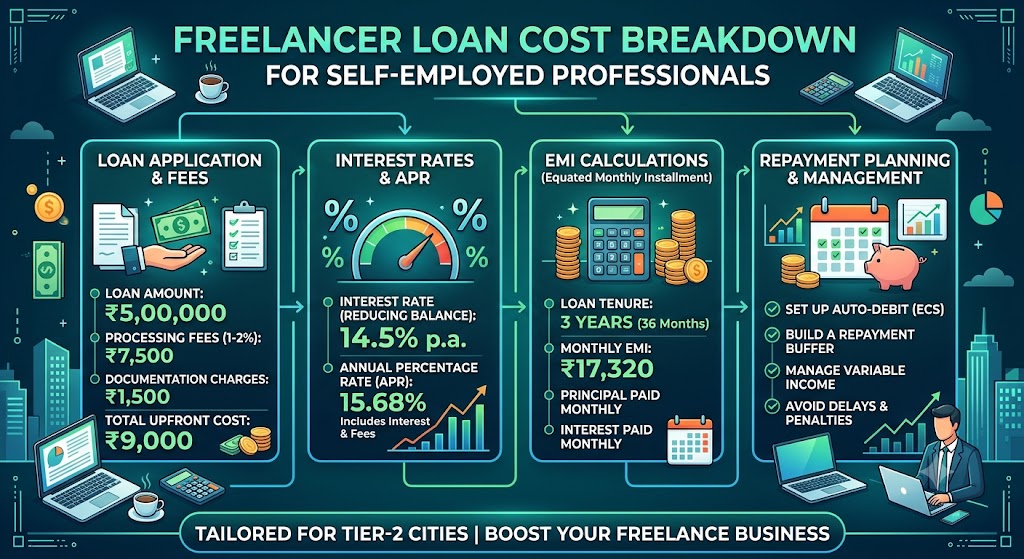
Freelancing is creating new income opportunities across India's Tier-2 cities. Content writers, graphic designers, software developers, digital marketers, consultants and other independent professionals can earn through client projects without working in a traditional salaried job.
However, when freelancers apply for a personal loan, lenders may assess their income consistency, credit history, existing EMIs and repayment capacity. Understanding these eligibility factors is important, but borrowers should also understand the total cost of borrowing before accepting a loan.
Interest rates, processing fees, applicable taxes and repayment tenure can affect the final amount a freelancer pays. A loan with a seemingly affordable EMI may cost more over a longer repayment period.
In this guide, Vizzve explains the cost breakdown of personal loans for freelancers in Tier-2 cities, the factors that influence loan eligibility, illustrative EMI calculations and practical ways to compare loan offers.
AI Answer Box: What Is the Cost of a Freelancer Loan in Tier-2 Cities?
The cost of a personal loan for freelancers in Tier-2 cities depends on the lender, loan amount, interest rate, repayment tenure, credit profile and applicable charges. Potential costs include interest, processing fees, applicable taxes on fees and other charges disclosed by the lender.
Freelancers should compare the Annual Percentage Rate (APR), monthly EMI, total repayment and net disbursed amount before accepting an offer. Eligibility and pricing differ between lenders, and living in a Tier-2 city does not automatically qualify an applicant for a lower interest rate.
1. Who Can Qualify for a Freelancer Personal Loan?
Freelancers may be eligible for personal loans if they meet the lender's requirements. There is no single eligibility standard that applies to every bank or non-banking financial company (NBFC).
Lenders may consider:
-
Age: Whether you meet the lender's age requirements.
-
Income: Whether your earnings support the proposed EMI.
-
Credit history: Your past repayment behaviour and outstanding debts.
-
Income proof: Bank statements, ITRs, invoices or other accepted records.
-
Work history: Whether you can demonstrate established freelance activity, if required.
-
Existing EMIs: Your current repayment obligations.
-
KYC documents: Valid identity and address information.
Freelancers in cities such as Jaipur, Lucknow, Indore, Nagpur, Coimbatore, Surat, Bhopal, Patna and other Tier-2 locations should check whether the lender serves their area and accepts freelance applicants.
These cities are examples, not a formal classification of every city under a single definition of Tier-2.
2. Main Costs of a Personal Loan for Freelancers
Before applying, understand the charges that may contribute to the overall borrowing cost.
Interest Charges
Interest is the amount charged for borrowing money. It depends on the interest rate, principal outstanding, repayment schedule and tenure.
The offered rate may vary according to the lender's assessment of your income, credit history, existing debt and other eligibility factors.
A lower rate may reduce borrowing costs, but it should not be the only factor used to compare offers.
Processing Fees
Some lenders charge a processing fee for handling a loan application. This may be a fixed amount or a percentage of the loan, depending on the product.
Check whether the fee is deducted from the loan amount or collected separately.
GST on Applicable Fees
Goods and Services Tax may apply to certain loan-related service fees under applicable tax rules. Check whether the quoted processing fee includes applicable taxes.
Do not assume that every lender charges the same fee or tax amount.
Documentation and Verification Charges
Some products may involve other disclosed service or verification charges. These depend on the lender and loan terms.
Ask for a written breakdown of all applicable charges before accepting the offer.
Late-Payment Charges
Missing an EMI may result in additional charges under the loan agreement and may affect your credit history. Review the applicable terms and select a repayment date that fits your cash flow.
Prepayment or Foreclosure Charges
If you want to repay a loan early, the applicable terms depend on the product, lender and relevant regulations. Check the agreement for permitted charges and conditions.
For covered digital loans, RBI's Digital Lending Directions, 2025 provide for borrower disclosures, including the KFS and APR. Review these documents to understand the cost and conditions of the specific loan. <Cite refs={["turn205763search1","turn205763search2"]} />
3. Illustrative Freelancer Loan Cost Breakdown
The following example shows how interest and an assumed processing fee can affect the cost of borrowing.
These figures are illustrative only. They are not a current market rate, a guaranteed offer or a standard cost for freelancers in Tier-2 cities.
Assume a freelancer borrows ₹1,00,000 for 12 months at a hypothetical annual interest rate of 18%, calculated using a standard reducing-balance EMI method.
| Cost component | Illustrative amount |
|---|---|
| Loan principal | ₹1,00,000 |
| Assumed annual interest rate | 18% |
| Loan tenure | 12 months |
| Approximate monthly EMI | ₹9,168 |
| Approximate total EMI payments | ₹1,10,016 |
| Approximate total interest | ₹10,016 |
| Assumed processing fee at 2% | ₹2,000 |
| Illustrative GST on fee at 18%, if applicable | ₹360 |
| Net disbursal if fees are deducted upfront | ₹97,640 |
| Approximate total outflow, including upfront fee and tax | ₹1,12,376 |
Amounts are rounded. Actual figures may vary according to the lender's calculation method, disbursal date, repayment schedule, fee structure and applicable taxes.
What Does This Breakdown Mean?
In this example, the sanctioned loan amount is ₹1,00,000, but the borrower receives ₹97,640 if the assumed processing fee and tax are deducted upfront.
The borrower then pays the scheduled EMIs and the upfront charges, resulting in an approximate total outflow of ₹1,12,376.
This illustrates why freelancers should compare the amount actually received with the total amount they will pay back.
4. How Loan Tenure Affects the Total Cost
Loan tenure affects the EMI and the total interest paid. A longer tenure generally reduces the monthly EMI for the same principal and interest rate, but it can increase the total interest paid.
A shorter tenure may reduce total interest but require a higher monthly payment.
Freelancers should consider:
-
Average monthly income
-
Income fluctuations between projects
-
Existing EMIs
-
Household and business expenses
-
Tax obligations
-
Emergency savings
Choose a tenure that makes repayments manageable without putting essential expenses at risk.
5. How Freelance Income Can Affect Loan Costs
Loan eligibility and loan pricing are related, but they are not identical. A lender may assess an applicant's financial profile before deciding whether to approve a loan and what terms to offer.
Income Consistency
Freelancers who receive regular client payments may find it easier to document their earnings. Applicants with irregular income may need additional financial records, depending on lender requirements.
Credit History
A record of timely repayments may support an application, but it does not guarantee approval or a particular interest rate.
Existing Debt
High existing EMIs can reduce the income available for a new repayment and may affect the lender's assessment.
Financial Documentation
Bank statements, ITRs, client invoices and contracts may help explain the source and consistency of freelance earnings.
Keep your financial records accurate and provide only genuine documents requested through the lender's authorized process.
6. Documents Freelancers May Need
Depending on the lender and loan product, applicants may be asked for:
-
PAN
-
Aadhaar or another accepted identity document
-
Address proof
-
Recent bank statements
-
Income Tax Returns (ITRs), where required
-
Client invoices or contracts
-
Business or professional records, where applicable
-
Additional application forms requested by the lender
Requirements vary. Confirm the exact document list before applying and submit sensitive information only through a verified channel.
7. How to Compare Freelancer Loan Offers
Do not select a loan based only on its advertised interest rate. Compare the complete cost and repayment terms.
| What to compare | Why it matters |
|---|---|
| Sanctioned amount | Shows the amount approved by the lender |
| Net disbursed amount | Shows how much money you actually receive |
| Interest rate | Indicates the rate used to calculate interest |
| APR | Helps compare the annualized cost of borrowing |
| Monthly EMI | Shows the scheduled monthly repayment |
| Total repayment | Shows the sum of scheduled repayments |
| Processing fee and applicable taxes | Identifies upfront charges |
| Late-payment terms | Explains potential costs if you miss payments |
| Prepayment conditions | Clarifies the terms for early repayment |
| KFS and loan agreement | Provides key loan disclosures and contractual terms |
For digital loans covered by RBI requirements, the KFS includes key information about the loan, including APR. Review the figures in the KFS and confirm that the offer matches the terms presented to you. <Cite refs={["turn205763search1","turn205763search2"]} />
8. Practical Tips to Manage Loan Costs
Borrow Only What You Need
A larger loan can increase the interest paid and the monthly repayment commitment. Calculate the amount needed before applying.
Maintain Clear Income Records
Keep invoices, bank credits and applicable tax records organized. This can help you document your financial profile.
Compare Offers Before Applying
Review eligibility requirements, APR, fees and repayment terms. Apply selectively rather than submitting unnecessary applications to many lenders.
Pay EMIs on Time
Set reminders or use automatic payments if appropriate, while ensuring that sufficient funds are available on the due date.
Keep an Emergency Buffer
Freelance income can fluctuate. Savings can help cover essential expenses and loan repayments during slower months.
Verify the Actual Lender
Check the lender's identity and review the loan agreement. Avoid apps or agents that promise guaranteed approval, hide charges or request OTPs, UPI PINs, ATM PINs or banking passwords.
9. Freelancer Loan Cost Checklist
Before accepting a loan, use this checklist:
-
I meet the lender's eligibility criteria.
-
I have prepared the required income and KYC documents.
-
I have reviewed my credit report and existing EMIs.
-
I know the sanctioned amount and net disbursal.
-
I understand the interest rate and APR.
-
I have checked the processing fee and applicable taxes.
-
I know the monthly EMI and total repayment.
-
I understand late-payment and prepayment terms.
-
I have reviewed the KFS and loan agreement.
-
The EMI fits my budget, even during a low-income month.
FAQs: Loan Eligibility for Freelancers in Tier-2 Cities
1. Can freelancers in Tier-2 cities apply for personal loans?
Yes, some lenders accept freelancers and self-employed professionals. Approval depends on the lender's criteria, income evidence, credit history, existing debt and other factors.
2. What costs are involved in a freelancer personal loan?
Potential costs include interest, processing fees, applicable taxes on fees and other charges disclosed by the lender. Late-payment charges may apply if you miss an EMI.
3. Do freelancers in Tier-2 cities get lower interest rates?
Not automatically. Interest rates depend on the lender, loan product, credit profile, income assessment and other factors. City tier alone does not guarantee a lower rate.
4. What is APR in a personal loan?
APR stands for Annual Percentage Rate. It represents the annualized cost of credit under the applicable framework and helps borrowers compare loan offers beyond the headline interest rate.
5. Can freelancers apply without salary slips?
Some lenders may accept bank statements, ITRs, client invoices or contracts instead of salary slips. Requirements differ, so check with the specific lender.
6. Does a longer loan tenure reduce the total cost?
Not necessarily. A longer tenure usually lowers the monthly EMI but may increase the total interest paid. Compare both the EMI and total repayment before deciding.
7. Can freelancers repay a personal loan early?
Possibly. The applicable conditions depend on the loan agreement, lender and relevant regulations. Check whether any permitted prepayment or foreclosure charges apply.
8. What is a KFS, and why should borrowers read it?
KFS stands for Key Facts Statement. It summarizes important loan information and applicable costs, helping borrowers understand the offer before entering into the loan contract.
9. How can freelancers reduce borrowing costs?
Borrow only what is necessary, compare APR and total repayment, select an affordable tenure, maintain timely repayments and review fees before accepting the offer.
10. Does loan eligibility differ between Tier-2 cities?
Eligibility depends primarily on the lender's product criteria and the applicant's financial profile. Location may affect service availability, but there is no universal eligibility rule for every Tier-2 city.
Conclusion
Understanding the cost breakdown of a freelancer personal loan is essential before borrowing. Interest, processing fees, applicable taxes and loan tenure can all affect the final repayment amount.
Freelancers in Tier-2 cities should organize their income records, assess their repayment capacity and compare loan offers using the APR, EMI, net disbursal and total repayment.
Published on : 23rd October 2026
Published by : Shibam nath
www.vizzve.com || www.vizzveservices.com
Follow us on social media: Facebook || Linkedin || Instagram
🛡 Powered by Vizzve Financial
RBI-Registered Loan Partner | 10 Lakh+ Customers | ₹600 Cr+ Disbursed