

Introduction
Freelancing is becoming a popular career option across India's Tier-2 cities. Professionals such as graphic designers, content writers, software developers, digital marketers, consultants and online tutors are increasingly earning through independent projects and remote work.
However, freelancers may face questions when applying for a personal loan. Unlike salaried employees, they may not receive a fixed monthly salary or have traditional salary slips to prove their income.
Understanding loan eligibility for freelancers in Tier-2 cities can help independent professionals prepare the right documents, assess their financial situation and choose suitable borrowing options.
In this guide, Vizzve explains freelancer loan eligibility in simple terms, including income requirements, credit scores, documents, benefits and important precautions.
What Is Loan Eligibility for Freelancers?
Loan eligibility means the conditions a lender uses to decide whether an applicant qualifies for a loan.
For freelancers, lenders may examine:
-
Monthly or annual income
-
Stability of earnings from clients
-
Credit score and repayment history
-
Existing EMIs and financial obligations
-
Bank statements and income documents
-
Identity and address verification
-
Ability to repay the proposed loan
Eligibility requirements vary by lender and loan product. Living in a Tier-2 city does not automatically make someone eligible or ineligible for a personal loan.
What Are Tier-2 Cities in India?
Tier-2 cities are urban centres that support growing business activity, employment, education and digital services. Examples commonly associated with this category include Jaipur, Lucknow, Indore, Bhopal, Nagpur, Coimbatore, Kochi, Surat, Patna and Bhubaneswar. Classifications can vary depending on the government, institution or business context.
Freelancers in these cities may work with local businesses, national companies or international clients. Their loan eligibility generally depends on the lender's criteria and documented financial profile rather than the city alone.
Main Factors That Affect Freelancer Loan Eligibility
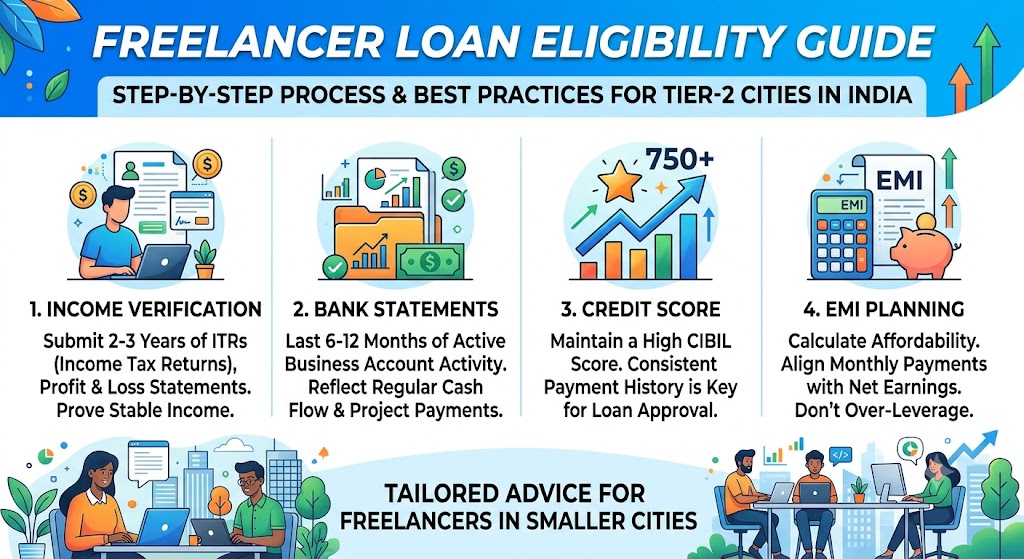
1. Income and Earnings Stability
Income is one of the important factors lenders may assess. Freelancers often receive payments at different times, and their earnings may change from month to month.
For example, a freelance designer may earn ₹45,000 in one month and ₹65,000 in another. Maintaining clear records of client payments can help demonstrate the pattern of earnings.
Tip: Calculate your average income over several months and make sure your expected EMI remains affordable even during slower periods.
2. CIBIL Score and Credit History
Lenders may check your credit report and score to understand how you have managed previous loans and credit cards.
A positive repayment history can support an application, while missed EMIs, defaults or high outstanding balances may create difficulties.
Freelancers should review their credit reports for errors, pay existing dues on time and avoid unnecessary loan applications.
3. Bank Statements and Income Proof
Because freelancers may not receive salary slips, alternative documents may be required to verify their earnings.
Depending on the lender, these may include:
-
Recent bank statements
-
Income Tax Returns (ITRs), where applicable
-
Client invoices and payment receipts
-
Work contracts or purchase orders
-
Relevant tax or professional income records
-
Additional documents requested by the lender
Keep your records genuine, accurate and up to date.
4. Existing EMIs and Repayment Capacity
If you already pay EMIs for a personal loan, vehicle loan or other credit facility, a lender may consider those obligations when assessing a new application.
Before applying, calculate how much money remains after essential expenses, taxes, business costs and existing repayments.
Choose a loan amount that fits your actual budget rather than borrowing the maximum amount offered.
5. Work Experience and Client Relationships
Some lenders may require a minimum period of freelance or self-employed activity. Others may consider the income evidence and other eligibility factors specified for their products.
Maintaining contracts, invoices and payment records from regular clients can help document your professional activity.
There is no single work-experience requirement that applies to every lender.
Documents Freelancers May Need for a Loan
| Document | Why it may be required |
|---|---|
| PAN | Identity and financial verification |
| Accepted identity document | KYC verification |
| Address proof | Confirmation of residential address |
| Bank statements | Review of income and transactions |
| ITR or tax records | Evidence of declared income, where applicable |
| Invoices or client contracts | Supporting evidence of freelance earnings |
| Additional documents | As specified by the lender |
Always confirm the required documents with the lender before submitting an application.
How Freelancers in Tier-2 Cities Can Improve Loan Eligibility
Step 1: Maintain Clear Income Records
Keep track of client payments, invoices and business expenses. Use bank records that make your income transactions easy to identify, where practical.
Step 2: Check Your Credit Report
Review your credit history before applying. If you find an error, raise a dispute through the appropriate credit bureau process.
Step 3: Reduce Unnecessary Debt
Existing debt can affect your ability to manage another EMI. Consider reducing outstanding balances where possible before taking on additional borrowing.
Step 4: Choose a Realistic Loan Amount
Estimate your income conservatively. Account for essential expenses, taxes, business costs and emergency savings before deciding how much to borrow.
Step 5: Compare Lenders Carefully
Compare eligibility criteria, interest rates, Annual Percentage Rate (APR), processing fees, tenure and repayment conditions.
If applying through a digital lending app, verify the actual bank or NBFC behind the offer. Read the loan agreement and the Key Facts Statement (KFS), where applicable, before accepting the loan.
Benefits and Challenges for Freelancers
Potential benefits
-
Access to credit without a traditional salary slip, where the lender accepts alternative income proof.
-
Convenient online application options offered by some lenders.
-
Potential support for planned personal or professional expenses.
-
An opportunity to build credit history through responsible repayment when the loan is reported to a credit bureau.
Potential challenges
-
Income may fluctuate between months.
-
Some lenders may require formal tax records or a minimum work history.
-
Limited credit history may make eligibility harder to assess.
-
Existing EMIs can reduce repayment capacity.
-
Interest rates and fees vary by lender and applicant profile.
A loan can be useful for a genuine financial need, but it should not create repayment pressure that is difficult to manage during low-income months.
Freelancer Loan Eligibility Checklist
Before applying, ask yourself:
-
Do I meet the lender's age and income requirements?
-
Can I provide genuine proof of earnings?
-
Have I checked my credit report?
-
Do I know how much I already pay in EMIs?
-
Can I afford the new EMI during a low-income month?
-
Have I compared APR, processing fees and total repayment?
-
Have I verified the lender's identity?
-
Have I read the loan agreement and privacy terms?
If you cannot comfortably manage the proposed EMI, consider borrowing less or postponing the application.
Frequently Asked Questions (FAQs)
1. Can freelancers in Tier-2 cities get a personal loan?
Yes, some banks and NBFCs accept eligible freelancers and self-employed professionals. Approval depends on the lender's criteria, documented income, credit history and repayment capacity.
2. Is a salary slip compulsory for freelancers?
Not always. Some lenders may accept bank statements, ITRs, invoices or other income records instead. Requirements vary by lender.
3. Does living in a Tier-2 city affect loan eligibility?
The city alone does not determine eligibility. Lenders may consider service availability, income, credit history, documents and other product-specific requirements.
4. Can a freelancer apply without an ITR?
Some lenders may accept alternative documents, while others may require ITRs or additional income evidence. Confirm the requirements before applying.
5. What CIBIL score is needed for a freelancer loan?
There is no universal score that guarantees approval. Each lender sets its own criteria and may also evaluate income, existing debt and other factors.
6. Can a new freelancer apply for a loan?
A new freelancer can explore available options, but some lenders may require a minimum period of professional activity or documented income history.
7. How can freelancers prove their income?
Depending on the lender, they may use bank statements, invoices, client contracts, payment receipts and tax records.
8. Are online loans safe for freelancers?
Online loans can be convenient, but borrowers should verify the lender, check the APR and fees, review privacy terms and avoid suspicious upfront payment demands. Never share OTPs, passwords or UPI PINs with an agent.
9. Can existing EMIs affect loan approval?
Yes. Existing repayments may reduce the income available for a new EMI and influence the lender's assessment.
10. Is loan approval guaranteed after submitting all documents?
No. Complete documentation helps the lender assess the application, but final approval depends on its eligibility criteria and credit assessment.
Conclusion
Understanding loan eligibility for freelancers in Tier-2 cities can help independent professionals prepare for the borrowing process with greater confidence. Income stability, credit history, bank statements, existing EMIs and genuine supporting documents can all influence a lender's decision.
Before applying, check the eligibility criteria, compare the full cost of borrowing and choose an EMI that fits your realistic income. Responsible financial planning can help freelancers manage credit without placing unnecessary pressure on their finances.
Published on : 22nd October 2026
Published by : Shibam nath
www.vizzve.com || www.vizzveservices.com
Follow us on social media: Facebook || Linkedin || Instagram
🛡 Powered by Vizzve Financial
RBI-Registered Loan Partner | 10 Lakh+ Customers | ₹600 Cr+ Disbursed