

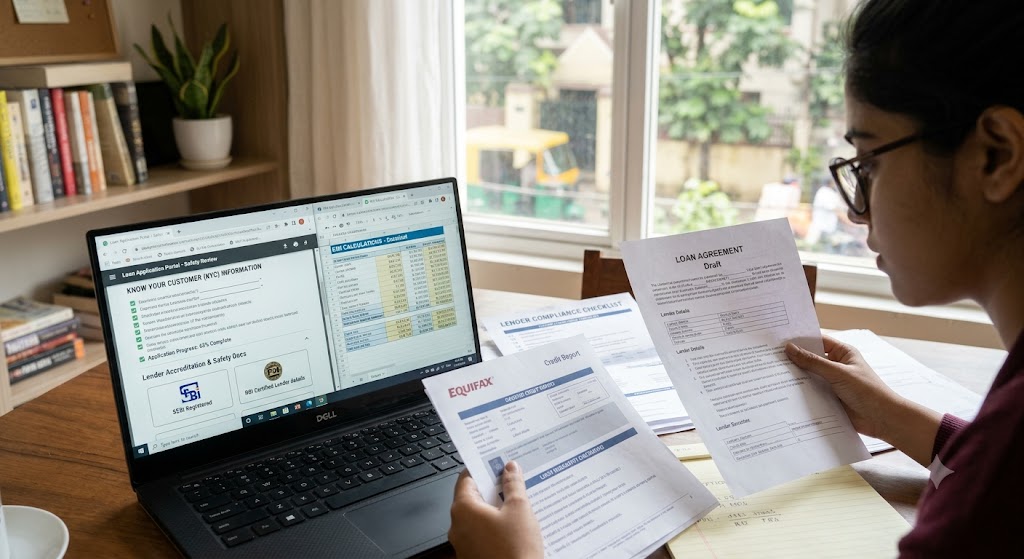
Freelancers in Tier-3 cities across India may apply for personal loans to manage professional expenses, medical bills, education costs or other financial needs. However, before applying online, it is important to verify the lender, protect personal information and understand the complete cost of borrowing.
Unlike salaried employees, freelancers may receive income from multiple clients, freelance platforms or project-based assignments. Lenders may therefore assess bank statements, Income Tax Returns (ITRs), credit history, existing EMIs and repayment capacity before deciding whether to approve an application.
A careful safety check can help freelancers avoid suspicious loan apps, misleading offers and unnecessary financial risks.
1. Verify the Actual Lender
One of the most important safety steps is identifying the institution that will actually provide the loan.
Some digital lending apps work with banks or regulated non-banking financial companies (NBFCs). The app's brand name may differ from the name of the actual lender.
Before applying, check:
-
The legal name of the bank or NBFC providing the loan.
-
Whether the lender is regulated by the appropriate authority.
-
Whether the app or lending service is associated with the lender through an authorized arrangement.
-
Whether official contact and grievance-redressal details are available.
-
Whether the loan terms clearly identify the lender.
Use official lender information and the Reserve Bank of India's available resources to verify relevant details. Do not rely only on advertisements, app-store ratings or social media promotions.
2. Check the App's Permissions and Privacy Policy
A loan application may need certain information to process and verify your application. However, you should understand why information is collected and how it will be used.
Before granting permission, review:
-
What personal information the app collects.
-
Whether the information is necessary for the stated purpose.
-
How your information may be shared.
-
The app's privacy policy and consent process.
-
Whether the app requests unnecessary access to your contacts, call logs, photos or other device information.
Do not automatically grant every permission simply because an app requests it. If the permissions or privacy terms appear excessive or unclear, stop and verify the service before proceeding.
3. Protect Your KYC Documents
Freelancers may be asked to submit PAN, Aadhaar or other accepted KYC documents, along with bank details and income evidence.
To protect these documents:
-
Submit them only through verified, authorized channels.
-
Check that the website or app belongs to the legitimate lending service.
-
Avoid sending identity documents to unknown individuals over messaging apps.
-
Do not upload documents to suspicious links.
-
Provide only the information required for the legitimate application.
-
Keep copies of the documents and application confirmation for your records.
Make sure your name, date of birth and other details are accurate and consistent across the application and supporting documents.
4. Never Share OTPs, UPI PINs or Banking Passwords
A legitimate loan application may use OTP verification to confirm your identity or authorize a specific action. However, you should never disclose an OTP to an agent or another person who asks you to read it out.
Never share:
-
OTPs with callers or loan agents.
-
UPI PINs.
-
ATM or debit-card PINs.
-
Internet-banking passwords.
-
Card security codes or confidential banking credentials.
Do not approve an unexpected payment request or install remote-access software at an agent's request.
Safety rule: If someone demands your PIN, password or an advance payment to guarantee loan approval, stop the process and verify the request independently.
5. Prepare Genuine Income Documents
Freelancers often demonstrate their income through records other than traditional salary slips.
Depending on the lender's requirements, these may include:
| Document | Purpose |
|---|---|
| Bank statements | Show income deposits and cash flow |
| ITRs | Provide evidence of reported income |
| Client invoices | Support freelance earnings |
| Client contracts | Document professional assignments |
| Payment records | Show receipts from clients or platforms |
| PAN and accepted KYC documents | Support identity verification |
| Existing loan details | Help assess current debt obligations |
Never alter bank statements, inflate income figures or submit fabricated invoices. Inaccurate information can lead to rejection and other consequences.
6. Check Your Credit Report Before Applying
Your credit history may influence a lender's assessment of your application.
Before applying, review your credit report for:
-
Incorrect personal information.
-
Loans or credit accounts you do not recognize.
-
Incorrect overdue amounts.
-
Payments incorrectly marked as late.
-
Unfamiliar credit enquiries.
If you find an error, raise a correction request with the relevant credit bureau and, where appropriate, the lender.
A good credit score does not guarantee approval. Income, existing EMIs, documents and lender-specific criteria may also affect the decision.
7. Calculate Whether You Can Afford the EMI
Do not apply only because an app offers a high loan amount or quick approval.
Calculate your dependable monthly income, existing EMIs, essential expenses and proposed new EMI.
For example, suppose a freelancer earns ₹35,000 in a typical month.
| Monthly financial detail | Illustrative amount |
|---|---|
| Dependable monthly income | ₹35,000 |
| Existing EMIs | ₹5,000 |
| Proposed new EMI | ₹6,000 |
| Income remaining after EMIs | ₹24,000 |
The remaining ₹24,000 must cover rent, food, utilities, business expenses, taxes, family responsibilities and savings. The example is illustrative and does not establish a universal safe EMI limit.
Freelancers should also consider months when client payments are delayed or fewer projects are available.
8. Review the Interest Rate, APR and Fees
A low advertised interest rate does not necessarily mean a loan is inexpensive.
Before accepting an offer, check:
-
Interest rate.
-
Annual Percentage Rate (APR).
-
Processing fee.
-
Applicable taxes and other charges.
-
EMI and repayment tenure.
-
Total repayment amount.
-
Late-payment and penal charges.
-
Prepayment or foreclosure conditions, where applicable.
Also confirm whether any fee will be deducted from the loan amount before disbursal.
Compare the complete cost of borrowing rather than choosing the first offer you receive.
9. Read the KFS and Loan Agreement
The Key Facts Statement (KFS) provides important information about loan costs and terms. For covered digital loans, applicable RBI requirements provide for disclosure of the APR and other key information.
Before accepting a loan, confirm:
-
The lender's legal name.
-
The approved loan amount.
-
The net amount to be disbursed.
-
The interest rate and APR.
-
The EMI and repayment schedule.
-
Applicable fees and charges.
-
Late-payment and penal-charge conditions.
-
Prepayment terms.
-
Grievance-redressal information.
Do not accept a loan based only on a phone call, text message or preliminary approval notification. Read the official documents carefully before agreeing to the terms.
10. Watch for Loan App Scams
Be cautious if a loan app or agent:
-
Guarantees approval without proper checks.
-
Demands an unexplained advance payment to release the loan.
-
Refuses to identify the actual lender.
-
Pressures you to accept immediately.
-
Hides fees or refuses to provide written terms.
-
Threatens to contact your friends or family.
-
Requests confidential banking credentials.
-
Sends suspicious links or asks you to install an unknown application.
If you suspect fraud, stop sharing information, preserve messages and payment records, and contact your bank or the appropriate official reporting channel. In India, suspected cyber financial fraud can be reported through the National Cyber Crime Reporting Portal or helpline 1930.
11. What to Do If You Find a Suspicious Loan App
Follow these steps:
Step 1: Stop the application and do not share further information.
Step 2: Do not make additional payments to the suspicious person or app.
Step 3: Save screenshots, messages, phone numbers and transaction details.
Step 4: If money has been transferred or your bank details may be compromised, contact your bank immediately.
Step 5: Report suspected cyber financial fraud through the appropriate official channels, including helpline 1930 in India when relevant.
Step 6: Change compromised credentials and secure affected financial accounts. Never share an OTP or PIN with someone claiming to help you recover money.
FAQs: Freelancer Loan Safety and Eligibility
1. Can freelancers in Tier-3 cities apply for personal loans?
Yes. Freelancers may apply for eligible personal loans, subject to the lender's requirements, income assessment, documentation and repayment-capacity checks.
2. Is a salary slip compulsory for freelancer loans?
Not always. Some lenders may accept bank statements, ITRs, invoices, contracts or other evidence of freelance income. Requirements vary by lender.
3. How can I check whether a loan app is genuine?
Identify the actual lender, check its official information and verify the app's authorized lending arrangement where applicable. Read the terms and privacy policy before sharing documents.
4. Is it safe to upload PAN and Aadhaar to a loan app?
Only submit documents through a verified, authorized process after checking the lender and understanding why the information is required. Avoid unknown links and suspicious requests.
5. Should I share an OTP with a loan agent?
No. Do not disclose OTPs, UPI PINs, ATM PINs or banking passwords to an agent or another person.
6. Does a good CIBIL score guarantee loan approval?
No. Credit history is only one part of the assessment. Income, existing EMIs, documentation and lender-specific eligibility rules may also matter.
7. What should I check before accepting a digital loan?
Review the actual lender, interest rate, APR, EMI, tenure, processing fees, total repayment, applicable charges, KFS and loan agreement.
8. What should I do if I have paid a fraudulent loan app?
Contact your bank immediately, preserve transaction evidence and report the suspected fraud through the appropriate official channels. In India, you can contact cyber financial fraud helpline 1930.
9. Can an app ask for access to my contacts or photos?
Review the stated purpose and necessity of each permission. Do not automatically grant excessive or unexplained access, and verify the app if its requests appear suspicious.
10. What is the safest way to apply for a freelancer loan?
Prepare accurate income and KYC documents, verify the actual lender, compare the full loan cost, calculate repayment capacity and read the official loan documents before accepting an offer.
Key Takeaways
-
Verify the actual lender before using a digital loan app.
-
Protect your PAN, KYC documents and banking credentials.
-
Maintain genuine income records and check your credit report.
-
Calculate the EMI using dependable income and existing expenses.
-
Compare APR, processing fees and total repayment.
-
Read the KFS and loan agreement before accepting the loan.
-
Avoid guaranteed-approval claims, suspicious advance payments and requests for confidential credentials.
-
Report suspected cyber financial fraud promptly.
Published on : 29th October 2026
Published by : Shibam nath
www.vizzve.com || www.vizzveservices.com
Follow us on social media: Facebook || Linkedin || Instagram
🛡 Powered by Vizzve Financial
RBI-Registered Loan Partner | 10 Lakh+ Customers | ₹600 Cr+ Disbursed