

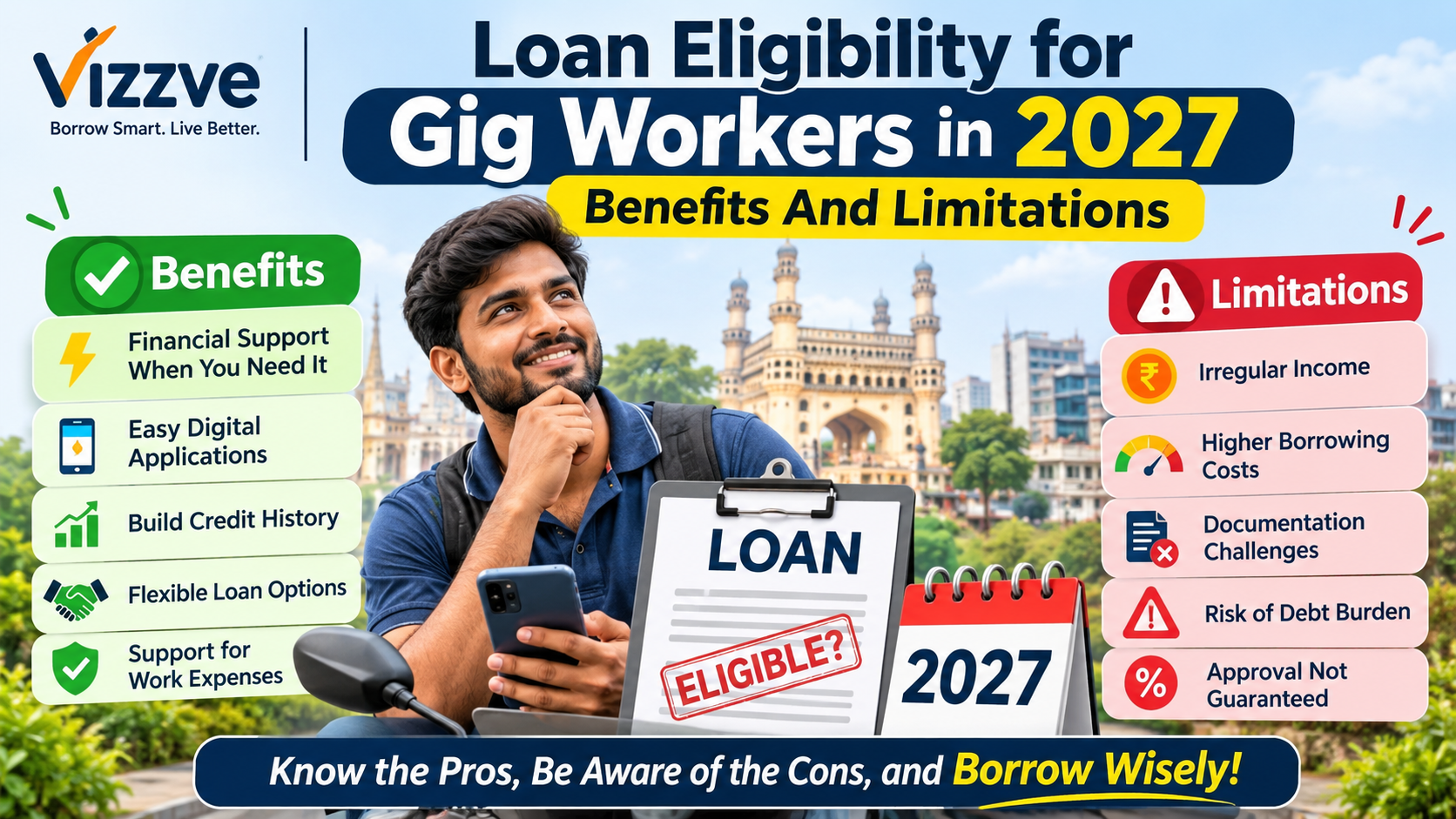
The gig economy continues to create earning opportunities for delivery partners, drivers, freelancers and independent service providers. Many people now earn through platforms such as food delivery services, ride-hailing applications, online marketplaces and freelance projects.
However, accessing loans can sometimes be challenging for gig workers because their monthly income may not be fixed like a traditional salaried employee.
In 2027, understanding loan eligibility will remain important for gig workers who want to manage personal expenses, handle emergencies or invest in their work.
This guide from Vizzve explains the benefits and limitations of loans for gig workers, the documents lenders may require, eligibility factors and important precautions to consider before borrowing.
What Is Loan Eligibility for Gig Workers?
Loan eligibility refers to the financial and personal conditions a lender evaluates before approving a loan.
Unlike salaried employees, gig workers may receive payments from multiple platforms or customers. Their earnings can change depending on working hours, demand, completed orders and seasonal opportunities.
Lenders may consider:
-
Monthly or average income.
-
Bank account transaction history.
-
Work and platform activity.
-
Existing loans and EMIs.
-
Credit history and repayment behaviour.
-
Age and identity verification.
-
Overall repayment capacity.
Important: Eligibility requirements differ between lenders. Having irregular income does not automatically disqualify a gig worker from applying for a loan.
Why Loan Eligibility Matters for Gig Workers in 2027
Understanding eligibility before applying can help gig workers:
-
Identify suitable loan products.
-
Prepare the required financial documents.
-
Understand their repayment capacity.
-
Avoid unnecessary loan applications.
-
Compare interest rates and additional charges.
-
Make informed borrowing decisions.
Benefits of Loans for Gig Workers in 2027
Loans can provide financial support when gig workers need money for personal or professional requirements. Here are some potential benefits.
1. Easy Access to Financial Support
Loans may help delivery partners, drivers and freelancers manage unexpected expenses without depending entirely on personal savings.
2. Flexible Loan Options
Gig workers may explore different loan products depending on their income, repayment capacity and financial requirements.
3. Support During Financial Emergencies
A suitable loan may help manage urgent expenses such as medical bills, vehicle repairs or household requirements.
4. Opportunity to Build Credit History
Responsible repayment of eligible credit products can help gig workers establish a credit history and improve their future borrowing opportunities.
5. Digital Application Convenience
Digital lending services can allow borrowers to complete applications online, submit documents and receive loan-related updates without visiting multiple branches.
6. Recognition of Alternative Income Sources
Traditional salary slips are not the only possible way to demonstrate income. Depending on lender policy, gig workers may be able to submit bank statements, platform earnings records and other income evidence.
7. Financial Independence
Access to suitable credit can help gig workers manage planned expenses and invest in work-related requirements such as smartphones, equipment or vehicle maintenance.
Limitations of Loans for Gig Workers in 2027
Although loans provide financial opportunities, gig workers should understand their limitations before borrowing.
1. Irregular Monthly Income
Gig workers may earn different amounts every month. Low-demand periods can make regular EMI payments difficult.
2. Limited Credit History
Some first-time borrowers may not have an established credit profile. This can make traditional loan assessments more challenging.
3. Higher Borrowing Costs
Depending on the lender and applicant's risk profile, interest rates and fees may make borrowing expensive.
4. Income Verification Challenges
Some lenders may require consistent income documentation. Workers receiving payments from several platforms may find this process difficult.
5. Loan Approval Is Not Guaranteed
Meeting basic eligibility requirements does not guarantee approval. Lenders independently assess financial stability and repayment capacity.
6. Risk of Debt Burden
Taking multiple loans or choosing an unaffordable EMI can create financial pressure, particularly when monthly earnings fluctuate.
7. Digital Lending Risks
Unverified loan applications, misleading advertisements and hidden charges can expose borrowers to financial and privacy risks.
Benefits vs Limitations – Quick Comparison
|
Benefits |
Limitations |
|---|---|
|
Access to emergency funds |
Irregular income |
|
Convenient digital applications |
Verification difficulties |
|
Multiple loan options |
Different interest rates |
|
Opportunity to build credit |
Limited credit history |
|
Support for work expenses |
Risk of excessive debt |
|
Alternative income evidence may be considered |
Approval depends on lender policy |
|
Financial flexibility |
Regular EMI obligations |
The availability of each benefit depends on the lender, loan product and applicant's circumstances.
Loan Eligibility Requirements for Gig Workers in 2027
Gig workers may need to meet the following general eligibility conditions:
|
Eligibility factor |
What lenders may check |
|---|---|
|
Age |
Minimum and maximum age requirements |
|
Income |
Average monthly earnings |
|
Work profile |
Delivery, driving, freelancing or other gig work |
|
Bank account |
Regular income transactions |
|
Credit score |
Existing credit history, if available |
|
Repayment capacity |
Income after expenses and existing EMIs |
|
KYC |
Identity and address verification |
There is no single universal income requirement or minimum credit score applicable to all gig worker loans.
Documents Required for Gig Worker Loans
Applicants may be asked to provide:
-
Aadhaar card or other accepted identity documents.
-
PAN card.
-
Bank statements.
-
Gig platform payment statements.
-
Work or platform registration details.
-
Address proof.
-
Income records.
-
Existing loan details, where applicable.
The exact documents depend on the lender's verification requirements.
How Gig Workers Can Improve Loan Eligibility in 2027
Here are some practical steps borrowers can follow.
-
Maintain regular bank transactions: Receive platform earnings into a consistent bank account wherever practical.
-
Keep income records: Save monthly earnings statements and payment details.
-
Maintain a good credit history: Pay existing EMIs and credit card bills on time.
-
Reduce existing debt: Avoid taking multiple loans unnecessarily.
-
Choose affordable loan amounts: Calculate your EMI before applying.
-
Update KYC documents: Ensure identity and address details are accurate.
-
Compare lenders: Review interest rates, APR, fees and repayment conditions.
The Future of Gig Worker Lending in 2027
The financial services industry is exploring better ways to assess borrowers who do not receive traditional salaries.
The RBI's 2024–25 Annual Report discusses a pilot by its innovation hub involving ride-hailing platforms and lenders. The pilot explored consent-based use of alternative information, such as work history, earnings and performance metrics, to assess gig workers' creditworthiness.
This creates an opportunity for more inclusive credit assessment models.
The Economic Survey 2025–26 also highlights that gig workers face challenges accessing formal credit and productive assets.
Potential developments in 2027 include:
-
Greater use of digital income records.
-
More attention to alternative credit assessment.
-
Improved online loan application processes.
-
More financial awareness among gig workers.
-
Greater focus on responsible digital lending.
These are potential developments, not guaranteed changes or promises of loan approval.
RBI Guidelines and Digital Loan Safety
The RBI's Digital Lending Directions, 2025 provide important borrower protections.
Borrowers should understand these points:
-
Lenders must assess borrower creditworthiness, including age, occupation and income.
-
Borrowers should receive a Key Facts Statement (KFS) containing important loan information.
-
Loan terms and charges should be disclosed clearly.
-
Digital lending arrangements have requirements for data collection, usage and privacy.
-
Grievance redressal mechanisms should be available.
Read the official RBI Digital Lending Directions, 2025 before choosing a digital loan.
Real-World Example: A Delivery Partner Applying for a Loan
Consider a hypothetical delivery partner working in Hyderabad.
|
Financial detail |
Amount |
|---|---|
|
Average monthly income |
₹25,000 |
|
Monthly household expenses |
₹12,000 |
|
Existing EMI |
₹2,000 |
|
Proposed loan amount |
₹50,000 |
|
Proposed tenure |
12 months |
Suppose the lender offers an illustrative annual interest rate of 18%.
Illustrative repayment calculation
₹4,584
Estimated monthly EMI
Loan amount
₹50,000
Tenure
12 months
Existing EMI
₹2,000
Total monthly EMIs
₹6,584
The borrower should evaluate whether the proposed EMI remains affordable during months when delivery orders and earnings are lower.
This example demonstrates why gig workers should consider average income, essential expenses and emergency savings before accepting a loan.
Common Mistakes Gig Workers Should Avoid
-
Applying without checking eligibility.
-
Providing incorrect income information.
-
Ignoring processing fees.
-
Borrowing more than necessary.
-
Missing EMI payment dates.
-
Using unverified loan applications.
-
Ignoring the loan agreement.
-
Depending on peak-month income to calculate repayment capacity.
Key Takeaways
-
Gig workers can explore different loan options in 2027.
-
Income stability and repayment capacity are important.
-
Bank statements and platform earnings records may support income verification.
-
Loans can provide financial flexibility but also create repayment obligations.
-
Credit history can influence lending decisions.
-
Borrowers should compare APR, EMI and additional charges.
-
Responsible borrowing is essential for long-term financial stability.
AI Answer Box – Quick Summary
What are the benefits and limitations of loans for gig workers in 2027?
Loans can help gig workers manage emergencies, personal expenses and work-related investments. Benefits include convenient digital applications, flexible borrowing options and opportunities to build credit history. However, irregular income, limited credit history, higher borrowing costs and repayment pressure can create challenges. Gig workers should compare lenders, maintain income records and choose affordable EMIs before applying.
Frequently Asked Questions (FAQs)
1. Can gig workers get personal loans in 2027?
Yes. Gig workers can apply for personal loans if they meet the lender's income, documentation and repayment requirements.
2. What are the main benefits of loans for gig workers?
Loans can provide emergency financial support, help manage personal expenses and support work-related investments.
3. What are the limitations of gig worker loans?
Common limitations include irregular income, documentation challenges, interest costs and repayment obligations.
4. Can delivery partners apply for loans?
Yes. Eligible delivery partners may apply using accepted income and identity documents.
5. Can gig workers get loans without salary slips?
Some lenders may accept bank statements, platform earnings reports or alternative income documents.
6. Is a CIBIL score compulsory for gig worker loans?
Requirements vary by lender. Some lenders may consider applicants without an established credit history.
7. Do gig workers need bank statements?
Many lenders request bank statements to verify income and financial transactions.
8. Can freelancers apply for personal loans?
Yes. Freelancers may qualify depending on documented earnings and repayment capacity.
9. How can gig workers improve loan eligibility?
Maintain consistent banking activity, save income records, pay existing EMIs on time and reduce unnecessary debt.
10. Are digital loans beneficial for gig workers?
They can offer application convenience, but borrowers should verify the lender and understand all charges.
11. Can irregular income affect loan approval?
Yes. Income fluctuations may affect how lenders assess repayment capacity.
12. What documents are needed for gig worker loans?
Common documents include PAN, accepted identity proof, bank statements, income records and work details.
13. Are loans suitable for all gig workers?
No. Borrowing is suitable only when the applicant has sufficient repayment capacity and a genuine financial need.
14. Can gig workers use loans for vehicle repairs?
Depending on the loan agreement, personal loans may be used for eligible vehicle repair expenses.
15. What should gig workers check before accepting a loan?
Check the interest rate, APR, processing fee, EMI, tenure, late payment charges and lender credentials.
Google Ranking Boost – EEAT
Expert Commentary
Loan eligibility for gig workers requires an understanding of income patterns beyond traditional salary structures. Bank transactions, platform earnings and work history may provide useful financial information for lenders.
Real-World Experience Points
-
Delivery partners may experience daily income fluctuations.
-
Freelancers may receive payments from multiple clients.
-
Ride-hailing drivers may have variable monthly earnings.
-
Maintaining financial records can simplify income verification.
-
Choosing affordable EMIs can reduce repayment difficulties.
Trust-Building Statement
Vizzve promotes responsible borrowing and financial awareness. Every borrower should understand loan conditions, compare available offers and evaluate repayment capacity before making a financial commitment.
Conclusion
Loan eligibility for gig workers in 2027 offers opportunities as well as financial challenges. Personal loans and digital lending services may help delivery partners, drivers and freelancers manage financial needs and work-related expenses.
However, irregular income, limited credit history and repayment responsibilities should not be ignored. Understanding the benefits and limitations before applying can help gig workers make better financial decisions.
Vizzve encourages every gig worker to compare loan options, maintain financial discipline and choose borrowing solutions that match their income and repayment capacity.
Published on : 19th November
Published by : Siva Nagaiah K
www.vizzve.com || www.vizzveservices.com
Follow us on social media: Facebook || Linkedin || Instagram
🛡 Powered by Vizzve Financial
RBI-Registered Loan Partner | 10 Lakh+ Customers | ₹600 Cr+ Disbursed