

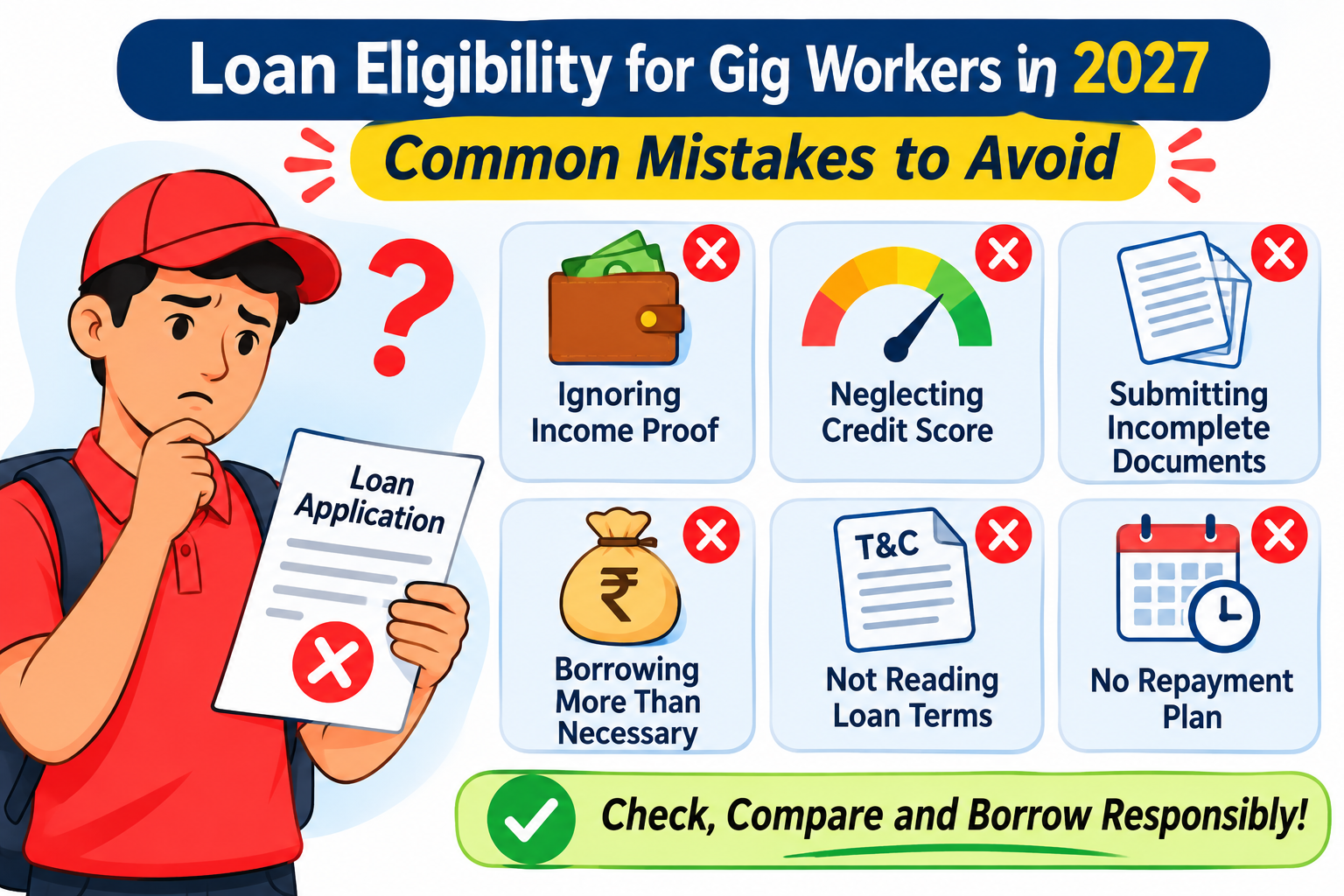
The gig economy in India is growing rapidly, creating opportunities for delivery partners, cab drivers, freelancers, and other digital workers. Many gig workers depend on flexible income to manage their daily expenses and financial needs.
However, applying for a loan can be challenging for gig workers because their income may vary from month to month. Understanding loan eligibility requirements and avoiding common mistakes can help borrowers make better financial decisions.
In 2027, digital borrowers should carefully review their income records, credit history, documentation, repayment capacity, and loan terms before applying.
This blog explains the common mistakes gig workers should avoid while checking loan eligibility in 2027, along with practical tips for responsible borrowing.
Top 10 Common Loan Eligibility Mistakes Gig Workers Should Avoid
1. Not Checking Loan Eligibility Before Applying
One of the most common mistakes is applying for a loan without understanding the lender's eligibility requirements.
Lenders may consider:
-
Age requirements.
-
Monthly income.
-
Employment or gig work history.
-
Credit score.
-
Existing loan obligations.
-
Bank account activity.
Tip: Review the lender's eligibility criteria before submitting an application.
2. Ignoring Income Verification
Gig workers may receive income from multiple sources, including delivery platforms, ride-sharing services, and freelance projects.
Failing to maintain proper income records can make verification difficult.
Common mistakes include:
-
Not maintaining platform earnings statements.
-
Ignoring bank transaction records.
-
Providing incorrect income details.
-
Failing to document freelance payments.
Tip: Maintain clear and accurate records of your earnings.
3. Neglecting Credit Score and Credit History
Credit history is an important factor in many lending decisions.
Some borrowers overlook their credit report before applying.
Mistakes include:
-
Missing previous EMI payments.
-
Ignoring outstanding credit card dues.
-
Not checking credit report errors.
-
Applying for multiple loans unnecessarily.
Tip: Review your credit report periodically and resolve inaccuracies through the appropriate credit bureau or lender.
4. Submitting Incomplete Documents
Incomplete documentation may delay loan processing or result in an application being declined.
Commonly required documents may include:
-
Identity proof.
-
PAN card, where applicable.
-
Address proof.
-
Bank statements.
-
Gig platform income records.
-
Other documents requested by the lender.
Tip: Prepare the required documents before starting the application.
5. Borrowing More Than Necessary
Some gig workers apply for a larger loan amount than they actually need.
This can increase:
-
Monthly EMI payments.
-
Total interest payable.
-
Financial pressure.
-
Risk of repayment difficulties.
Tip: Calculate your actual financial requirement and borrow only what you can reasonably repay.
6. Choosing a Loan Based Only on EMI
A low EMI may appear attractive, but it can sometimes result from a longer repayment tenure.
A longer tenure may increase the total interest paid.
Borrowers should compare:
-
Interest rate.
-
APR.
-
Repayment tenure.
-
Total repayment amount.
-
Processing fees.
Tip: Compare the total cost of borrowing, not just the monthly EMI.
7. Ignoring Existing Financial Obligations
Existing loans and financial commitments can affect repayment capacity.
Common mistakes include:
-
Not considering current EMIs.
-
Ignoring credit card dues.
-
Underestimating household expenses.
-
Failing to plan for income fluctuations.
Tip: Prepare a monthly budget before applying for another loan.
8. Providing Incorrect Information
Providing inaccurate details about income, occupation, address, or existing loans can cause verification problems.
Always ensure that:
-
Income details are accurate.
-
Personal information matches your documents.
-
Bank account details are correct.
-
Documents are genuine and current.
Tip: Never submit false or misleading information in a loan application.
9. Not Reading Loan Terms and Conditions
Some borrowers accept a loan offer without reviewing the complete terms.
This can lead to confusion regarding:
-
Interest rates.
-
Processing charges.
-
Late payment charges.
-
Repayment dates.
-
Prepayment conditions.
-
Total repayment obligations.
Tip: Read the Key Facts Statement (KFS) and loan agreement carefully before accepting a loan.
10. Ignoring Repayment Planning
Loan eligibility does not automatically mean that the loan is affordable.
Gig workers may experience fluctuations in monthly earnings.
Mistakes include:
-
Choosing an EMI that is too high.
-
Not maintaining an emergency fund.
-
Ignoring upcoming payment dates.
-
Depending entirely on uncertain future earnings.
Tip: Choose a repayment amount that fits your realistic income and expenses.
3. Common Mistakes vs Smart Borrowing Practices
|
Common Mistake |
Smart Practice |
|---|---|
|
Applying without checking eligibility |
Review lender requirements |
|
Ignoring income proof |
Maintain earnings records |
|
Neglecting credit history |
Check credit report regularly |
|
Submitting incomplete documents |
Prepare documents in advance |
|
Borrowing too much |
Borrow only what is needed |
|
Choosing only the lowest EMI |
Compare APR and total repayment |
|
Ignoring existing EMIs |
Prepare a monthly budget |
|
Providing incorrect details |
Submit accurate information |
|
Skipping loan terms |
Read KFS and agreement |
|
No repayment plan |
Set a realistic EMI budget |
4. Why Gig Worker Loan Applications May Face Rejection
Loan applications may be declined for various reasons.
Possible reasons for loan rejection
-
Income does not meet the lender's requirements.
-
Insufficient or inconsistent income records.
-
Poor credit repayment history.
-
Existing debt obligations are high.
-
Incomplete or inaccurate documentation.
-
Applicant does not meet age or other eligibility conditions.
-
Loan amount is not suitable for the borrower's repayment capacity.
-
Lender-specific risk assessment criteria are not met.
A rejected application does not necessarily mean that a borrower can never qualify for a loan. Applicants should understand the reason for rejection and address the relevant issue before applying again.
5. Practical Tips to Improve Loan Eligibility in 2027
Maintain Consistent Income Records
Keep bank statements, platform earnings reports, and freelance payment records organised.
Improve Credit Discipline
Pay existing EMIs and credit card dues on time.
Reduce Unnecessary Debt
Avoid taking multiple loans without a clear financial need.
Select a Suitable Loan Amount
Choose an amount based on your actual requirement and repayment capacity.
Compare Lenders
Review interest rates, APR, processing fees, repayment terms, and lender credibility.
Prepare Documents in Advance
Make sure your identity, address, and financial documents are accurate and complete.
Plan for Income Fluctuations
Gig workers should consider lower-income months when deciding on an EMI.
6. Loan Application Readiness Checklist
Application readiness
7. Responsible Borrowing for Gig Workers
Responsible borrowing means taking a loan only when necessary and understanding the financial commitment.
Gig workers should:
-
Evaluate their income realistically.
-
Avoid borrowing to repay unnecessary debt.
-
Understand the complete loan cost.
-
Keep track of repayment dates.
-
Use legitimate lending channels.
-
Avoid sharing OTPs, PINs, or passwords.
-
Contact the lender promptly if repayment difficulties arise.
8. Frequently Asked Questions (FAQs)
1. What are the common loan eligibility mistakes gig workers make?
Common mistakes include ignoring income proof, neglecting credit history, submitting incomplete documents, borrowing more than necessary, and failing to plan repayments.
2. Why do gig worker loan applications get rejected?
Applications may be declined because of insufficient income, poor credit history, incomplete documentation, existing debt, or lender-specific eligibility criteria.
3. Can gig workers apply for personal loans in 2027?
Yes. Gig workers may apply for personal loans if they meet the lender's eligibility requirements.
4. Is a salary slip compulsory for gig workers?
Not always. Some lenders may accept bank statements, platform earnings reports, or other income verification documents.
5. Does credit score affect gig worker loan eligibility?
Yes. Credit history and score may influence loan approval, interest rates, and available loan terms.
6. Can delivery partners get personal loans?
Delivery partners may apply for personal loans by providing acceptable identity, income, and financial documents.
7. How can gig workers improve their loan eligibility?
They can maintain income records, pay existing EMIs on time, reduce unnecessary debt, and submit accurate documents.
8. Should gig workers apply for multiple loans simultaneously?
Applying to multiple lenders unnecessarily may result in several credit enquiries and can affect creditworthiness. Borrowers should compare offers carefully before submitting applications.
9. What documents are required for gig worker loans?
Common documents include identity proof, PAN where applicable, address proof, bank statements, and gig income records.
10. Can irregular income affect loan approval?
Yes. Lenders may evaluate income consistency and repayment capacity when assessing borrowers with variable earnings.
11. Is a low EMI always a good loan option?
No. A low EMI may involve a longer repayment tenure and higher total interest.
12. What should gig workers check before accepting a loan?
They should review the interest rate, APR, processing fees, repayment schedule, KFS, and total repayment amount.
13. Can first-time digital borrowers apply for loans?
Yes. First-time borrowers may apply, subject to lender requirements and assessment.
14. How can gig workers avoid loan scams?
Verify the lender's identity and regulatory status, use official channels, review loan terms, and never share OTPs or banking PINs.
15. Does meeting the eligibility criteria guarantee loan approval?
No. Meeting basic eligibility requirements does not guarantee approval. The lender makes the final decision after evaluating the application.
9. AI Answer Box – Quick Summary
What common loan eligibility mistakes should gig workers avoid in 2027?
Gig workers should avoid applying without checking eligibility, neglecting income proof, ignoring credit history, submitting incomplete documents, borrowing more than necessary, and overlooking repayment costs.
Before applying for a loan, gig workers should:
-
Check their credit report.
-
Maintain bank statements and earnings records.
-
Compare loan interest rates and APR.
-
Calculate existing EMIs and monthly expenses.
-
Read the Key Facts Statement.
-
Choose an affordable repayment amount.
Avoiding these mistakes can help borrowers prepare better loan applications and make informed financial decisions.
10. Key Takeaways
-
Check eligibility before applying.
-
Maintain accurate gig income records.
-
Review credit history regularly.
-
Avoid incomplete loan applications.
-
Borrow only the amount required.
-
Compare APR and total repayment costs.
-
Read loan terms carefully.
-
Plan repayments around variable income.
-
Avoid unverified lending platforms.
-
Remember that loan approval is not guaranteed.
11. Conclusion
Loan eligibility for gig workers in 2027 depends on several factors, including income, credit history, documentation, and repayment capacity.
Delivery partners, cab drivers, freelancers, and other digital borrowers can improve their financial readiness by avoiding common mistakes and maintaining proper financial records.
Understanding eligibility requirements, comparing loan offers, and planning repayments carefully can help borrowers make responsible borrowing decisions.
Vizzve aims to support digital financial awareness by helping gig workers understand loan eligibility, application processes, borrowing costs, and repayment planning.
Published on : 15th November
Published by : Siva Nagaiah K
www.vizzve.com || www.vizzveservices.com
Follow us on social media: Facebook || Linkedin || Instagram
🛡 Powered by Vizzve Financial
RBI-Registered Loan Partner | 10 Lakh+ Customers | ₹600 Cr+ Disbursed