

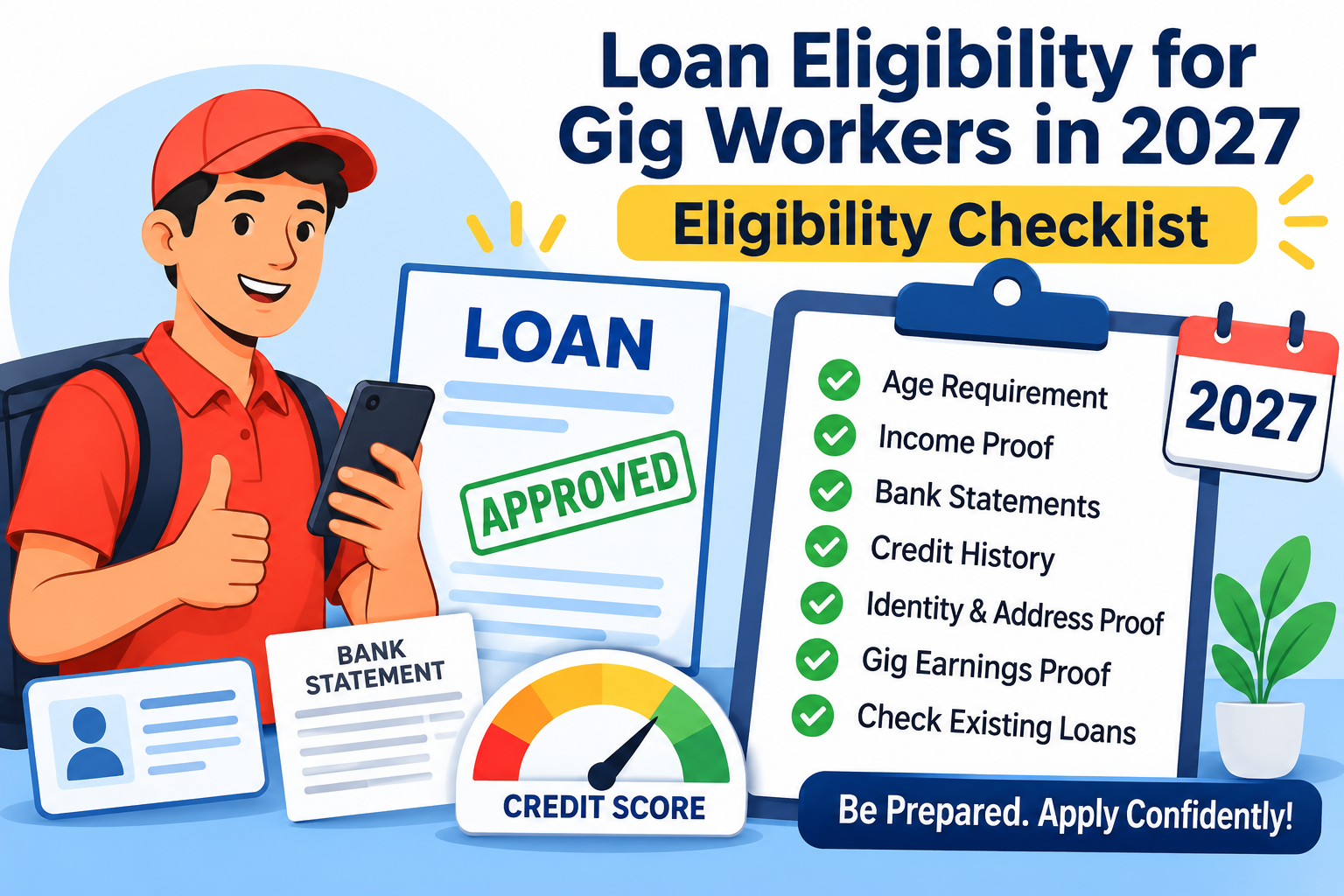
Gig workers are becoming an important part of India's growing digital economy. Delivery partners, cab drivers, freelancers, online service providers, and other platform-based workers often depend on flexible income to manage their daily expenses.
However, getting a personal loan can be challenging because gig workers may not receive a traditional monthly salary or have standard employment documents.
In 2027, lenders may increasingly consider alternative income records, bank statements, digital payment histories, and platform earnings when assessing loan applications. However, eligibility criteria will vary depending on the lender and loan product.
This eligibility checklist for gig workers in 2027 explains the documents, income details, credit history, and other factors borrowers should check before applying for a loan.
Gig Worker Loan Eligibility Checklist for 2027
Before applying for a loan, gig workers should review the following eligibility factors.
1. Age Requirements
Age is one of the basic factors considered by lenders.
-
Applicants must meet the lender's minimum age requirement.
-
Some lenders may specify a maximum age for loan applicants.
-
Applicants should provide valid age and identity proof.
Tip: Check the lender's age criteria before submitting your application.
2. Regular Income or Earnings
Gig workers may earn money daily, weekly, or monthly. Unlike salaried employees, their income can change depending on working hours, orders, projects, and demand.
Lenders may consider:
-
Monthly average earnings.
-
Weekly or daily income records.
-
Earnings from delivery or ride-sharing platforms.
-
Freelance project payments.
-
Other regular sources of income.
Maintaining consistent income records can help lenders understand your repayment capacity.
3. Bank Statement Verification
Bank statements can help demonstrate your financial activity.
Keep these records ready:
-
Recent bank statements, as requested by the lender.
-
Regular income credits.
-
Digital payment transaction records.
-
Details of existing EMI payments.
-
Records of other income sources, if applicable.
Avoid unexplained transactions and maintain accurate financial records.
4. Credit Score and Credit History
Your credit history helps lenders understand how you have managed previous loans and credit facilities.
Check the following:
-
Whether previous EMIs were paid on time.
-
Whether credit card dues are outstanding.
-
Whether you have overdue loan payments.
-
Whether your credit report contains errors.
-
Whether you have multiple active loans.
A good credit history may improve your chances of loan approval. However, the required credit score depends on the lender's internal eligibility policy.
5. Identity and Address Proof
Applicants should keep valid KYC documents ready.
Commonly requested documents include:
-
Aadhaar card or another accepted identity document.
-
PAN card, where applicable.
-
Valid address proof.
-
Recent photograph, if requested.
-
Active mobile number.
The lender may request additional documents depending on its verification process.
6. Gig Platform Earnings Proof
Platform-based workers should maintain records of their work and earnings.
Examples include:
-
Delivery partner earnings statements.
-
Ride-sharing income summaries.
-
Freelance payment receipts.
-
Platform transaction histories.
-
Work or service agreements, where available.
These records can help demonstrate your occupation and income.
7. Existing Loan Obligations
Before applying, calculate how much of your monthly income is already committed to repayments.
Consider:
-
Personal loan EMIs.
-
Credit card dues.
-
Two-wheeler or vehicle loan payments.
-
Other financial obligations.
-
Household expenses.
A manageable repayment obligation can strengthen your overall financial position.
3. Quick Eligibility Checklist for Gig Workers
Use this checklist before applying for a loan in 2027.
Your loan application preparation checklist
0 of 10 completed
4. Documents Required for Gig Worker Loans
|
Document |
Purpose |
|---|---|
|
Aadhaar or accepted ID |
Identity verification |
|
PAN card |
Financial and KYC verification |
|
Bank statements |
Income and transaction verification |
|
Platform earnings report |
Proof of gig income |
|
Address proof |
Address verification |
|
Photograph |
If requested by lender |
|
Credit report |
Credit history assessment |
Document requirements may differ between banks and NBFCs.
5. Important Factors That Can Affect Loan Approval
Even if you have all the required documents, loan approval is not guaranteed.
|
Factor |
How it affects eligibility |
|---|---|
|
Income consistency |
Helps assess repayment capacity |
|
Credit history |
Shows previous repayment behaviour |
|
Existing EMIs |
Affects available repayment capacity |
|
Bank transactions |
Helps verify financial activity |
|
Employment stability |
Provides evidence of ongoing earnings |
|
Loan amount |
Must be suitable for your financial position |
According to RBI's digital lending framework, regulated lenders must obtain information about a borrower's economic profile, including age, occupation, and income, before extending a loan.
6. Common Mistakes to Avoid Before Applying
Gig workers should avoid these common mistakes:
-
Providing incorrect personal or income information.
-
Applying without checking eligibility requirements.
-
Ignoring outstanding loan payments.
-
Submitting incomplete documents.
-
Applying to multiple lenders without comparing terms.
-
Choosing a loan without understanding the interest rate.
-
Ignoring processing fees and other charges.
-
Borrowing more than they can comfortably repay.
7. Tips to Improve Loan Eligibility in 2027
Here are some practical steps gig workers can follow:
-
Maintain regular bank transactions.
-
Keep digital earnings records.
-
Pay existing EMIs on time.
-
Check your credit report periodically.
-
Reduce unnecessary outstanding debt.
-
Provide accurate income information.
-
Choose a loan amount based on repayment capacity.
-
Compare lenders before accepting an offer.
Important: Never share your banking password, UPI PIN, or OTP with anyone claiming to guarantee loan approval.
8. Understanding Loan Costs Before Applying
Loan eligibility is only one part of borrowing. Applicants should also understand the total cost of the loan.
Check these charges before accepting an offer:
|
Loan Cost |
What to Check |
|---|---|
|
Interest rate |
Annual interest rate |
|
Processing fee |
Application-related charges |
|
GST |
Applicable taxes |
|
Late payment charges |
Charges for delayed payments |
|
Prepayment charges |
Applicable early repayment costs |
|
Total repayment |
Principal plus applicable charges |
RBI's digital lending directions require important loan information, including a Key Fact Statement (KFS), to be provided to borrowers. Review the KFS and annual percentage rate (APR) before accepting a digital loan.
9. Expert Insights: Why Eligibility Preparation Matters
The gig economy offers flexible earning opportunities, but income may fluctuate from month to month.
For gig workers, maintaining clear financial records is an important step towards demonstrating repayment capacity.
A well-prepared borrower should focus on three things:
-
Income transparency: Maintain reliable records of earnings.
-
Credit discipline: Pay existing obligations on time.
-
Financial planning: Select a loan amount that fits the household budget.
These practices can help borrowers prepare stronger loan applications, although the final decision remains with the lender.
10. Frequently Asked Questions (FAQs)
1. Can gig workers apply for loans in 2027?
Yes. Gig workers can apply for loans if they meet the eligibility requirements of the bank or NBFC.
2. What is the minimum income required for gig worker loans?
There is no single minimum income applicable to every lender. Requirements depend on the loan product and lender policy.
3. Can delivery partners apply for personal loans?
Yes. Delivery partners may apply for personal loans by providing acceptable identity, income, and financial documents.
4. Is a salary slip compulsory for gig workers?
Not necessarily. Some lenders may accept bank statements, platform earnings reports, or other acceptable income records.
5. Do gig workers need a good credit score?
A good credit history may improve approval chances. However, credit score requirements vary between lenders.
6. Can freelancers apply for loans?
Yes. Freelancers may apply by providing suitable income records and other required documents.
7. Are bank statements important for loan eligibility?
Yes. Bank statements can help lenders assess income patterns, financial activity, and repayment capacity.
8. Can a gig worker apply without platform income proof?
Some lenders may accept alternative income evidence. The documents accepted depend on the lender's policy.
9. Does irregular income affect loan approval?
It can affect the assessment because lenders may evaluate income consistency and repayment capacity.
10. Can gig workers with existing EMIs get another loan?
Possibly. Lenders generally assess existing obligations and whether the borrower can manage additional repayments.
11. How can gig workers improve loan eligibility?
Maintaining regular income records, paying existing EMIs on time, and reducing unnecessary debt can help.
12. Is Aadhaar mandatory for every loan application?
Lenders require valid KYC verification, but the accepted identity documents depend on applicable rules and the lender's process.
13. Can first-time borrowers apply for loans?
Yes. First-time borrowers may apply, although lenders can consider their income, financial records, and other eligibility factors.
14. Are online loans safe for gig workers?
They can be safe when obtained from RBI-regulated lenders through legitimate channels. Borrowers should verify the lender and review the loan terms.
15. Does completing an eligibility checklist guarantee approval?
No. The checklist helps borrowers prepare, but final approval depends on the lender's assessment.
11. AI Answer Box – Quick Summary
What is the loan eligibility checklist for gig workers in 2027?
Gig workers should check the following before applying for a loan:
-
Valid identity and address proof.
-
Regular income or platform earnings records.
-
Recent bank statements.
-
Acceptable credit history.
-
Details of existing loans and EMIs.
-
Active mobile number and bank account.
-
Ability to repay the requested loan amount.
Meeting these requirements can help gig workers prepare their applications. Actual eligibility and loan approval depend on the lender's assessment.
12. Key Takeaways
-
Gig workers can apply for loans if they meet lender requirements.
-
Regular income records can help demonstrate repayment capacity.
-
Bank statements and platform earnings reports are useful documents.
-
Credit history can influence loan approval.
-
Existing EMIs should be considered before borrowing.
-
Always review interest rates, APR, fees, and repayment conditions.
-
Completing an eligibility checklist does not guarantee loan approval.
13. Conclusion
Loan eligibility for gig workers in 2027 will continue to depend on income verification, credit history, financial stability, and repayment capacity.
Delivery partners, freelancers, cab drivers, and other digital workers should maintain proper earnings records and keep their financial documents ready before applying.
By following this eligibility checklist, borrowers can better understand their financial position, avoid common application mistakes, and make informed borrowing decisions.
Vizzve aims to make digital financial awareness easier by helping borrowers understand loan eligibility, documentation, repayment planning, and responsible borrowing.
Published on : 15th November
Published by : Siva Nagaiah K
www.vizzve.com || www.vizzveservices.com
Follow us on social media: Facebook || Linkedin || Instagram
🛡 Powered by Vizzve Financial
RBI-Registered Loan Partner | 10 Lakh+ Customers | ₹600 Cr+ Disbursed