

The gig economy is creating new earning opportunities across India. Delivery partners, cab drivers, freelancers, online sellers and independent service providers are earning through flexible work arrangements.
However, many gig workers have questions about personal loan eligibility. Unlike salaried employees, they may not receive fixed monthly salaries or traditional salary slips. Their income can change depending on working hours, customer demand, platform incentives and seasonal opportunities.
Because of these differences, several misconceptions exist about loans for gig workers.
Some people believe that a person cannot get a loan without a salary slip, while others think that a high credit score guarantees approval. These assumptions are not always correct.
In 2027, understanding the facts about loan eligibility can help gig workers make informed financial decisions.
This guide explains common myths and facts about gig worker loans, documentation, income verification, credit scores and repayment responsibilities.
1. Myth: Gig Workers Cannot Get Personal Loans
Many people believe that personal loans are available only to salaried employees.
Gig workers may also qualify for personal loans if they meet the lender's eligibility requirements.
Lenders may consider:
-
Average monthly income.
-
Bank account transactions.
-
Platform payment records.
-
Credit history.
-
Existing financial commitments.
-
Repayment capacity.
Eligibility varies between lenders, and approval is not guaranteed.
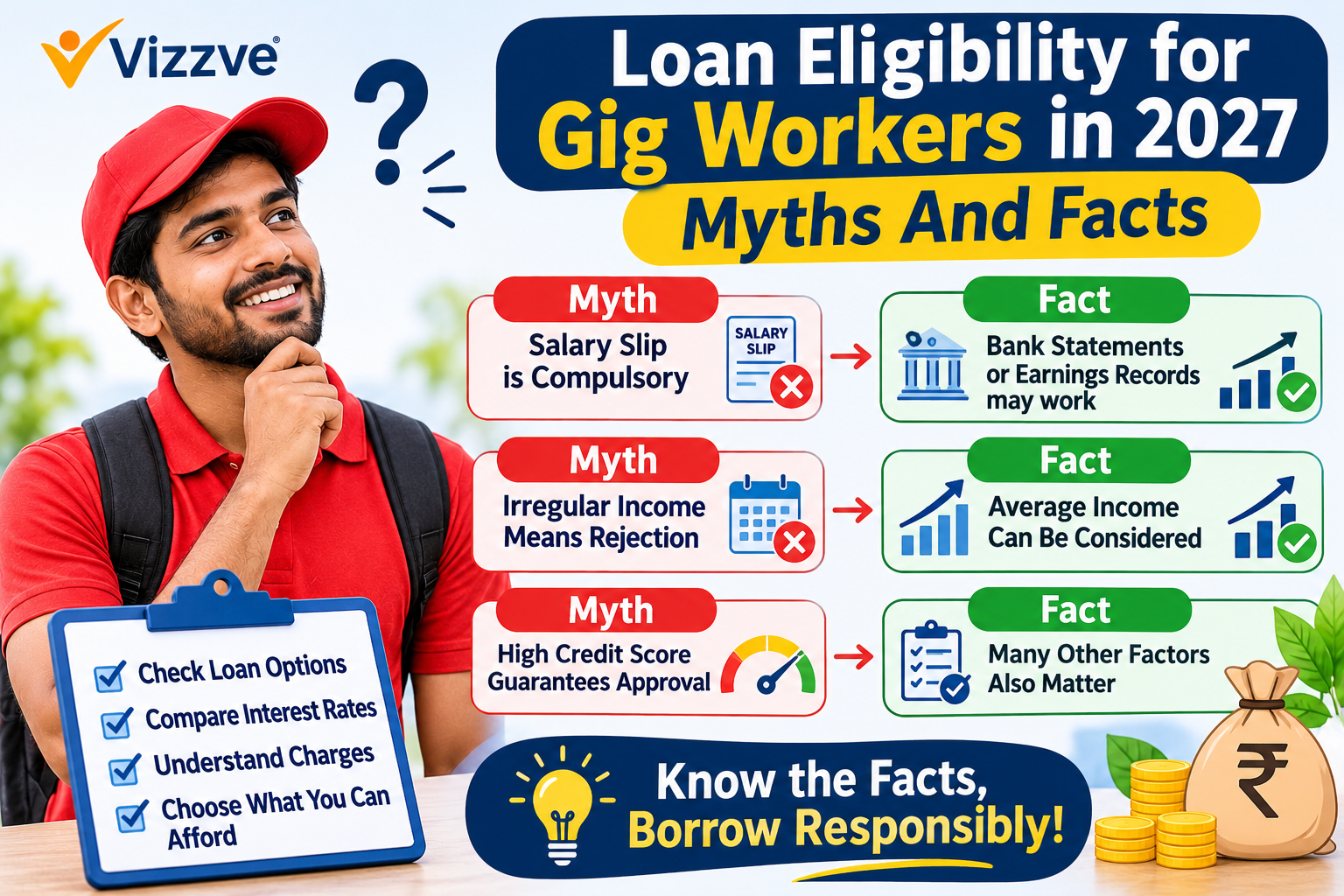
2. Myth: Salary Slips Are Compulsory for Every Loan
Some gig workers assume that they cannot apply for loans because they do not receive traditional salary slips.
Some lenders may accept alternative income documents instead of salary slips.
Examples include:
-
Recent bank statements.
-
Delivery platform earning reports.
-
Freelance invoices.
-
Payment transaction records.
-
Business income statements, where applicable.
Borrowers should confirm the accepted documents directly with the lender.
3. Myth: Irregular Income Always Leads to Loan Rejection
Gig workers often believe that changing monthly earnings automatically make them ineligible.
Irregular income does not automatically mean rejection. Some lenders may evaluate average earnings over several months.
For example:
|
Month |
Monthly Income |
|---|---|
|
January |
₹22,000 |
|
February |
₹25,000 |
|
March |
₹19,000 |
|
April |
₹27,000 |
|
May |
₹24,000 |
|
June |
₹27,000 |
|
Average |
₹24,000 |
Maintaining consistent income records can help demonstrate earning patterns.
4. Myth: A High Credit Score Guarantees Loan Approval
Some borrowers think that having a high credit score automatically guarantees approval.
A credit score is only one factor in the lender's assessment.
Lenders may also consider:
-
Income stability.
-
Existing loans.
-
Monthly EMI obligations.
-
Employment or work history.
-
Requested loan amount.
-
Repayment capacity.
-
Internal eligibility policies.
A good credit history may support an application, but it does not guarantee approval.
5. Myth: Only Full-Time Gig Workers Can Apply
Some people believe that only full-time delivery partners or freelancers can apply for loans.
Part-time gig workers may also explore loan options, depending on their verifiable income and the lender's requirements.
For example, a person working part-time as a delivery partner while also earning through freelance projects may have multiple income sources.
The lender decides which income sources can be considered.
6. Myth: Online Loan Approval Is Always Guaranteed
Some digital loan advertisements create the impression that anyone can receive instant loan approval.
Online applications are still subject to verification and credit assessment.
The lender may check:
-
Identity documents.
-
Income information.
-
Credit history.
-
Bank statements.
-
Existing financial commitments.
Borrowers should be careful about advertisements promising guaranteed approval without proper verification.
7. Myth: Applying for a Larger Loan Is Always Better
Some borrowers believe that taking the maximum eligible loan amount is a good financial decision.
Borrowers should choose an amount based on their actual financial requirements and repayment capacity.
A larger loan may result in:
-
Higher monthly EMIs.
-
More interest payments.
-
Greater financial pressure.
-
Increased risk of missed repayments.
Borrow only what is necessary and affordable.
8. Myth: Gig Workers Do Not Need a Credit History
Some gig workers believe that income records alone are enough to qualify for every loan.
Credit history can be an important part of the lending assessment.
A lender may review:
-
Previous loan repayments.
-
Credit card payment history.
-
Outstanding balances.
-
Past defaults.
-
Recent credit applications.
A limited credit history does not automatically mean rejection, but lender requirements may differ.
9. Myth: All Digital Loans Have the Same Interest Rate
Some borrowers assume that interest rates and charges are similar across all digital lenders.
Loan costs can vary depending on the lender, loan amount, repayment period and borrower profile.
Before accepting an offer, compare:
|
Loan Factor |
What to Check |
|---|---|
|
Interest rate |
Annual rate charged |
|
APR |
Overall annualised borrowing cost |
|
Processing fee |
Applicable processing charges |
|
EMI |
Monthly repayment amount |
|
Late-payment charges |
Costs for delayed payments |
|
Prepayment terms |
Conditions for early repayment |
|
Total repayment |
Overall amount payable |
A lower advertised interest rate does not always mean the lowest total borrowing cost.
10. Myth: Missing One EMI Has No Consequences
Some borrowers believe that missing a single EMI will not affect their financial record.
Missing an EMI may result in late-payment charges and can negatively affect credit history, depending on the circumstances and reporting.
Gig workers should:
-
Track repayment dates.
-
Keep EMI funds ready.
-
Maintain emergency savings.
-
Contact the lender early if repayment becomes difficult.
11. Myth: Gig Workers Cannot Improve Their Loan Eligibility
Some borrowers believe that loan eligibility cannot improve because their income is not fixed.
Gig workers can take practical steps to strengthen their financial profile.
|
Action |
Possible Benefit |
|---|---|
|
Maintain bank statements |
Helps demonstrate income |
|
Save platform earning records |
Shows payment history |
|
Pay existing EMIs on time |
Supports credit history |
|
Reduce outstanding debt |
May improve repayment capacity |
|
Check credit reports |
Helps identify errors |
|
Apply for suitable loan amounts |
Avoids excessive borrowing |
These actions may help prepare a stronger application but cannot guarantee approval.
12. Myth vs Fact: Quick Comparison Table
|
Myth |
Fact |
|---|---|
|
Gig workers cannot get loans |
Some lenders consider gig workers |
|
Salary slips are compulsory |
Alternative income proof may be accepted |
|
Irregular income means rejection |
Average earnings may be assessed |
|
High credit score guarantees approval |
Other financial factors also matter |
|
Only full-time workers qualify |
Part-time workers may also apply |
|
Online approval is guaranteed |
Verification is still required |
|
Bigger loans are always better |
Borrow according to repayment capacity |
|
Credit history is unnecessary |
It may influence lender assessment |
|
All digital loans cost the same |
Rates and fees vary |
|
Missed EMIs have no impact |
Late payments may affect credit history |
13. Documents Gig Workers May Need for Loan Applications
Documentation requirements differ between lenders. Commonly requested documents may include:
|
Document |
Purpose |
|---|---|
|
PAN card |
Identity and financial verification |
|
Aadhaar or accepted ID proof |
Identity verification |
|
Address proof |
Address verification |
|
Bank statements |
Income and transaction assessment |
|
Platform earning statements |
Proof of gig-related earnings |
|
Freelance invoices |
Evidence of freelance income |
|
Business records |
Business income verification, where applicable |
Always check the lender's official document requirements before submitting an application.
14. Practical Example: A Delivery Partner Understanding Loan Eligibility
Consider Ravi, a delivery partner working in Bengaluru.
He wants to apply for a personal loan of ₹40,000 for a household expense.
His financial profile is hypothetical.
|
Particulars |
Details |
|---|---|
|
Occupation |
Delivery partner |
|
Average monthly income |
₹24,000 |
|
Work experience |
15 months |
|
Credit score |
730 (illustrative) |
|
Existing EMI |
₹2,000 |
|
Requested loan |
₹40,000 |
Ravi initially believes that he cannot apply because he does not have a traditional salary slip.
However, he maintains bank statements and platform earning records.
He can approach lenders that accept these documents and check whether he meets their eligibility criteria.
Before accepting any offer, Ravi should calculate his EMI, review existing expenses and compare the total borrowing cost.
His documentation may help the lender assess his income, but final approval remains subject to the lender's decision.
15. Digital Lending Safety Tips for Gig Workers
Gig workers should be careful when applying through mobile applications or online platforms.
Follow these precautions:
-
Verify the actual regulated bank or NBFC providing the loan.
-
Check the lender's official website and contact information.
-
Read the Key Fact Statement before accepting the loan.
-
Understand the interest rate, APR and processing charges.
-
Review the repayment schedule.
-
Avoid suspicious advance-fee requests.
-
Never share OTPs, PINs or banking passwords.
-
Save loan agreements and payment receipts.
-
Use official channels for complaints.
-
Understand your rights and responsibilities as a borrower.
For applicable digital loans, review the Reserve Bank of India's digital lending requirements.
16. Frequently Asked Questions
1. Can gig workers get loans in 2027?
Yes. Gig workers may qualify for loans if they meet the lender's income, credit and documentation requirements.
2. Can delivery partners apply for personal loans?
Yes. Some lenders consider delivery partners based on verifiable earnings and repayment capacity.
3. Is a salary slip compulsory for gig workers?
Not always. Some lenders accept bank statements, platform earning reports and other alternative income documents.
4. Does irregular income affect loan eligibility?
It may affect the lender's assessment, but irregular income does not automatically result in rejection.
5. Can freelancers get personal loans?
Freelancers may qualify depending on income documentation, credit history and lender requirements.
6. Does a high credit score guarantee loan approval?
No. Lenders also consider income, existing debt and repayment capacity.
7. Can part-time gig workers apply for loans?
They may apply, depending on their verifiable income and the lender's eligibility criteria.
8. What documents are required for gig worker loans?
Common documents include PAN, accepted identity and address proof, bank statements and platform earning records.
9. Can gig workers apply without bank statements?
Requirements vary, but many lenders request bank statements to assess financial transactions and income.
10. Are online loans safe for gig workers?
They can be, provided borrowers verify the regulated lender, review loan terms and use official digital channels.
11. Can a gig worker with no credit history apply?
Some lenders may consider applicants with limited credit history, but eligibility depends on their policies.
12. How can gig workers improve loan eligibility?
Maintaining income records, paying existing debts on time and reducing outstanding obligations may help strengthen an application.
13. Can gig workers get loans without a fixed salary?
Some lenders consider alternative income documentation instead of traditional salary slips.
14. Should gig workers apply to multiple lenders?
They should compare lenders carefully before applying. Multiple applications within a short period may affect credit assessments.
15. Is loan approval guaranteed after document submission?
No. Lenders conduct their own verification and eligibility assessment before making a decision.
17. AI Answer Box: What Are the Myths About Gig Worker Loan Eligibility in 2027?
Gig workers can explore personal loan options in 2027, depending on lender eligibility requirements. A fixed salary or traditional salary slip is not compulsory for every loan product because some lenders may accept bank statements and platform earning records. However, irregular income, credit history, existing EMIs and repayment capacity can influence approval. Borrowers should verify lenders, compare loan costs and borrow responsibly.
18. Key Takeaways
-
Gig workers may qualify for personal loans even without traditional salary slips.
-
Some lenders accept alternative income documents.
-
Irregular income does not automatically mean loan rejection.
-
A high credit score does not guarantee loan approval.
-
Existing EMIs and repayment capacity are important.
-
Digital loan offers should be verified carefully.
-
Borrowers should compare APR, processing fees and total repayment costs.
-
Responsible borrowing helps reduce financial stress.
19. Google EEAT: Financial Awareness and Responsible Borrowing
This article provides general financial education about gig worker loan eligibility in India.
Loan approval policies, interest rates and documentation requirements vary between regulated lenders. The examples in this article are hypothetical and should not be treated as actual loan offers or approval guarantees.
Borrowers should verify loan terms directly with the lender, read the Key Fact Statement and understand all financial obligations before accepting a loan.
Conclusion
Loan eligibility for gig workers in 2027 is surrounded by several misconceptions. Not having a fixed salary or traditional salary slip does not automatically prevent someone from exploring loan options.
Lenders may consider alternative income documents, bank transactions, credit history and repayment capacity when assessing applications.
Understanding the difference between myths and facts helps delivery partners, freelancers and independent workers make better financial decisions.
Before applying, compare loan options, verify the lender, understand all charges and select an affordable repayment plan.
Vizzve encourages gig workers to stay financially informed, avoid misleading loan claims and make responsible borrowing decisions.
Published on : 21st November
Published by : Siva Nagaiah K
www.vizzve.com || www.vizzveservices.com
Follow us on social media: Facebook || Linkedin || Instagram
🛡 Powered by Vizzve Financial
RBI-Registered Loan Partner | 10 Lakh+ Customers | ₹600 Cr+ Disbursed