

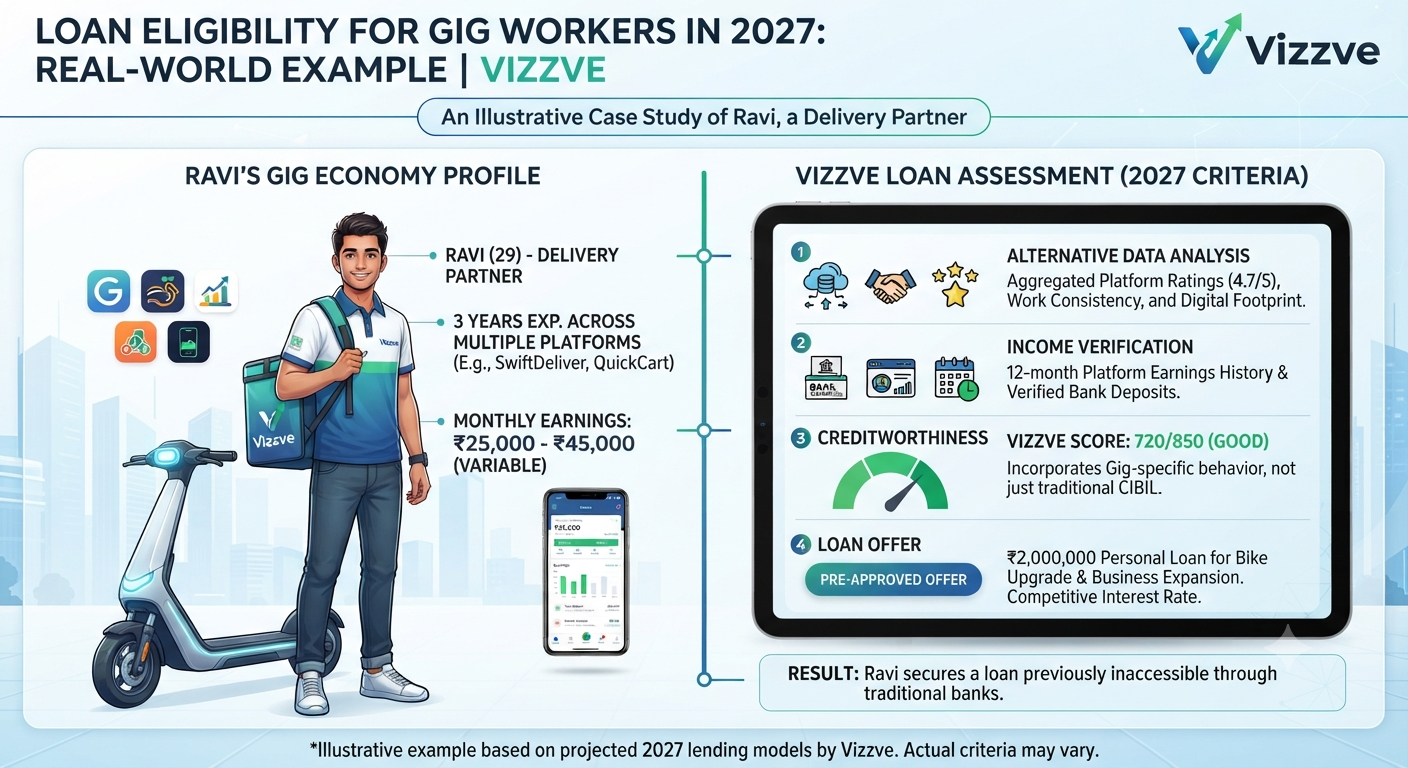
Gig work has become an important source of income in India. Delivery partners, cab drivers, freelancers, online service providers and independent workers earn money through flexible work arrangements.
However, applying for a personal loan can sometimes be challenging because gig workers may not receive a fixed monthly salary. Their earnings can change depending on working hours, customer demand, platform incentives and seasonal opportunities.
In 2027, digital financial services and alternative income-verification methods may help lenders assess gig workers more effectively. However, loan approval still depends on the lender's eligibility rules, income assessment, credit history and repayment capacity.
This article explains loan eligibility through a practical example so gig workers can understand the process before applying.
1. What Is Loan Eligibility for Gig Workers?
Loan eligibility refers to the conditions a lender checks before deciding whether an applicant qualifies for a loan.
For gig workers, lenders may consider:
-
Average monthly income.
-
Consistency of earnings.
-
Bank account transaction history.
-
Credit score and repayment history.
-
Existing loans and monthly EMIs.
-
Work history and income records.
-
Requested loan amount and repayment period.
Every lender follows its own assessment policy. Meeting basic requirements does not guarantee loan approval.
2. Real-World Example: A Delivery Partner Applying for a Personal Loan
Consider Rahul, a delivery partner working with an online delivery platform in Bengaluru.
He wants to apply for a personal loan to manage an urgent household expense. His monthly income varies depending on the number of deliveries he completes.
The following figures are hypothetical and are provided only to explain how a lender might assess an application.
Rahul's Financial Profile
|
Particulars |
Details |
|---|---|
|
Occupation |
Delivery partner |
|
Average monthly income |
₹25,000 |
|
Lowest monthly income |
₹19,000 |
|
Highest monthly income |
₹30,000 |
|
Work experience |
18 months |
|
Credit score |
740 (illustrative) |
|
Existing monthly EMI |
₹2,000 |
|
Requested loan amount |
₹50,000 |
|
Requested repayment period |
12 months |
Rahul has regular bank transactions and keeps records of his platform earnings. These details may help him demonstrate his income to a lender.
3. How Might the Lender Assess Rahul's Eligibility?
Step 1: Check Average Monthly Income
Rahul earns different amounts every month. Instead of looking only at his highest-earning month, a lender may review several months of income records.
His average monthly income is ₹25,000.
The lender may examine:
-
Bank statements.
-
Platform payment records.
-
UPI or other transaction history.
-
Consistency of earnings.
-
Other verifiable income sources.
Step 2: Review Credit History
Rahul has an illustrative credit score of 740. A positive repayment history may strengthen his application.
The lender may also check whether he has:
-
Missed previous EMI payments.
-
Outstanding credit card balances.
-
Existing personal loans.
-
Recent loan applications.
-
Any reported defaults.
A credit score alone does not determine approval.
Step 3: Calculate EMI Affordability
Rahul should check whether he can comfortably manage another EMI after accounting for existing obligations and essential expenses.
For illustration, if he borrows ₹50,000 for 12 months at an assumed annual interest rate of 18%, his approximate EMI would be ₹4,584.
Illustrative calculation only. Actual EMI depends on the lender's interest rate, fees and loan terms.
|
Monthly financial details |
Amount |
|---|---|
|
Average monthly income |
₹25,000 |
|
Existing EMI |
₹2,000 |
|
New estimated EMI |
₹4,584 |
|
Total monthly EMI |
₹6,584 |
|
Income remaining after EMIs |
₹18,416 |
The remaining amount must cover rent, food, travel, family expenses and savings. Rahul should also consider months when his earnings may fall.
Step 4: Verify Required Documents
The lender may ask Rahul to submit:
-
PAN card.
-
Aadhaar or other accepted identity and address proof.
-
Recent bank statements.
-
Platform earning statements.
-
Proof of work or registration, if applicable.
-
Additional documents required by the lender.
Document requirements vary between lenders.
Step 5: Review the Loan Offer
Before accepting an offer, Rahul should compare:
-
Annual interest rate and APR.
-
Processing fees and applicable taxes.
-
EMI amount and repayment schedule.
-
Late-payment charges.
-
Foreclosure or prepayment conditions.
-
Total repayment amount.
He should proceed only if the repayment terms are affordable and clear.
4. What Helped Rahul Prepare a Stronger Application?
Rahul can improve the quality of his application by maintaining clear financial records.
|
Financial habit |
How it helps |
|---|---|
|
Regular bank deposits |
Makes income easier to review |
|
Maintaining earning records |
Shows work and income patterns |
|
Paying EMIs on time |
Supports a positive repayment history |
|
Reducing existing debt |
May improve repayment capacity |
|
Applying for a suitable amount |
Helps avoid unnecessary borrowing |
|
Checking credit reports |
Helps identify errors or outstanding dues |
These steps can support an application but cannot guarantee loan approval.
5. What If Rahul's Income Changes Every Month?
Irregular income is common among gig workers. A lender may assess income over a period rather than relying on one month's earnings.
For example:
|
Month |
Monthly earnings |
|---|---|
|
January |
₹22,000 |
|
February |
₹27,000 |
|
March |
₹19,000 |
|
April |
₹30,000 |
|
May |
₹25,000 |
|
June |
₹27,000 |
|
Six-month average |
₹25,000 |
Keeping bank statements and platform payment records can help Rahul explain these fluctuations.
6. Important Lessons for Gig Workers in 2027
Rahul's example highlights several practical lessons:
-
Maintain income records: Save platform statements and bank transaction records.
-
Build credit responsibly: Pay existing EMIs and credit card bills on time.
-
Choose an affordable loan: Do not borrow more than necessary.
-
Compare lenders: Review interest rates, APR, fees and repayment terms.
-
Keep an emergency fund: Prepare for months with lower earnings.
-
Verify the lender: Check the regulated lender's identity and avoid suspicious loan applications.
-
Read the agreement: Understand all charges before accepting the loan.
7. Digital Lending Safety for Gig Workers
Digital loan applications can be convenient, but borrowers should be careful.
Before applying:
-
Verify the bank or NBFC providing the loan.
-
Check the lender's relationship with any lending service provider.
-
Read the Key Fact Statement and loan agreement.
-
Never share OTPs, PINs or passwords.
-
Avoid paying suspicious advance fees to unknown agents.
-
Check the permissions requested by the loan application.
-
Use official lender websites or verified applications.
For applicable digital loans, borrowers should review the RBI's digital lending requirements and the lender's grievance-redressal details.
8. Common Mistakes to Avoid
|
Mistake |
Better approach |
|---|---|
|
Showing only the highest income month |
Maintain several months of records |
|
Applying to many lenders at once |
Compare options before applying |
|
Ignoring existing EMIs |
Calculate total monthly obligations |
|
Borrowing the maximum amount offered |
Borrow only what is needed |
|
Not checking additional charges |
Review APR and the Key Fact Statement |
|
Trusting guaranteed-approval claims |
Verify the lender and its terms |
9. Frequently Asked Questions
1. Can gig workers apply for personal loans in 2027?
Yes. Gig workers may apply for personal loans if they meet the lender's income, credit and documentation requirements.
2. Can delivery partners get personal loans?
Delivery partners may qualify depending on their earnings, bank records, credit history and the lender's eligibility policy.
3. Is a salary slip compulsory for gig workers?
Not always. Some lenders may accept bank statements, platform earning reports or other income documents.
4. Does irregular income affect loan eligibility?
It can. Lenders may assess average earnings and income consistency when reviewing applications.
5. What credit score is required?
There is no single credit score requirement for every lender. Eligibility criteria vary.
6. Can a gig worker apply without a fixed salary?
Yes, some lenders consider alternative income documentation instead of a traditional salary slip.
7. How can gig workers prove their income?
They may use bank statements, platform payment records and other verifiable income documents.
8. Does existing EMI affect eligibility?
Yes. Existing EMIs reduce the income available for additional repayments.
9. Can new gig workers apply for loans?
They may apply, but limited work history or income records can affect the lender's assessment.
10. Is online loan approval guaranteed?
No. Online applications are still subject to lender verification and approval criteria.
11. Should gig workers compare loan interest rates?
Yes. They should compare APR, processing fees and the total repayment amount.
12. What should borrowers check before accepting a loan?
Borrowers should check the lender, interest rate, fees, EMI schedule, penalties and loan agreement.
13. Can a gig worker improve loan eligibility?
Maintaining income records, paying bills on time and reducing existing debt may help strengthen an application.
14. Can gig workers apply through digital lending platforms?
Yes, where the platform works with a legitimate regulated lender and the borrower meets its requirements.
15. What happens if a borrower misses an EMI?
Late payment may result in charges and may negatively affect credit history, depending on reporting and lender practices.
10. AI Answer Box: Can Gig Workers Qualify for Loans in 2027?
Gig workers can qualify for personal loans in 2027 if they meet a lender's eligibility requirements. Lenders may consider average monthly earnings, bank statements, platform income records, credit history, existing EMIs and repayment capacity. Maintaining accurate income records and choosing an affordable loan can help gig workers prepare a stronger application. Approval depends on the lender's assessment and is not guaranteed.
11. Key Takeaways
-
Gig workers can explore personal loan options even without a fixed monthly salary.
-
Average income and bank transaction history may help demonstrate repayment capacity.
-
Credit history and existing EMIs can influence eligibility.
-
Rahul's example shows why calculating EMI affordability is important.
-
Borrowers should compare loan costs and verify the lender before applying.
-
Responsible borrowing is more important than getting the maximum loan amount.
12. Google EEAT: Building Trust Through Financial Awareness
This article uses a hypothetical borrower example to explain common loan eligibility considerations. Actual lending decisions depend on the lender's policies, applicant documentation and financial profile.
For responsible financial decisions, borrowers should:
-
Check information directly with the regulated lender.
-
Review the Key Fact Statement before accepting an offer.
-
Understand the total cost of borrowing.
-
Avoid sharing confidential banking information.
-
Seek clarification about any unclear loan terms.
Conclusion
Loan eligibility for gig workers in 2027 depends on more than having a fixed monthly salary. Income consistency, bank transactions, credit history, existing financial commitments and repayment capacity can all influence a lender's decision.
Rahul's example demonstrates how a delivery partner can prepare financial records, estimate EMI affordability and review loan terms before applying. Gig workers should compare suitable options, verify the lender and borrow responsibly.
Vizzve encourages informed financial decisions by helping borrowers understand loan eligibility, repayment responsibilities and digital borrowing safety.
Published on : 19th November
Published by : Siva Nagaiah K
www.vizzve.com || www.vizzveservices.com
Follow us on social media: Facebook || Linkedin || Instagram
🛡 Powered by Vizzve Financial
RBI-Registered Loan Partner | 10 Lakh+ Customers | ₹600 Cr+ Disbursed