

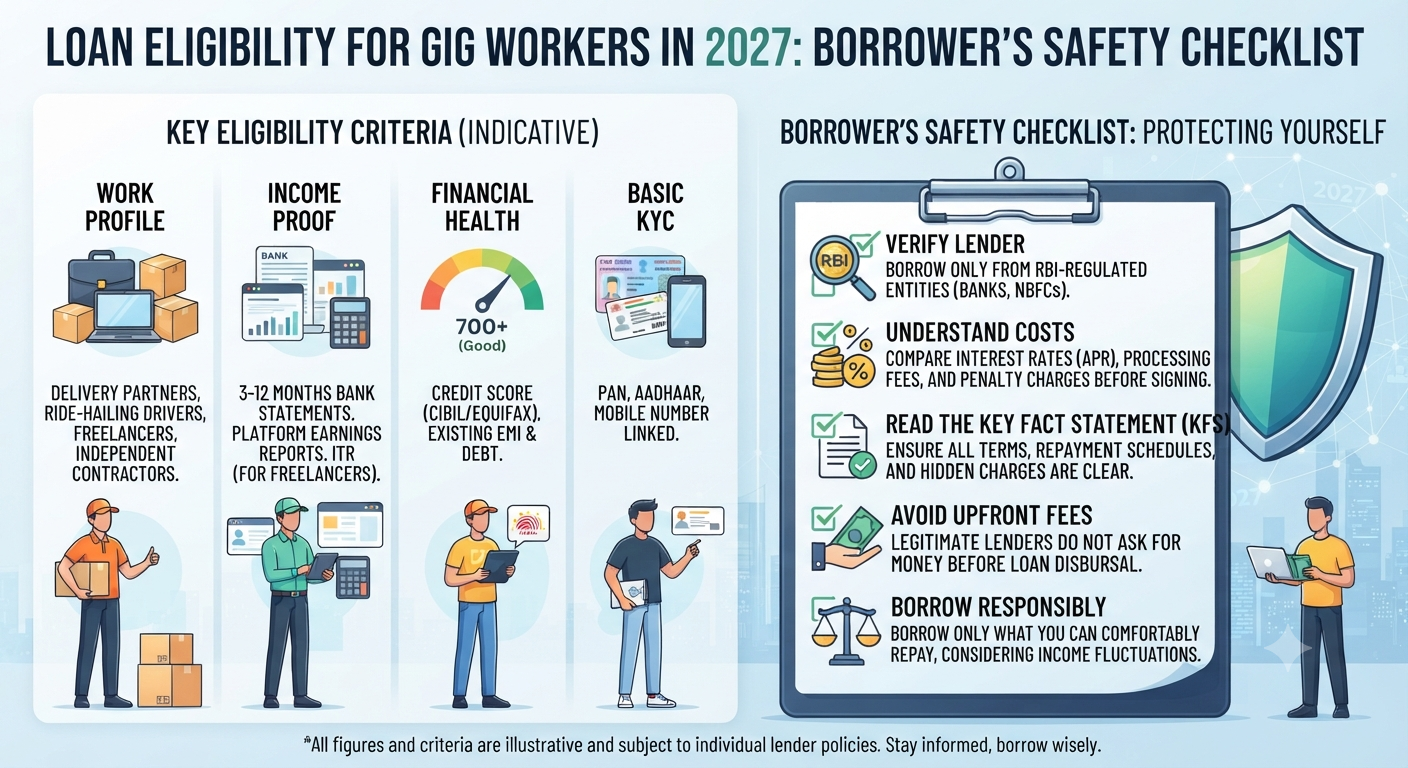
The gig economy is creating earning opportunities for delivery partners, cab drivers, freelancers and independent service providers. Many gig workers depend on daily or weekly earnings to manage their household expenses and financial responsibilities.
However, getting a loan can sometimes be challenging because gig workers may not receive a fixed monthly salary or traditional salary slips.
In 2027, understanding loan eligibility and following proper safety precautions will be important before applying for personal loans or digital credit products.
A safe loan application process helps borrowers avoid fraudulent loan apps, hidden charges, unnecessary debt and misuse of personal information.
In this Vizzve guide, we provide a practical safety checklist covering lender verification, eligibility requirements, documents, loan costs, repayment planning and digital lending precautions.
1. Check Your Loan Eligibility Before Applying
Before submitting a loan application, understand whether your financial profile meets the lender's requirements.
Check the following factors:
-
Age eligibility.
-
Average monthly income.
-
Employment or gig work details.
-
Bank account transaction history.
-
Existing loan repayments.
-
Credit history and credit score, if available.
-
Monthly repayment capacity.
Important: Different lenders have different eligibility policies. Meeting basic requirements does not guarantee loan approval.
2. Verify the Lender Before Applying
One of the most important steps is checking whether the loan is offered by a legitimate financial institution.
Before applying:
-
Verify the bank or NBFC providing the loan.
-
Check the lender's official website.
-
Confirm the digital lending app's relationship with the regulated lender.
-
Read the lender's terms and conditions.
-
Check customer support and grievance redressal details.
-
Avoid unknown individuals promising guaranteed loan approval.
You can visit the Reserve Bank of India official website to learn about regulated financial institutions and digital lending requirements.
3. Safety Checklist Before Sharing Documents
Gig workers may need to submit personal and financial documents during loan applications.
|
Document |
Safety precaution |
|---|---|
|
Aadhaar |
Use an accepted and secure KYC method |
|
PAN card |
Submit only through verified channels |
|
Bank statements |
Check the recipient before uploading |
|
Income records |
Share genuine earnings information |
|
Address proof |
Ensure details are accurate |
|
Photograph |
Upload only when officially required |
|
Platform earnings |
Use authentic payment statements |
Never share your banking password, ATM PIN, UPI PIN or OTP with anyone claiming to process your loan.
4. Check the Interest Rate, EMI and Hidden Charges
Before accepting a loan, understand the complete repayment amount.
Check these details:
-
Annual interest rate.
-
Annual Percentage Rate (APR).
-
Processing fees.
-
Loan tenure.
-
Monthly EMI.
-
Late payment charges.
-
Foreclosure or prepayment conditions.
-
Total repayment amount.
|
Loan detail |
What to verify |
|---|---|
|
Interest rate |
Is it fixed or variable? |
|
Processing fee |
How much will be deducted? |
|
EMI |
Can you afford it during low-income months? |
|
Tenure |
Is the repayment period suitable? |
|
Late fee |
What happens if payment is delayed? |
|
APR |
What is the overall annual borrowing cost? |
Safety tip: Never accept a loan based only on a low advertised EMI. Compare the total amount payable.
5. Read the Loan Agreement Carefully
A loan agreement explains your responsibilities and the lender's conditions.
Before accepting, verify:
-
Approved loan amount.
-
Actual amount credited to your account.
-
Interest rate and APR.
-
Repayment schedule.
-
Processing and other charges.
-
Late payment penalties.
-
Prepayment conditions.
-
Customer support details.
-
Loan cancellation and cooling-off conditions, where applicable.
Never accept a loan agreement without understanding its terms.
6. Protect Your Personal and Financial Information
Digital loan applications may request access to certain information for verification.
Follow these precautions:
-
Do not share OTPs with agents or unknown callers.
-
Never reveal your UPI PIN or ATM PIN.
-
Avoid uploading documents through unofficial links.
-
Check app permissions before granting access.
-
Read the privacy policy.
-
Avoid applications that demand unnecessary access to contacts, call logs or personal files.
-
Do not share banking passwords.
The RBI's Digital Lending Directions, 2025 establish requirements for borrower data collection, usage, storage and privacy.
7. Check Your Income and Repayment Capacity
Gig workers often experience changes in monthly earnings. Therefore, calculating repayment capacity is essential.
Consider:
-
Average monthly income.
-
Household expenses.
-
Fuel and vehicle maintenance.
-
Existing EMIs.
-
Emergency savings.
-
Seasonal income fluctuations.
Example:
A delivery partner earns an average of ₹25,000 per month. After household expenses, fuel costs and existing loan payments, only a limited amount may remain available for a new EMI.
The borrower should calculate affordability using conservative income estimates rather than assuming every month will be equally profitable.
8. Avoid Fake Loan Offers and Advance-Fee Scams
Fraudulent loan offers may target people who urgently need money.
Watch out for these warning signs:
-
Guaranteed loan approval without verification.
-
Requests for advance payment to release a loan.
-
Unknown WhatsApp loan links.
-
Fake bank or NBFC identities.
-
Threatening phone calls.
-
Unrealistic interest-rate promises.
-
Pressure to share OTPs or personal documents immediately.
The RBI advises customers to verify whether a digital lending app is associated with a regulated bank or NBFC through the institution's official website. It also recommends avoiding loan apps received through unsolicited SMS or social media links.
9. RBI Digital Lending Safety Guidelines
The RBI's Digital Lending Directions, 2025 provide important safeguards for digital borrowers.
Important points include:
-
Lenders must assess borrower creditworthiness.
-
Important loan information must be disclosed.
-
Borrowers should receive a Key Facts Statement (KFS), where applicable.
-
Digital lending arrangements must follow data privacy requirements.
-
Grievance redressal arrangements must be available.
-
Applicable cooling-off period requirements must be followed.
Borrowers can also use the RBI's public Digital Lending Apps directory to help verify an app's claimed association with a regulated entity. The directory is a verification aid, not a guarantee of an app's safety.
Official resources:
10. Complete Safety Checklist Before Applying
Use this checklist before submitting a loan application.
Gig Worker Loan Safety Checklist
11. Benefits of Following a Loan Safety Checklist
Following a proper checklist can help gig workers:
-
Avoid fraudulent loan applications.
-
Protect personal and banking information.
-
Understand loan terms and conditions.
-
Compare different loan offers.
-
Avoid unnecessary borrowing.
-
Plan monthly EMI payments.
-
Make informed financial decisions.
-
Reduce the risk of repayment difficulties.
12. Common Loan Safety Mistakes to Avoid
|
Common mistake |
Safer approach |
|---|---|
|
Applying through unknown apps |
Verify the lender |
|
Ignoring loan charges |
Read the KFS |
|
Sharing OTPs |
Keep OTPs private |
|
Borrowing too much |
Calculate your actual need |
|
Ignoring repayment dates |
Maintain an EMI calendar |
|
Trusting guaranteed approval claims |
Check official lender information |
|
Ignoring privacy permissions |
Review app permissions |
|
Taking multiple loans |
Assess total monthly obligations |
13. Real-World Example: A Gig Worker Applying for a Loan
Consider a hypothetical food delivery partner working in Bengaluru.
-
Average monthly income: ₹28,000
-
Household expenses: ₹12,000
-
Fuel and maintenance: ₹3,000
-
Existing EMI: ₹2,000
-
Proposed loan amount: ₹50,000
Before applying, the worker should:
-
Check the average earnings from delivery platforms.
-
Review recent bank statements.
-
Verify the lending institution.
-
Compare the APR and processing fees.
-
Calculate whether the proposed EMI is affordable.
-
Read the loan agreement.
-
Keep emergency savings for low-income months.
The important lesson is that loan approval should never be the only priority. Financial safety and repayment ability matter just as much.
14. Key Takeaways
-
Verify the lender before applying for a loan.
-
Check loan eligibility and income requirements.
-
Keep bank statements and gig earnings records ready.
-
Never share OTPs, PINs or banking passwords.
-
Compare interest rates, APR and processing fees.
-
Read the loan agreement carefully.
-
Avoid fake loan apps and advance-fee scams.
-
Choose an EMI that fits your monthly income.
-
Follow RBI digital lending safety guidelines.
-
Borrow responsibly and protect your financial information.
AI Answer Box – Quick Summary
How can gig workers safely apply for loans in 2027?
Gig workers can safely apply for loans by verifying the lender, checking eligibility requirements, preparing genuine income documents and reviewing the loan agreement. They should compare interest rates, APR, processing fees and EMI amounts before borrowing. Avoiding suspicious loan applications, protecting personal information and choosing affordable repayment terms are essential steps for safe borrowing.
Frequently Asked Questions (FAQs)
1. Can gig workers apply for personal loans in 2027?
Yes. Eligible gig workers can apply for personal loans depending on their income, credit profile and lender requirements.
2. What documents are required for gig worker loans?
Common documents include PAN, accepted identity and address proof, bank statements and platform earnings records.
3. Is a CIBIL score compulsory for gig workers?
Requirements vary by lender. Some lenders may consider applicants without an established credit history.
4. How can gig workers verify a loan app?
Check the app's association with an RBI-regulated bank or NBFC through the lender's official website and RBI's digital lending app directory.
5. Is it safe to apply for loans through mobile apps?
It can be safe when using legitimate digital lending arrangements with regulated lenders and proper security practices.
6. Should I pay an advance fee to receive a loan?
Be cautious of requests for advance payments to guarantee or release a loan. Verify every charge through official lender channels.
7. Can delivery partners get personal loans?
Yes. Eligible delivery partners may apply using accepted income records and other required documents.
8. What is APR in a loan?
APR represents the annualised overall cost of borrowing, including applicable charges.
9. Can irregular income affect loan approval?
Yes. Income fluctuations can affect how lenders assess repayment capacity.
10. Why should gig workers read the loan agreement?
It helps them understand interest rates, repayment schedules, penalties and other important conditions.
11. Can loan apps access my contacts?
Digital lending apps must follow applicable data protection and privacy requirements. Avoid granting unnecessary permissions.
12. What happens if I miss an EMI?
Late payment charges may apply, and missed repayments can negatively affect your credit history.
13. How can gig workers avoid digital loan fraud?
Use verified lending channels, avoid suspicious links and never share OTPs, PINs or banking passwords.
14. What is a Key Facts Statement (KFS)?
It is a document that provides important loan information, including APR, charges and repayment details.
15. How much loan should a gig worker borrow?
Borrow only what is genuinely required and what can comfortably be repaid from regular income.
Google Ranking Boost – EEAT
Expert Commentary
Loan safety is especially important for gig workers because irregular earnings can create repayment challenges. Borrowers should evaluate their average income, verify lender credentials and understand the total cost of borrowing before accepting a loan.
Real-World Experience Points
-
Delivery partners should maintain platform payment records.
-
Freelancers should keep client payment records.
-
Drivers should track monthly earnings and operating expenses.
-
First-time borrowers should review loan conditions carefully.
-
Gig workers should maintain emergency savings wherever possible.
Trust-Building Statement
Vizzve promotes responsible lending awareness, transparent financial information and safer borrowing practices. Our goal is to help borrowers understand loan requirements and make informed financial decisions.
Conclusion
Loan eligibility for gig workers in 2027 is not just about meeting income requirements. It is also about choosing a legitimate lender, protecting personal information and understanding repayment responsibilities.
Delivery partners, drivers and freelancers should carefully verify loan applications, compare borrowing costs and maintain proper financial records before applying.
Following a loan safety checklist can help gig workers avoid unnecessary risks and make better financial decisions.
Vizzve encourages every gig worker to stay informed, borrow safely and build a responsible financial future.
Published on : 19th November
Published by : Siva Nagaiah K
www.vizzve.com || www.vizzveservices.com
Follow us on social media: Facebook || Linkedin || Instagram
🛡 Powered by Vizzve Financial
RBI-Registered Loan Partner | 10 Lakh+ Customers | ₹600 Cr+ Disbursed