

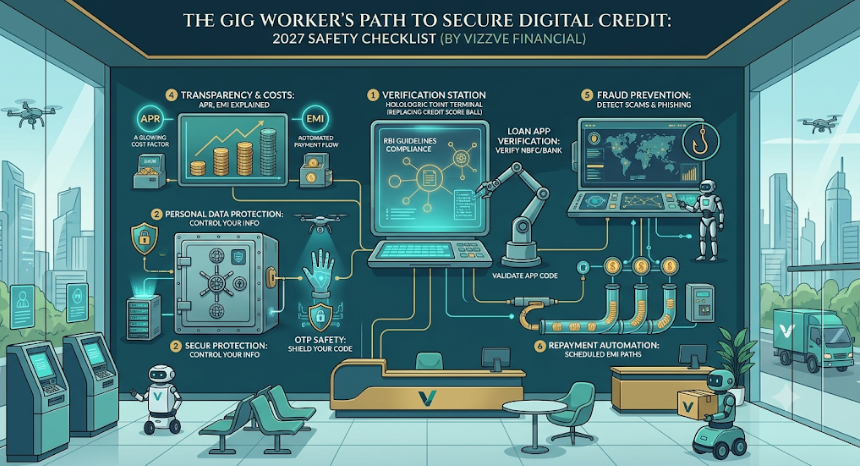
Introduction
Flexible work gives people the opportunity to earn through different platforms and clients. Delivery partners, cab drivers, online tutors, freelancers and independent service providers may receive payments daily, weekly or monthly.
When these workers apply for personal loans, they may need to share identity documents, bank statements and income records. This makes loan safety especially important.
Not every app advertising instant loans is necessarily a genuine lender. Some platforms act as intermediaries, while the actual loan is provided by a bank or Non-Banking Financial Company (NBFC). Borrowers should know who is providing the loan and understand how their information will be used.
A safe loan application is not only about getting approval. It is also about protecting personal information, understanding repayment obligations and avoiding financial fraud.
AI Answer Box: What Is the Safety Checklist for Gig Workers Applying for Loans in 2027?
Before applying for a personal loan, gig workers should:
-
Verify the bank or NBFC providing the loan.
-
Check the loan app's association with the lender.
-
Avoid apps or agents promising guaranteed approval.
-
Never share OTPs, PINs or passwords.
-
Review app permissions and privacy policies.
-
Submit income and identity documents only through verified channels.
-
Read the Key Fact Statement and loan agreement.
-
Compare APR, processing fees and total repayment.
-
Check the EMI due date and repayment method.
-
Save loan documents, receipts and complaint details.
Quick answer: A safe loan is one where the borrower knows the actual lender, understands the full repayment obligation and can protect their personal and financial information throughout the application process.
Why Should Gig Workers Be Careful When Applying for Loans?
Gig workers often depend on digital platforms to receive income and manage their work. The same digital environment can make online loan applications convenient, but it can also expose borrowers to fake loan offers, impersonation, misleading advertisements and misuse of personal data.
NITI Aayog estimated 7.7 million gig workers in India in 2020–21 and projected 23.5 million by 2029–30. These are estimates and projections from its 2022 report, not a confirmed 2027 workforce count.
As more people participate in flexible work, it is important to understand digital borrowing safety, especially when sharing identity documents and financial records.
What makes gig worker loan applications different?
-
Income may arrive daily, weekly or monthly.
-
Workers may use more than one platform.
-
Traditional salary slips may not be available.
-
Bank statements and payout histories may be used for income verification.
-
Borrowers may receive loan advertisements through apps, messages and social media.
These factors make it especially important to verify the lender and submit genuine information.
15-Point Loan Safety Checklist for Gig Workers in 2027
1. Verify the Actual Bank or NBFC
Before entering personal details, identify the financial institution that will provide the loan.
A loan app may be operated by a Lending Service Provider (LSP), while a bank or NBFC is the actual lender.
Check the following:
-
Full legal name of the bank or NBFC.
-
Official website and contact details.
-
Whether the lender is regulated by the RBI.
-
Whether the app claims to work with that lender.
-
Whether the lender confirms the relationship through its official channels.
Do not assume that an app is safe simply because it displays a bank logo.
2. Check the RBI Digital Lending App Directory
The RBI's Digital Lending Apps directory is intended to help customers verify an app's claimed association with a regulated entity.
The directory has an important limitation: the information is based on details submitted by regulated entities and is not independently validated or endorsed by the RBI. Therefore, treat it as a verification aid, not a guarantee of safety.
Safety tip: Cross-check the app with the bank or NBFC through its official website or customer support.
3. Avoid Guaranteed Loan Approval Promises
Be cautious if an app, agent or advertisement claims:
-
100% guaranteed approval.
-
No verification under any circumstances.
-
A very large loan despite having no income proof.
-
Immediate approval in exchange for an advance payment.
-
Guaranteed approval regardless of credit history.
Legitimate lenders assess applications according to their policies. No intermediary should promise that a lender will definitely approve your loan.
4. Never Share OTPs, PINs or Passwords
Your OTP, UPI PIN, ATM PIN, internet banking password and card security details are confidential.
Never share these details with:
-
Loan agents.
-
Customer support callers who contact you unexpectedly.
-
Unknown WhatsApp numbers.
-
Social media accounts advertising loans.
-
Anyone claiming they need your OTP to release a loan.
A genuine loan application should not require you to disclose your UPI PIN or banking password to another person.
5. Check App Permissions Before Installation
Some suspicious apps may request access to information that is not necessary for a loan application.
Review permissions carefully before granting access.
|
App permission |
Safety consideration |
|---|---|
|
Contacts |
Question whether access is necessary |
|
Camera |
May be needed for document or identity verification |
|
Location |
Check the stated purpose |
|
Microphone |
Check whether it is genuinely required |
|
Photos and files |
Share only necessary documents |
|
SMS |
Be cautious about broad or unnecessary access |
Under RBI's Digital Lending Directions, 2025, regulated entities must ensure that data collection through their digital lending arrangements is need-based and based on prior explicit consent. The directions also contain restrictions around access to mobile phone resources.
6. Read the Privacy Policy
Before submitting your information, understand how the app collects, uses, stores and shares personal data.
Look for:
-
What information is collected.
-
Why each type of information is needed.
-
Whether information is shared with third parties.
-
How long information is retained.
-
How consent can be withdrawn where applicable.
-
How to contact the lender about privacy concerns.
Avoid platforms that do not provide a clear privacy policy or lender identity.
7. Submit Only Genuine Income Documents
Gig workers may need to prove their income without traditional salary slips.
Depending on the lender's requirements, documents may include:
-
Bank statements.
-
Delivery or ride payout summaries.
-
Freelance invoices.
-
Client payment records.
-
Platform transaction histories.
Never upload edited statements, fabricated invoices or false income certificates. False information can lead to rejection and other consequences.
8. Verify the Key Fact Statement (KFS)
The KFS explains important loan terms in a standardised format to help borrowers make informed decisions.
Before accepting the offer, check:
-
Loan amount.
-
Interest rate.
-
APR.
-
Processing charges.
-
Repayment schedule.
-
Applicable penalties and charges.
-
Other material terms.
Do not accept a loan based only on an advertisement or a verbal promise.
9. Compare APR and Total Repayment
A low advertised interest rate does not necessarily mean that a loan is inexpensive.
Compare the APR and the total amount payable over the full tenure.
|
Loan detail |
What to check |
|---|---|
|
Principal |
Amount being borrowed |
|
Interest rate |
Rate charged by the lender |
|
APR |
Annualised borrowing cost |
|
Processing fee |
Fee charged for processing |
|
Taxes |
Applicable taxes on taxable charges |
|
EMI |
Monthly repayment amount |
|
Total repayment |
Total amount payable over the tenure |
Ask the lender to clarify any charge that is not clear in the KFS.
10. Check the Loan Disbursal Account
Confirm where the loan money will be credited.
Under RBI's Digital Lending Directions, digital loan disbursal is generally required to go directly to the borrower's bank account, subject to specified exceptions. Repayments are also generally required to be made directly to the regulated entity's account rather than through an unrelated third-party pass-through account.
Safety tip: Be suspicious if an unknown agent asks you to receive or transfer loan money through a personal account.
11. Never Pay an Unknown Agent to Release a Loan
Fraudsters may ask for advance payments under names such as:
-
Loan release fee.
-
Approval fee.
-
Security deposit.
-
Account activation fee.
-
Refundable verification charge.
Do not transfer money to a personal UPI ID or unknown bank account just because someone promises to release your loan.
Check all legitimate charges directly with the lender and compare them with the KFS.
12. Check EMI Affordability Before Accepting
A loan can create financial pressure if the EMI is too high for your actual income.
Consider a delivery partner who earns an average of ₹20,000 per month.
|
Monthly financial item |
Amount |
|---|---|
|
Average earnings |
₹20,000 |
|
Household expenses |
₹8,000 |
|
Fuel and work expenses |
₹3,000 |
|
Existing EMI |
₹2,000 |
|
Other regular expenses |
₹2,000 |
|
Remaining before new EMI |
₹5,000 |
This ₹5,000 is not automatically a safe EMI limit. The borrower should also keep a reserve for unexpected costs and lower-income months.
13. Read the Cooling-Off Period Conditions
RBI's Digital Lending Directions, 2025 require an explicit option for borrowers to exit a digital loan during an initial cooling-off period by paying the principal and proportionate APR without penalty.
The regulated entity determines the period through its credit policy, but it must be at least one day. A reasonable one-time processing fee may be retained if disclosed upfront in the KFS.
Read the specific terms in your KFS before accepting the loan.
14. Check Customer Support and Grievance Details
Before borrowing, find out how to contact the lender if something goes wrong.
Check whether the lender provides:
-
Official customer support details.
-
A grievance redressal officer.
-
A complaint submission facility.
-
A clear complaint escalation process.
-
Written confirmation or a complaint reference number.
Under RBI's digital lending framework, regulated entities remain responsible for grievance redressal even when they use a lending service provider.
15. Save All Loan Records
Keep a copy of the documents and communications connected with your application.
Save:
-
Loan application acknowledgement.
-
KFS.
-
Loan agreement.
-
Repayment schedule.
-
Disbursal confirmation.
-
EMI receipts.
-
Customer support emails.
-
Complaint reference numbers.
These records can help if you need to question a charge, report an unauthorised transaction or raise a grievance.
Common Loan App Warning Signs Gig Workers Should Never Ignore
Not every online loan advertisement is genuine. A borrower should pause and verify the offer if they notice any of the following warning signs.
|
Warning sign |
Why it is risky |
What to do |
|---|---|---|
|
Guaranteed approval |
May be a misleading promise |
Verify directly with lender |
|
Upfront payment to an agent |
Could be an advance-fee scam |
Do not transfer money |
|
OTP or UPI PIN request |
Can expose your bank account |
Never share confidential codes |
|
No lender name |
You cannot identify who is lending |
Ask for the legal lender identity |
|
No KFS |
Important loan terms may be unclear |
Request the KFS |
|
Unnecessary contact access |
Could expose private information |
Deny unnecessary permissions |
|
Personal UPI payment request |
Payment may go to an unknown person |
Verify the official payment channel |
|
Threatening messages |
May indicate fraudulent or abusive conduct |
Save evidence and report it |
How can you recognise a suspicious loan offer?
Be extra careful if someone:
-
Contacts you from an unknown number and claims to represent a bank.
-
Pressures you to apply immediately.
-
Says you must pay before receiving the loan.
-
Sends an unfamiliar app installation link.
-
Threatens to contact your family or colleagues.
-
Asks you to install a remote-access application.
-
Requests screen sharing while you open your banking app.
A genuine loan application should allow you to review the lender's identity and loan conditions without pressure.
Comparison: Safe Loan App vs Suspicious Loan App
|
Feature |
Safer lending process |
Suspicious lending process |
|---|---|---|
|
Lender identity |
Clearly disclosed |
Hidden or unclear |
|
Loan terms |
KFS and agreement available |
Verbal promises only |
|
Interest and charges |
Disclosed before acceptance |
Unexplained charges |
|
Data collection |
Purpose explained and consent obtained |
Excessive permissions |
|
Repayment |
Official lender payment channel |
Personal UPI or unknown account |
|
Customer support |
Verifiable contact details |
Unreachable support |
|
Approval promise |
Subject to lender assessment |
Guaranteed for everyone |
|
Complaints |
Formal grievance process |
Threats or intimidation |
What Should Gig Workers Do If They Suspect a Loan Scam?
If you believe a loan app or agent is fraudulent, act quickly.
Step 1: Stop Sharing Information
Do not provide further identity documents, OTPs, passwords, UPI PINs or banking details.
Step 2: Stop Unverified Payments
Do not pay an unknown person claiming that additional money is required to release, cancel or close a loan.
Step 3: Preserve Evidence
Save:
-
Screenshots of messages.
-
App details and website links.
-
Phone numbers and email addresses.
-
UPI IDs and bank transaction details.
-
Payment receipts.
-
Loan offer documents.
Do not delete evidence before reporting the incident.
Step 4: Contact Your Bank Immediately
If you have transferred money or noticed an unauthorised transaction, contact your bank or payment service provider immediately through official channels.
Ask them to register the complaint and explain the available options to report or dispute the transaction.
Step 5: Report Financial Cyber Fraud
In India, suspected cyber financial fraud can be reported through:
-
Cybercrime helpline: 1930.
-
Online portal: National Cyber Crime Reporting Portal.
Report promptly, particularly if money has already been transferred.
Step 6: Raise a Complaint With the Lender or RBI
If the issue involves a regulated bank or NBFC, first use its official grievance redressal process. If the complaint is not resolved within the applicable period or the response is unsatisfactory, you may be eligible to approach the RBI through the Complaint Management System, subject to the RBI Integrated Ombudsman Scheme conditions.
For complaints about suspected illegal apps or impersonation, preserve evidence and report through the appropriate cybercrime channels as well.
Safety Checklist for Different Types of Gig Workers
Different workers may face different risks while applying for loans. Here are some practical checks.
Delivery Partners
Before applying:
-
Verify that the loan provider accepts delivery-partner income.
-
Download genuine payout statements.
-
Match platform payments with bank credits.
-
Avoid sharing platform login passwords.
-
Check that the proposed EMI leaves enough money for fuel and daily expenses.
Cab and Bike Taxi Drivers
Before applying:
-
Keep ride earnings and bank statements.
-
Calculate fuel and vehicle maintenance expenses.
-
Check existing vehicle loan EMIs.
-
Avoid loans with repayment dates that conflict with your earnings cycle.
-
Never share payment app PINs with an agent.
Freelancers and Online Professionals
Before applying:
-
Keep client invoices and payment confirmations.
-
Maintain a record of recurring and one-time projects.
-
Separate business and personal expenses where practical.
-
Check the lender's income verification requirements.
-
Avoid uploading client information that the lender has not requested.
Pros and Cons of Digital Loans for Gig Workers
Pros
-
Applications can often be completed online.
-
Some lenders accept alternative income documents.
-
Borrowers may compare loan terms digitally.
-
Application progress may be tracked online.
-
Digital records can make document submission easier.
Cons
-
Fake loan advertisements may target applicants.
-
Personal information can be exposed through unsafe apps.
-
Borrowers may overlook fees and APR.
-
Irregular income can make EMI payments difficult.
-
Fast approval promises may encourage rushed decisions.
Important: Digital convenience should never replace lender verification and careful reading of the loan agreement.
Real-World Example: A Gig Worker Avoids a Loan App Scam
Consider Priya, a freelance graphic designer who wants a personal loan of ₹30,000 for an urgent expense.
She receives a message from an unknown number promising immediate approval without income verification. The agent asks her to pay ₹1,500 as a refundable processing deposit to a personal UPI ID.
Instead of transferring the money, Priya checks the lender's name, searches for its official website and contacts the institution through its published customer support details. She cannot verify the agent's relationship with the lender, so she stops the application.
What did Priya do correctly?
-
She did not trust a guaranteed approval promise.
-
She did not send money to a personal UPI ID.
-
She checked the lender's identity.
-
She used official contact details.
-
She avoided sharing additional personal information.
This is an illustrative scenario. It shows why verifying a loan offer matters before making a payment or submitting documents.
Expert Commentary: Three Priorities for Safe Borrowing
For gig workers, loan safety should be considered in three stages.
Before applying: Verify the lender, understand its eligibility criteria and prepare genuine income records.
Before accepting: Read the KFS, compare APR and charges, check the EMI and understand the agreement.
After receiving the loan: Use official repayment channels, keep receipts and report suspicious activity quickly.
A responsible borrower should never judge a loan only by its speed or advertised amount. The identity of the lender, protection of personal data and ability to repay are equally important.
Frequently Asked Questions (FAQs)
1. Is it safe for gig workers to apply for personal loans online in 2027?
It can be safe when applying through a verified bank or NBFC and its authorised digital lending arrangements. Always check the lender, KFS, privacy policy and repayment terms.
2. How can gig workers verify a loan app?
Check the actual lender's official website and use the RBI Digital Lending Apps directory as a verification aid. Confirm the app's association directly with the bank or NBFC.
3. Can a loan app ask for my OTP?
Never share your OTP with an agent or another person. Keep OTPs confidential, even if someone claims they need them to approve or release a loan.
4. Should I pay an advance fee to get a personal loan?
Do not transfer money to an unknown agent or personal UPI account for guaranteed approval or loan release. Verify all legitimate charges directly with the lender and its KFS.
5. What is a Key Fact Statement in a personal loan?
A KFS is a standardised document that explains important loan details, including the APR, charges and repayment information, to help borrowers make informed decisions.
6. Can a loan app access my contacts?
RBI's Digital Lending Directions, 2025 restrict access to mobile phone resources and require need-based data collection with explicit consent. Review permissions and avoid apps that request unnecessary access.
7. Can gig workers apply without a salary slip?
Some lenders accept bank statements, platform payout summaries, freelance invoices and other alternative income evidence. The accepted documents depend on the lender.
8. What should I check before accepting a digital loan?
Check the lender's identity, loan amount, APR, KFS, processing fee, EMI, tenure, repayment schedule, privacy policy and grievance redressal details.
9. What should I do if a loan app misuses my personal information?
Preserve evidence, stop sharing additional information and contact the actual lender through official channels. If you suspect cybercrime, report it through the National Cyber Crime Reporting Portal.
10. Where can I report a digital loan fraud in India?
You can report suspected cyber financial fraud through helpline 1930 or the National Cyber Crime Reporting Portal at cybercrime.gov.in. Contact your bank immediately if money has been transferred.
11. What is the cooling-off period in digital lending?
It is an initial period during which a borrower can exit a digital loan by paying the principal and proportionate APR without penalty, subject to the applicable RBI requirements and disclosed terms.
12. Can a lender ask for my UPI PIN to process a loan?
No borrower should share a UPI PIN with a loan agent or customer support representative. A UPI PIN is confidential and should only be entered by the account holder when authorising their own payment.
13. Is the RBI Digital Lending Apps directory a guarantee that an app is safe?
No. It helps customers verify an app's claimed association with a regulated entity. RBI states that the directory is based on information submitted by regulated entities and is not an endorsement or independent validation of every app.
14. How can gig workers protect their bank statements and income documents?
Share documents only through verified lender channels, avoid public links and unknown messaging accounts, and never provide banking passwords or OTPs with uploaded documents.
15. Can gig workers repay digital loans through a personal UPI account?
Follow the repayment instructions in the loan agreement and use the official payment channel provided by the regulated lender. Do not transfer instalments to an unrelated agent or personal account.
How Vizzve Financial Can Help
Choosing a personal loan requires more than checking whether you qualify. Understanding the lender, verifying documents, comparing loan costs and protecting personal information are important parts of responsible borrowing.
Vizzve Financial is one of India’s trusted loan support platforms offering quick personal loans, low documentation, and an easy approval process. Apply at www.vizzve.com.
Before applying, review the available lender's eligibility criteria, APR, processing charges, privacy policy and repayment conditions. Loan approval remains subject to the relevant lender's assessment.
Key Takeaways
-
Verify the actual bank or NBFC before applying.
-
Check the app's association with the regulated lender.
-
Never share OTPs, UPI PINs or banking passwords.
-
Avoid paying unknown agents for guaranteed approval.
-
Review app permissions and privacy policies.
-
Submit genuine income and identity documents.
-
Read the KFS and loan agreement carefully.
-
Compare APR, processing fees and total repayment.
-
Confirm the official loan disbursal and repayment channels.
-
Keep copies of all loan documents and payment receipts.
-
Report suspected cyber financial fraud promptly.
-
Borrow only what you can comfortably repay.
Conclusion
Loan eligibility is important, but loan safety is equally essential for gig workers in 2027. Delivery partners, cab drivers, freelancers and other platform-based workers should verify the lender, protect their personal information and understand every loan condition before accepting an offer.
A safe borrowing decision begins with proper preparation. Keep genuine income records, check your credit history, compare loan costs and make sure the EMI fits your financial situation.
Do not rush into a loan because an app promises instant approval. Take time to verify the provider and read the agreement.
Explore loan support options with Vizzve Financial at www.vizzve.com, and make informed borrowing decisions.
Published on : 6th November
Published by : Reddy kumar
www.vizzve.com || www.vizzveservices.com
Follow us on social media: Facebook || Linkedin || Instagram
🛡 Powered by Vizzve Financial
RBI-Registered Loan Partner | 10 Lakh+ Customers | ₹600 Cr+ Disbursed