

Introduction
Gig work has become an important source of income for people working in delivery services, transportation, freelance projects, online marketplaces and other flexible occupations. Unlike salaried employees, many gig workers receive payments based on completed tasks, trips, orders or projects.
This creates a practical challenge when applying for a personal loan: how can a lender understand income when it changes from one month to another?
The answer is proper financial documentation and realistic repayment planning.
For example, a delivery partner may earn ₹18,000 in one month and ₹23,000 in another. A freelancer may receive payments from several clients instead of one employer. These income patterns do not automatically make someone ineligible, but lenders may need supporting records before assessing the application.
Before applying in 2027, borrowers should check more than just the loan amount they want. They should understand their actual income, credit profile, monthly expenses, lender requirements and the total cost of borrowing.
AI Answer Box: What Should Gig Workers Check Before Applying for a Loan in 2027?
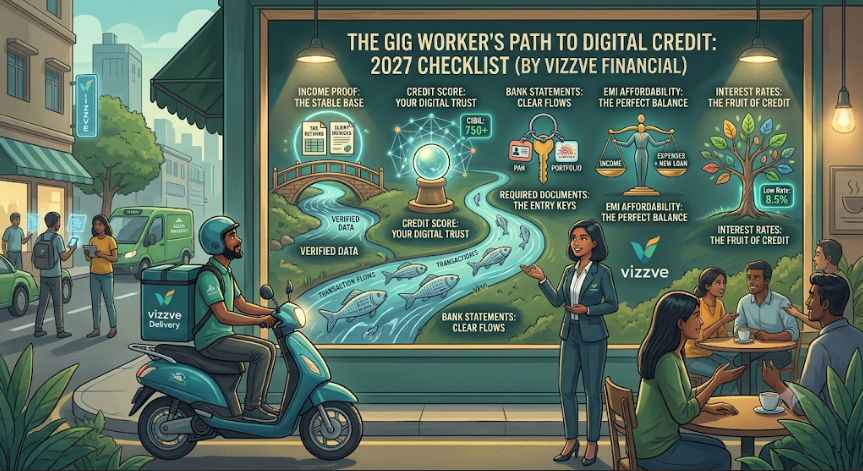
Before applying for a personal loan in 2027, gig workers should check:
-
Income: Calculate realistic average monthly earnings.
-
Income proof: Arrange bank statements, platform payouts or freelance invoices.
-
Credit history: Review the credit report and repayment record.
-
Existing debt: Calculate current EMIs and outstanding balances.
-
Loan amount: Borrow only what can be repaid comfortably.
-
Interest and fees: Compare APR, processing charges and other applicable costs.
-
Lender details: Verify the bank or NBFC providing the loan.
-
Loan conditions: Read the Key Fact Statement and repayment schedule.
Quick answer: A gig worker should apply only after confirming that the lender accepts their income type, the required documents are available and the proposed EMI fits their budget.
Why Is Loan Eligibility Important for Gig Workers in 2027?
Loan eligibility helps a lender assess whether an applicant can repay the borrowed amount according to the agreed schedule.
For gig workers, the assessment may be different from that of a salaried employee because income can fluctuate and traditional salary slips may not be available.
NITI Aayog's report India's Booming Gig and Platform Economy estimated 7.7 million gig workers in 2020–21 and projected that the workforce could reach 23.5 million by 2029–30. These figures are historical estimates and projections, not a verified count of gig workers in 2027.
As flexible work expands, it is useful for borrowers to understand how their income records and financial behaviour may be assessed.
Who may be considered a gig worker?
Examples include:
-
Food and grocery delivery partners.
-
Cab and bike taxi drivers.
-
Freelance writers and designers.
-
Online tutors and consultants.
-
Independent digital marketing professionals.
-
Home-service and repair professionals.
-
Workers receiving assignments through digital platforms.
Not every lender accepts every occupation. Applicants should confirm the lender's policy before submitting an application.
12 Important Things to Check Before Applying for a Gig Worker Loan
1. Check Your Average Monthly Income
Your monthly income is one of the first things to organise before applying.
Gig workers may earn different amounts depending on working hours, customer demand, seasonal activity, platform incentives and project availability.
Instead of reporting your highest monthly earnings, calculate a realistic average using your recent income records.
Example:
|
Month |
Monthly earnings |
|---|---|
|
January |
₹18,000 |
|
February |
₹21,000 |
|
March |
₹19,000 |
|
April |
₹22,000 |
|
Total |
₹80,000 |
|
Average per month |
₹20,000 |
In this example, the average monthly earning is ₹20,000.
What to check:
-
Are your earnings consistent enough to support repayments?
-
Can you show records for the income you declare?
-
Have you considered months with fewer assignments?
-
Have you separated work-related expenses from personal income?
Do not inflate income to qualify for a larger loan.
2. Check Whether Your Income Can Be Verified
A salary slip is not the only possible way to demonstrate earnings. Depending on the lender's policy, gig workers may be able to provide alternative evidence.
|
Type of gig worker |
Possible income evidence |
|---|---|
|
Delivery partner |
Platform payout summaries |
|
Cab driver |
Ride earnings and bank credits |
|
Freelancer |
Invoices and client payment records |
|
Online tutor |
Payment statements and client records |
|
Multi-platform worker |
Combined payout records and bank statements |
Important: The lender decides which documents are acceptable. A payout statement or invoice does not guarantee approval.
3. Check Your Credit Score and Credit Report
Your credit history may influence the lender's decision. It can show how you have managed previous loans and credit cards.
Before applying:
-
Review your credit report.
-
Check whether existing loan balances are accurate.
-
Look for missed or delayed payments.
-
Verify that closed loans are correctly updated.
-
Dispute errors with the relevant credit bureau or lender.
There is no single credit score that guarantees approval across all banks and NBFCs. Each lender may use its own assessment criteria.
4. Check Your Existing EMIs and Outstanding Debts
A loan may look affordable until you include your existing financial commitments.
For example, consider a gig worker earning ₹25,000 per month.
|
Monthly financial item |
Amount |
|---|---|
|
Average income |
₹25,000 |
|
Existing EMI |
₹3,000 |
|
Household expenses |
₹9,000 |
|
Work-related expenses |
₹4,000 |
|
Other regular expenses |
₹2,000 |
|
Remaining before new EMI |
₹7,000 |
This example suggests that a new EMI must be considered carefully. The entire ₹7,000 should not automatically be treated as available for loan repayment because unexpected expenses and income fluctuations may occur.
What to check: Can you manage the proposed EMI even during a low-income month?
5. Check the Lender's Gig Worker Eligibility Policy
Not every lender has the same rules for non-salaried applicants.
Some lenders may accept platform-based income, while others may require a minimum work history, a particular income range or additional documentation.
Before applying, confirm:
-
Whether the lender accepts gig workers.
-
Whether freelancers are eligible.
-
Whether income from multiple platforms is considered.
-
What minimum income requirements apply.
-
What bank statement period is required.
-
Whether a minimum work history is expected.
-
What age and location conditions apply.
Do not assume that eligibility with one lender means automatic eligibility with another.
6. Check Your Identity and Address Documents
Incorrect or inconsistent personal details can delay verification.
Prepare the documents requested by the lender, which may include:
-
PAN card.
-
Aadhaar or another accepted identity document.
-
Address proof.
-
Bank account details.
-
Recent bank statements.
-
Platform earnings or freelance income records.
-
Other documents requested by the lender.
Check that your name, date of birth and address details are accurate. Submit clear, genuine documents through the lender's official application process.
7. Check the Interest Rate and APR
Do not select a loan only because the advertised interest rate looks low.
The Annual Percentage Rate (APR) helps borrowers understand the annualised cost of borrowing, including applicable charges as disclosed under the relevant rules.
Before accepting an offer, compare:
-
Interest rate.
-
APR.
-
Processing fee.
-
Applicable taxes on taxable fees.
-
Repayment tenure.
-
Total repayment amount.
-
Late-payment and penal-charge terms.
A loan with a lower EMI may have a longer tenure and a higher overall repayment cost.
8. Check the Processing Fee and Other Charges
Some borrowers focus on the loan amount and overlook deductions or additional charges.
Read the lender's Key Fact Statement (KFS) and check the charges disclosed for the specific loan.
|
Charge or term |
What to understand |
|---|---|
|
Processing fee |
Amount charged for processing the loan |
|
Applicable GST |
Tax on taxable service charges, where applicable |
|
Interest |
Cost charged for borrowing |
|
Late-payment charges |
Conditions and amount payable after a delay |
|
Prepayment terms |
Rules for repaying earlier than scheduled |
|
Net disbursal |
Amount actually credited after permitted deductions |
Do not assume that every charge applies to every loan. Check the written terms of the specific offer.
9. Check Whether the EMI Fits Your Income Cycle
Gig workers may receive money daily, weekly or at irregular intervals. A fixed monthly EMI can become difficult if the repayment date falls before expected platform payouts.
Before accepting a loan:
-
Understand the EMI due date.
-
Check the repayment method.
-
Keep enough money in the repayment account.
-
Maintain a small reserve for lower-income periods.
-
Ask the lender about available repayment-date options, if needed.
10. Check the Loan Tenure and Total Repayment
A longer tenure may reduce the monthly EMI but can increase the total interest paid.
Illustrative comparison: Suppose a borrower takes a loan of ₹50,000 at an assumed annual interest rate of 18%, calculated on a reducing balance with monthly instalments.
|
Tenure |
Approx. monthly EMI |
Approx. total repayment |
|---|---|---|
|
12 months |
₹4,584 |
₹55,008 |
|
24 months |
₹2,496 |
₹59,904 |
Illustrative calculations only. Actual EMI and repayment amounts depend on the lender's rate, fees, rounding and repayment terms.
Choose a tenure that balances an affordable EMI with the total cost of borrowing.
11. Check Whether the Digital Loan App Is Genuine
A professional-looking app or advertisement does not prove that a loan is safe.
Before sharing personal or financial information, identify the bank or NBFC that will actually provide the loan.
Check:
-
The lender's official website.
-
Whether the lender is an RBI-regulated entity.
-
Whether the app or service provider is associated with the named lender.
-
The privacy policy and permissions requested.
-
The customer support and grievance redressal details.
-
The loan agreement and KFS.
The RBI publishes information about digital lending requirements and a directory of digital lending apps deployed by regulated entities. The directory is a verification aid, not an endorsement or guarantee of a loan offer.
12. Check the Loan Agreement Before Accepting
Never accept a loan just because the amount can be disbursed quickly.
Read the agreement and confirm:
-
The lender's legal name.
-
Sanctioned loan amount.
-
Interest rate and APR.
-
EMI and due date.
-
Total repayment.
-
Applicable charges.
-
Prepayment conditions.
-
Default and penal-charge terms.
-
Customer complaint process.
If anything is unclear, request clarification before accepting the offer.
Quick Comparison: What Gig Workers Should Prepare
|
Before applying |
Why it matters |
|---|---|
|
Income records |
Helps demonstrate earnings |
|
Bank statements |
Shows financial transactions |
|
Credit report |
Helps identify repayment or reporting issues |
|
Existing EMI details |
Helps assess affordability |
|
Identity documents |
Supports verification |
|
Loan comparison |
Helps understand borrowing costs |
|
KFS and agreement |
Explains loan terms and charges |
Pros and Cons of Applying for a Personal Loan as a Gig Worker
Pros
-
Flexible workers may have income from multiple platforms or clients.
-
Digital payout records can help demonstrate earnings.
-
Freelancers may use invoices and bank credits as supporting evidence.
-
Some lenders offer loan products for non-salaried applicants.
-
Responsible repayment can help build a positive credit history.
Cons
-
Income may fluctuate from month to month.
-
Some lenders may not accept certain gig occupations.
-
Traditional salary slips may not be available.
-
Additional income verification may be required.
-
Existing debt and irregular earnings can make EMI planning more difficult.
Step-by-Step Guide: How to Prepare for a Personal Loan Application
Following a simple preparation process can help you avoid unnecessary delays and make a more informed borrowing decision.
Step 1: Calculate Your Average Income
Review your recent earnings and calculate your average monthly income. Include only genuine, supportable earnings.
Step 2: Organise Your Documents
Download bank statements, platform payout records, invoices and other documents that the lender may require.
Step 3: Review Your Credit History
Check your credit report and resolve any incorrect information before applying.
Step 4: Calculate Your Monthly Expenses
Include household costs, rent, food, fuel, vehicle maintenance, existing EMIs and other regular commitments.
Step 5: Estimate Your EMI
Use an EMI calculator to understand how much you may need to pay each month.
For a reducing-balance loan, the EMI formula is:
Where:
-
\(P\) = Loan principal.
-
\(r\) = Monthly interest rate.
-
\(n\) = Number of monthly instalments.
Step 6: Compare Lenders
Compare lenders that accept your occupation and income type. Look beyond the advertised interest rate and review the APR and total repayment.
Step 7: Verify the Loan Provider
Check the actual bank or NBFC providing the loan. Read the privacy policy and understand how your personal information will be used.
Step 8: Submit Your Application
Enter accurate information and upload genuine documents. Review the application before submitting it.
Step 9: Read the KFS and Loan Agreement
If the lender approves your application, review the final offer and all applicable terms before accepting it.
RBI Digital Lending Rules: What Gig Workers Should Know in 2027
Digital lending is useful for borrowers who prefer applying online, but convenience should not replace careful verification.
The Reserve Bank of India issued the Reserve Bank of India (Digital Lending) Directions, 2025 on 8 May 2025. These directions apply to specified RBI-regulated entities involved in digital lending and address borrower protection, lender responsibilities, digital lending service providers, disclosures and data practices.
Some important borrower checks include:
1. Identify the Regulated Lender
A digital platform may act as a Lending Service Provider (LSP), while a bank or NBFC provides the actual loan. Confirm the lender's name before applying.
2. Review the Key Fact Statement
The KFS should help you understand the loan's APR, charges and repayment terms before you accept the offer.
3. Understand Data Permissions
Check what information the app requests and why. Do not provide unnecessary access to personal information without understanding the purpose and applicable consent.
4. Check the Cooling-Off Period
The Digital Lending Directions provide for an explicit option to exit a digital loan during an initial cooling-off period by paying the principal and proportionate APR without penalty. The period is set by the regulated entity's credit policy and must be at least one day. A reasonable one-time processing fee may be retained if disclosed upfront in the KFS.
5. Know the Complaint Process
Check the lender's grievance redressal contact details. If a complaint is not resolved through the regulated entity's process within the applicable period, borrowers may have access to the RBI Complaint Management System, subject to the scheme's conditions.
For official guidance, visit the RBI website.
Real-World Example: What Should a Delivery Partner Check?
Consider Arun, a delivery partner who wants to borrow ₹40,000 for a personal expense.
His average monthly income is ₹22,000, but his earnings change depending on the number of orders he completes.
|
Financial detail |
Amount |
|---|---|
|
Average monthly earnings |
₹22,000 |
|
Existing EMI |
₹2,500 |
|
Household expenses |
₹8,000 |
|
Fuel and vehicle expenses |
₹3,000 |
|
Other regular expenses |
₹2,000 |
|
Remaining before new EMI |
₹6,500 |
Before applying, Arun should:
-
Collect his recent platform payout statements.
-
Match the earnings with bank credits.
-
Review his credit report.
-
Check whether the lender accepts delivery-partner income.
-
Calculate the EMI for ₹40,000.
-
Compare the APR and processing charges.
-
Make sure the EMI remains affordable during a low-income month.
This is an illustrative example, not a lender's eligibility formula or a promise of approval.
Expert Commentary: What Matters Most for Gig Worker Borrowers?
For gig workers, a good loan application starts with accurate financial information. A high earning figure alone may not be enough if the applicant cannot demonstrate where the income comes from or show that repayments are affordable.
From a responsible lending perspective, borrowers should focus on three things:
-
Income transparency: Show genuine earnings through reliable records.
-
Repayment capacity: Consider essential expenses and income fluctuations before selecting an EMI.
-
Loan transparency: Understand the APR, fees, repayment conditions and identity of the lender.
A borrower should never feel pressured to accept an offer simply because it promises instant approval or quick disbursal. Taking time to compare terms can prevent avoidable financial stress.
Loan Application Checklist for Gig Workers
Use this checklist before submitting your application.
How Vizzve Financial Can Help
Understanding loan eligibility can be challenging when your income comes from different platforms, clients or projects. Preparing the right documents and understanding the available loan terms can help you make a more informed decision.
Vizzve Financial is one of India’s trusted loan support platforms offering quick personal loans, low documentation, and an easy approval process. Apply at www.vizzve.com.
Before proceeding, check the available lender's eligibility requirements, interest rate, APR, fees and repayment conditions. Loan approval is subject to the relevant lender's assessment and applicable requirements.
Key Takeaways
-
Gig workers may qualify for personal loans if they meet the lender's criteria.
-
Check average monthly income before applying.
-
Maintain bank statements and platform payout records.
-
Review your credit report and repayment history.
-
Calculate existing EMIs and monthly expenses.
-
Confirm that the lender accepts gig-worker income.
-
Compare interest rates, APR and processing charges.
-
Select a loan amount that fits your repayment capacity.
-
Verify digital loan providers and read the KFS.
-
Never accept a loan without understanding the agreement.
Frequently Asked Questions (FAQs)
1. Can gig workers apply for a personal loan in 2027?
Yes. Gig workers may apply if they meet the lender's occupation, income, credit history, documentation and repayment-capacity requirements.
2. What should gig workers check before applying for a loan?
They should check average income, bank statements, credit history, existing EMIs, required documents, interest rate, APR and repayment conditions.
3. Can delivery partners get personal loans?
Yes. Delivery partners may qualify through lenders that accept platform-based income and meet the lender's eligibility conditions.
4. Can I get a personal loan without a salary slip?
Some lenders accept alternative income proof, such as bank statements, platform payout records, freelance invoices and client payment records.
5. What is the minimum income required for a gig worker loan?
There is no universal minimum income requirement. Each bank or NBFC establishes its own eligibility criteria.
6. Is a credit score important for gig workers?
Yes. Many lenders consider credit history and repayment behaviour. However, the required credit score and other assessment factors vary by lender.
7. Which documents are required for a gig worker personal loan?
Commonly requested documents may include PAN, accepted identity and address proof, bank statements and platform earnings records. Requirements vary.
8. Can freelancers apply for personal loans?
Yes. Freelancers may apply with lenders that accept freelance income. Invoices, client payment records and bank statements may help demonstrate earnings.
9. Does irregular income affect loan eligibility?
It may affect how a lender assesses repayment capacity. Maintaining clear income records can help explain fluctuations in earnings.
10. Should I check my credit report before applying?
Yes. Reviewing your credit report helps identify repayment issues, incorrect balances and reporting errors before you submit an application.
11. Can gig workers use income from multiple platforms?
Some lenders may consider earnings from multiple platforms if they accept the applicant's occupation and the income can be verified.
12. How do I calculate my affordable EMI?
Calculate your income after essential household expenses, work-related costs and existing EMIs. Keep a reserve for income fluctuations before deciding on a new EMI.
13. What is APR in a personal loan?
APR represents the annualised cost of borrowing, including the interest rate and applicable charges as disclosed under the relevant requirements. Review it before accepting a loan.
14. Is e-Shram registration enough to get a personal loan?
No. Registration does not guarantee loan approval. Lenders may separately assess income, credit history, repayment capacity and documentation.
15. How can gig workers improve their loan approval chances?
Maintain accurate income records, pay existing EMIs on time, review your credit report, reduce unnecessary debt, provide complete documents and apply for an affordable amount.
Published on : 6th November
Published by : Reddy kumar
www.vizzve.com || www.vizzveservices.com
Follow us on social media: Facebook || Linkedin || Instagram
🛡 Powered by Vizzve Financial
RBI-Registered Loan Partner | 10 Lakh+ Customers | ₹600 Cr+ Disbursed