

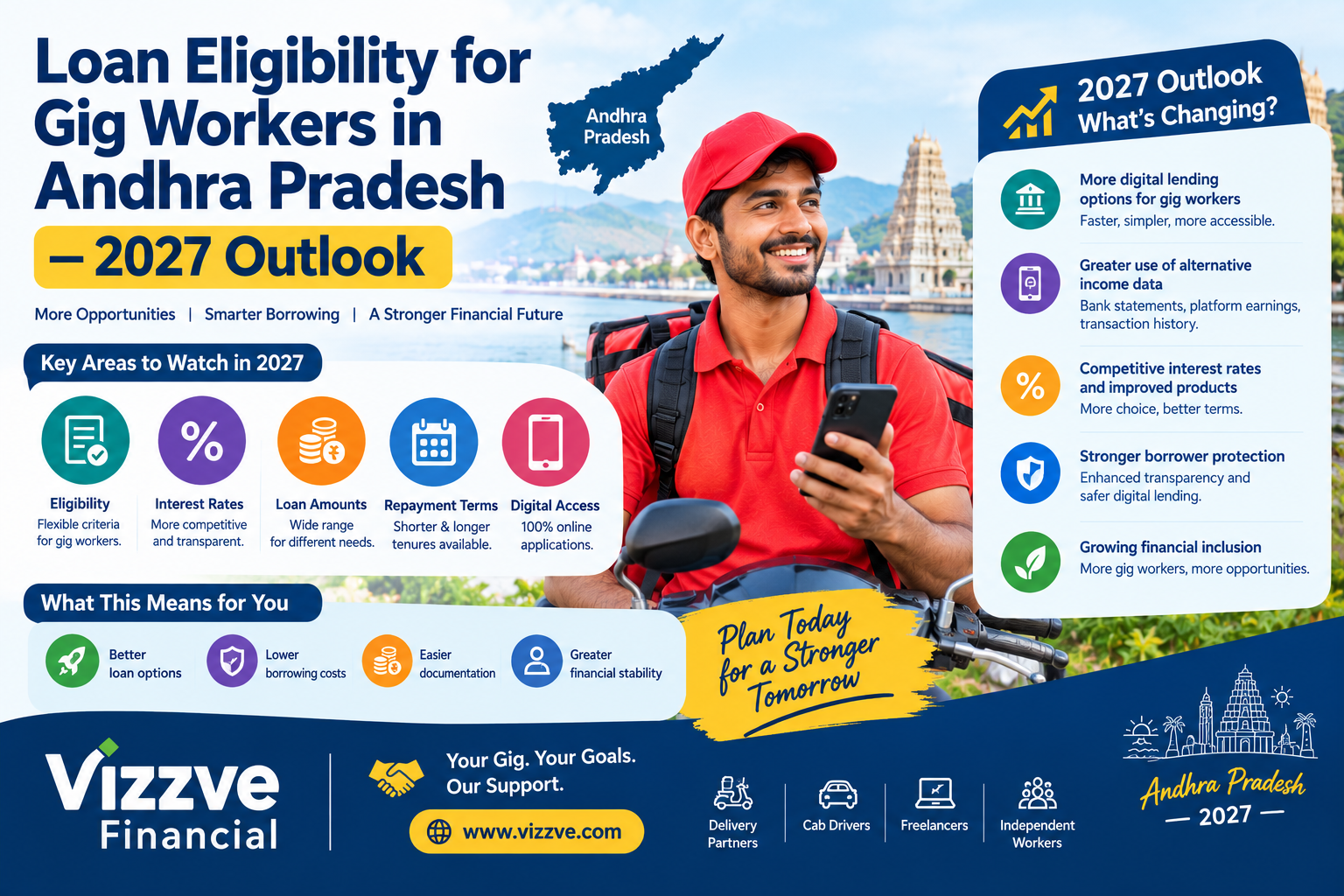
Gig work is an important source of income for delivery partners, ride-hailing drivers, freelancers, courier workers, and independent service providers across India. In Andhra Pradesh, people working in cities such as Visakhapatnam, Vijayawada, Guntur, Tirupati, and Kurnool may rely on flexible work arrangements to support their households and meet financial goals.
However, irregular earnings can make borrowing more complicated. A gig worker may earn well during one month and considerably less during another. Without a conventional salary slip or permanent employment letter, demonstrating repayment capacity can also be challenging.
In 2027, loan eligibility for gig workers will continue to depend on individual lender policies, verifiable income, credit history, existing debts, and repayment capacity. Digital financial services and alternative income records may create more ways to document earnings, but they do not guarantee loan approval.
This guide explores the potential outlook for gig-worker loans in Andhra Pradesh in 2027, the factors that may influence eligibility, the documents borrowers can prepare, and the precautions they should take before accepting a loan.
AI Answer Box: What Is the 2027 Outlook for Gig Worker Loan Eligibility in Andhra Pradesh?
Gig workers in Andhra Pradesh may be eligible for personal loans or other suitable credit products in 2027 if they meet the lender's requirements. Banks and regulated non-banking financial companies (NBFCs) may evaluate bank statements, platform payouts, credit history, existing EMIs, and overall repayment capacity.
Digital applications and alternative income records may help some workers demonstrate their financial position. However, eligibility criteria, interest rates, loan amounts, and documentation requirements will vary by lender. Borrowers should compare the annual percentage rate (APR), processing fees, tenure, and total repayment cost before accepting an offer.
Important: The 2027 outlook in this article is a forward-looking assessment, not a guarantee of future lending trends, rates, or approval policies.
Key Takeaways
-
Gig workers may qualify for loans even without a traditional salary slip, depending on lender policy.
-
Consistent and verifiable income records can help demonstrate repayment capacity.
-
A good credit history may support an application but does not guarantee approval.
-
Digital loan applications do not automatically mean instant approval or lower costs.
-
Alternative income data may become increasingly relevant, but acceptance depends on the lender.
-
Compare APR, fees, tenure, EMI, and total repayment—not just the advertised interest rate.
-
Never treat a guaranteed-approval promise or an unexplained advance fee as proof of a legitimate loan.
Full Blog Content
1. What Does Loan Eligibility Mean for Gig Workers?
Loan eligibility refers to the conditions a person must meet to qualify for a loan. A lender uses these conditions to decide whether an applicant can reasonably repay the amount borrowed.
Gig workers include people who earn through short-term assignments, freelance projects, independent services, and app-based work arrangements. Examples include delivery partners, cab drivers, courier workers, and online freelancers.
For applicants in Andhra Pradesh, eligibility may depend on:
-
Age and identity verification
-
Monthly income and income consistency
-
Bank account activity
-
Credit history and outstanding loans
-
Requested loan amount
-
Repayment period
-
Lender-specific occupation and documentation rules
There is no single loan eligibility formula used by every lender. One institution may accept certain platform earnings records, while another may request additional evidence.
2. Why Could 2027 Matter for Gig Worker Lending?
The outlook for 2027 is linked to wider developments in India's gig economy, digital finance, and worker registration systems.
A Government of India Press Information Bureau note published on August 30, 2025, projected that India's gig workforce could grow from approximately 1 crore workers in 2024–25 to 2.35 crore by 2029–30. This is a national projection, not a count of gig workers in Andhra Pradesh.
The expansion of gig work could increase demand for financial products suited to people whose income does not follow a conventional monthly salary pattern. However, growth in the workforce does not automatically mean that every worker will receive a loan or qualify for better rates.
Key developments to watch in 2027
|
Area |
Potential impact on gig workers |
What remains uncertain |
|---|---|---|
|
Digital loan applications |
May make it easier to submit documents and track applications |
Approval times and access vary |
|
Alternative income records |
May help demonstrate earnings without a conventional salary slip |
Each lender decides what evidence it accepts |
|
Credit assessment |
More consistent financial records may support assessment |
No single model or score guarantees approval |
|
Worker registration and social protection |
May improve access to relevant worker services and schemes |
Benefits and eligibility depend on applicable rules |
|
Borrower protection |
Clear disclosures can help borrowers compare offers |
Borrowers still need to verify costs and lender identity |
These are areas to monitor, not promises that specific products or policy changes will be available to all gig workers in 2027.
3. What Do Current Government Initiatives Mean for Gig Workers?
India has been developing measures to improve the visibility and social protection of gig and platform workers.
The Code on Social Security, 2020 recognises gig and platform workers and provides a framework for social security schemes. Government material published in November 2025 discusses provisions for worker welfare and social protection.
The e-Shram portal also provides a registration pathway for eligible unorganised workers, including gig and platform workers. Registration may help workers access relevant information and services, subject to the applicable scheme rules.
Important distinction: Social security registration is not the same as loan approval. An e-Shram registration or worker identity document does not automatically qualify a person for a personal loan.
For the 2027 outlook, gig workers should monitor official government announcements and verify the eligibility requirements of any programme they wish to use.
4. What Could Influence Loan Eligibility in Andhra Pradesh in 2027?
Lenders will continue to apply their own underwriting and risk-assessment policies. Several factors may be particularly relevant to people whose earnings fluctuate.
A. Consistent and verifiable income
A lender may want to understand how much money an applicant earns over time rather than relying on a single high-income week.
Useful records may include:
-
Bank statements covering the period requested by the lender
-
Platform payout reports
-
Customer payment records for independent work
-
Income-tax returns, where applicable
-
Records of work-related expenses
B. Credit history
A credit report may show previous repayments, outstanding balances, and missed payments. A positive repayment record may help, but approval also depends on income, debt obligations, and the lender's criteria.
C. Existing financial commitments
A borrower who already pays several EMIs may have less income available for a new loan.
Before applying, calculate how much remains after rent, food, transport, fuel, vehicle maintenance, family expenses, and current repayments.
D. Loan amount and tenure
A smaller loan may be easier to manage than a large loan, but approval still depends on the full application. A longer tenure can reduce the monthly instalment while increasing the total interest paid.
E. Identity and application verification
Lenders may need to verify the applicant's identity, bank account, contact information, and income evidence. Inaccurate or inconsistent information can delay or prevent approval.
5. What Documents Should Gig Workers Prepare for 2027?
Preparing documents in advance can make an application more organised. The exact requirements vary by bank, NBFC, and product.
|
Document or record |
Why it may be useful |
|---|---|
|
PAN card |
Financial identification |
|
Accepted identity and address proof |
KYC verification |
|
Bank statements |
Shows transactions and incoming payments |
|
Platform earnings statement |
Supports evidence of gig-work income |
|
Work history or payout summaries |
Helps explain the source and consistency of income |
|
Existing loan information |
Helps assess monthly obligations |
|
Income-tax records, if applicable |
May provide additional income evidence |
Keep digital copies in a secure location. Submit them only through verified channels and provide only the information reasonably required for the application.
How to organise your income records
-
Collect payout records from each platform you use.
-
Match those payouts to the relevant bank transactions where possible.
-
Record work-related expenses separately.
-
Calculate average income across several months.
-
Keep existing EMI statements and repayment receipts.
-
Ask the lender which documents it accepts before applying.
This process can help you explain your financial position more clearly, even if your monthly income varies.
6. How Can Gig Workers Improve Loan Eligibility Before Applying?
Improving loan readiness is often more practical than trying to predict which lender will approve an application.
-
Maintain accurate earnings records. Keep bank statements and platform payout reports organised.
-
Pay existing EMIs on time. Consistent repayments can support a healthier credit history.
-
Review your credit report. Check for errors or loans incorrectly shown as outstanding.
-
Reduce unnecessary debt. Existing repayments affect how much additional EMI you can afford.
-
Choose a realistic amount. Borrow for a specific need instead of automatically accepting the maximum offer.
-
Compare before applying. Check eligibility requirements and indicative costs before submitting multiple applications.
-
Plan for low-income periods. Make sure repayments remain manageable when orders, trips, or freelance projects decline.
A practical example
Suppose a delivery partner in Vijayawada earns ₹24,000 in one month, ₹28,000 the next, and ₹20,000 in the third month.
The average monthly income over those three months is ₹24,000. However, the worker should also account for fuel, vehicle maintenance, household expenses, and existing debt before deciding how much EMI is affordable.
This example is illustrative. A lender may use a different period, calculation method, or income assessment.
7. How to Compare Loan Offers in 2027
Do not compare loan offers by interest rate alone. The total cost may include processing fees, applicable taxes, and other charges disclosed in the agreement.
|
Factor |
What to check |
|---|---|
|
Interest rate |
Whether it is fixed or variable and how it is calculated |
|
APR |
The annualised cost of borrowing |
|
Processing fee |
Amount charged and applicable taxes |
|
EMI |
Monthly payment and due date |
|
Tenure |
Total repayment period |
|
Total repayment |
Principal, interest, and applicable charges |
|
Late-payment terms |
Charges and consequences of missed payments |
|
Prepayment terms |
Conditions and applicable charges, if any |
|
Lender identity |
Which bank or NBFC actually provides the loan |
|
Grievance process |
How to raise a complaint or dispute |
The Reserve Bank of India issued its Digital Lending Directions, 2025 on May 8, 2025, consolidating digital-lending instructions and addressing matters such as borrower protection, data privacy, and lending-service-provider arrangements.

Before accepting a digital loan, read the Key Facts Statement (KFS) and loan agreement. Make sure the actual lender, APR, charges, and repayment terms are clear.
8. What Is the Role of Digital Lending in the 2027 Outlook?
Digital lending may continue to provide a convenient way to submit applications and documents. For gig workers, the ability to provide electronic bank statements or earnings records may be useful when a lender accepts those documents.
However, digital access is not the same as affordable credit.
A borrower should check:
-
Whether the lender is a regulated bank or NBFC
-
Whether the app is associated with the lender it names
-
Whether the full loan cost is disclosed
-
Whether the app requests permissions that are unnecessary for its service
-
Whether repayment and complaint procedures are clearly explained
-
Whether the offer is genuine and suitable for the borrower's needs
The RBI's official website is a useful starting point for checking regulatory information: Reserve Bank of India.
Avoid offers that promise guaranteed approval in exchange for an unexplained advance payment. Never disclose your OTP, PIN, or password to an agent.
9. Potential Benefits and Limitations of Gig Worker Loans
|
Potential benefits |
Potential limitations |
|---|---|
|
May help cover necessary expenses |
Approval is not guaranteed |
|
Alternative income evidence may be accepted by some lenders |
Document requirements differ |
|
Online applications may be convenient |
Digital applications can still require verification |
|
Responsible repayments may support credit history |
Missed repayments may harm credit history |
|
Comparing products may help identify suitable terms |
Lower EMI does not necessarily mean lower total cost |
|
Formal credit may help manage a planned expense |
Borrowing can increase financial pressure |
A loan should be considered only when the purpose is clear and repayment is affordable. If income is highly uncertain, postponing a non-essential purchase or building savings may be safer.
10. Step-by-Step Guide to Applying for a Loan in 2027
-
Identify the need. Work out the minimum amount required and why you need it.
-
Estimate your income conservatively. Use several months of records rather than your highest earning month.
-
Check existing commitments. Calculate current EMIs and essential expenses.
-
Review eligibility. Check age, location, income, documentation, and credit criteria.
-
Compare offers. Review APR, fees, tenure, EMI, and total repayment.
-
Verify the lender. Use official channels and confirm which institution is providing the credit.
-
Read the KFS and agreement. Check all costs and conditions before agreeing.
-
Keep records. Save the agreement, repayment schedule, receipts, and grievance details.
11. What Should Gig Workers in Different Andhra Pradesh Cities Consider?
The basic principles of responsible borrowing apply across Andhra Pradesh, but a worker's income pattern and expenses may differ by occupation and location.
|
Location |
Practical consideration |
|---|---|
|
Visakhapatnam |
Delivery, transport, and service workers should account for fuel, maintenance, and variable demand |
|
Vijayawada |
Delivery partners and independent workers can organise platform payouts and recurring expenses |
|
Guntur |
Freelancers and self-employed service providers may need clear records of customer payments |
|
Tirupati |
Workers in delivery, hospitality-related services, and transport should budget for changes in work demand |
|
Kurnool |
Independent workers should assess income consistency and travel or equipment costs |
These are general budgeting considerations, not claims about loan availability or approval rates in each city. Lender coverage and eligibility must be checked individually.
12. Expert Commentary: What Matters More Than a Loan Advertisement?
A responsible loan decision begins with the borrower's actual ability to repay—not with a headline promising fast approval.
For a gig worker, three questions are especially important:
-
Can I prove my earnings accurately?
-
Can I pay the EMI during a low-income month?
-
Do I understand the complete cost of the loan?
A lender's published eligibility criteria can help determine whether it is worth applying, but only the lender can make the final decision. Borrowers should avoid relying on social media claims, informal agents, or unverified promises.
Real-world preparation checklist
Before applying, a gig worker should ideally have:
-
Several months of income records, if available
-
A clear view of monthly work expenses
-
Details of existing loans and EMIs
-
A realistic repayment budget
-
The official loan terms for comparison
-
A plan for handling a temporary fall in earnings
This preparation does not guarantee approval, but it can help the borrower make a more informed decision.
13. Vizzve Financial: Loan Support for Gig Workers
Vizzve Financial is one of India’s trusted loan support platforms offering quick personal loans, low documentation, and an easy approval process. Apply at www.vizzve.com.
Gig workers considering a loan should review the specific product's eligibility requirements, actual lending institution, fees, interest rate, and repayment conditions before applying. Approval and disbursement depend on the applicable lender's assessment and terms.
14. Frequently Asked Questions (FAQs)
1. Can gig workers in Andhra Pradesh get personal loans in 2027?
Gig workers may qualify for personal loans if they meet the lender's requirements. Eligibility can depend on income, credit history, existing debt, documentation, and repayment capacity.
2. Will loan eligibility rules change for gig workers in 2027?
Lenders may update their policies, but future changes cannot be guaranteed. Check current eligibility requirements directly with the bank or NBFC before applying.
3. Can I apply for a loan without a salary slip?
Possibly. Some lenders may accept bank statements, platform payout records, or other evidence of income. Requirements vary by lender.
4. What is the minimum income required for a gig worker loan?
There is no universal minimum income applicable to every loan product. Each lender sets its own criteria and may assess income alongside expenses and existing EMIs.
5. Does a good credit score guarantee loan approval?
No. A good credit history may support an application, but lenders also assess income, debt obligations, identity verification, and other eligibility conditions.
6. Can delivery partners apply for loans in Visakhapatnam or Vijayawada?
Delivery partners may apply for suitable products if the lender serves their location and they meet its eligibility criteria. Availability should be verified with the lender.
7. Which documents should gig workers prepare?
Commonly requested documents include PAN, accepted identity and address proof, bank statements, and platform earnings records. The lender may require additional information.
8. Can freelancers qualify for personal loans?
Freelancers may qualify depending on the lender's policies, their income records, credit profile, and repayment capacity.
9. Will e-Shram registration guarantee a loan?
No. Worker registration and loan eligibility are different. Registration may support access to relevant worker services, but it does not guarantee credit approval.
10. Are digital loans a good option for gig workers?
Digital applications may be convenient, but borrowers should compare costs, verify the actual lender, read the KFS, and understand the repayment conditions.
11. How can gig workers improve their chances of loan approval?
Maintain accurate income records, pay existing debts on time, review credit reports, reduce unnecessary debt, and request an amount that fits the budget.
12. What is APR, and why should borrowers check it?
APR represents the annualised cost of borrowing under the applicable calculation and disclosure rules. It helps borrowers compare loan costs beyond the headline interest rate.
13. Is a longer repayment tenure better?
Not always. A longer tenure may reduce the monthly EMI but can increase total interest. Compare both affordability and the total repayment amount.
14. What should I do if I cannot repay an EMI?
Contact the lender through official channels as early as possible and ask about available options. Do not ignore missed payments or borrow from an unverified source to cover an existing EMI.
15. Where can I check official digital lending rules?
Visit the Reserve Bank of India website for applicable regulations, borrower guidance, and official announcements.
Conclusion: Preparing for Gig Worker Loan Eligibility in 2027
The 2027 outlook for gig workers in Andhra Pradesh will depend on developments in digital finance, lender policies, income verification, and access to financial services. India's expanding gig economy creates a reason to pay attention to how financial products serve workers with irregular earnings, but it does not guarantee easier approval or lower interest rates.
Gig workers can prepare by maintaining clear income records, reviewing credit history, managing existing debt, and comparing loan offers carefully. Understanding the total borrowing cost and choosing an affordable repayment plan are essential steps.
Plan ahead, verify every offer, and borrow responsibly. Visit Vizzve Financial to explore the available information and review the applicable terms before making a borrowing decision.
Published on : 18th October
Published by : Siva Nagaiah K
www.vizzve.com || www.vizzveservices.com
Follow us on social media: Facebook || Linkedin || Instagram
🛡 Powered by Vizzve Financial
RBI-Registered Loan Partner | 10 Lakh+ Customers | ₹600 Cr+ Disbursed