

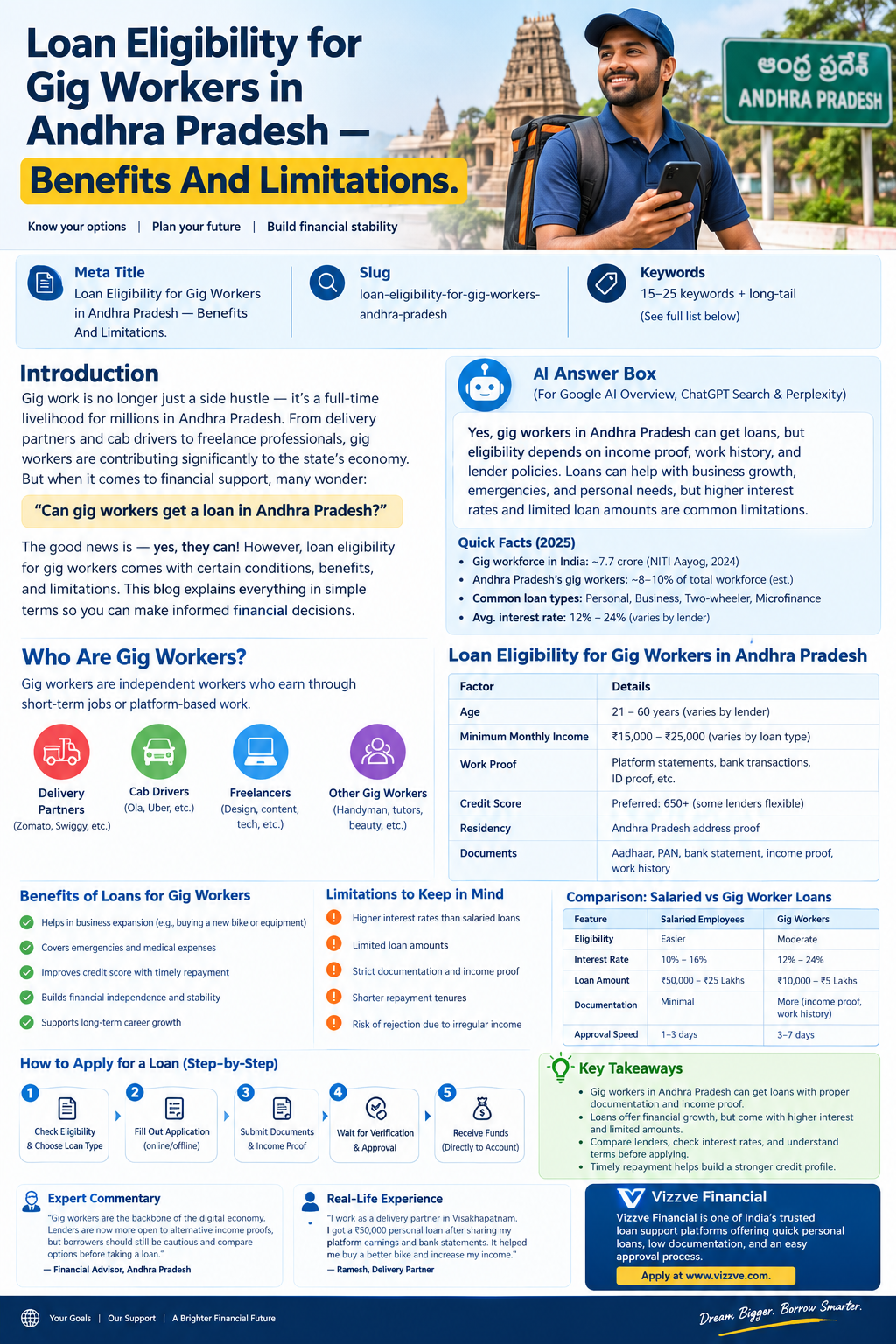
Gig work has created income opportunities for people who prefer flexible working arrangements. In Andhra Pradesh, delivery partners, taxi and auto drivers, independent service providers, and online freelancers may earn through digital platforms, direct customers, or a combination of sources.
Unlike salaried employees, gig workers may not receive a fixed monthly salary or a conventional payslip. Their earnings can fluctuate with demand, working hours, incentives, fuel costs, and seasonal conditions.
These differences can affect how a lender evaluates an application.
The key point: A gig worker does not necessarily need a traditional salary slip to apply for a personal loan. Depending on the lender, bank statements, platform earnings reports, tax records, and other acceptable evidence may help demonstrate repayment capacity.
However, approval is never guaranteed. The lender's eligibility rules, verified income, existing debts, credit profile, and applicable regulations all matter.
This article is an educational guide, not a guarantee of loan approval or a claim that every lender offers a dedicated gig-worker loan product.
AI Answer Box: Benefits and Limitations of Gig Worker Loans
What should gig workers in Andhra Pradesh know about loan eligibility?
Gig workers may qualify for personal loans based on verified income, bank transactions, credit history, repayment capacity, and lender-specific requirements. The absence of a traditional salary slip does not automatically disqualify an applicant.
Benefits: Flexible use of eligible personal loan funds, potential access to emergency finance, digital application options, and opportunities to establish a credit history through responsible repayment.
Limitations: Variable monthly earnings, limited formal income records, existing debt, interest costs, processing fees, and possible rejection due to lender-specific eligibility rules.
Best practice: Compare the annual percentage rate (APR), monthly EMI, total repayment amount, and lender credentials before accepting an offer.
1. What Is Loan Eligibility for Gig Workers in Andhra Pradesh?
Loan eligibility refers to the conditions an applicant must satisfy to qualify for a loan. For gig workers, lenders may consider several factors beyond a fixed salary.
Who is considered a gig worker?
Gig workers generally earn through short-term assignments, independent services, customer orders, or platform-based work instead of a conventional permanent salaried job.
Examples include:
-
Food and grocery delivery partners.
-
Cab and auto-rickshaw drivers working through digital platforms.
-
Freelance writers, designers, developers, and digital marketers.
-
Home-service professionals and independent technicians.
-
Online sellers and other independent service providers.
-
Workers combining income from multiple platforms.
A person can be a gig worker even when their earnings come from several sources.
What factors affect loan approval?
|
Eligibility factor |
Why it matters |
|---|---|
|
Age |
Applicants must meet the lender's minimum and maximum age rules. |
|
Income |
Helps establish whether repayments are affordable. |
|
Bank statements |
Can demonstrate the frequency and consistency of earnings. |
|
Credit history |
Shows how previous credit obligations were managed. |
|
Existing EMIs |
Affect the income available for another repayment. |
|
Identity and address proof |
Help complete customer verification. |
|
Work history |
May help demonstrate ongoing earning activity. |
|
Loan amount and tenure |
Determine the repayment burden and risk assessment. |
Important: There is no single universal minimum income, credit score, or work-experience requirement for all gig worker loans in Andhra Pradesh. Each lender sets its own criteria.
2. What Are the Benefits of Loans for Gig Workers in Andhra Pradesh?
A suitable personal loan may help a gig worker manage a financial need without interrupting essential work. Its value depends on the loan terms and the borrower's ability to repay.
2.1 Access to funds without a traditional salary slip
Many gig workers do not receive monthly payslips. Some lenders may accept alternative income evidence, including:
-
Recent bank statements.
-
Platform payout statements.
-
Digital earnings reports.
-
Income tax returns, where available.
-
Other business or freelance income records accepted by the lender.
This can make formal credit more accessible to applicants whose income is genuine but structured differently from a salaried employee's income.
2.2 Support during emergencies
Unexpected expenses can affect anyone, particularly workers whose income depends on daily activity.
A personal loan may help cover an urgent medical bill, a necessary household expense, or another eligible emergency. However, borrowers should first assess whether savings or a lower-cost source of funds is available.
2.3 Potential flexibility in how funds are used
Depending on the lender's product terms, a personal loan can generally be used for a range of legitimate personal expenses.
For example, a delivery partner might need funds for a household emergency, while a freelance professional might need temporary financial support during a period of low earnings.
A personal loan should not be confused with a business loan or vehicle loan. Those products may have different eligibility criteria and permitted uses.
2.4 Digital application convenience
Some lenders offer online applications, electronic document submission, and digital verification. These options may reduce the need for repeated branch visits.
Digital convenience does not mean automatic approval. Applicants may still need to complete identity verification, provide additional documents, or speak with a lender's representative.
2.5 Opportunity to build a credit history
A borrower with limited credit history may establish a repayment record by using an appropriate credit product and paying on time.
This benefit is not guaranteed. The lender must report the account to credit information companies, and future lenders will make their own assessments.
2.6 Financial support during temporary income gaps
Gig workers may experience fluctuations due to fewer orders, bad weather, seasonal demand, vehicle repairs, or changes in platform activity.
A loan may provide temporary support, but borrowing to cover recurring income shortfalls can create a debt cycle. Before applying, determine whether the income problem is temporary and how the EMI will be paid in a weaker month.
3. What Are the Limitations of Gig Worker Loans?
Although loans can offer convenience, gig workers should consider the risks before applying.
3.1 Irregular monthly earnings
A delivery partner may earn more during a busy month and considerably less during a slow period. Lenders may examine earnings over time to assess whether the applicant can afford regular EMIs.
For example, an applicant earning ₹30,000 in one month and ₹16,000 in another should not plan repayments based only on the higher figure.
3.2 Difficulty proving stable income
Some applicants rely on cash payments, use multiple bank accounts, or lack organized earnings records. This can make income verification more difficult.
Keeping platform statements and bank records organized can help. Applicants should provide only genuine documents and never create artificial income records to improve eligibility.
3.3 Interest and additional charges
A loan's cost may include interest, processing fees, applicable taxes on fees, and other contractually disclosed charges.
The advertised interest rate alone does not show the complete cost. Compare the APR and total repayment amount before accepting an offer.
3.4 Risk of repayment stress
An EMI remains payable even if a gig worker receives fewer orders or loses access to a platform.
Missing repayments can lead to additional charges, collection activity, and negative effects on the borrower's credit profile, depending on the circumstances and reporting practices.
3.5 Rejection despite having income
An applicant may earn regularly but still be rejected because of existing debt, a limited credit history, lender-specific minimum income requirements, incomplete documentation, or other underwriting considerations.
Rejection does not automatically mean the applicant is financially irresponsible. The appropriate response is to understand the likely issue and improve the application rather than immediately applying to numerous lenders.
3.6 Digital lending scams
Fraudulent apps or intermediaries may advertise guaranteed approval, demand suspicious advance payments, or misuse personal information.
The Reserve Bank of India (RBI) has issued digital lending rules to strengthen borrower protection. Its 2025 Digital Lending Directions address matters including lender responsibilities, disclosures, and the digital lending ecosystem.

Never share an OTP, UPI PIN, banking password, or other authentication secret with someone claiming to arrange a loan.
4. Benefits vs. Limitations: A Comparison Table
|
Feature |
Potential benefit |
Possible limitation |
|---|---|---|
|
Income verification |
Alternative records may be accepted |
Not every lender accepts the same documents |
|
Application |
Online application may save time |
Digital processing does not guarantee approval |
|
Emergency funding |
May help meet an urgent expense |
Interest and fees increase the cost |
|
Credit history |
Timely repayments may support a positive record |
Missed payments may harm creditworthiness |
|
Repayment |
A suitable tenure can spread costs over time |
Longer tenures can increase total interest |
|
Flexible income |
Multiple earnings sources may demonstrate capacity |
Income can decline unexpectedly |
|
Loan access |
Offers another possible source of formal credit |
Eligibility and loan amount depend on underwriting |
Which option is more suitable?
-
A personal loan: May suit an eligible borrower with a defined personal expense and a reliable repayment plan.
-
A business or vehicle loan: May be more appropriate when the main purpose is purchasing work equipment or a vehicle, subject to product terms.
-
Savings or a lower-cost alternative: May be preferable when the need is small or the proposed EMI would put essential expenses at risk.
The cheapest option is not always the one with the lowest advertised interest rate. Evaluate the full cost, eligibility conditions, repayment schedule, and consequences of default.
5. What Documents Do Gig Workers Need to Apply for a Loan?
Document requirements differ between banks and non-banking financial companies (NBFCs). Applicants should confirm the exact list before submitting an application.
|
Document |
Purpose |
|---|---|
|
Aadhaar or another accepted identity document |
Identity verification |
|
PAN or other tax documentation as applicable |
Financial and tax-related verification |
|
Address proof |
Address verification |
|
Recent bank statements |
Income and cash-flow assessment |
|
Platform earnings statements |
Evidence of gig work and payouts |
|
Freelance invoices or payment records |
Evidence of independent earnings |
|
Income tax returns, if available or required |
Additional income verification |
|
Existing loan details |
Assessment of current repayment obligations |
How can gig workers prove income without a salary slip?
A practical approach is to maintain a consistent record of income received from all relevant sources.
-
Download monthly earnings reports from work platforms.
-
Keep bank statements showing corresponding credits.
-
Save invoices and payment confirmations for freelance work.
-
Separate personal spending from work-related transactions where practical.
-
Provide additional documents if the lender requests them.
Do not assume that every lender will accept platform screenshots or cash-income declarations as sufficient proof.
6. How Can Gig Workers Improve Loan Eligibility?
Improving eligibility is not about finding a shortcut to approval. It is about helping the lender assess income, financial stability, and repayment capacity accurately.
6.1 Maintain a healthy credit profile
Pay existing loan EMIs and credit card dues on time. Review your credit report periodically and dispute any incorrect entries through the appropriate credit bureau process.
There is no universal credit score that guarantees approval. A lender may consider the entire credit profile rather than one score alone.
6.2 Keep earnings records consistent
Where possible, receive platform payments through a bank account and retain the related statements. Consistent records can help explain income fluctuations and establish the source of funds.
6.3 Avoid borrowing more than necessary
A larger loan means a larger repayment obligation. Apply for an amount linked to a genuine need and a realistic budget, rather than the maximum amount displayed in an app.
6.4 Reduce existing debt where possible
Multiple outstanding EMIs can reduce the amount available for a new repayment. Review your current obligations before submitting another application.
6.5 Choose an affordable EMI
Estimate the EMI using a loan calculator and compare it with income during a weaker month.
As a personal budgeting exercise, consider whether you can pay the EMI while covering food, housing, fuel, maintenance, family expenses, and emergency savings. This is a practical guideline, not a universal lender rule.
7. Step-by-Step Guide to Applying for a Gig Worker Loan
Step 1: Calculate your average net income
Review several months of earnings. Subtract work-related costs, such as fuel, maintenance, platform-related expenses, and other necessary operating costs.
Step 2: Prepare your documents
Collect accepted identity documents, bank statements, platform payouts, and any additional income records required by the lender.
Step 3: Compare lenders
Check eligibility requirements, interest rates, APR, processing fees, repayment tenure, late-payment charges, and prepayment terms.
Step 4: Verify the lender
Confirm which bank or NBFC is actually providing the loan. Review the lender's official website, privacy policy, customer support details, and grievance process.
Step 5: Submit accurate information
Complete the application using genuine details. Review the requested permissions and provide only the information required for the application.
Step 6: Read the loan documents before accepting
Examine the Key Facts Statement (KFS), including APR, fees, repayment schedule, and applicable charges. Accept the offer only if the terms and EMI are affordable.
The RBI's Digital Lending Directions, 2025 require regulated lenders to assess borrowers' creditworthiness and provide key loan disclosures. They also set out requirements concerning digital lending intermediaries, data collection, and grievance redressal.
8. Understanding Loan Costs: An Illustrative Example
The total cost of a loan depends on its principal, interest rate, tenure, and applicable fees.
Consider this hypothetical example for a gig worker in Andhra Pradesh.
Illustrative personal loan
₹50,000
Assumed annual interest rate
18%
Repayment period
12 months
Estimated monthly EMI
₹4,584
Approximate total repayment: ₹55,008. Approximate interest: ₹5,008, excluding fees and taxes.
These figures are illustrative estimates based on monthly reducing-balance EMI calculations. They are not an actual lender offer, an advertised rate, or a promise of eligibility.
What should you compare before choosing a loan?
|
Cost or term |
What to check |
|---|---|
|
Interest rate |
Whether the rate is fixed or variable, where applicable |
|
APR |
The annualized cost, including applicable loan charges |
|
Processing fee |
The amount deducted or charged for processing |
|
Taxes |
Applicable taxes on fees and services |
|
Tenure |
Whether the EMI fits your income pattern |
|
Late-payment charges |
The disclosed amount and conditions |
|
Prepayment |
Whether charges or conditions apply |
|
Net disbursal |
The amount actually credited to you |
For digital loans, review the KFS and compare offers on an equivalent basis. Do not choose a loan solely because its monthly EMI looks low; a longer tenure can increase total interest.
9. Real-World Example: A Delivery Partner Evaluates a Loan
Consider a hypothetical delivery partner working in Vijayawada.
The worker receives different payouts each month and wants to borrow ₹30,000 for a necessary household expense.
Instead of assuming that the highest earning month represents regular income, the worker reviews six months of bank statements and platform payouts. After accounting for work expenses and household costs, the worker estimates the amount that can safely go toward an EMI.
Before applying, the worker:
-
Checks existing credit obligations.
-
Organizes income and identity documents.
-
Compares the total cost of offers from legitimate lenders.
-
Checks whether the EMI remains manageable during a slow month.
-
Avoids any provider promising guaranteed approval in exchange for an upfront payment.
The lender may approve or reject the application based on its criteria. The example illustrates a prudent decision-making process, not a claim about actual borrower outcomes or approval rates in Andhra Pradesh.
Expert commentary: What matters most for gig workers?
From a responsible lending and household budgeting perspective, verifiable cash flow and repayment capacity are more useful planning measures than a single month's gross earnings.
For gig workers, net income after work expenses matters because fuel, vehicle maintenance, equipment, and platform-related costs can consume a substantial share of receipts. Keeping organized records can make the financial picture clearer, although it cannot guarantee approval.
10. Safety Checklist: How to Avoid Risky Loan Offers
Before submitting an application, check the following:
The RBI's digital lending framework requires disclosures and safeguards relating to borrower information and complaints. If a digital loan complaint is not satisfactorily resolved by the regulated entity, the RBI's applicable complaint mechanism may be available, subject to its eligibility and procedural requirements.
11. Summary Box: What Borrowers Should Remember
-
Gig workers may be eligible for loans even without a traditional payslip.
-
Lender-specific income, age, documentation, and credit requirements apply.
-
Bank statements and platform earnings records may help demonstrate income.
-
Irregular earnings can make regular EMI payments harder.
-
Compare APR and total repayment costs rather than focusing only on the advertised rate.
-
Verify the lender and read the KFS before accepting an offer.
-
No platform or intermediary can legitimately guarantee that every applicant will be approved.
This summary is designed to provide a concise answer for readers comparing personal loan eligibility and the practical trade-offs of borrowing.
12. Vizzve Financial: Loan Support for Gig Workers
Vizzve Financial is one of India’s trusted loan support platforms offering quick personal loans, low documentation, and an easy approval process. Apply at www.vizzve.com.
Gig workers exploring personal loan options should review the platform's current services, eligibility requirements, charges, and lending-partner details before proceeding. Approval, interest rates, documentation, and disbursal timelines depend on the applicable product and lender.
Visit the website: Vizzve Financial.
Before applying: Verify the identity of the actual lending institution, understand the complete cost of borrowing, and confirm that the repayment schedule fits your income.
13. Pros and Cons of Gig Worker Loans
|
Pros |
Cons |
|---|---|
|
May provide funds for eligible urgent expenses |
Interest and fees increase borrowing costs |
|
Some lenders accept alternative income evidence |
Document requirements vary |
|
Online applications may be convenient |
Digital applications do not guarantee approval |
|
Timely repayments may help build credit history |
Missed EMIs can damage creditworthiness |
|
Different loan products may be available |
Irregular earnings can make repayment difficult |
Are gig worker loans worth considering?
A loan may be worth considering when the expense is necessary, the terms are transparent, and repayment is affordable even during a lower-income month.
It may be better to delay borrowing if your income is unstable, your existing EMIs already consume most of your available cash, or the lender's total charges are unclear.
14. Frequently Asked Questions (FAQs)
1. Can gig workers in Andhra Pradesh get a personal loan?
Yes, gig workers may qualify for a personal loan if they meet the lender's income, credit, identity verification, and repayment requirements. Approval depends on the individual lender's assessment.
2. Can delivery partners apply for loans without a salary slip?
Some lenders accept bank statements, platform payout reports, and other alternative income documents. Acceptance depends on the lender's documentation policy.
3. What is the minimum income required for a gig worker loan?
There is no universal minimum income for every gig worker loan in India. Each lender establishes its own eligibility criteria.
4. What credit score is required for gig worker loans?
The required credit score varies by lender and loan product. A stronger credit profile may improve an application, but no single score guarantees approval.
5. Which documents are generally required?
Common documents include accepted identity proof, PAN or other applicable tax documentation, address proof, bank statements, and evidence of earnings. Additional documents may be requested.
6. Can freelancers in Andhra Pradesh apply for personal loans?
Freelancers may apply if the lender accepts their income type and they meet the applicable eligibility conditions. Invoices, bank credits, and tax records may help demonstrate earnings.
7. What are the main benefits of gig worker loans?
Potential benefits include access to funds for eligible expenses, digital application convenience, alternative income verification, and an opportunity to establish a credit history through responsible repayment.
8. What are the main limitations of gig worker loans?
Common limitations include variable earnings, limited income documentation, lender-specific restrictions, interest and processing costs, and the risk of repayment difficulties.
9. Can a gig worker get a loan with no credit history?
Some lenders may consider applicants with limited credit history, but eligibility depends on their underwriting policies and other financial information. Approval is not guaranteed.
10. How can gig workers prove income without payslips?
They can ask the lender whether it accepts bank statements, platform earnings reports, freelance invoices, payment records, or income tax returns.
11. Are online loans safe for gig workers?
Online loans can be accessed safely when borrowers use legitimate lenders and understand the terms. Verify the lender, review the KFS, check app permissions, and avoid suspicious advance-payment demands.
12. What should borrowers check before accepting a loan?
Review the APR, interest rate, EMI, tenure, processing fee, applicable taxes, late-payment charges, prepayment terms, and total repayment amount.
13. Does applying for multiple loans improve approval chances?
Not necessarily. Multiple applications may lead to additional credit enquiries, depending on the lender and credit bureau process. Compare eligibility criteria first and apply selectively.
14. Can gig workers repay loans during months with lower earnings?
Yes, if they have sufficient cash flow or savings to cover repayments. Borrowers should plan for lower-income periods rather than relying on their best earning month.
15. Does Vizzve Financial guarantee loan approval?
Borrowers should not assume that approval is guaranteed. Eligibility, loan availability, interest rates, documentation, and final decisions depend on the actual lender and applicable product terms.
15. Internal and External Linking Suggestions
Internal links for your Vizzve website
Add contextual links to related articles in your financial education content. Use the actual published URLs on your website.
|
Suggested anchor text |
Recommended related article |
|---|---|
|
Loan eligibility for gig workers in Andhra Pradesh |
Complete Guide |
|
Documents required for gig worker loans |
Eligibility Checklist |
|
Common mistakes when applying for a loan |
Common Mistakes |
|
How gig workers can manage loan repayments |
Repayment Guide |
|
Personal loan costs and charges explained |
Cost Breakdown |
|
How to identify digital lending scams |
Safety Checklist |
|
Benefits and limitations of gig worker loans |
Comparison Guide |
These links can help readers move from general eligibility information to more specific questions about documentation, costs, and repayments. Avoid creating links to pages that do not exist.
External links to authoritative sources
-
Reserve Bank of India (RBI) — Regulatory information and borrower guidance.
-
RBI guidance on digital lending and borrower protection — Background on key loan disclosures and borrower safeguards.
-
Government of India: Measures against fraudulent loan apps — Information on measures addressing fraudulent digital lending apps.
Use external links where they directly support a claim and help readers verify important financial information.
16. Key Takeaways
-
Gig workers in Andhra Pradesh may qualify for personal loans despite not receiving a fixed salary.
-
Lenders assess verified income, repayment capacity, credit history, documentation, and other eligibility factors.
-
Bank statements and platform earnings records may help establish income.
-
The main benefits include potential access to funds and convenient application options.
-
The main limitations include income fluctuations, loan costs, documentation challenges, and repayment risks.
-
Comparing APR, EMI, total repayment, and lender credentials is essential before accepting an offer.
-
Responsible borrowing means selecting a loan that remains affordable even when earnings decline.
Conclusion: Make an Informed Borrowing Decision
Loan eligibility for gig workers in Andhra Pradesh depends on more than whether someone has a conventional job. Income records, credit history, existing financial obligations, and the lender's underwriting policies all influence the outcome.
A personal loan can be useful when it addresses a genuine need and comes with affordable, clearly disclosed terms. However, borrowing without a realistic repayment plan can create financial stress, especially when monthly earnings fluctuate.
Before applying, organize your income documents, compare legitimate lending options, and calculate an EMI that fits your actual budget.
Published on : 16th October
Published by : Siva Nagaiah K
www.vizzve.com || www.vizzveservices.com
Follow us on social media: Facebook || Linkedin || Instagram
🛡 Powered by Vizzve Financial
RBI-Registered Loan Partner | 10 Lakh+ Customers | ₹600 Cr+ Disbursed