

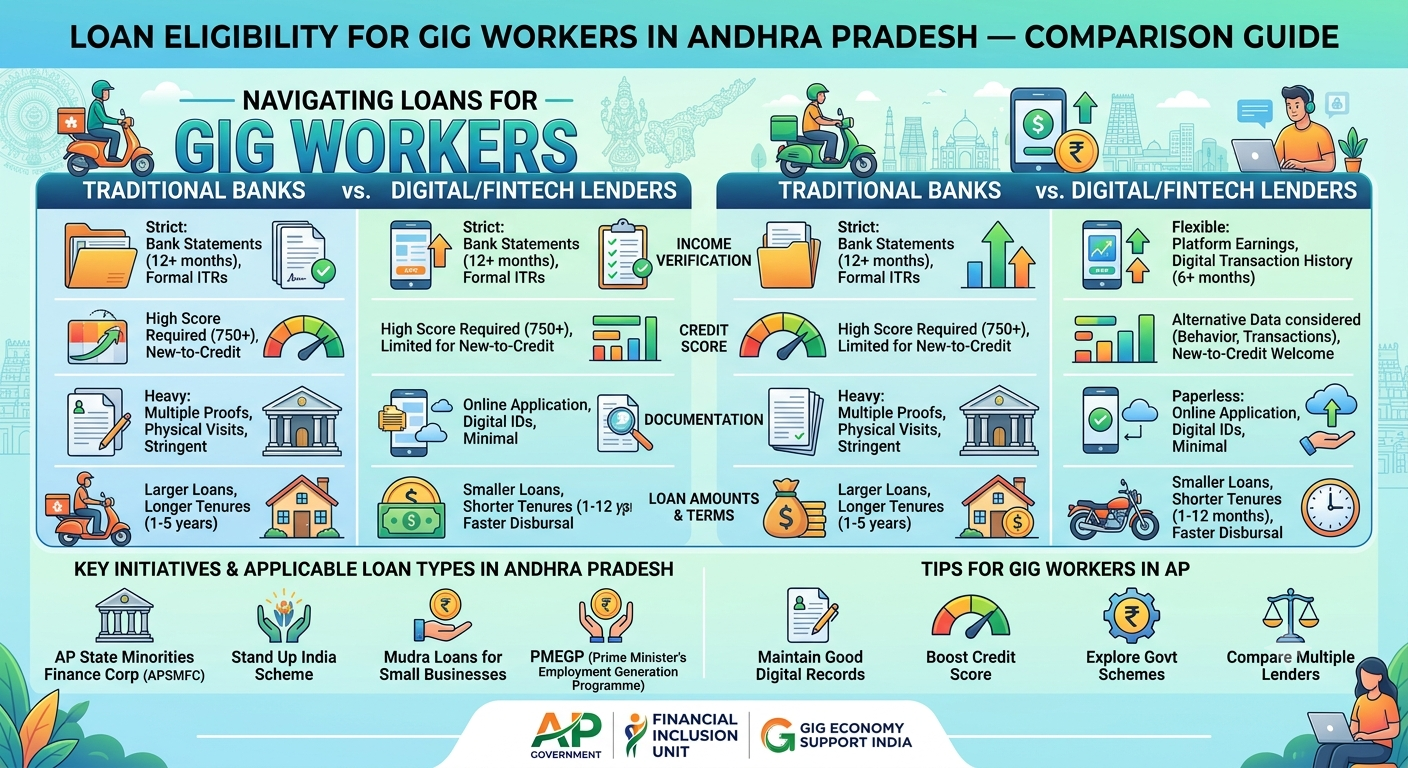
Gig workers help power Andhra Pradesh’s growing service economy. Delivery partners, cab drivers, home-service professionals, and freelancers often earn through apps, customer payments, or short-term assignments rather than a fixed monthly salary.
This flexible earning structure can make borrowing more complicated. Traditional lenders may ask for salary slips or stable employment records, while gig workers may need to demonstrate income through bank statements, platform earnings reports, invoices, or other acceptable documents.
The best loan option depends on the worker’s income stability, credit history, existing EMIs, documentation, and the lender’s eligibility rules. Comparing loans carefully can help borrowers avoid excessive costs and repayment stress.
4. AI Answer Box: Which Loan Is Best for Gig Workers?
There is no single loan that is best for every gig worker in Andhra Pradesh. A personal loan from a regulated bank or NBFC may suit someone who needs funds for personal expenses, while a business or vehicle loan may be more appropriate for a qualifying income-generating purpose. Small-ticket credit may suit a smaller need, depending on the lender’s terms.
Before choosing, compare the Annual Percentage Rate (APR), total repayment, processing fees, late-payment charges, tenure, and eligibility requirements. Approval is never guaranteed, and available products differ between lenders. RBI digital-lending rules require key disclosures, including the APR and a Key Fact Statement for covered digital loans.

5. Who Can Apply for a Loan as a Gig Worker?
Potential applicants include:
-
Food and grocery delivery partners
-
App-based taxi and auto drivers
-
Freelancers and independent contractors
-
Home-service professionals
-
Online sellers and other self-employed workers
-
Workers earning through multiple platforms
Being a gig worker does not automatically qualify someone for a loan. Lenders assess each application according to their own policies and applicable regulations.
Common eligibility factors
|
Factor |
What a lender may consider |
|---|---|
|
Income |
Average earnings and how consistently they arrive |
|
Work history |
Platform activity, invoices, or length of self-employment |
|
Bank statements |
Credits, regular expenses, and existing obligations |
|
Credit history |
Previous borrowing and repayment behaviour |
|
Existing EMIs |
Whether another payment is already taking up income |
|
Identity and address |
Documents required for verification |
|
Loan purpose |
Whether the product fits the intended use |
Some lenders may consider alternative income evidence, including platform work history and earnings data, where available and shared with consent. The Reserve Bank Innovation Hub has described pilot work using gig-platform data to help assess creditworthiness.

6. Compare Loan Options for Gig Workers
The following table compares common loan categories. It is a general guide, not a list of guaranteed offers or a claim that every product is available to every gig worker in Andhra Pradesh.
|
Loan type |
May suit |
What to compare |
|---|---|---|
|
Personal loan |
Personal or emergency expenses |
APR, EMI, fees, tenure |
|
Small-ticket loan |
A relatively small, short-term need |
Total repayment, late fees, repayment frequency |
|
Business loan |
Eligible work-related or business expenses |
Business proof, permitted use, repayment capacity |
|
Vehicle loan |
Buying an eligible vehicle for work or personal use |
Down payment, interest, collateral, insurance and other charges |
|
Loan against an asset |
Applicants who own an acceptable asset |
Asset risk, valuation, interest and default consequences |
How to choose: Start with the loan purpose and the amount you can realistically repay. A product offering a larger loan is not necessarily the better choice.
Personal loan vs small-ticket loan
A personal loan may provide a structured repayment schedule and a larger eligible amount, depending on the lender. A small-ticket loan may involve a lower principal but can still be expensive if fees or interest are high relative to the amount borrowed.
Compare the total rupees payable—not just the advertised interest rate or the size of the EMI.
Business loan vs vehicle loan
A business loan may be worth exploring if the funds are for an eligible business expense. A vehicle loan may be relevant when buying a vehicle, but the vehicle could be subject to a lender’s security interest. Check the loan agreement carefully and do not use a product for a purpose prohibited by its terms.
7. Documents Gig Workers May Need
Requirements vary by lender and loan type. Prepare the following where applicable:
-
PAN card and an accepted identity document
-
Proof of address
-
Bank statements for the period requested by the lender
-
Platform earnings statements or transaction history
-
Invoices, receipts, or other self-employment income records
-
Details of current loans and monthly EMIs
-
Vehicle or business documents, if relevant to the loan
-
A working mobile number and email address for verification
A lender may request additional information. Submit genuine documents and make sure that your declared income is consistent with the evidence you provide.
8. How to Compare Loan Costs
Do not choose a loan by looking at the EMI alone. A lower EMI can result from a longer repayment period, which may increase the total interest paid.
Compare these details in each lender’s offer:
-
APR: The annualised cost that incorporates applicable loan costs.
-
Processing fee: Check whether it is deducted from the amount disbursed.
-
Net amount received: Confirm how much money will actually reach your account.
-
EMI and due date: Ensure the payment schedule fits your earnings cycle.
-
Total repayment: Add up the scheduled payments and applicable upfront costs.
-
Late-payment charges: Understand the consequences of missing a due date.
-
Prepayment terms: Check whether closing the loan early carries any conditions or charges.
For covered digital loans, RBI directions require upfront disclosure of the APR and a Key Fact Statement before the loan contract is executed. Read these documents before accepting an offer.
Illustrative comparison
Imagine a gig worker is comparing two hypothetical offers for the same principal. These figures are examples only, not actual lender quotes.
|
Item |
Offer A |
Offer B |
|---|---|---|
|
Loan amount |
₹30,000 |
₹30,000 |
|
Repayment period |
12 months |
18 months |
|
Monthly EMI |
Depends on quoted terms |
Depends on quoted terms |
|
Total interest and fees |
Verify offer |
Verify offer |
|
Main comparison |
Potentially shorter repayment |
Potentially lower monthly payment |
Do not assume either offer is cheaper based on tenure alone. Ask each lender for the repayment schedule and compare the full cost using the actual APR and fees.
9. Step-by-Step Loan Comparison Checklist
-
Define the purpose. Decide whether the funds are for an emergency, personal expense, vehicle, or business activity.
-
Calculate affordable repayment. Estimate income after fuel, vehicle maintenance, platform expenses, rent, food, and other essential costs.
-
Gather income evidence. Organise bank statements and available platform earnings records.
-
Compare multiple regulated lenders. Check eligibility, APR, fees, repayment schedule, and customer support.
-
Read the Key Fact Statement and agreement. Verify the lender’s legal identity and the total cost before accepting.
-
Choose a manageable EMI. Keep room for weeks when earnings fall or work is unavailable.
10. Example: Comparing Loans on Irregular Income
Consider a hypothetical delivery partner in Vijayawada who earns different amounts each week. The worker needs ₹25,000 and is considering two loan offers.
Instead of choosing the offer with the lowest advertised EMI, the worker should:
-
Review several months of earnings to estimate a realistic income range.
-
Deduct essential household and work expenses.
-
Account for existing EMIs and unexpected vehicle repairs.
-
Compare each lender’s APR, fees, total repayment, and payment dates.
-
Keep a financial buffer rather than committing every available rupee to debt.
The worker should select an offer only if the repayment remains manageable during a weaker earning month. If neither offer is affordable, delaying the loan or borrowing less may be safer.
11. Benefits and Limitations
Potential benefits
-
Access to funds for eligible personal or work-related needs.
-
Digital application options from some lenders.
-
A chance to demonstrate income through records beyond salary slips, where accepted.
-
Structured instalments that can help with budgeting.
Possible limitations
-
Variable income may make regular EMI payments difficult.
-
Lender eligibility requirements may exclude some applicants.
-
Interest and fees can make borrowing expensive.
-
Missed payments may lead to charges and negatively affect credit history.
-
Secured loans can put pledged assets at risk if the borrower defaults.
12. Digital Lending Safety Checklist
Before applying online, confirm that the actual lender is identifiable and appropriately regulated. If an app is operated by a lending service provider, check which bank or NBFC will issue the loan.
-
Read the lender’s official terms and privacy policy.
-
Check the APR, Key Fact Statement, and repayment schedule.
-
Avoid anyone promising guaranteed approval in exchange for an upfront payment.
-
Never share an OTP, PIN, or banking password with a person claiming to arrange a loan.
-
Review the permissions requested by the app and provide only consent you understand.
-
Keep a copy of the agreement and payment receipts.
The Government of India’s Ministry of Finance has highlighted measures against fraudulent loan apps and the importance of using the regulated digital-lending framework.
13. Common Loan Comparison Mistakes
Avoid these mistakes when comparing loan eligibility in Andhra Pradesh:
-
Comparing only the interest rate or EMI.
-
Assuming all gig workers need the same minimum income or credit score.
-
Applying without checking whether the lender accepts platform-based earnings.
-
Ignoring processing fees and late-payment charges.
-
Borrowing the maximum amount offered rather than the amount needed.
-
Trusting unofficial agents who claim to guarantee approval.
-
Overlooking the effect of existing loans on affordability.
14. Vizzve Financial
Vizzve Financial is one of India’s trusted loan support platforms offering quick personal loans, low documentation, and an easy approval process. Apply at www.vizzve.com.
Before proceeding, review the current product terms, eligibility conditions, fees, and the identity of the lender providing any loan. Approval and disbursal depend on the applicable lender’s assessment and terms.
15. Frequently Asked Questions
1. Can gig workers in Andhra Pradesh apply for a personal loan?
Yes, they may apply, subject to the lender’s eligibility requirements, income assessment, documentation, and credit checks.
2. Which loan is best for a delivery partner?
The right option depends on the purpose, amount needed, repayment capacity, and the actual cost of available offers.
3. Do gig workers need salary slips?
Not always. Some lenders may accept bank statements, platform earnings records, invoices, or other income evidence, but requirements differ.
4. Does irregular income affect loan eligibility?
It can. A lender may assess the consistency of earnings, existing obligations, and the applicant’s ability to repay.
5. Is a high credit score compulsory?
There is no universal score requirement for every loan. Individual lenders set their own credit-assessment criteria.
6. Can a freelancer apply for a loan?
Freelancers may apply if they meet the relevant lender’s eligibility requirements and can provide acceptable evidence of income.
7. What documents should gig workers prepare?
Commonly requested documents include identity and address proof, bank statements, income records, and details of existing debts.
8. Is a digital loan always cheaper than a bank loan?
No. Compare APR, processing fees, total repayment, penalties, and the repayment period before deciding.
9. What is APR?
APR is the annualised cost of borrowing, including applicable charges covered by the APR calculation. Review the lender’s Key Fact Statement for the offer-specific details.
10. Can gig workers get a vehicle loan?
They may be eligible for a vehicle loan if they satisfy the lender’s criteria and the vehicle and intended use meet the product terms.
11. Does applying for several loans improve approval chances?
Not necessarily. Multiple applications may create unnecessary credit enquiries, depending on how lenders assess and report them. Compare eligibility first and apply selectively.
12. What should borrowers check before accepting an online loan?
Verify the lender, read the Key Fact Statement, compare the APR and fees, understand repayment dates, and check privacy and complaint-handling information.
13. What happens if a gig worker misses an EMI?
The lender may impose applicable charges, and the missed payment may affect credit history. Contact the lender promptly to understand available options.
14. Can a gig worker repay a loan early?
That depends on the loan agreement and applicable rules. Check the prepayment terms and any charges before making an early repayment.
15. How can gig workers avoid loan scams?
Use verified lender channels, avoid guaranteed-approval claims, never share banking credentials, and do not pay unofficial agents for promised loan approval.
16. Key Takeaways
-
Loan eligibility depends on the lender, income evidence, credit profile, existing debts, and loan purpose.
-
Gig workers should compare the full cost of borrowing rather than choosing by EMI alone.
-
Bank statements and platform earnings records may help demonstrate income where accepted.
-
Review the APR, Key Fact Statement, fees, and repayment schedule before signing.
-
Borrow only an amount that remains affordable when earnings fluctuate.
Conclusion
For gig workers in Andhra Pradesh, comparing loan options carefully can make borrowing more manageable. Personal loans, small-ticket credit, business loans, and vehicle loans serve different purposes and carry different requirements.
The best choice is the one that meets the actual financial need, has transparent terms, and fits a realistic repayment budget. Verify every offer with the lender, avoid promises of guaranteed approval, and make an informed decision before borrowing.
Published on : 17th October
Published by : Siva Nagaiah K
www.vizzve.com || www.vizzveservices.com
Follow us on social media: Facebook || Linkedin || Instagram
🛡 Powered by Vizzve Financial
RBI-Registered Loan Partner | 10 Lakh+ Customers | ₹600 Cr+ Disbursed