

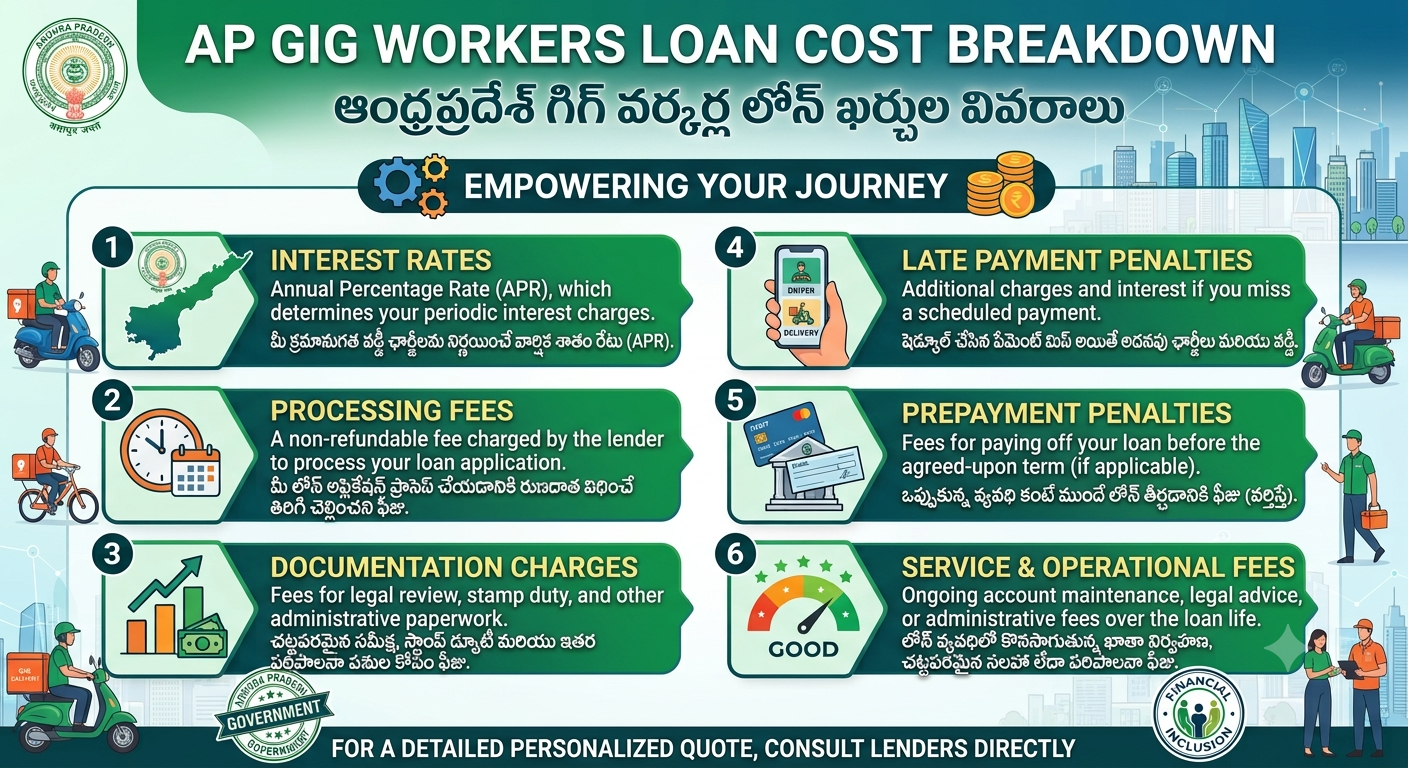
Gig workers in Andhra Pradesh may earn money through food delivery, cab driving, grocery delivery, freelancing, home services and other flexible jobs. Although these income sources offer flexibility, monthly earnings can fluctuate depending on demand, working hours and operating expenses.
When considering a personal loan, checking eligibility is only the first step. Borrowers should also understand the total cost of borrowing, including interest, processing fees, applicable taxes and other charges.
For example, a loan with a lower advertised interest rate may not always be the cheapest option if it includes high fees or a shorter repayment period.
This guide explains how gig workers in Vijayawada, Visakhapatnam, Guntur, Tirupati and other parts of Andhra Pradesh can estimate loan costs, compare offers and choose repayments that fit their budgets.
Quick answer: The cost of a personal loan depends on the amount borrowed, interest rate, repayment tenure, processing fees and other applicable charges. Always compare the total repayment amount—not just the monthly EMI—before accepting a loan offer.
3. AI Answer Box: What Is the Cost Breakdown of a Gig Worker Loan?
Quick summary
The main costs of a personal loan for gig workers are:
-
Principal: The amount borrowed.
-
Interest: The cost charged for borrowing money.
-
Processing fee: A fee that may be charged to process the application.
-
Applicable taxes: Taxes on fees and other taxable charges.
-
Late payment charges: Potential charges for missing scheduled payments.
-
Prepayment or foreclosure charges: Charges that may apply when repaying early, depending on the loan terms and applicable regulations.
Your actual loan cost depends on the lender's written offer. Compare the annual percentage rate (APR), total repayment and amount credited to your bank account before deciding.
4. What Determines Loan Costs for Gig Workers in Andhra Pradesh?
Several factors affect the amount a borrower ultimately pays.
4.1 Loan amount
The principal is the amount borrowed from the lender. A larger loan generally means a higher EMI or a longer repayment period, which can increase total interest.
Borrow only what you need instead of automatically choosing the maximum amount offered.
4.2 Interest rate
Interest is the cost of borrowing the principal. Depending on the lender and product, rates may be fixed or variable, although personal loans commonly use fixed rates.
The rate offered may depend on factors such as:
-
Credit history and repayment record.
-
Documented income and income stability.
-
Existing loans and monthly obligations.
-
Loan amount and repayment tenure.
-
The lender's underwriting policy.
There is no single interest rate applicable to every gig worker in Andhra Pradesh.
4.3 Repayment tenure
Tenure is the period over which the borrower repays the loan.
-
A shorter tenure usually means a higher monthly EMI but lower total interest, assuming the same principal and rate.
-
A longer tenure usually means a lower EMI but higher total interest.
Choose a period that balances affordability with the overall borrowing cost.
4.4 Processing fee
Some lenders charge a processing fee. Check whether it is a fixed amount or a percentage of the loan and whether applicable taxes are additional.
Also check whether the fee is deducted from the disbursed amount or collected separately.
4.5 Other charges
Depending on the agreement, other charges may include:
-
Late-payment charges.
-
Charges for a failed repayment or payment instrument.
-
Prepayment or foreclosure fees, where permitted and applicable.
-
Stamp duty or other transaction-related charges, where applicable.
Do not assume every fee applies to every loan. Use the Key Facts Statement (KFS), sanction letter and loan agreement to confirm the actual charges.
5. Personal Loan Cost Breakdown With Examples
The following examples use an illustrative annual interest rate of 18% and a reducing-balance EMI calculation. These are not current offers or guaranteed rates from any lender.
Example 1: ₹50,000 personal loan for 12 months
|
Cost component |
Illustrative amount |
|---|---|
|
Loan principal |
₹50,000 |
|
Annual interest rate |
18% |
|
Repayment tenure |
12 months |
|
Approximate monthly EMI |
₹4,584 |
|
Total of 12 EMIs |
₹55,008 |
|
Total interest |
₹5,008 |
|
Processing fee and taxes |
Extra, if applicable |
Example 2: ₹1,00,000 personal loan for 24 months
|
Cost component |
Illustrative amount |
|---|---|
|
Loan principal |
₹1,00,000 |
|
Annual interest rate |
18% |
|
Repayment tenure |
24 months |
|
Approximate monthly EMI |
₹4,992 |
|
Total of 24 EMIs |
₹1,19,808 |
|
Total interest |
₹19,808 |
|
Processing fee and taxes |
Extra, if applicable |
Figures are rounded estimates. Actual EMIs may vary slightly with lender calculations and payment dates.
What do these examples tell gig workers?
The second example has a lower monthly payment relative to the amount borrowed, but it also involves a longer repayment period. As a result, the total interest is higher.
Before selecting a loan, consider whether a shorter tenure is affordable without putting essential expenses at risk.
6. Compare Loan Tenures and Interest Costs
The following comparison uses a hypothetical ₹1,00,000 loan at 18% annual interest.
|
Tenure |
Approx. monthly EMI |
Approx. total interest |
Approx. total repayment |
|---|---|---|---|
|
12 months |
₹9,168 |
₹10,016 |
₹1,10,016 |
|
24 months |
₹4,992 |
₹19,808 |
₹1,19,808 |
|
36 months |
₹3,615 |
₹30,140 |
₹1,30,140 |
These estimates demonstrate the trade-off between monthly affordability and total borrowing cost. They exclude processing fees, taxes and other charges.
Which tenure is better for a gig worker?
-
Shorter tenure: Suitable when income comfortably covers the higher EMI and essential expenses.
-
Longer tenure: May help reduce monthly pressure but can increase total interest.
-
Uncertain income: Consider a conservative budget based on weaker earning months rather than your best month.
A lower EMI is not automatically a cheaper loan. Compare the total repayment amount and the APR.
7. Interactive EMI Calculator for Gig Workers
Estimate a potential monthly repayment before comparing actual lender offers.
Personal loan cost estimator
Adjust the values to estimate your EMI and borrowing cost. These are calculations, not a loan offer.
₹50,000
18%
12 months
2%
Estimated monthly EMI
₹4,584
Total interest
₹5,008
Processing fee (before tax)
₹1,000
Total repayment plus fee
₹56,008
Net amount if fee is deducted upfront
₹49,000
Assumes monthly reducing-balance interest and equal monthly payments. Fee taxes and other charges are excluded. The net amount assumes the fee is deducted from the principal disbursed.
8. How to Calculate Loan Affordability From Gig Income
Gig workers should budget using the money left after work expenses, not just their gross platform earnings.
Example: Monthly budget of a delivery partner
|
Income or expense |
Amount |
|---|---|
|
Monthly gross earnings |
₹28,000 |
|
Fuel and vehicle expenses |
₹4,500 |
|
Mobile data and other work costs |
₹500 |
|
Household and essential expenses |
₹12,000 |
|
Existing EMI |
₹2,000 |
|
Remaining balance |
₹9,000 |
The remaining ₹9,000 is not necessarily safe to spend entirely on a new EMI. The worker still needs to account for emergencies, savings and changes in income.
A prudent approach is to calculate the budget using a lower-than-average earning month and leave enough room for unexpected costs.
Signs a loan may be too expensive
-
The EMI requires you to work excessive hours to make payments.
-
You need another loan to repay the existing one.
-
You cannot cover rent, food, fuel or other essential expenses after paying the EMI.
-
Your budget depends on earning bonuses or incentives every month.
-
The lender's fees or final repayment amount are unclear.
9. How to Reduce the Cost of a Gig Worker Loan
Compare the APR, not just the interest rate
The APR reflects the annualised cost of credit, including interest and applicable included charges. For digital loans, the RBI's Digital Lending Directions, 2025, address disclosures of the all-inclusive cost and the Key Facts Statement.

Review the KFS before accepting an offer. Compare loans with similar amounts and tenures.
Borrow only the amount you need
If your planned expense is ₹40,000, borrowing ₹80,000 may increase interest and repayment obligations without providing a real benefit.
Maintain reliable income records
Keep platform earnings statements, bank statements and invoices organised. These records may help lenders assess your financial circumstances.
Avoid missed payments
Late payments can result in charges under the agreement and may affect your credit history. Set reminders or arrange an appropriate repayment method while maintaining sufficient funds in your account.
Check early repayment terms
If your income improves and you want to repay early, check the agreement and applicable regulations before assuming that prepayment is free or that a fee will apply.
RBI's Pre-payment Charges on Loans Directions, 2025, apply to covered loans sanctioned or renewed on or after 1 January 2026. They prohibit prepayment charges for specified categories, including floating-rate loans to individuals for purposes other than business, subject to the directions' scope and conditions. Fixed-rate loans and other cases may have different treatment.
10. Loan Cost Breakdown: Pros and Cons
|
Advantages |
Potential disadvantages |
|---|---|
|
Predictable EMI with a fixed-rate loan |
Interest increases the total amount repaid |
|
Can help cover a planned urgent expense |
Processing fees may reduce the net disbursal |
|
Comparing offers can help identify lower-cost options |
Longer tenures may increase total interest |
|
Clear repayment schedules support budgeting |
Missed payments may attract charges |
|
Early repayment may reduce future interest where permitted and beneficial |
Prepayment terms vary by product and applicable rules |
When might a personal loan make sense?
A personal loan may be worth considering when the expense is necessary, the repayment schedule is clear and the EMI fits your conservative monthly budget.
It may be unsuitable when earnings are highly uncertain, existing debts are difficult to manage or the loan would cover recurring expenses that exceed your income.
11. Step-by-Step Guide to Checking the Full Loan Cost
-
Calculate the amount you need.
Identify the actual expense and avoid borrowing more than necessary.
-
Check your eligibility.
Review your credit history, income records, bank statements and existing EMI obligations.
-
Request written loan details.
Obtain the interest rate, APR, processing fee, repayment tenure, EMI and applicable charges.
-
Compare the total repayment.
Compare the full cost of similar loan offers rather than relying only on the advertised monthly EMI.
-
Check the net disbursal.
Confirm how much will actually reach your bank account after any permitted upfront deductions.
-
Review the agreement.
Read the KFS, sanction letter and loan agreement, including repayment and early-closure conditions.
-
Make a repayment plan.
Set aside money for the EMI and essential expenses, allowing for slower work periods.
12. Loan Safety Checklist for Gig Workers
Before applying for a loan online, verify the actual lender and review the terms.
For additional guidance, visit the official Reserve Bank of India website and review its Digital Lending Directions, 2025.
13. Expert Commentary and Practical Insights
For workers with variable earnings, the biggest loan-cost mistake is to focus only on the EMI. A low EMI can look affordable while the longer tenure increases the total interest significantly.
A more useful comparison considers three figures together:
-
Monthly EMI: Can you pay it during a slow earning month?
-
Total repayment: How much will you pay over the complete tenure?
-
Net disbursal: How much money will you actually receive?
These checks are useful for delivery partners, cab drivers, freelancers and independent service providers across Andhra Pradesh.
For example, a worker earning ₹30,000 in one month and ₹22,000 in another should not plan repayments solely around the higher figure. A budget based on conservative earnings is more likely to remain manageable.
This is general financial education, not a guarantee of approval or a recommendation for a particular lender.
14. Vizzve Financial: Loan Support for Gig Workers
Vizzve Financial can be explored by gig workers looking for information about personal loan options and application requirements.
Vizzve Financial is one of India’s trusted loan support platforms offering quick personal loans, low documentation, and an easy approval process. Apply at www.vizzve.com.
Before applying, confirm the services currently available, the identity of the actual lending institution, the eligibility conditions, the APR and all applicable fees. Approval and disbursal depend on the relevant lender's assessment.
15. Frequently Asked Questions
1. What is the cost of a personal loan for gig workers in Andhra Pradesh?
The cost depends on the principal, interest rate, tenure, processing fees and other applicable charges. Review the APR and total repayment before accepting an offer.
2. What interest rate can a gig worker expect?
There is no single rate for all gig workers. The rate depends on the lender, loan product, credit profile, income evidence and other underwriting factors.
3. How much EMI will I pay on a ₹50,000 loan?
At an illustrative 18% annual interest rate over 12 months, the EMI is approximately ₹4,584, excluding fees and taxes.
4. Is a longer loan tenure cheaper?
Not necessarily. A longer tenure usually reduces the monthly EMI but increases the total interest when the principal and interest rate remain the same.
5. What is a processing fee?
It is a charge that a lender may collect for processing a loan application. Check the amount, applicable taxes and whether it is deducted from the disbursed funds.
6. What is APR in a personal loan?
APR represents the annualised cost of credit, including interest and relevant charges. It can help borrowers compare loan offers more meaningfully than the nominal interest rate alone.
7. Can gig workers apply without a salary slip?
Some lenders may accept bank statements, platform earnings reports, invoices or other income evidence. Requirements differ by lender.
8. Does a higher credit score guarantee a lower interest rate?
No. A stronger credit profile may help, but the final rate depends on the lender's assessment and the specific loan product.
9. Can delivery partners and cab drivers apply for personal loans?
They may apply to lenders that accept gig workers. Approval depends on income verification, repayment capacity and the lender's eligibility rules.
10. Are there hidden charges in personal loans?
Potential costs include processing fees, applicable taxes, late-payment charges and other contractually disclosed fees. Review the KFS and agreement before accepting the loan.
11. Can I repay my personal loan early?
Early repayment may be possible, but the applicable terms depend on the loan and relevant regulations. Check whether any prepayment charge applies to your specific loan.
12. How can I reduce my total loan cost?
Borrow only what you need, compare APRs, choose a suitable tenure, avoid missed payments and check the early-repayment terms.
13. What happens if I miss an EMI?
You may incur charges under the loan agreement and experience a negative impact on your credit history. Contact the lender promptly if you anticipate difficulty paying.
14. Is a digital personal loan safe?
It can be safe if you use a verified channel associated with a legitimate, appropriately regulated lender. Check the lender's identity, APR, fees, privacy terms and repayment schedule.
15. Where can gig workers learn more about loan options?
Workers can explore available options through lender websites and loan-support platforms such as Vizzve Financial, while independently verifying the actual lender and loan terms.
16. Key Takeaways
Remember before applying
-
Loan eligibility is only one part of borrowing; total cost matters just as much.
-
Interest rate, tenure, fees and taxes determine the overall cost.
-
Compare APR, EMI, total repayment and net disbursal.
-
Choose an EMI that remains affordable when gig earnings decline.
-
Review the KFS and agreement and verify the lender before accepting an offer.
-
No platform or lender can guarantee approval for every applicant.
17. Conclusion
Understanding the full cost of a personal loan can help gig workers make better financial decisions. Whether you work in delivery, transportation, freelancing or home services in Andhra Pradesh, calculate your repayment capacity before choosing a loan.
Compare interest rates and APRs, examine processing fees, understand the repayment tenure and leave enough money for essential expenses. A loan should help address a financial need without creating an unmanageable repayment burden.
Published on : 14th October
Published by : Siva Nagaiah K
www.vizzve.com || www.vizzveservices.com
Follow us on social media: Facebook || Linkedin || Instagram
🛡 Powered by Vizzve Financial
RBI-Registered Loan Partner | 10 Lakh+ Customers | ₹600 Cr+ Disbursed