

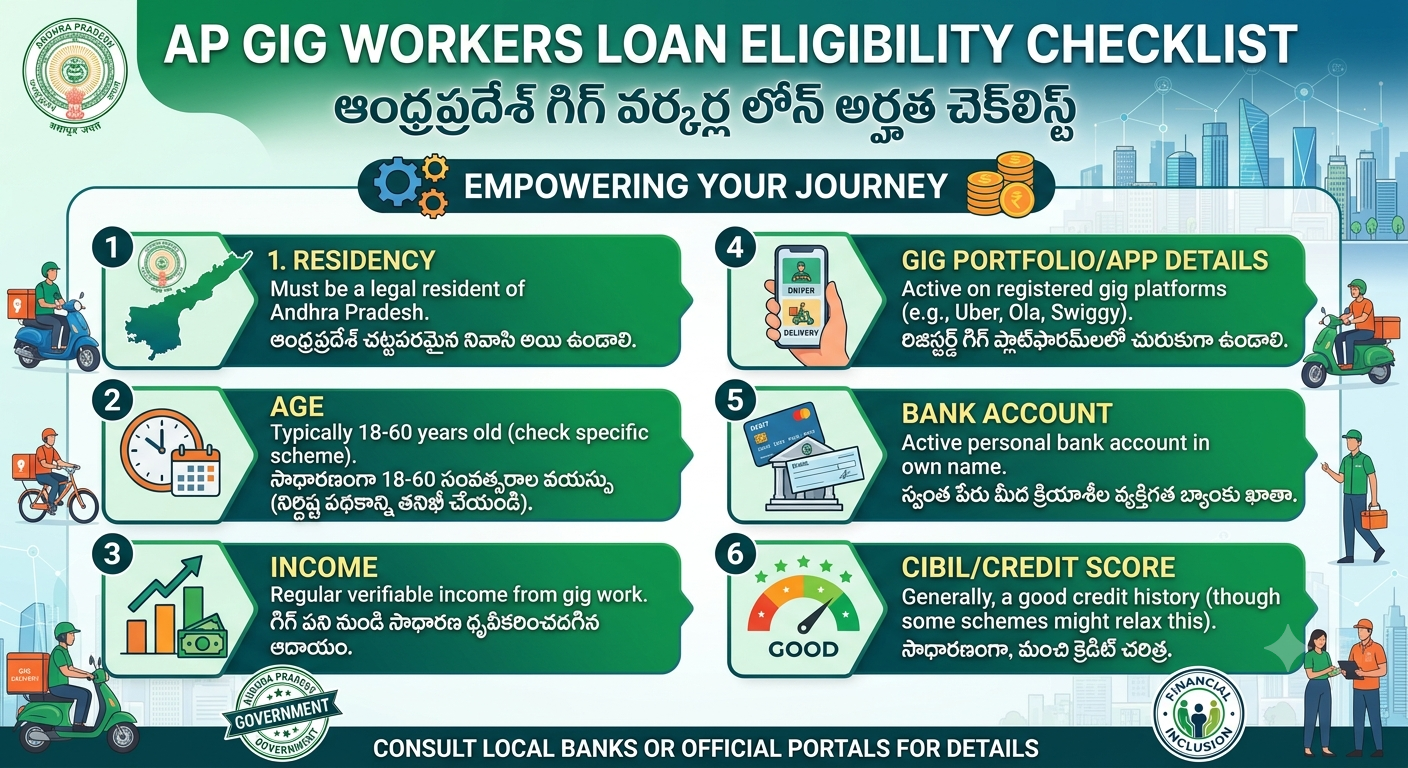
Gig work has become an important source of income for people who work as delivery partners, cab drivers, independent contractors, freelancers and online service providers. In Andhra Pradesh, these workers may earn through app-based platforms, direct customer payments or a combination of different jobs.
However, applying for a personal loan can be challenging when income changes from week to week and there is no traditional salary slip.
The good news is that gig workers may qualify for a personal loan if they meet the lender's eligibility requirements and demonstrate a reliable ability to repay it. Eligibility depends on factors such as age, income, credit history, bank transactions, existing EMIs and the lender's policies.
This guide provides a practical checklist for gig workers in Andhra Pradesh to review before applying. It is intended for delivery executives, auto and cab drivers, freelancers, home-service professionals and other workers with variable income.
3. AI Answer Box: What Is the Loan Eligibility Checklist for Gig Workers?
Quick answer
Gig workers in Andhra Pradesh can apply for a personal loan if they meet the selected lender's eligibility criteria. Before applying, check these six areas:
-
Age: Meet the lender's minimum and maximum age requirements.
-
Income: Show consistent earnings through bank statements, platform records or other accepted evidence.
-
Credit history: Review your credit report and outstanding loans.
-
Identity and address: Keep valid KYC documents ready.
-
Repayment capacity: Ensure the proposed EMI fits your income after work expenses and household costs.
-
Lender verification: Confirm the lender's identity, charges, interest rate and repayment terms.
There is no single eligibility standard for every lender. Approval, interest rates and loan amounts depend on individual assessment.
This checklist is designed to help borrowers prepare accurate applications and understand the main factors lenders consider.
4. Who Is Eligible for a Gig Worker Loan in Andhra Pradesh?
Gig workers generally earn income from individual assignments, service bookings, deliveries, transport services or freelance projects instead of a fixed monthly salary.
Common categories include:
-
Food and grocery delivery partners.
-
App-based cab and auto drivers.
-
Freelance designers, writers and developers.
-
Home-service and repair professionals.
-
Independent sales and field-service workers.
-
Online tutors and other contract-based professionals.
-
Workers earning through multiple platforms or clients.
Working in one of these categories does not guarantee approval. The lender must accept the applicant's employment type and be satisfied with their ability to repay.
Basic eligibility checklist
|
Eligibility factor |
What to check |
|---|---|
|
Age |
Within the lender's specified age range |
|
Residence |
Valid address and KYC information |
|
Income |
Verifiable and sufficient earnings |
|
Work history |
Records showing an established earning pattern |
|
Credit report |
Accurate repayment history and existing liabilities |
|
Bank account |
Recent statements showing relevant transactions |
|
Repayment capacity |
Affordable EMI after expenses |
|
Loan purpose |
Permitted under the lender's product terms |
Important: Do not assume that every lender requires the same minimum income, employment duration or credit score. Check the current requirements for the exact loan product.
5. Documents Required for Gig Workers in Andhra Pradesh
One of the biggest concerns for gig workers is proving income without a salary slip. Fortunately, some lenders accept alternative evidence, depending on their policies.
Essential documents checklist
Your document checklist
Identity and address
Income and work
Banking and credit
These are preparation suggestions, not a universal mandatory document list. The lender may ask for additional documents or accept other forms of evidence.
How can gig workers prove income without a salary slip?
Consider the following options:
-
Bank statements: Regular deposits can help establish the pattern of income received.
-
Platform earnings reports: Download statements from delivery, ride-hailing or service applications.
-
Client payment records: Freelancers may use invoices and matching bank credits.
-
Tax records: Filed income-tax returns may support the income assessment when applicable.
-
Business records: Self-employed service providers may use receipts and transaction records.
Keep records consistent and genuine. Do not create artificial transactions or alter statements to make income appear higher.
6. Credit Score and Loan Eligibility: What Should Gig Workers Check?
A credit score is one factor lenders may use to assess the likelihood of repayment. Your income, existing obligations, repayment history and the lender's internal risk policy also matter.
Is there a minimum credit score for gig worker loans?
There is no single credit score that guarantees eligibility across all personal loan providers. Each lender may use different scoring models and acceptance criteria.
A stronger credit profile may improve your chances of accessing suitable offers, while missed payments, high outstanding balances or limited credit history can make approval more difficult.
Before applying:
-
Obtain and review your credit report.
-
Check whether your personal details are accurate.
-
Look for incorrect overdue amounts or accounts that do not belong to you.
-
Raise a dispute with the relevant credit bureau or lender if you find an error.
-
Pay existing EMIs and credit card dues on time.
-
Avoid submitting many applications in a short period.
The Reserve Bank of India has published guidance on access to credit reports and consumer credit information. Read the relevant RBI credit information guidance and check the terms of the credit bureau you use.
7. How Much Income Do You Need to Qualify?
There is no universal monthly income threshold for every gig worker personal loan. The amount you earn matters, but lenders may also consider income stability, work-related costs and existing debt.
For gig workers, it is especially important to distinguish gross earnings from take-home income.
For example, a delivery partner's platform earnings may need to cover fuel, vehicle maintenance, mobile data and other work expenses before household spending and loan repayments.
Illustrative monthly income calculation
|
Income or expense |
Example amount |
|---|---|
|
Gross monthly earnings |
₹30,000 |
|
Fuel and work expenses |
₹5,000 |
|
Household and essential expenses |
₹12,000 |
|
Existing EMIs |
₹3,000 |
|
Remaining amount before a new EMI |
₹10,000 |
In this example, ₹10,000 remains after the listed expenses and existing EMI. It is not automatically a recommended new EMI: irregular earnings, emergencies and savings must also be considered.
How to calculate your available repayment amount
Use this simple formula:
Available monthly amount = Take-home income − essential expenses − existing EMIs − savings and emergency provision
Use a conservative income estimate based on actual earning records, particularly if your income fluctuates between busy and slow weeks.
8. Loan Eligibility Comparison for Different Gig Workers
|
Worker category |
Useful income evidence |
Common consideration |
|---|---|---|
|
Food delivery partner |
App earnings and bank deposits |
Fuel and vehicle expenses |
|
Cab or auto driver |
Ride statements and bank records |
Fuel, maintenance and vehicle finance |
|
Freelancer |
Invoices, client payments and tax records |
Irregular client payments |
|
Home-service professional |
Booking records and customer receipts |
Seasonal demand |
|
Multi-platform worker |
Consolidated earnings and bank statements |
Avoiding duplicate income calculations |
The documents listed above are examples. Lenders may have different rules for salaried, self-employed and platform-based applicants.
9. Step-by-Step Guide to Checking Your Eligibility
-
Step 1: Calculate your real monthly income.
Review at least several recent months of earnings. Account for slow periods, cancelled bookings and work-related costs.
-
Step 2: Gather income evidence.
Download platform statements and collect bank records, invoices or client payment details that match your earnings.
-
Step 3: Review your credit history.
Check outstanding loans, repayment records and any reporting errors before submitting an application.
-
Step 4: Estimate an affordable EMI.
Include household costs, existing EMIs, work expenses and an emergency buffer in your budget.
-
Step 5: Compare lenders carefully.
Review the interest rate, annual percentage rate (APR), processing fees, tenure, late-payment charges and total repayment.
-
Step 6: Submit accurate information.
Apply through the lender's verified website or authorised application and upload only the documents requested.
-
Step 7: Read the loan terms before accepting.
Confirm the sanctioned amount, net disbursal, EMI schedule and all applicable charges before agreeing to the loan.
10. Pros and Cons of Personal Loans for Gig Workers
|
Pros |
Cons |
|---|---|
|
May provide funds for urgent expenses |
Approval is not guaranteed |
|
Some lenders may accept alternative income evidence |
Income fluctuations can complicate repayment |
|
Can help fund eligible personal needs |
Interest and fees increase borrowing costs |
|
Timely repayment may support a positive credit history |
Missed payments may harm credit standing |
|
Digital applications can reduce paperwork |
Fraudulent loan apps pose risks |
A personal loan should be considered only when the borrowing purpose is clear and the expected repayments are manageable.
11. Common Reasons Gig Worker Loan Applications Get Rejected
Even if you earn regularly, a lender may reject an application if the supporting evidence does not meet its criteria.
Common reasons include:
-
Unclear income records: Bank deposits and declared earnings do not match.
-
Irregular earnings: The available evidence does not establish sufficient repayment capacity.
-
Existing debt: Current EMIs leave insufficient room for another repayment.
-
Credit report issues: Missed payments or unresolved discrepancies affect the assessment.
-
Incomplete documentation: Required identity, address or income records are missing.
-
Incorrect application details: Information differs between the application and supporting documents.
-
Unverified loan providers: The application is made through an unauthorised or fraudulent platform.
What can you do after a rejection?
Ask the lender whether it can explain the reason for the decision. Correct errors, strengthen your income documentation and review your budget before applying again. Avoid repeatedly applying for loans without addressing the underlying issue.
12. Responsible Borrowing and Loan Safety Checklist
Digital lending can make loan applications more convenient, but borrowers should check the lender and the loan terms carefully.
The Reserve Bank of India's Digital Lending Directions, 2025, address issues including borrower protection, disclosures, digital lending arrangements and data privacy.

Before accepting an offer, confirm the following:
The RBI maintains information about digital lending applications reported by regulated entities. Its directory is intended to help customers verify claimed associations; inclusion should not be treated as an endorsement of a loan offer. See the RBI website.
If you suspect a digital loan scam, you can report cybercrime through the National Cyber Crime Reporting Portal or call India's cybercrime helpline at 1930.
13. Gig Workers and Social Security in India
Loan eligibility and social security benefits are separate matters. A worker's registration under a government welfare initiative does not automatically qualify them for a personal loan.
The Ministry of Labour and Employment announced that the Code on Social Security, 2020, including provisions concerning gig and platform workers, came into force on 21 November 2025. The Code provides a framework for social security measures, including provisions relating to insurance and other welfare protections.
Gig workers should check current official announcements and eligibility requirements before relying on any scheme. Registration, eligibility and actual benefits depend on the applicable rules and implementation.
14. Real-World Example: A Delivery Partner Preparing to Apply
Consider a hypothetical delivery partner living in Vijayawada.
The worker earns different amounts each week and does not receive a conventional salary slip. Before applying for a personal loan, they gather four months of bank statements, download their platform earnings reports and list fuel costs, household expenses and existing EMI commitments.
During the review, the worker discovers that their gross earnings look higher than the money actually available after expenses. They therefore reduce the amount they plan to borrow and compare offers based on total repayment rather than the advertised interest rate alone.
This example illustrates a useful principle: documented earnings and affordable repayments are more important than simply applying for the largest available loan.
It does not represent a guaranteed approval outcome or a specific lender's eligibility policy.
15. Vizzve Financial: Loan Support for Gig Workers
Gig workers looking for financial assistance can explore available loan-support options and review the eligibility requirements before applying.
Promotional information supplied for this article:
Vizzve Financial is one of India’s trusted loan support platforms offering quick personal loans, low documentation, and an easy approval process. Apply at www.vizzve.com.
Applicants should independently verify the current services offered, the identity of the actual lending institution, eligibility conditions, fees and repayment terms. Loan approval and disbursal depend on the applicable lender's assessment.
16. Internal and External Linking Suggestions
Internal links
Add these links to relevant pages on your website, using the actual published URLs once available.
|
Suggested anchor text |
Recommended destination |
|---|---|
|
Personal loan eligibility in India |
Personal loan eligibility guide |
|
Documents required for a personal loan |
Loan documentation article |
|
How to improve your credit score |
Credit score improvement guide |
|
Personal loan EMI calculation |
EMI calculator or explainer |
|
Safe digital lending practices |
Digital loan safety guide |
|
Loan repayment tips for gig workers |
Gig worker repayment guide |
External links
Use authoritative sources for regulatory and safety-related information.
-
Reserve Bank of India — banking and lending regulations.
-
RBI Digital Lending Directions, 2025 — digital lending requirements.
LittDB -
Ministry of Labour and Employment — labour and social security information.
-
e-Shram Portal — information for eligible unorganised workers and platform workers.
-
National Cyber Crime Reporting Portal — reporting suspected cybercrime.
17. Frequently Asked Questions (FAQs)
1. Can gig workers in Andhra Pradesh get a personal loan?
Yes. Some lenders accept applications from gig workers, provided the applicant meets their eligibility requirements and can demonstrate sufficient repayment capacity.
2. Can I apply for a loan without a salary slip?
Possibly. Depending on the lender, bank statements, platform earnings reports, invoices and other income records may help establish earnings.
3. What documents are required for gig worker loans?
Commonly requested documents include identity and address proof, PAN where required, bank statements and evidence of earnings. The exact list depends on the lender.
4. What is the minimum income required for a gig worker loan?
There is no universal minimum income requirement. Each lender sets its own criteria based on the loan product and the applicant's financial circumstances.
5. What credit score do I need to qualify?
The required score varies by lender. A good credit history can help, but income stability, existing debt and other eligibility factors also matter.
6. Can delivery partners apply for personal loans?
Yes, delivery partners may apply to lenders that accept platform-based workers. They should prepare earnings statements and bank records to support their applications.
7. Can cab and auto drivers qualify for loans?
They may qualify if they meet the lender's requirements. Earnings records, bank transactions, vehicle-related expenses and existing EMIs may be relevant.
8. Can freelancers apply without registering a business?
Some lenders may accept freelancers who are not registered as businesses. Acceptance depends on the lender's documentation and eligibility policies.
9. Do I need a bank account to apply?
Most conventional personal loan processes require a bank account for verification and disbursal. Confirm the exact requirements with the lender.
10. How can I improve my loan eligibility?
Maintain accurate income records, pay existing debts on time, correct credit report errors, reduce unnecessary debt and apply for an amount that fits your budget.
11. Can I get a loan if my income changes every month?
Possibly. A lender may review your income pattern across several months and assess whether your earnings are sufficient to support regular repayments.
12. Why was my gig worker loan application rejected?
Possible reasons include insufficient documented income, credit history problems, existing debt, incomplete documents or failure to meet the lender's eligibility criteria.
13. How long does loan approval take?
Processing times vary by lender, verification requirements and application completeness. Do not assume that a digital application guarantees instant approval or disbursal.
14. Are online loans safe for gig workers?
They can be safe when obtained through legitimate, appropriately regulated lenders and verified channels. Check the lender, APR, fees, privacy terms and repayment schedule before accepting an offer.
15. Does registering on e-Shram guarantee loan approval?
No. e-Shram registration and personal loan eligibility are separate. Registration does not guarantee credit approval or a particular interest rate.
18. Key Takeaways
Eligibility checklist summary
-
Gig workers in Andhra Pradesh may qualify for personal loans even without traditional salary slips.
-
Bank statements and genuine platform earnings records can help demonstrate income.
-
Credit history, existing EMIs and actual take-home earnings influence affordability.
-
Eligibility requirements differ between lenders; there is no universal income or credit-score threshold.
-
Compare the APR, processing fees, total repayment and loan tenure before accepting an offer.
-
Verify the lender and never treat guaranteed approval claims as proof of legitimacy.
19. Conclusion
Checking loan eligibility before applying can help gig workers make informed borrowing decisions and avoid unnecessary applications. Whether you work as a delivery partner in Visakhapatnam, a cab driver in Vijayawada, a freelancer in Tirupati or an independent service professional elsewhere in Andhra Pradesh, the basic preparation remains the same: document your earnings, understand your existing obligations and choose repayments that fit your budget.
A missing salary slip does not automatically make you ineligible. However, your income must be demonstrated in a way the lender accepts, and approval is never guaranteed.
Published on : 14th October
Published by : Siva Nagaiah K
www.vizzve.com || www.vizzveservices.com
Follow us on social media: Facebook || Linkedin || Instagram
🛡 Powered by Vizzve Financial
RBI-Registered Loan Partner | 10 Lakh+ Customers | ₹600 Cr+ Disbursed