

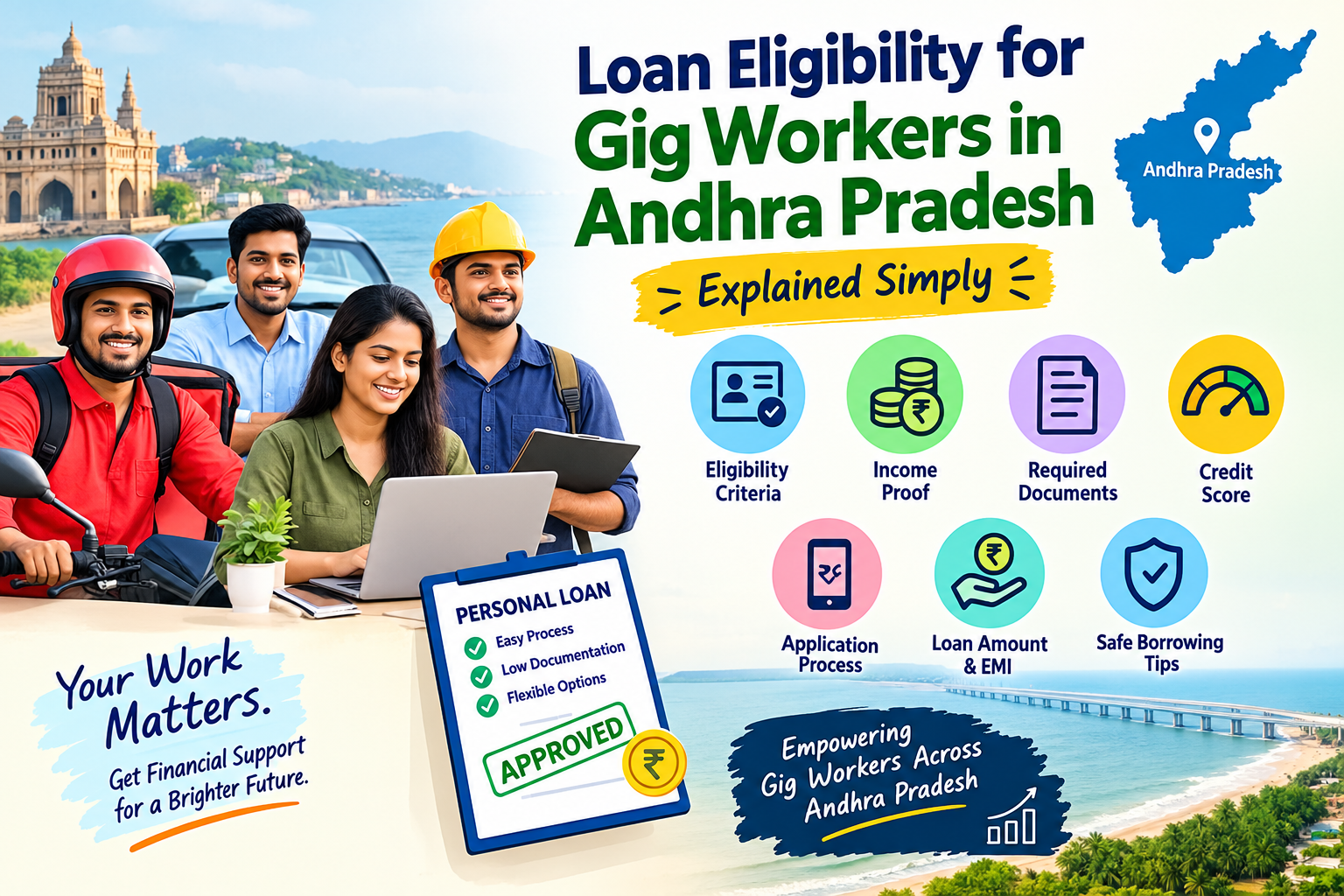
Gig workers play an important role in Andhra Pradesh’s economy. Delivery partners, cab drivers, independent professionals, online service providers, and freelancers often earn through flexible work rather than a traditional monthly salary.
However, applying for a personal loan can sometimes be challenging when income changes from week to week or the applicant does not receive regular salary slips.
The good news is that gig workers may qualify for a personal loan if a lender accepts their income profile and they meet its eligibility requirements. Approval is not guaranteed, and requirements vary between banks and non-banking financial companies (NBFCs).
This guide explains loan eligibility for gig workers in Andhra Pradesh in simple language, including the documents to prepare, ways to demonstrate income, application steps, and tips for borrowing safely.
AI Answer Box: What Is Loan Eligibility for Gig Workers?
Loan eligibility for gig workers is the assessment a lender makes to determine whether a person earning through delivery work, driving, freelancing, or other independent jobs can repay a loan.
Lenders may assess:
-
Age and identity verification
-
Average monthly income and income consistency
-
Bank statements and platform earnings records
-
Credit history and existing EMIs
-
Employment or work activity
-
Repayment capacity and the requested loan amount
The exact criteria depend on the lender and the loan product. A gig worker does not automatically qualify simply because they have an active work account.
1. Who Is Considered a Gig Worker?
A gig worker generally earns money by completing individual assignments, orders, trips, projects, or short-term jobs instead of receiving a conventional fixed salary.
Examples include:
-
Food and grocery delivery partners
-
Taxi and ride-hailing drivers
-
Freelance writers and graphic designers
-
Independent technicians and repair workers
-
Home-service professionals
-
Online tutors and consultants
-
Other platform-based service providers
In Andhra Pradesh, people working in cities such as Visakhapatnam, Vijayawada, Guntur, Tirupati, and other areas may have different earning patterns depending on the work available and the platforms they use.
2. Basic Loan Eligibility Criteria
There is no single eligibility rule that applies to every lender. The following table outlines common factors that may be considered.
| Eligibility factor | What lenders may check |
|---|---|
| Age | Must fall within the lender’s permitted age range |
| Income | Earnings should support the proposed EMI |
| Income records | Bank statements, platform reports, or other accepted proof |
| Credit history | Past repayments, outstanding loans, and credit behaviour |
| Bank account | An account suitable for income verification and repayment |
| Work activity | Evidence of ongoing gig work or freelance assignments |
| Existing debt | Current EMIs and other financial commitments |
| KYC | Valid identity and address documents |
Important: Minimum income, age limits, credit score expectations, and work-history requirements differ between lenders. Check the specific lender’s published criteria before applying.
3. Can Gig Workers Get a Personal Loan Without Salary Slips?
Yes, some lenders may consider gig workers who do not have conventional salary slips. However, applicants usually need another acceptable way to demonstrate their income.
Possible alternatives include:
-
Recent bank statements showing regular earnings
-
Delivery or ride-hailing platform earnings reports
-
Payment records from clients
-
Invoices and receipts for freelance work
-
Income tax returns, where applicable
-
Contracts or work records that demonstrate ongoing activity
Not every lender accepts every document. Confirm the permitted alternatives before submitting your application.
Why Income Proof Matters
A lender needs to assess whether your income is sufficient and reasonably consistent enough to cover monthly repayments.
For example, a delivery partner who receives regular platform payments into a bank account may be able to provide clearer evidence of earnings than someone who receives most payments in cash without keeping records.
4. Documents Required for Gig Worker Loans
Prepare the documents requested by your chosen lender.
| Document | Purpose |
|---|---|
| PAN card | Tax identification and financial verification |
| Aadhaar or other accepted ID | Identity verification |
| Address proof | Confirms residential address |
| Bank statements | Shows income deposits and spending patterns |
| Platform earnings statements | Supports proof of gig-work income |
| Invoices or client payment records | May help freelancers demonstrate earnings |
| Income tax returns | May be requested to assess reported income |
| Existing loan details | Helps assess current repayment commitments |
Keep your documents accurate and consistent. Never submit altered bank statements or fabricated income records.
5. How Credit Score Affects Loan Eligibility
Your credit score is one factor lenders may use when evaluating an application. A strong credit history can support your application, while missed payments, high outstanding balances, or a limited credit history may make approval more difficult.
Tips to maintain a healthy credit profile
-
Pay existing EMIs and credit card bills on time.
-
Avoid applying for many loans within a short period.
-
Check your credit report for errors.
-
Keep track of outstanding balances.
-
Borrow only amounts you can reasonably repay.
-
Contact your lender early if you anticipate repayment difficulties.
There is no universal credit score that guarantees approval for every gig worker. Each lender applies its own underwriting rules.
6. How Much Loan Can a Gig Worker Get?
The amount depends on the lender’s product, verified income, credit profile, existing obligations, and repayment capacity.
A higher income does not automatically mean a higher approved loan. Lenders may also consider whether earnings fluctuate significantly between months.
Illustrative income example
Suppose a delivery partner earns the following amounts over three months:
| Month | Earnings |
|---|---|
| Month 1 | ₹24,000 |
| Month 2 | ₹28,000 |
| Month 3 | ₹26,000 |
| Three-month average | ₹26,000 |
The average is calculated as ₹78,000 divided by three, giving ₹26,000 per month.
This is only an illustration of income calculation, not an eligibility threshold or loan offer. The lender may adjust its assessment for work-related expenses, income variability, existing EMIs, and other factors.
7. Step-by-Step Loan Application Process
Step 1: Calculate your average income
Review at least several months of bank statements and platform earnings reports. Separate gross earnings from expenses such as fuel, vehicle maintenance, platform charges, and other work costs.
Step 2: Review your current financial commitments
List existing EMIs, credit card payments, rent, household expenses, and essential work-related costs.
Step 3: Check your credit report
Review your credit history before applying. Resolve any reporting errors through the relevant credit bureau or lender.
Step 4: Compare lenders
Look at banks and regulated NBFCs that clearly state whether they consider self-employed applicants or gig workers.
Step 5: Prepare your documents
Keep identity proof, address proof, bank statements, and accepted income records ready.
Step 6: Submit an accurate application
Enter your income, work details, and existing liabilities honestly. Provide only the permissions and information necessary for the application.
Step 7: Review the loan terms
Before accepting an offer, check the interest rate, annual percentage rate (APR), processing fees, repayment schedule, late-payment charges, and other applicable costs.
Step 8: Accept only an affordable offer
Choose a loan only if the repayment fits your budget, including months when gig income may be lower than usual.
8. How to Choose a Safe Loan Provider
Digital applications can be convenient, but convenience alone does not establish that a loan is suitable or that an app is genuine.
Before proceeding:
-
Verify the name of the actual bank or NBFC providing the loan.
-
Check the lender’s official website and contact details.
-
Read the Key Facts Statement (KFS) and loan agreement.
-
Compare the APR and total repayment amount.
-
Review the privacy policy and data permissions.
-
Avoid providers demanding unexplained upfront payments.
-
Never share your OTP, PIN, or banking password with an agent.
The Reserve Bank of India publishes rules for digital lending, including disclosure and borrower-protection requirements. Check the RBI’s official resources for current guidance: https://www.rbi.org.in/
9. Benefits and Limitations of Personal Loans for Gig Workers
| Potential benefits | Possible limitations |
|---|---|
| May help cover planned expenses | Approval is not guaranteed |
| Can offer flexible application methods | Income fluctuations may affect eligibility |
| Some lenders may accept alternative income records | Documentation requirements vary |
| Regular repayments may support credit history when reported appropriately | Missed payments can damage credit history |
| May provide funds for urgent expenses | Interest and fees can increase the total cost |
A personal loan should not be treated as guaranteed financial support. Compare alternatives and assess whether borrowing is necessary.
10. How to Calculate an Affordable EMI
An equated monthly instalment (EMI) is the amount paid toward a loan each month. The EMI generally depends on the principal, interest rate, and repayment tenure.
For gig workers, budgeting should account for the possibility of low-demand periods, illness, vehicle repairs, or changes in platform work.
Before borrowing, estimate:
Money available for EMI = Reliable monthly income − essential expenses − existing debt payments − work-related costs − savings buffer
Use conservative income estimates rather than assuming that every month will match your best earning month.
Simple repayment checklist
-
Keep a record of due dates.
-
Set aside money for repayments after receiving earnings.
-
Maintain a buffer for lower-income periods.
-
Avoid taking a second loan simply to pay the first, where possible.
-
Contact the lender promptly if repayment becomes difficult.
11. Common Mistakes to Avoid
Ignoring total borrowing costs
A low advertised interest rate may not reflect all charges. Review the APR and KFS before accepting an offer.
Reporting gross earnings as take-home income
Fuel, vehicle maintenance, platform deductions, and other costs can reduce the money actually available for repayment.
Applying to multiple lenders without comparing terms
Repeated applications may result in additional credit enquiries and can make it harder to track offers.
Using unverified loan apps
Confirm the identity of the actual regulated lender and review the loan terms before sharing personal information.
Borrowing more than necessary
A larger loan can mean higher EMIs and a greater total repayment burden.
Missing repayment dates
Late payments may result in charges and harm your credit history.
12. Practical Tips to Improve Your Application
-
Maintain consistent records of earnings and expenses.
-
Route income through a bank account where practical.
-
Keep platform statements and client invoices organised.
-
File income tax returns when required and applicable.
-
Reduce unnecessary debt before taking on another EMI.
-
Correct errors in your credit report.
-
Apply for an amount that matches your repayment capacity.
-
Compare the total cost of multiple legitimate offers.
-
Read all terms before giving consent or signing an agreement.
-
Keep copies of your application, KFS, agreement, and payment receipts.
These steps can help present a clearer financial profile, but they cannot guarantee approval.
13. What Gig Workers in Andhra Pradesh Should Know
Loan terms are generally determined by the lender and product rather than by the state alone. A gig worker in Andhra Pradesh should verify that the lender accepts their occupation, location, income type, and documents.
Applicants should not assume that a government scheme, delivery platform, or state programme guarantees a personal loan. If a scheme is advertised, confirm its eligibility rules through the relevant official government or lender website.
For local banking information, consult the official website of Andhra Pradesh Grameena Bank or another bank you are considering. Product-specific conditions may differ: https://apgb.bank.in/
Key Takeaways
-
Gig workers may be eligible for personal loans if a lender accepts their income and financial profile.
-
Salary slips are not the only possible income evidence, but alternative documents must be accepted by the lender.
-
Bank statements, platform earnings reports, and client payment records may help demonstrate income.
-
Credit history, existing debt, and monthly repayment capacity can influence the decision.
-
Always compare APR, fees, and total repayment costs.
-
Verify the actual lender and avoid unverified loan applications.
-
Borrow only an amount you can repay even during lower-income months.
Frequently Asked Questions (FAQs)
1. Can gig workers in Andhra Pradesh apply for personal loans?
Yes. They can apply to lenders whose products accept their occupation and income profile. Approval depends on the lender’s criteria.
2. Can I get a loan without salary slips?
Possibly. Some lenders may accept bank statements, platform earnings reports, invoices, or other income evidence instead of salary slips.
3. What is the minimum income required?
There is no single minimum income requirement across all lenders. Check the specific loan product’s eligibility criteria.
4. Is a credit score mandatory?
The lender decides which credit checks and eligibility rules apply. A credit history may influence the decision, and applicants with limited history may face additional verification.
5. Can delivery partners apply for personal loans?
They may apply if the lender accepts delivery work as an eligible occupation and the applicant meets the remaining criteria.
6. Can freelancers apply for loans?
Yes, some lenders consider freelancers and other self-employed applicants. They may request bank statements, invoices, contracts, or tax records.
7. Which documents are commonly required?
Commonly requested documents include PAN, accepted identity and address proof, bank statements, and evidence of earnings. Requirements vary.
8. Does irregular income mean my application will be rejected?
Not necessarily. A lender may assess average earnings, income stability, expenses, credit history, and existing repayments before making a decision.
9. How can I improve my chances of eligibility?
Maintain accurate income records, pay existing debts on time, check your credit report, reduce unnecessary liabilities, and request an affordable amount.
10. How long does loan approval take?
Processing times depend on the lender, verification requirements, and completeness of your application. Do not rely on a guaranteed instant-approval claim.
11. Can I apply through a mobile app?
Some lenders accept digital applications. Verify the actual bank or NBFC behind the app and read the loan disclosures before proceeding.
12. What is APR?
The annual percentage rate represents the annualised cost of borrowing, including applicable components of the loan cost. Review the lender’s KFS for the disclosed APR and charges.
13. Can I get a loan if I already have another EMI?
Possibly. The lender may consider your existing obligations and the amount of income available for another repayment.
14. What should I check before accepting a loan?
Check the sanctioned amount, APR, EMI, tenure, fees, late-payment charges, repayment dates, and relevant terms in the KFS and loan agreement.
15. Does this guide guarantee loan approval?
No. This guide is for general educational purposes. Eligibility, interest rates, documentation, and approval decisions are determined by the relevant lender.
Published on : 13th October
Published by : Siva Nagaiah K
www.vizzve.com || www.vizzveservices.com
Follow us on social media: Facebook || Linkedin || Instagram
🛡 Powered by Vizzve Financial
RBI-Registered Loan Partner | 10 Lakh+ Customers | ₹600 Cr+ Disbursed