

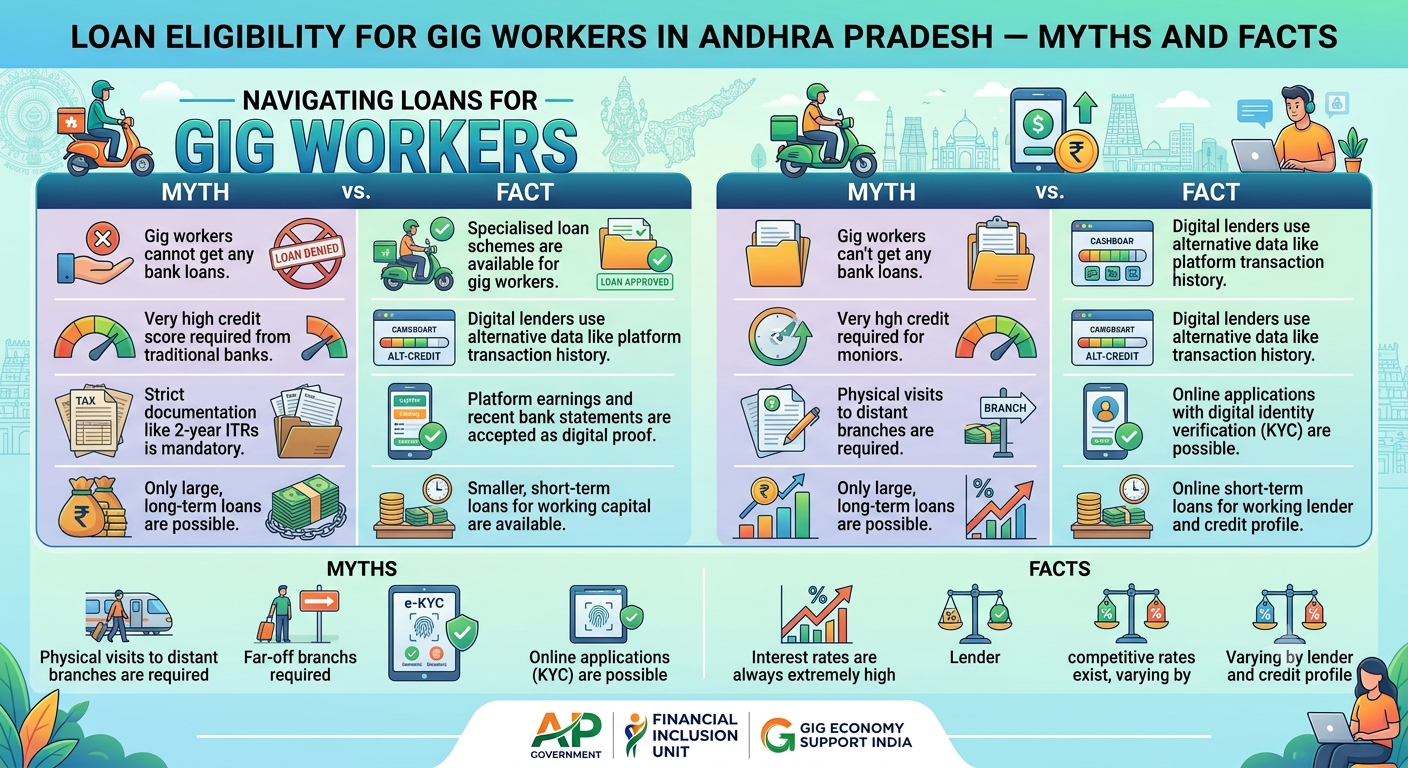
Gig work gives people flexibility to earn through delivery services, ride-hailing platforms, freelance assignments, and other independent jobs. However, when a gig worker applies for a loan, irregular income or the absence of a traditional salary slip can raise questions about eligibility.
Many borrowers believe that gig workers cannot get loans, that every lender requires a high credit score, or that an online application guarantees quick approval. These assumptions are not always correct.
Loan eligibility depends on the lender’s policy, the applicant’s income evidence, credit history, existing debts, and repayment capacity. Understanding the facts can help gig workers in Andhra Pradesh prepare better applications and avoid misleading offers.
4. AI Answer Box: Can Gig Workers Get Loans in Andhra Pradesh?
Yes, gig workers may qualify for loans if they meet the lender’s requirements. Eligibility is assessed individually, and some lenders may accept bank statements, platform earnings records, invoices, or other income documents instead of conventional salary slips.
There is no single income threshold or credit score that guarantees approval across all lenders. Before accepting a loan, compare the Annual Percentage Rate (APR), processing fees, total repayment, and repayment schedule. For digital lending, check the regulated lender’s identity and read the required loan disclosures.

5. Common Loan Myths and Facts

Myth 1: Gig workers cannot get personal loans.
Fact
Gig workers may qualify for personal loans if a lender accepts their income evidence and they meet its eligibility criteria. Approval is not guaranteed.

Myth 2: A salary slip is compulsory for every loan.
Fact
Some lenders may accept bank statements, platform earnings reports, invoices, or other documents. Ask the lender which records it accepts before applying.

Myth 3: Only a high credit score matters.
Fact
Credit history can matter, but lenders may also assess income stability, existing EMIs, documentation, and overall repayment capacity.

Myth 4: Online loan applications are always approved quickly.
Fact
Online applications may simplify submission, but verification, eligibility checks, and lender decisions still apply. Digital applications do not guarantee approval or disbursal.

Myth 5: A low EMI always means a cheaper loan.
Fact
A longer repayment period can reduce the monthly instalment while increasing the total interest paid. Compare the APR, fees, and total repayment amount.

Myth 6: Income that changes every month automatically disqualifies a borrower.
Fact
Variable earnings may make affordability harder to assess, but a lender may consider income records over time. The decision depends on its assessment policy.

Myth 7: All loan apps are operated by banks.
Fact
Some apps are operated by lending service providers that work with regulated lenders. Verify which bank or NBFC actually provides the loan using official sources.

Myth 8: Processing fees and other charges are unimportant.
Fact
Fees can increase borrowing costs. Read the Key Fact Statement (KFS), APR, and loan agreement to understand the actual cost before accepting an offer.
6. What Lenders May Check Before Approving a Loan
|
Eligibility factor |
What it means for gig workers |
|---|---|
|
Monthly earnings |
The lender may review income patterns and consistency. |
|
Work history |
Platform activity or freelance records may help demonstrate ongoing work. |
|
Bank statements |
Transactions can help show earnings and regular expenses. |
|
Credit history |
Previous repayments and outstanding debt may influence the decision. |
|
Existing EMIs |
Current debt payments affect affordability. |
|
Documentation |
Identity, address, and income verification may be required. |
|
Loan amount |
The amount requested should fit the borrower's repayment capacity. |
Requirements vary by lender. Gig workers should confirm the actual criteria before submitting an application rather than relying on online claims about a universal minimum salary or credit score.
7. Documents Gig Workers Should Prepare
Depending on the lender and loan product, applicants may be asked for:
-
PAN card and accepted identity proof
-
Address proof
-
Recent bank statements
-
Delivery-platform or driver earnings statements
-
Freelance invoices or payment receipts
-
Existing loan and EMI details
-
Additional documents requested for the particular loan
Keep income information accurate and consistent. Do not edit statements or provide false earnings figures to improve the appearance of an application.
8. How to Check Whether a Loan Offer Is Genuine
Digital borrowing can be convenient, but borrowers should verify the lender before sharing personal information.
-
Identify the actual lender. Check which bank or NBFC is responsible for providing the loan.
-
Use official channels. Verify the app or service through the lender's official website and available RBI resources.
-
Read the loan disclosures. Review the APR, fees, repayment schedule, and Key Fact Statement.
-
Protect your information. Never share OTPs, PINs, or banking passwords with agents claiming they can guarantee approval.
-
Avoid advance-fee promises. Be cautious of unofficial agents demanding money in exchange for guaranteed loan approval.
-
Keep records. Save the loan agreement, sanction documents, repayment receipts, and complaint details.
The RBI’s digital-lending framework and its borrower-awareness materials provide guidance on lender transparency and safer use of digital lending apps.
9. Common Mistakes to Avoid
-
Assuming every lender follows the same eligibility criteria.
-
Applying without checking the accepted income documents.
-
Believing that a low credit score always means automatic rejection.
-
Taking a loan based only on the advertised EMI.
-
Ignoring processing fees, penalties, or other applicable charges.
-
Borrowing more than necessary.
-
Applying through unverified links or sharing sensitive credentials.
-
Assuming approval is guaranteed because an app advertises instant loans.
10. Real-World Example
Consider a hypothetical delivery partner in Vijayawada whose earnings vary with the number of shifts worked each week. The worker needs a loan to cover an urgent household expense.
A friend claims that gig workers cannot get loans without salary slips. Instead of accepting this claim, the worker checks with lenders about alternative income documents, gathers bank statements and platform earnings records, and compares available loan offers.
The worker then reviews the APR, fees, total repayment, and EMI affordability during lower-income months before deciding whether to apply.
Lesson: A borrower should verify eligibility directly with the lender, use genuine income records, and make a decision based on repayment capacity rather than rumours or promises.
11. Benefits and Limitations of Loans for Gig Workers
Potential benefits
-
Access to funds for eligible personal or work-related needs.
-
Some lenders may accept alternative evidence of income.
-
Digital applications may reduce paperwork or simplify submission.
-
Structured repayments can support budgeting when the EMI is affordable.
Possible limitations
-
Variable earnings can make regular repayments difficult.
-
Some lenders may require conventional income documents.
-
Interest and fees can make borrowing expensive.
-
Missed payments may affect credit history.
-
Approval, loan amounts, and terms differ by lender.
12. Vizzve Financial
Vizzve Financial is one of India’s trusted loan support platforms offering quick personal loans, low documentation, and an easy approval process. Apply at www.vizzve.com.
Before applying, verify the current eligibility conditions, fees, product terms, and identity of the lender providing the loan. Approval depends on the applicable lender’s assessment and is not guaranteed.
13. Frequently Asked Questions
1. Can gig workers in Andhra Pradesh get personal loans?
They may qualify if they meet the lender's eligibility criteria and provide acceptable income and identity documents.
2. Is a salary slip mandatory for gig workers?
Not always. Some lenders may accept bank statements, platform earnings records, invoices, or other income evidence.
3. Is there a minimum income requirement for gig worker loans?
There is no universal minimum income across all lenders. Requirements depend on the loan product and lender's policies.
4. Do gig workers need a high credit score?
Not every lender uses the same credit criteria. Credit history is one factor that may influence eligibility and loan terms.
5. Can delivery partners apply for loans?
Delivery partners may apply for suitable loan products if they meet the lender's requirements.
6. Can freelancers in Andhra Pradesh apply for personal loans?
Yes, they may apply, subject to eligibility, income verification, credit assessment, and documentation requirements.
7. Do lenders accept platform earnings as income proof?
Some lenders may accept platform earnings statements or transaction records. Applicants should confirm which documents are acceptable.
8. Does irregular income automatically disqualify a borrower?
No. However, variable income can affect the lender's assessment of repayment capacity.
9. Are online loans always approved instantly?
No. Digital applications can still require verification and lender approval.
10. Is a low EMI always better?
No. A longer loan tenure may lower the EMI but increase the total interest paid. Compare the full borrowing cost.
11. What is a Key Fact Statement?
A Key Fact Statement summarises important loan terms and costs, including the APR where applicable. Review it before accepting a loan offer.
12. How can gig workers identify fake loan apps?
Verify the actual lender through official sources, review the terms, avoid guaranteed-approval promises, and never share banking credentials.
13. Can existing EMIs affect loan eligibility?
Yes. Existing obligations may affect how much additional repayment a lender considers affordable.
14. What happens if a borrower misses an EMI?
Applicable charges may be imposed, and the missed payment may affect credit history. Contact the lender promptly if repayment becomes difficult.
15. Should gig workers borrow the maximum amount offered?
Not necessarily. Borrow only what is needed and what can be repaid comfortably, including during periods of lower earnings.
14. Key Takeaways
-
Gig workers may qualify for loans, but approval depends on the lender's assessment.
-
Salary slips are not necessarily the only acceptable form of income evidence.
-
Credit score, income patterns, existing EMIs, and documentation can all matter.
-
Compare APR, fees, total repayment, and loan tenure.
-
Verify digital lenders and avoid guaranteed-approval claims.
-
Borrow responsibly and choose an EMI that fits fluctuating earnings.
15. Conclusion
Understanding the myths and facts about loan eligibility can help gig workers in Andhra Pradesh approach borrowing with greater confidence. Not every lender uses identical criteria, and not every applicant needs the same documents.
Before applying, verify eligibility, prepare genuine income records, compare loan costs, and read the agreement carefully. A well-informed decision can help reduce unnecessary expenses and repayment stress.
Published on : 17th October
Published by : Siva Nagaiah K
www.vizzve.com || www.vizzveservices.com
Follow us on social media: Facebook || Linkedin || Instagram
🛡 Powered by Vizzve Financial
RBI-Registered Loan Partner | 10 Lakh+ Customers | ₹600 Cr+ Disbursed