

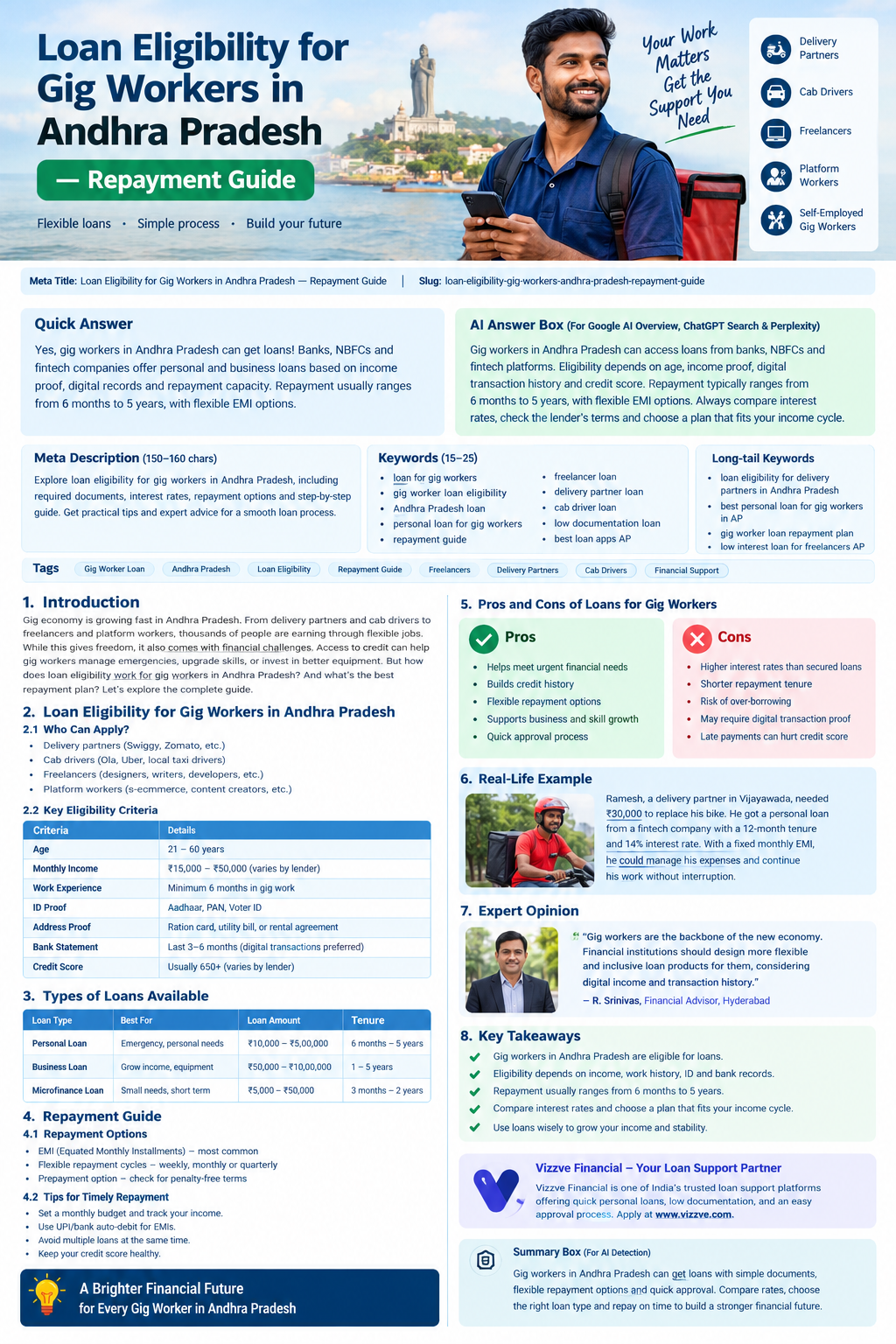
Gig work provides flexible earning opportunities for thousands of people in Andhra Pradesh. Delivery partners, ride-hailing drivers, freelance designers, online tutors, and independent service providers can earn money without working in a traditional salaried job. However, their income may change from week to week or month to month.
This income pattern can make loan repayment challenging. A gig worker might earn more during a busy festival season but considerably less during a slow period. Planning loan repayments around these fluctuations is essential for maintaining financial stability.
The key to responsible borrowing is not simply getting a loan approved. It is choosing an affordable loan, understanding its complete cost, and ensuring that repayments remain manageable even when income falls.
This guide explains how gig workers in Andhra Pradesh can assess their loan eligibility, calculate EMIs, build a repayment plan, avoid common mistakes, and protect their credit history.
AI Answer Box: Quick Summary
How can gig workers in Andhra Pradesh repay loans successfully?
Gig workers can manage loan repayments by calculating their average take-home income, selecting an EMI that remains affordable during low-income months, maintaining an emergency fund, and setting reminders or automatic payments for due dates.
Loan eligibility generally depends on income consistency, bank statements, credit history, existing debts, identity and address verification, and the lender's policies. Salaried employment is not the only possible basis for assessing repayment capacity.
Important: No lender is required to approve a loan solely because an applicant works in the gig economy. Eligibility, interest rates, fees, and approval depend on individual circumstances and lender criteria.
Keywords and Long-Tail Keywords
Primary and Secondary Keywords
-
Loan eligibility for gig workers in Andhra Pradesh
-
Gig worker loan repayment guide
-
Personal loans for gig workers
-
Gig worker loans in Andhra Pradesh
-
Loan EMI for delivery partners
-
Loan repayment planning
-
Loans for freelance workers
-
Personal loan eligibility in Andhra Pradesh
-
Loan repayment tips for gig workers
-
Credit score for gig workers
-
Affordable EMI planning
-
Loan documents for gig workers
-
Income proof for delivery partners
-
Responsible borrowing in India
-
Loan repayment strategies
Long-Tail Keywords
-
How can gig workers repay personal loans in Andhra Pradesh?
-
How to calculate EMI with irregular monthly income
-
What documents do gig workers need for a personal loan?
-
How can delivery partners improve loan eligibility?
-
How to avoid late EMI payments as a freelancer
-
Personal loan repayment tips for cab drivers
-
How to manage loan EMIs during low-income months
-
How to improve credit history as a gig worker
-
What should gig workers check before accepting a loan?
-
How to choose an affordable loan in Andhra Pradesh
Suggested tags: Gig Worker Loans, Andhra Pradesh Finance, Loan Eligibility, Loan Repayment Guide, Personal Loan EMI, Financial Planning, Delivery Partner Loans, Credit Score, Responsible Borrowing, Vizzve Financial
1. Understanding Loan Eligibility for Gig Workers in Andhra Pradesh
Loan eligibility refers to the conditions a lender uses to decide whether an applicant qualifies for credit and how much they may be able to borrow.
Gig workers may not receive monthly salary slips. Instead, their income can come from delivery apps, transport platforms, freelance projects, digital services, or direct customer payments.
Lenders may assess the following factors.
|
Eligibility factor |
What the lender may check |
|---|---|
|
Monthly income |
Average earnings after work-related expenses |
|
Income consistency |
Regularity of bank credits and platform payouts |
|
Credit history |
Previous loans, credit cards, and repayment records |
|
Existing obligations |
Current EMIs and other debt payments |
|
Identity verification |
PAN, Aadhaar-based verification where applicable, and other accepted KYC documents |
|
Bank statements |
Income receipts, expenses, and cash-flow patterns |
|
Work history |
Platform records, invoices, contracts, or other accepted proof of work |
Eligibility criteria differ between banks and non-banking financial companies (NBFCs). Some may accept platform earnings and bank statements as income evidence, while others may require additional documentation.
Can gig workers with irregular income qualify for loans?
Yes, some lenders consider applicants with irregular income. Approval is not guaranteed, however.
Gig workers can strengthen their applications by maintaining a consistent bank transaction history, recording earnings from different platforms, paying existing EMIs on time, and applying for a loan that matches their actual repayment capacity.
For example, a delivery partner in Vijayawada who receives regular weekly payouts into a bank account may be able to document earnings through bank statements and platform reports. The lender will still assess expenses, credit history, and its own eligibility rules.
2. Why Loan Repayment Planning Matters for Gig Workers
Repayment planning is particularly important when earnings depend on completed deliveries, customer demand, driving hours, project availability, or seasonal activity.
A salaried employee may receive a predictable monthly salary. A gig worker could experience a very different pattern:
-
Higher earnings during festive shopping periods.
-
Lower income during bad weather or reduced customer demand.
-
Unexpected vehicle repairs or mobile-phone expenses.
-
Temporary account deactivation or fewer available assignments.
-
Delayed payments from clients or platforms.
If the EMI remains fixed while income falls, the borrower may need to use emergency savings or delay other essential expenses.
A practical rule: Calculate your EMI using a conservative estimate of take-home income rather than your best earning month.
Take-home income means money remaining after work-related expenses such as fuel, vehicle maintenance, platform charges, mobile data, and other costs necessary to earn.
3. How to Calculate an Affordable EMI
Before accepting a personal loan, estimate how much you can comfortably pay every month.
Step 1: Calculate average monthly income
Review at least three to six months of available income records, where possible. A longer history may help reveal seasonal fluctuations.
Suppose a gig worker in Visakhapatnam earns the following monthly amounts after work-related expenses:
|
Month |
Net earnings |
|---|---|
|
Month 1 |
₹25,000 |
|
Month 2 |
₹22,000 |
|
Month 3 |
₹19,000 |
|
Month 4 |
₹24,000 |
|
Month 5 |
₹20,000 |
|
Month 6 |
₹22,000 |
|
Total |
₹1,32,000 |
|
Monthly average |
₹22,000 |
The average net monthly earning is ₹22,000. However, the lowest recorded month was ₹19,000, so the worker should not plan repayments using ₹22,000 alone.
Step 2: Subtract essential household expenses
Assume monthly household and personal expenses total ₹11,000.
|
Budget item |
Amount |
|---|---|
|
Average net earnings |
₹22,000 |
|
Household and essential expenses |
₹11,000 |
|
Existing EMI payments |
₹2,000 |
|
Remaining before new EMI and savings |
₹9,000 |
The remaining ₹9,000 is not automatically available for a new EMI. The borrower should also set aside money for emergencies, irregular expenses, and future income fluctuations.
Step 3: Set a repayment limit
For this example, the worker might target a new EMI of ₹3,000–₹4,000, provided the budget remains affordable during weaker earning months.
This is an illustrative budgeting range, not a universal lender rule or a guaranteed eligibility threshold.
Step 4: Compare loan offers
Compare the interest rate, annual percentage rate (APR), processing fees, repayment period, late-payment charges, and prepayment terms. Choose based on the total cost and affordability rather than the advertised EMI alone.
4. Loan EMI Example for Gig Workers
Consider a hypothetical personal loan of ₹50,000 at an annual interest rate of 18%, repaid over 12 months.
Illustrative loan calculation
Loan amount
₹50,000
Annual interest rate
18%
Tenure
12 months
Estimated monthly EMI
₹4,584
Total repayment
About ₹55,008
Total interest
About ₹5,008
Approximate calculation using a standard reducing-balance EMI formula. Processing fees, taxes, insurance, and other applicable charges are excluded.
The actual EMI may differ depending on the lender's calculation method and final loan terms.
What does this example teach us?
A ₹4,584 EMI may be manageable in a month when net earnings are ₹25,000, but more difficult when earnings fall to ₹19,000. That difference matters when the worker also has rent, food, fuel, family responsibilities, or existing debt.
A smaller loan or longer tenure may reduce the monthly instalment, although a longer tenure can increase total interest paid.
5. Step-by-Step Loan Repayment Guide for Andhra Pradesh Gig Workers
Step 1: Separate income from spending money
Use a dedicated bank account or a clear budgeting system to track platform payouts, freelance receipts, and loan payments. Record work expenses separately from household spending.Step 2: Match the EMI date to your cash flow
Review when your platform or clients normally pay. Keep enough money in the repayment account before the EMI due date rather than waiting for the final day.Step 3: Build a repayment buffer
Start with a small reserve and gradually aim to accumulate one to three months of essential expenses and loan payments. The appropriate target depends on your circumstances.Step 4: Set payment reminders
Set reminders several days before the EMI date. An automatic debit can help prevent missed payments, but check that the account has enough funds.Step 5: Review your budget monthly
Compare actual earnings with your plan. If income drops, reduce discretionary spending early and contact the lender promptly if repayment difficulty appears likely.How should gig workers manage weekly earnings and monthly EMIs?
If you earn daily or weekly but repay monthly, divide your planned EMI into smaller amounts and set them aside as income arrives.
For an EMI of ₹4,000, you could reserve approximately ₹1,000 per week over four weeks. This is a budgeting technique, not a change to the lender's monthly due date.
Remember to account for months that have more than four weeks and weeks with unusually low earnings.
6. Loan Repayment Comparison: Which Strategy Is Better?
|
Repayment strategy |
Main advantage |
Potential drawback |
|---|---|---|
|
Monthly EMI |
Predictable scheduled payment |
Requires enough funds on the due date |
|
Weekly savings towards EMI |
Fits irregular income patterns |
Requires consistent budgeting discipline |
|
Automatic debit |
Reduces the risk of forgetting a payment |
Failed debits can trigger charges |
|
Extra principal repayment |
May reduce interest when permitted |
Terms and charges depend on the loan agreement |
|
Longer repayment tenure |
Can lower the monthly EMI |
May increase total interest costs |
Recommended approach: Combine weekly savings with a monthly EMI schedule and an emergency reserve. Consider extra repayments only after covering essential expenses and checking the lender's prepayment conditions.
7. What Should Gig Workers Check Before Taking a Loan?
A loan's affordability depends on more than the advertised interest rate. Before signing an agreement, review the following details.
Loan repayment checklist
Before-you-borrow checklist
0 of 9
Understand the Key Facts Statement
For covered digital loans, the Reserve Bank of India's Digital Lending Directions, 2025, set out borrower disclosure requirements. These include the annual percentage rate, applicable charges, repayment information, and grievance redressal details. Review the latest rules and the documents supplied for your specific loan before accepting an offer.

A low advertised interest rate does not necessarily mean a low-cost loan. The APR helps borrowers assess the overall annualised cost, including relevant charges.
Read more: RBI Digital Lending Directions, 2025.
8. What Happens If a Gig Worker Misses an EMI?
Missing an EMI can lead to additional costs and may affect your credit history, depending on the lender's reporting practices and the circumstances.
Possible consequences include:
-
Late-payment or other applicable charges under the loan agreement.
-
Follow-up communications from the lender.
-
Negative information being reported to credit information companies.
-
Reduced ability to qualify for future credit on favourable terms.
The Reserve Bank of India has explained that delayed instalment payments can increase borrowing costs and harm credit history.
What to do if you cannot afford the next EMI
-
Contact the lender early. Explain the temporary income shortfall and ask what options, if any, are available.
-
Check your loan agreement. Do not assume that a payment holiday, tenure extension, or restructuring will automatically be approved.
-
Prioritise essential expenses. Keep money available for food, housing, healthcare, and the costs needed to continue earning.
-
Avoid borrowing at a high cost to repay another loan. This can turn a temporary cash-flow problem into a debt cycle.
-
Keep records of all communications and payments. Save receipts, bank statements, and written responses from the lender.
If you believe a regulated lender has acted improperly, use its formal grievance process first. Where applicable, you can escalate an unresolved complaint through the RBI's Complaint Management System, subject to the relevant eligibility and complaint rules.
9. Common Loan Repayment Mistakes to Avoid
|
Mistake |
Why it is risky |
Better practice |
|---|---|---|
|
Borrowing based on peak-month earnings |
Income may fall unexpectedly |
Use conservative income estimates |
|
Ignoring work-related expenses |
Overstates repayment capacity |
Calculate net earnings |
|
Accepting an EMI without a budget |
Leaves too little for essentials |
Prepare a monthly cash-flow plan |
|
Missing the due date |
May trigger charges or credit-reporting consequences |
Set reminders and maintain funds |
|
Taking multiple loans simultaneously |
Increases repayment pressure |
Review total debt obligations first |
|
Ignoring the loan agreement |
Can lead to unexpected costs |
Read the terms before signing |
|
Paying an unverified agent an upfront fee |
Creates fraud risk |
Verify the lender and authorised payment route |
|
Using another expensive loan to pay an EMI |
Can compound debt |
Contact the current lender and review alternatives |
How can gig workers improve loan eligibility over time?
Improving eligibility is a gradual process rather than a guaranteed outcome. Consider these practical steps:
-
Deposit platform earnings into a bank account and maintain clear transaction records.
-
Keep invoices, platform statements, and other accepted proof of income.
-
Pay existing credit obligations on time.
-
Reduce outstanding debt when your budget permits.
-
Avoid submitting multiple applications without first checking eligibility requirements.
-
Apply for a reasonable amount based on documented income and expenses.
-
Review your credit report and dispute inaccuracies through the appropriate channel.
A good repayment record can support future credit applications, but lenders also consider income, debt, internal risk policies, and other factors.
10. Real-World Example: A Delivery Partner in Andhra Pradesh
Consider a hypothetical delivery partner working in Guntur. The worker receives payouts from a delivery platform and is considering a personal loan for a necessary household expense.
The following example illustrates how a repayment plan can work.
|
Monthly budget item |
Amount |
|---|---|
|
Average gross earnings |
₹28,000 |
|
Fuel, maintenance, and work expenses |
₹6,000 |
|
Net earnings |
₹22,000 |
|
Household essentials |
₹11,000 |
|
Existing EMI |
₹2,000 |
|
Savings and emergency provision |
₹3,000 |
|
Remaining before a new EMI |
₹6,000 |
The worker should not automatically use the entire ₹6,000 for a new loan. Unexpected expenses may reduce the available amount.
Suppose the worker is offered a loan with an EMI of ₹4,584. That payment would leave only ₹1,416 beyond the planned budget, assuming every other figure stays unchanged. A weaker earning month could make the payment difficult.
A smaller loan with a lower EMI—or delaying the loan until savings improve—may be more appropriate.
Practical lesson: Eligibility and affordability are different. A lender might approve a loan that still stretches a borrower's budget. The final decision should account for real expenses, income fluctuations, and the consequences of missed payments.
This is an illustrative scenario, not a verified borrower case or a promise of loan approval.
11. Pros and Cons of Borrowing as a Gig Worker
Potential advantages
Potential disadvantages
12. How Vizzve Financial Can Fit Into Your Loan Search
Vizzve Financial is one of India’s trusted loan support platforms offering quick personal loans, low documentation, and an easy approval process. Apply at www.vizzve.com.
Gig workers in Andhra Pradesh can use a loan-support platform as a starting point for exploring potential borrowing options. Before submitting an application, check the identity of the actual lending institution, its eligibility requirements, the full loan cost, and the applicable repayment terms.
Keep these points in mind:
-
Approval depends on the relevant lender's assessment.
-
Documentation requirements and processing times may vary.
-
Interest rates, fees, loan amounts, and tenure should be confirmed from the actual offer.
-
Do not assume that every applicant will receive approval or the same terms.
-
Never share an OTP, UPI PIN, or banking password with an agent.
Choose a loan only after comparing its cost with your expected earnings and essential expenses.
13. Expert Commentary: Building a Sustainable Repayment Plan
From a practical financial-planning perspective, gig workers should treat loan repayment as a recurring business expense rather than an obligation to address only when the due date arrives.
Three principles can make a meaningful difference:
1. Plan for low-income months. Use actual income records to identify weaker periods. A repayment plan that works only when every week is busy is too fragile.
2. Protect working capacity. For drivers and delivery partners, fuel, vehicle maintenance, insurance, and repairs help generate future income. Avoid committing all available funds to debt repayments at the expense of essential work expenses.
3. Keep borrowing transparent. Read the loan agreement, understand the APR and applicable charges, and retain repayment receipts. These records can help you manage your finances and resolve disputes.
These are general financial education principles, not personalised financial advice or a guarantee of loan approval.
14. Frequently Asked Questions (FAQs)
1. Can gig workers in Andhra Pradesh apply for personal loans?
Yes. Some banks and NBFCs consider gig workers for personal loans, subject to their eligibility rules, income assessment, credit history, and documentation requirements.
2. How can gig workers repay loans with irregular income?
Estimate average net earnings, budget for essential expenses, set aside part of each payout for the EMI, and maintain a financial buffer for low-income periods.
3. What documents are required for a gig worker loan?
Depending on the lender, applicants may need identity and address documents, PAN, bank statements, platform earnings reports, invoices, and other accepted income evidence.
4. Is a salary slip compulsory for gig workers?
Not necessarily. Some lenders accept alternative evidence such as bank statements, platform payout records, and invoices. Requirements vary by lender and product.
5. How much EMI can a gig worker afford?
There is no universal affordable EMI. Calculate net income after work expenses, subtract essential household costs and existing debt payments, and retain a reasonable emergency reserve before deciding.
6. Does a low credit score prevent loan approval?
Not in every case, but a lower score or negative repayment history may reduce approval chances or affect the terms offered. Each lender uses its own assessment criteria.
7. What happens if a gig worker misses an EMI?
Depending on the agreement and lender practices, the borrower may face applicable charges, collection follow-ups, and negative credit reporting. Contact the lender promptly if payment difficulty arises.
8. Can delivery partners repay their loans weekly?
Some loans may have different repayment schedules, but a monthly EMI must be paid according to its agreed due date. Setting aside a portion of weekly earnings can help prepare for that payment.
9. Is a longer loan tenure better for gig workers?
A longer tenure may lower the monthly EMI, but it can increase the total interest paid. Compare both monthly affordability and the total repayment amount.
10. Can gig workers repay a loan early?
Early repayment may be possible, subject to the loan agreement and applicable rules. Check foreclosure or prepayment terms and any permitted charges before making an extra payment.
11. How can gig workers improve their loan eligibility?
Maintain clear income records, pay existing debts on time, reduce outstanding obligations where possible, and apply for an amount that fits documented repayment capacity.
12. Are digital loans safe for gig workers?
They can be useful when obtained through legitimate, appropriately regulated lenders. Verify the actual lender, review the Key Facts Statement and privacy terms, and avoid unverified apps or agents promising guaranteed approval.
13. Should gig workers take a new loan to repay an existing EMI?
Usually, this deserves considerable caution. A second loan can increase total interest and debt. First contact the existing lender and explore available options before considering additional borrowing.
14. Can gig workers in Vijayawada, Guntur, and Visakhapatnam use this repayment guide?
Yes. The budgeting principles apply throughout Andhra Pradesh, although available lenders, documentation requirements, and individual eligibility can differ.
15. Does Vizzve Financial guarantee loan approval?
No loan approval should be assumed without an assessment by the relevant lender. Applicants should confirm the actual lender, eligibility criteria, costs, and terms before accepting an offer through any loan-support platform.
15. Key Takeaways
-
Loan eligibility depends on the lender's assessment of income, credit history, existing debts, and documentation.
-
Gig workers can use bank statements and platform earnings records to help demonstrate their income where accepted.
-
Calculate EMIs using conservative net earnings rather than peak-month income.
-
Keep loan payments, essential expenses, and emergency savings in balance.
-
Compare APR, fees, tenure, prepayment terms, and total repayment before accepting a loan.
-
Contact the lender early if you anticipate missing a payment.
-
Verify the lender and review all loan documents before borrowing.
16. Conclusion: Repay Smartly and Borrow Responsibly
Loan repayment becomes easier to manage when it is built around the realities of gig work. For delivery partners, drivers, freelancers, and other independent workers in Andhra Pradesh, the goal should be to select a loan that remains affordable even when earnings fluctuate.
Track income and expenses, maintain a repayment reserve, schedule EMI payments carefully, and review the full cost of borrowing before signing an agreement. If a loan stretches your budget too far, consider a smaller amount or postponing the application until your finances are more stable.
Published on : 17th October
Published by : Siva Nagaiah K
www.vizzve.com || www.vizzveservices.com
Follow us on social media: Facebook || Linkedin || Instagram
🛡 Powered by Vizzve Financial
RBI-Registered Loan Partner | 10 Lakh+ Customers | ₹600 Cr+ Disbursed