

Gig work gives people the flexibility to earn through delivery services, ride-hailing platforms, freelancing, online projects, and other independent jobs. Unlike traditional employees, many gig workers do not receive a fixed monthly salary or a standard salary slip.
This difference can make applying for a personal loan less straightforward. Lenders may need additional evidence to understand how much an applicant earns, how regularly the money arrives, and whether the proposed EMI is affordable.
For gig workers in Andhra Pradesh, understanding these requirements before applying can save time and help avoid unnecessary applications.
Whether you work as a delivery partner in Vijayawada, a driver in Visakhapatnam, a freelancer in Guntur, or an independent service provider elsewhere in the state, the first step is to understand your financial profile.
A lender may evaluate your income records, credit history, existing debts, identity documents, and repayment capacity. There is no universal loan amount, minimum income, or credit score that guarantees approval for every gig worker.
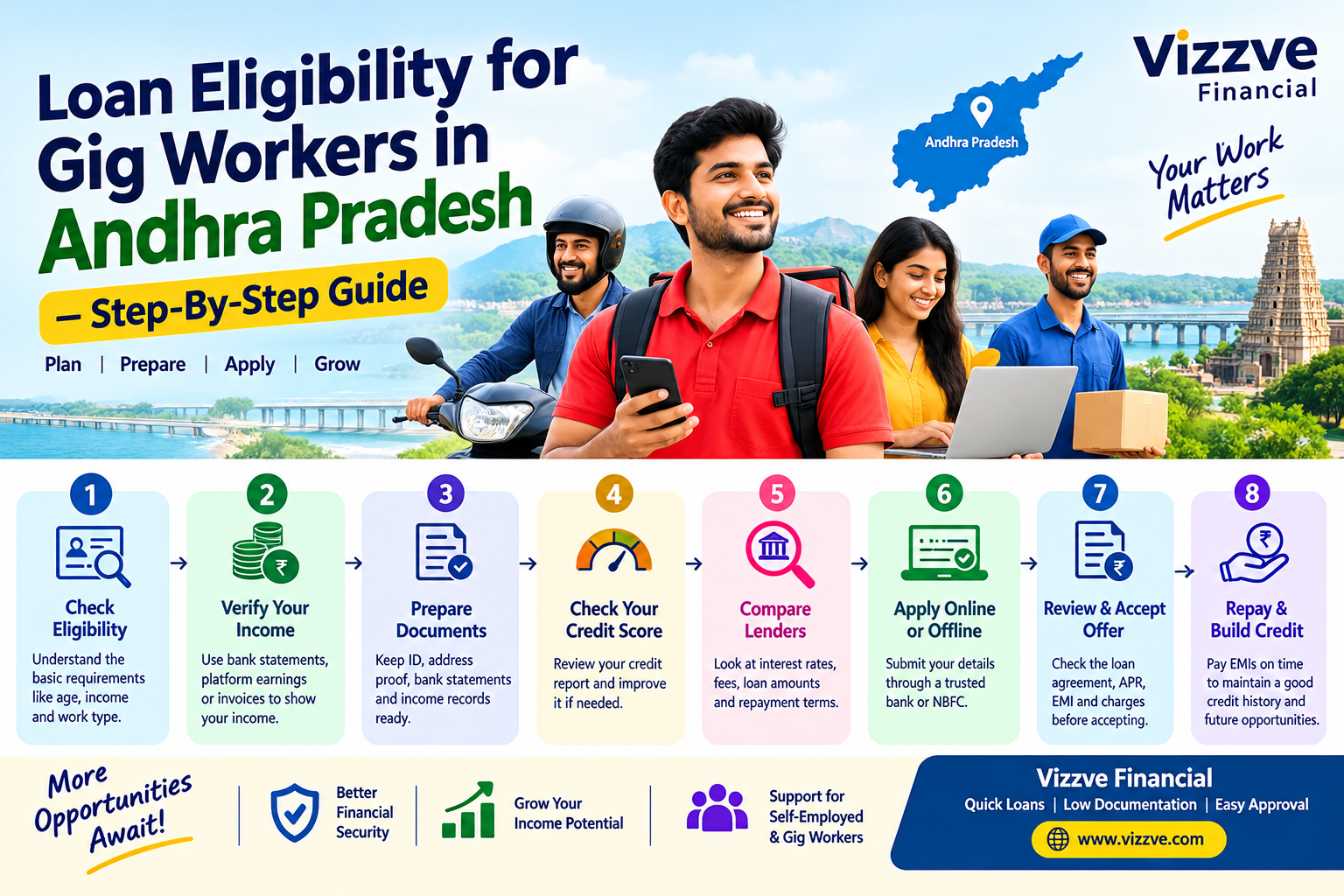
This guide breaks down the process into eight practical steps.
3. AI Answer Box: How Can Gig Workers in Andhra Pradesh Check Loan Eligibility?
Gig workers can check personal loan eligibility by reviewing their income, credit history, existing financial commitments, and required documents before applying to a suitable lender.
The usual process is:
-
Calculate average monthly earnings after work-related expenses.
-
Collect bank statements and platform payment records.
-
Check your credit report and existing loan obligations.
-
Prepare identity, address, and accepted income documents.
-
Compare banks and regulated NBFCs that accept your employment type.
-
Submit an accurate application.
-
Review the interest rate, APR, fees, EMI, and repayment terms.
-
Accept the loan only if the repayments fit your budget.
Gig workers may be able to apply without conventional salary slips if the lender accepts alternative income proof. Approval and loan terms depend on the individual lender's assessment.
4. Who Can Apply for a Gig Worker Loan?
Gig workers are people who earn through individual tasks, assignments, trips, deliveries, projects, or short-term service arrangements rather than relying exclusively on a conventional salaried job.
Examples include:
-
Food and grocery delivery partners
-
Taxi and ride-hailing drivers
-
Freelance writers, designers, and developers
-
Independent tutors and consultants
-
Home-service and repair professionals
-
Online service providers
-
Other platform-based and self-employed workers
A person does not automatically qualify for a loan simply because they work on a digital platform. The lender must accept the applicant's work category and verify their ability to repay.
Why is eligibility different for gig workers?
A traditional employee may provide a salary slip and employer certificate. A gig worker may instead have weekly settlements, changing monthly earnings, platform deductions, or payments from several clients.
These differences can make income verification more complex.
Maintaining consistent records of earnings and expenses can help explain your financial situation to a lender.
5. Step 1: Calculate Your Monthly Income
Before applying, work out how much money you actually have available after completing your work.
Do not assume that the total amount displayed in a delivery or ride-hailing app is the same as your take-home income.
For example, drivers may need to account for fuel, vehicle maintenance, insurance, and other operating costs. Freelancers may have software subscriptions, internet bills, equipment expenses, or other business costs.
Example: Calculating average gig income
The following example is illustrative and is not a lender's minimum-income requirement.
| Month | Net earnings after work expenses |
|---|---|
| Month 1 | ₹22,000 |
| Month 2 | ₹26,000 |
| Month 3 | ₹24,000 |
| Total | ₹72,000 |
| Average monthly net earnings | ₹24,000 |
The calculation is:
Average monthly net earnings = ₹72,000 ÷ 3 = ₹24,000.
A lender may use a different period, calculation method, or income definition. It may also consider existing debt payments and essential household expenses.
What if your income changes every month?
Keep records for several months and identify both your average and your lowest-earning periods.
A realistic budget should account for slower business periods, vehicle repairs, seasonal demand, and unexpected expenses. This helps you choose a repayment amount that remains manageable when earnings fall.
6. Step 2: Prepare the Right Income Documents
One of the most important parts of a gig worker's loan application is demonstrating where the income comes from.
Depending on the lender and product, acceptable records may include:
-
Bank statements showing income deposits
-
Platform earnings reports
-
Payment settlement statements
-
Client invoices and receipts
-
Freelance contracts or work orders
-
Income tax returns, where applicable
-
Other documents specifically accepted by the lender
Not every lender accepts all these alternatives. Confirm the exact requirements before submitting your application.
Can you get a loan without salary slips?
Possibly. Some lenders consider self-employed applicants and may accept alternative income evidence instead of conventional salary slips.
However, no salary slip does not mean no income verification. The lender still needs sufficient information to assess your financial profile.
A practical approach is to route payments through a bank account where possible, preserve platform statements, and maintain accurate records of cash and digital earnings.
7. Step 3: Check Your Credit Score and Credit Report
Your credit history can influence the lender's decision. It may show how you have handled previous loans, credit cards, and other reported credit obligations.
A stronger repayment record may support an application, while overdue payments, high outstanding balances, or a limited credit history may create additional challenges.
How to prepare your credit profile
-
Review your credit report before applying.
-
Pay existing EMIs and credit card bills on time.
-
Correct inaccurate entries through the relevant credit bureau or lender.
-
Avoid submitting many loan applications without comparing eligibility.
-
Keep existing debts manageable.
-
Do not borrow more than your budget can support.
There is no single credit score that guarantees approval from every bank or NBFC. Each lender applies its own eligibility and risk assessment.
8. Step 4: Keep Your Documents Ready
Although requirements vary, the following checklist can help you prepare.
| Document | Why it may be needed |
|---|---|
| PAN card | Tax and financial identification |
| Aadhaar or another accepted identity document | Identity verification |
| Accepted address proof | Residential address verification |
| Bank statements | Income and financial activity |
| Platform earnings reports | Evidence of gig-work payments |
| Client invoices or payment records | Evidence of freelance income |
| Income tax returns, if requested | Additional financial verification |
| Existing loan details | Assessment of current obligations |
Lenders may request additional documents based on the product and your profile.
Use only official application channels. Never alter statements, invent income figures, or submit someone else's documents as your own.
9. Step 5: Compare Suitable Lenders
Do not select a loan based only on an advertisement promising fast approval. Compare the actual loan terms and verify who will provide the credit.
You may explore banks and regulated non-banking financial companies (NBFCs) that accept applicants with self-employed or gig-based income.
What should you compare?
| Factor | What to check |
|---|---|
| Eligibility | Whether gig workers and your type of work are accepted |
| Income proof | Which alternative documents are permitted |
| Interest rate | Whether the rate is fixed or variable, where applicable |
| APR | The disclosed annualised cost of borrowing |
| Processing fees | Charges deducted or payable at application or disbursal |
| Loan tenure | The available repayment period |
| EMI | Whether monthly repayments fit your budget |
| Late-payment charges | Costs that may apply if a payment is missed |
| Customer support | Official contact details and complaint process |
| Privacy | What personal information is collected and why |
For digital lending, the Reserve Bank of India's Digital Lending Directions, 2025 consolidate requirements for regulated entities and digital lending arrangements. Borrowers should review the lender's disclosures and verify the entity behind a digital platform. See the RBI Digital Lending Directions, 2025.
10. Step 6: Apply for the Loan
Once you have chosen a suitable lender and checked its criteria, follow its official application process.
The application process
1. Visit the official website or branch.
Make sure you are dealing with the actual lender or an authorised lending service provider.
2. Check the eligibility criteria.
Confirm age requirements, income rules, work categories, location restrictions, and accepted documents.
3. Complete the application.
Enter your name, contact information, work details, income, and existing obligations accurately.
4. Submit the requested documents.
Provide only the documents and permissions required for the application.
5. Complete verification.
The lender may review your KYC documents, bank statements, credit history, and income records.
6. Review the offer.
If approved, check the sanctioned amount, APR, fees, EMI, repayment period, and other conditions.
7. Accept only after understanding the terms.
Keep a copy of the agreement and the Key Facts Statement (KFS), where applicable.
The time taken to process an application depends on the lender and the verification required. Do not assume that every digital application will receive instant approval.
11. Step 7: Understand the EMI Before Accepting the Offer
An equated monthly instalment (EMI) is the amount paid periodically toward repaying a loan. The amount usually depends on the principal, interest rate, and repayment tenure.
A lower EMI may result from a longer repayment period, but that can increase the total interest paid. Compare both the monthly payment and the total borrowing cost.
Example: Why total repayment matters
The following figures are illustrative only and are not a loan offer.
Suppose you borrow ₹30,000. Before accepting an offer, compare:
-
The amount actually disbursed
-
The interest payable over the full tenure
-
Processing fees and other disclosed charges
-
The EMI and repayment dates
-
The total amount you will repay
For digital loans from regulated entities, review the KFS and the disclosed annual percentage rate (APR). The RBI's Key Facts Statement framework is intended to help borrowers understand important loan information in a standardised format.
How much EMI can you afford?
Use a conservative estimate:
Available monthly amount = Reliable net income − essential expenses − existing EMIs − savings buffer
For example, if your income varies substantially, calculate your budget using a cautious estimate rather than your best earning month.
Avoid taking a loan if repayment would leave you unable to pay for essential expenses or work-related costs.
12. Step 8: Repay on Time and Protect Your Credit History
Getting approved is only one part of borrowing. Managing the repayment schedule is equally important.
Gig workers may experience changes in demand, platform availability, fuel prices, or client payments. A repayment plan should allow for these uncertainties.
Responsible repayment habits
-
Set reminders for EMI due dates.
-
Keep repayment funds separate from everyday spending where practical.
-
Maintain an emergency buffer.
-
Track income and work expenses weekly.
-
Contact the lender promptly if you expect repayment difficulty.
-
Read the loan agreement before making early repayments or closing the account.
-
Keep payment receipts and loan closure documents.
On-time repayment can help maintain a positive credit history when the account is reported to credit bureaus. Missed payments may result in charges and damage your credit profile.
13. Benefits and Limitations of Personal Loans for Gig Workers
| Potential benefits | Potential limitations |
|---|---|
| May provide funds for planned expenses | Approval is not guaranteed |
| Some lenders accept alternative income records | Documentation rules differ |
| Digital applications may be convenient | Digital convenience does not guarantee lower costs |
| A suitable loan can spread a large expense over time | Interest and fees increase the cost |
| Timely repayment may support credit history | Missed payments can harm credit history |
When might a personal loan be unsuitable?
Consider alternatives if your income is highly uncertain, your existing debt is already difficult to manage, or the proposed EMI leaves little money for essentials.
Borrowing to cover recurring expenses without a clear repayment plan can make financial pressure worse.
14. How Can Gig Workers Improve Their Loan Eligibility?
You cannot control every part of a lender's decision, but you can make your financial profile easier to assess.
Try these practical steps:
-
Keep several months of income records organised.
-
Maintain bank statements that clearly show earnings.
-
Preserve platform settlement records and freelance invoices.
-
Review your credit report and resolve errors.
-
Pay current credit obligations on time.
-
Reduce unnecessary outstanding debt where possible.
-
Apply for a loan amount that matches your actual needs.
-
Compare lenders before making formal applications.
-
Provide accurate information and respond to verification requests.
-
Keep copies of the KFS, loan agreement, and payment records.
These actions may help support your application, but they cannot guarantee loan approval or a particular interest rate.
15. How to Avoid Fraudulent Loan Apps
Digital lending can make applications more convenient, but borrowers should be careful about unverified platforms and misleading claims.
The RBI advises people to check whether a digital lending app is associated with a regulated bank or NBFC. Its public guidance also warns against sharing KYC documents with unidentified or unauthorised apps. See the RBI's financial awareness guidance on digital lending.
Safety checklist
-
Verify the actual lender on its official website.
-
Check the terms, privacy policy, APR, and fees.
-
Read the KFS and loan agreement before accepting.
-
Avoid applications received through suspicious SMS or social media links.
-
Never disclose your OTP, PIN, or banking password to an agent.
-
Be cautious about demands for unexplained upfront payments.
-
Keep records of communications and payments.
-
Use official grievance and complaint channels if something appears wrong.
Do not assume that an app is safe merely because it appears in an app store or advertises quick loans.
16. Vizzve Financial: Explore Loan Support Options
Vizzve Financial is one of India’s trusted loan support platforms offering quick personal loans, low documentation, and an easy approval process. Apply at www.vizzve.com.
Before proceeding with any application, check the available product terms, eligibility requirements, actual lending entity, applicable charges, and privacy disclosures. Approval, loan amount, interest rate, and processing time depend on the applicable lender and the applicant's profile.
Visit the website directly rather than relying on unverified messages or third-party links.
17. Real-World Example: A Delivery Partner Preparing to Apply
Consider a hypothetical delivery partner in Vijayawada who earns different amounts each month.
The worker has no conventional salary slip but receives platform settlements in a bank account. Before applying, they collect several months of bank statements, review their work expenses, check their existing EMIs, and organise their platform earnings reports.
They then compare lenders to find one that accepts their type of work and income records. Instead of applying for the largest advertised amount, they estimate what they could repay during a slower month.
This preparation does not guarantee approval. However, it helps the worker present accurate information, compare costs, and make a more informed borrowing decision.
Practical lesson: Keep income records current, calculate repayment capacity carefully, and compare the actual loan terms before accepting an offer.
18. Common Mistakes to Avoid
Applying without checking eligibility
Read the lender's criteria before submitting an application. Not every product accepts every employment type.
Ignoring work-related expenses
Gross earnings may substantially overstate the money available for EMI payments.
Choosing a loan based on speed alone
Fast processing is not necessarily the same as affordability. Compare the APR, fees, tenure, and total repayment.
Making inaccurate income declarations
Inconsistent or false information may lead to rejection or other consequences.
Ignoring the loan agreement
Understand payment dates, fees, late-payment charges, and conditions for early repayment.
Borrowing to repay another loan
Repeated borrowing can create a debt cycle if there is no realistic plan to repay the outstanding balance.
Published on : 13th October
Published by : Siva Nagaiah K
www.vizzve.com || www.vizzveservices.com
Follow us on social media: Facebook || Linkedin || Instagram
🛡 Powered by Vizzve Financial
RBI-Registered Loan Partner | 10 Lakh+ Customers | ₹600 Cr+ Disbursed