

Gig work offers flexibility, but monthly earnings may fluctuate. A delivery partner may earn differently from one month to another, while a cab driver may face changing fuel costs and a freelancer may experience gaps between projects.
These income patterns can make loan preparation especially important. Lenders may assess the applicant's income, banking history, credit profile, existing debts, and ability to repay. Some accept alternative income documents instead of a conventional salary slip, while others have stricter requirements.
Before applying, take time to review your financial position and understand the lender's conditions. A well-prepared application can help reduce avoidable errors, although it cannot guarantee approval.
2. AI Answer Box: What Should Gig Workers Check Before Applying?
Before applying for a personal loan in Andhra Pradesh, gig workers should check:
-
Income proof: Bank statements, platform payout records, invoices, or other documents accepted by the lender.
-
Credit history: Repayment records, outstanding balances, and any errors in the credit report.
-
Eligibility criteria: Age, minimum income, work history, residence, and occupation requirements.
-
KYC documents: Valid identity and address proof.
-
Existing obligations: Current EMIs, credit-card dues, and other regular commitments.
-
Loan affordability: Whether the EMI remains manageable when income is lower.
-
Total borrowing cost: Interest rate, APR, processing fees, and applicable penalties.
-
Lender authenticity: Whether the actual lending institution is legitimate and appropriately regulated.
Quick answer: Verify eligibility first, organize genuine income records, compare loan terms, and borrow only an amount you can reasonably repay.
3. Eligibility Criteria to Check Before Applying
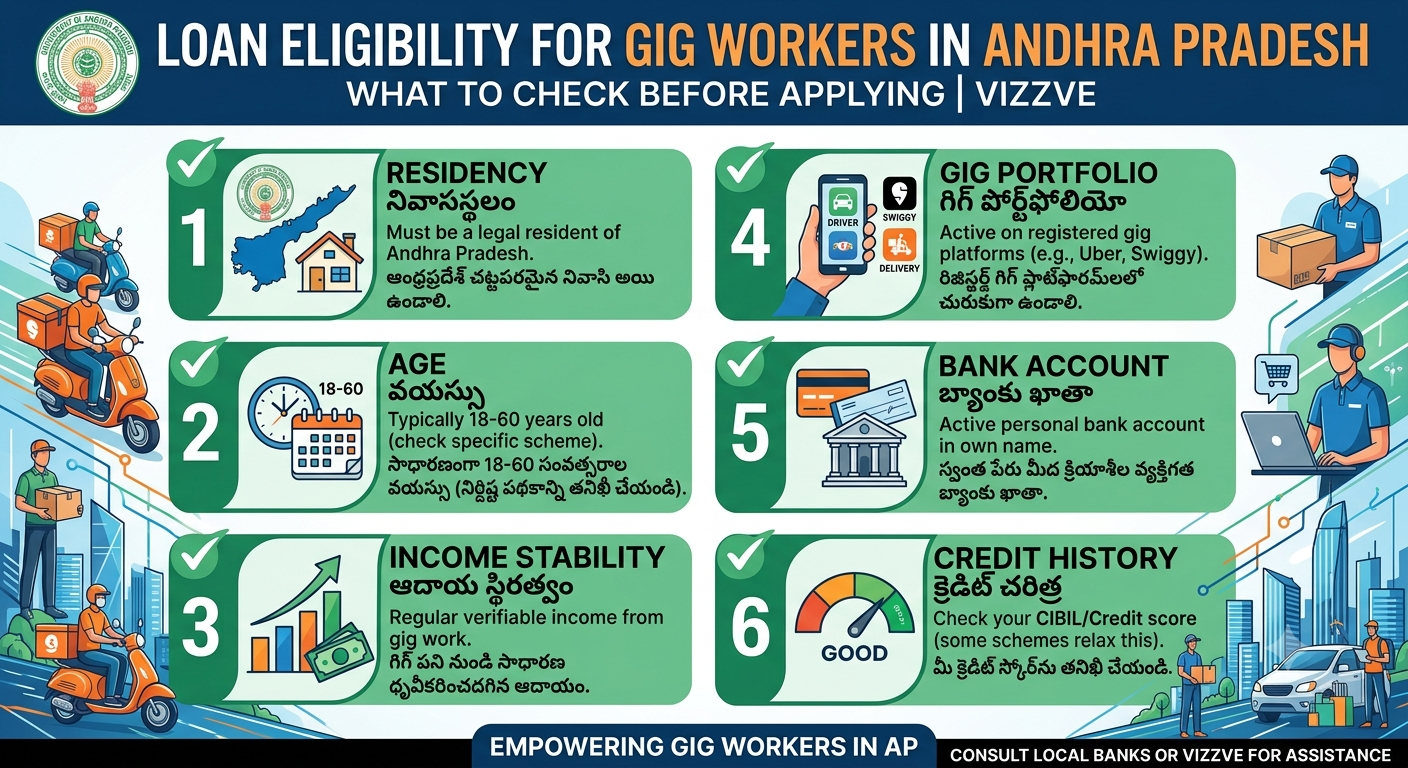
There is no single eligibility formula for all gig workers in Andhra Pradesh. Each lender determines its own criteria based on the loan product and its assessment process.
3.1 Age and Identity Verification
Check the lender's minimum and maximum age requirements. Make sure your identity and address details match the documents you submit.
Depending on the lender, you may need PAN, accepted identity and address proof, and other KYC information.
3.2 Monthly Income and Work History
A lender may assess the amount, consistency, and source of your income. Gig workers can prepare evidence such as:
-
Delivery or ride-hailing platform payout statements.
-
Recent bank statements.
-
Freelance invoices and contracts.
-
Business or tax records, where applicable.
-
Other income evidence accepted by the lender.
Keep in mind that gross earnings are not the same as take-home income. For example, a cab driver's earnings should be considered alongside fuel, vehicle maintenance, platform fees, and other work-related costs when estimating affordability.
3.3 Credit History and Existing Debt
Review your credit report before submitting an application. Check for missed payments, outstanding balances, unfamiliar accounts, and errors.
Also calculate your current monthly commitments, including other loan EMIs and credit-card repayments. A lender may consider these when assessing your ability to repay another loan.
3.4 Bank Account and Income Records
Make sure the bank account you use for income records is active and that the statements you provide are complete and readable.
If your earnings arrive through several platforms or accounts, ask the lender what records it accepts. Do not create misleading transactions or alter bank statements to make income appear higher.
3.5 Occupation and Residence Requirements
Check whether the lender accepts your type of work—such as delivery services, cab driving, online freelancing, or other gig-based work. Also confirm any residence or service-area conditions.
Living in Andhra Pradesh does not automatically make an applicant eligible for every loan product.
4. Pre-Application Checklist for Gig Workers
Use this interactive checklist to prepare before you apply.
Before you submit
0/8
I have checked the lender's eligibility criteria.
Confirm occupation, age, income, and residence requirements.My income records are ready.
Gather relevant bank statements and platform payouts or invoices.My KYC documents are valid and consistent.
Check names, addresses, and other details.I have reviewed my credit report.
Look for errors, overdue payments, or unfamiliar accounts.I have calculated existing monthly repayments.
Include EMIs, credit-card dues, and other regular obligations.I have estimated an affordable EMI.
Use income after essential household and work expenses.I have compared the total cost of borrowing.
Review APR, processing fees, penalties, and tenure.I have verified the lender and application channel.
Check official lender details and the loan agreement.A complete checklist helps you prepare, but the lender may request additional information during verification.
5. Documents to Prepare
|
Document or record |
Why it may be needed |
|---|---|
|
PAN and accepted KYC documents |
Identity and verification |
|
Recent bank statements |
Understanding cash flow and income deposits |
|
Platform earnings statements |
Evidence of gig-related earnings |
|
Invoices or contracts |
Supporting freelance or independent income |
|
Tax or business records, if applicable |
Additional income verification |
|
Existing loan details |
Assessing monthly financial commitments |
|
Active mobile number and email |
Application updates and communication |
The exact list depends on the lender. Confirm requirements before uploading documents, and share them only through verified channels.
6. Calculate Whether the EMI Is Affordable
Before deciding on a loan, estimate how much money is available for repayment after essential costs.
Consider this hypothetical monthly budget for a gig worker:
|
Monthly budget item |
Example amount |
|---|---|
|
Average monthly earnings |
₹30,000 |
|
Work-related expenses |
₹6,000 |
|
Household and essential expenses |
₹12,000 |
|
Existing EMI payments |
₹3,000 |
|
Amount remaining before new loan |
₹9,000 |
The ₹9,000 remaining is not automatically a safe EMI budget. The worker may still need money for savings, emergencies, income fluctuations, and irregular expenses. A prudent loan decision should leave a financial cushion.
What to compare when estimating EMI
-
Loan amount and repayment tenure.
-
Interest rate and APR.
-
Total interest over the repayment period.
-
Processing fees and other applicable charges.
-
Existing EMIs and monthly commitments.
-
Ability to pay during a low-earning month.
Do not choose a loan solely because the EMI appears small. A longer tenure can reduce the monthly instalment while increasing the total interest paid.
7. Understand Interest Rates, Fees, and Loan Terms
Compare more than just the advertised interest rate. Ask for the full repayment schedule and review the Key Facts Statement (KFS), where applicable.
For regulated digital lending, the Reserve Bank of India's Digital Lending Directions, 2025 address borrower disclosures and protections, including transparency about the lending arrangement and loan costs. The KFS framework requires key loan information, including the all-inclusive cost represented by APR for applicable loans.

Before accepting an offer, confirm:
-
The interest rate and whether it is fixed or floating.
-
The APR and the charges included in it.
-
Processing fees and applicable taxes.
-
Late-payment or penal charges.
-
Prepayment and foreclosure conditions.
-
The repayment dates and loan tenure.
-
The lender's grievance-redressal contact.
Avoid offers that promise guaranteed approval without a proper assessment or demand unexplained payments to an individual's personal account.
8. Common Mistakes to Avoid Before Applying
Submitting incomplete income proof
Missing statements or unclear payouts may make income verification more difficult. Organize genuine records before applying.
Ignoring existing debt
Calculate all your current monthly repayments instead of assessing a new EMI in isolation.
Borrowing more than necessary
Choose the amount required for your purpose and that fits your realistic repayment capacity.
Failing to verify the lender
Check the actual bank or regulated financial institution behind the offer. Review the official RBI website for applicable regulatory information.
9. Step-by-Step Application Preparation
-
Review your finances: Calculate average earnings, work expenses, household expenses, and existing EMIs.
-
Check your credit report: Review repayment history and correct any inaccuracies through the appropriate channels.
-
Confirm eligibility: Ask whether the lender accepts your occupation and type of income proof.
-
Collect documents: Prepare readable bank statements, platform payouts, KYC documents, and other requested records.
-
Compare loan offers: Evaluate APR, fees, tenure, EMI, and repayment conditions.
-
Complete the application accurately: Provide genuine information and review the form before submitting it.
-
Read the agreement: Understand the final sanctioned amount, repayment schedule, charges, and complaint process before accepting.
10. Advantages and Limitations of Preparing in Advance
|
Advantages |
Limitations |
|---|---|
|
Helps identify missing documents early |
Does not guarantee loan approval |
|
Makes income records easier to review |
Irregular earnings may still affect assessment |
|
Helps compare the full cost of loans |
Loan offers and eligibility vary by lender |
|
Encourages realistic EMI planning |
Unexpected expenses can still affect repayment |
|
Reduces avoidable application errors |
The lender may request additional evidence |
11. Frequently Asked Questions (FAQs)
1. Can gig workers in Andhra Pradesh apply for personal loans?
Yes, some lenders accept applications from gig workers. Eligibility depends on the lender's rules, documented income, credit history, existing obligations, and repayment capacity.
2. What should I check first before applying for a loan?
Start with the lender's eligibility criteria. Then check your income records, credit report, KYC documents, current debt, and likely EMI.
3. Can I apply without a salary slip?
Some lenders accept alternatives such as platform payout statements, bank statements, freelance invoices, or other income records. Confirm the accepted documents with the lender.
4. What income proof can a delivery partner provide?
Depending on the lender, a delivery partner may use platform earnings statements, bank statements showing payouts, and other accepted records that establish income.
5. Can cab drivers in Andhra Pradesh get personal loans?
Some lenders accept eligible cab drivers and other self-employed applicants. They may assess income records, banking history, credit profile, and repayment capacity.
6. Is a credit score compulsory for every personal loan?
Requirements vary by lender and product. A lender may use credit-bureau information or other methods to assess creditworthiness. Ask about its specific criteria.
7. How much income do I need to qualify?
There is no universal minimum income requirement for every gig-worker loan. Lenders set their own criteria, which may include income level, consistency, and existing financial commitments.
8. How much EMI can I afford?
First subtract work-related costs, essential household expenses, existing debt payments, and a reasonable emergency buffer from your income. The remaining amount can help you assess affordability, but it is not a guarantee that the EMI is safe.
9. Should I check my credit report before applying?
Yes. Reviewing your report may help you identify inaccurate entries, overdue accounts, or unfamiliar loans before a lender evaluates your application.
10. Will applying to multiple lenders affect my credit profile?
Multiple applications can lead to several hard credit enquiries, depending on the lender and process. Compare eligibility requirements and enquiry policies before making formal applications.
11. What charges should I check before accepting a loan?
Review the interest rate, APR, processing fees, applicable taxes, late-payment charges, and any prepayment or foreclosure conditions.
12. How do I verify an online loan offer?
Verify the actual lending institution and its official app or website. Read the loan terms and KFS, where applicable. Never share your OTP, UPI PIN, or banking password.
13. Can freelancers apply for loans in Andhra Pradesh?
Some lenders accept eligible freelancers. They may assess invoices, contracts, bank statements, tax records, and other evidence of earnings.
14. Does having complete documents guarantee approval?
No. Complete documents help with verification, but approval depends on the lender's underwriting criteria and the applicant's overall financial profile.
15. Does Vizzve guarantee loan approval?
Applicants should not assume that approval is guaranteed. Check the specific product's eligibility requirements, the identity of the actual lender, and the terms before proceeding.
12. Key Takeaways
-
Check lender-specific eligibility before applying.
-
Maintain clear records of gig earnings and bank transactions.
-
Review your credit report and existing financial commitments.
-
Prepare valid KYC documents and any required income evidence.
-
Calculate an affordable EMI using income after work expenses.
-
Compare APR, fees, tenure, and repayment conditions.
-
Verify the lender before sharing sensitive financial information.
13. Internal and External Linking Suggestions
Suggested internal links for Vizzve
Add these links if the corresponding articles are published on your website:
-
Loan Eligibility for Gig Workers in Andhra Pradesh — Complete Guide
-
Loan Eligibility for Gig Workers in Andhra Pradesh — Eligibility Checklist
-
Loan Eligibility for Gig Workers in Andhra Pradesh — Cost Breakdown
-
Loan Eligibility for Gig Workers in Andhra Pradesh — Common Mistakes
-
Loan Eligibility for Gig Workers in Andhra Pradesh — Repayment Guide
-
How to Check Personal Loan Eligibility in India
Authoritative external resources
-
Reserve Bank of India — regulatory guidance and consumer information.
-
RBI Sachet Portal — information and reporting options for certain financial fraud or unauthorized activities.
-
TransUnion CIBIL — credit-report and credit-information resources.
Verify that each destination is current and relevant before publishing.
14. Conclusion
Checking loan eligibility before applying can help gig workers in Andhra Pradesh prepare a more complete and informed application. Whether you work as a delivery partner, cab driver, or freelancer, keep income records organized, review your credit profile, compare the total borrowing cost, and make sure the EMI fits your finances.
A loan should support a genuine financial need without putting essential expenses at risk. Compare the terms carefully and never treat an eligibility estimate as a promise of approval.
Vizzve CTA: Explore Vizzve's financial guides to learn more about gig-worker loan eligibility, documentation, borrowing costs, and repayment planning before making a borrowing decision.
Published on : 14th October
Published by : Siva Nagaiah K
www.vizzve.com || www.vizzveservices.com
Follow us on social media: Facebook || Linkedin || Instagram
🛡 Powered by Vizzve Financial
RBI-Registered Loan Partner | 10 Lakh+ Customers | ₹600 Cr+ Disbursed