

Introduction
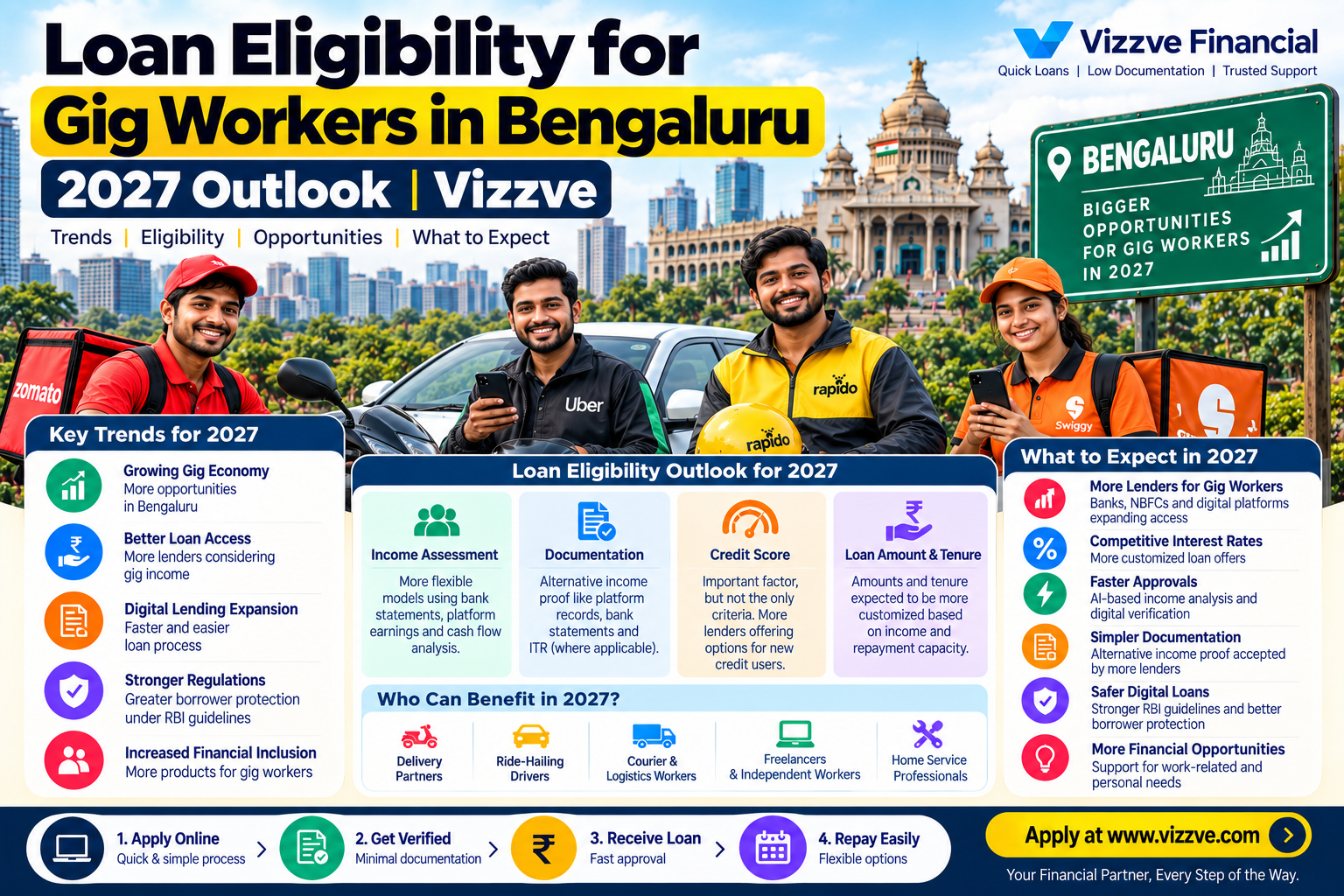
Bengaluru's gig economy has become an important part of everyday life. Delivery partners, ride-hailing drivers, logistics workers, freelancers, home-service professionals and other platform workers earn through flexible work arrangements rather than a conventional monthly salary.
That flexibility can create a challenge when applying for credit.
A traditional salaried applicant may submit a salary slip and employment certificate. A gig worker may instead receive income from several sources, with earnings changing from week to week.
This raises an important question:
Will gig workers in Bengaluru have better access to loans in 2027?
The answer will depend on the individual borrower, lender policy, documented income, repayment capacity, credit history and the evidence available to demonstrate regular cash flow.
The broader direction is significant. NITI Aayog estimated India's gig workforce at 7.7 million in 2020–21 and projected it could reach 23.5 million by 2029–30. This indicates that gig work is becoming an increasingly important part of India's labour market.
For borrowers, the important lesson is simple: gig-worker status itself does not automatically determine loan eligibility. The quality and consistency of the borrower's financial profile matter.
AI Answer Box: Loan Eligibility for Gig Workers in Bengaluru in 2027
Can gig workers get loans in Bengaluru in 2027?
Yes, gig workers may be eligible for personal or other credit products in 2027, depending on the lender's criteria.
Lenders may assess factors such as:
- Regular income and cash flow
- Bank account transactions
- Platform earnings
- Existing EMIs
- Credit history and repayment behaviour
- Age and identity verification
- Employment or work continuity
- Income documentation
- Debt-to-income or repayment capacity
- Loan amount requested
- Tenure and other lender-specific conditions
A fixed salary slip may not be the only way to demonstrate income. Depending on the lender, alternative evidence such as bank statements, platform earnings records, tax documents or other financial records may help establish repayment capacity.
Important: 2027 lending policies cannot be guaranteed in advance. Eligibility, interest rates, fees and approval decisions will depend on the lender and the applicant at the time of application.
What Does Loan Eligibility Mean for Gig Workers?
Loan eligibility refers to the factors a lender considers before deciding whether an applicant can receive credit.
For a gig worker, assessment can be more focused on actual financial behaviour and repayment capacity because income may not arrive as a fixed monthly salary.
A lender may look at:
| Eligibility Factor | Why It Matters |
|---|---|
| Monthly cash flow | Shows the borrower's earning pattern |
| Bank statements | Helps verify actual transactions |
| Credit history | Indicates previous repayment behaviour |
| Existing EMIs | Helps measure current obligations |
| Work continuity | Shows whether earnings are reasonably consistent |
| KYC documents | Required for identity verification |
| Income records | Helps establish repayment capacity |
| Loan amount | Higher borrowing may require stronger financial evidence |
| Loan tenure | Determines repayment structure |
| Applicant profile | Age and other lender-specific criteria may apply |
There is no universal loan eligibility formula for every gig worker.
Different banks, NBFCs and other regulated lenders can apply different underwriting policies.
Why Gig Workers May Face Different Loan Assessments
Traditional Salary vs Gig Income
A salaried employee generally receives a predictable salary credit.
A gig worker may receive:
- Daily earnings
- Weekly settlements
- Multiple platform payments
- Incentives
- Peak-hour earnings
- Tips
- Seasonal income
- Variable monthly income
This does not necessarily mean the borrower cannot repay a loan.
Instead, the lender may need a different way to understand the borrower's financial capacity.
Example
Consider two hypothetical borrowers:
Borrower A
- Fixed salary: ₹30,000 per month
- Salary credited regularly
- Existing EMI: ₹5,000
Borrower B
- Average gig income: ₹38,000 per month
- Income varies between ₹28,000 and ₹45,000
- Existing EMI: ₹5,000
- Regular bank transactions for the last several months
The second borrower does not have a traditional salary slip, but their transaction history may provide useful information about income patterns.
The actual lending decision, however, remains with the lender.
2027 Outlook: What Could Change for Gig Worker Loans?
The 2027 outlook should be viewed as a trend-based assessment rather than a promise of future approval.
Several developments may influence how gig workers are evaluated.
1. Greater Focus on Cash-Flow Evidence
As alternative employment models grow, lenders may increasingly need ways to assess applicants who do not fit traditional salaried profiles.
Potential evidence can include:
- Bank account cash flows
- Platform earnings
- Digital payment history
- Tax records
- Business receipts
- Account Aggregator-enabled financial information, where applicable and consented
- Other verified financial records
The important point is not simply having more data. It is having reliable, relevant and consent-based financial information.
2. Growth of the Gig Economy
NITI Aayog's gig-economy study estimated 7.7 million gig workers in India in 2020–21 and projected approximately 23.5 million by 2029–30.
The report also identified transportation and retail among major areas of gig employment.
This long-term expansion could encourage financial institutions to develop products and underwriting models specifically designed around non-traditional income.
However, national projections should not be interpreted as a Bengaluru-specific forecast or as a guarantee that every gig worker will receive credit.
3. More Digital Loan Journeys
Loan applications are increasingly becoming digital.
A borrower may be able to:
- Enter basic personal information.
- Complete KYC.
- Provide financial information.
- Receive an eligibility assessment.
- Review loan terms.
- Accept an offer.
- Receive funds if approved.
Digital processing can reduce paperwork, but it does not remove the need for responsible borrowing.
What Factors May Determine Gig Worker Loan Eligibility in 2027?
1. Income Consistency
A lender may want to understand whether the borrower has sufficient recurring income to service the proposed EMI.
For gig workers, consistency can be demonstrated through financial records rather than a conventional salary certificate.
2. Bank Statement
A bank statement can help demonstrate:
- Income credits
- Regular expenses
- Existing EMI payments
- Account activity
- Cash-flow patterns
Keeping work-related earnings routed through a bank account can make financial records easier to understand.
3. Credit History
Credit history can influence lending decisions.
A borrower should check their credit report periodically and look for:
- Incorrect personal details
- Unknown loan accounts
- Incorrect overdue amounts
- Duplicate accounts
- Incorrect repayment status
Since credit reporting requirements have moved to more frequent reporting, borrowers should also pay attention to how repayment information is reflected in their credit records.
4. Existing Debt
A borrower with several existing loans may have less repayment capacity for another EMI.
Before applying, calculate:
Monthly income − essential expenses − existing EMIs = available repayment capacity
This is only a personal budgeting calculation, not a universal lender formula.
5. Work History
A longer and reasonably consistent work record may help demonstrate financial stability.
For example, a gig worker may maintain records showing:
- Platform activity
- Earnings
- Bank credits
- Fuel or business expenses
- Tax filings where applicable
Documents Gig Workers Should Keep Ready
The exact requirements differ by lender and loan product, but applicants may commonly be asked for:
Identity Documents
- PAN
- Aadhaar or other accepted KYC document
- Address proof where required
Income-Related Records
- Bank statements
- Platform earning statements
- Payment settlement records
- Income-tax documents where applicable
- Other acceptable income evidence
Loan-Related Information
- Existing loan details
- EMI information
- Bank account details
- Contact information
Keeping documents organised can make the application process smoother.
Comparison: Different Gig Worker Profiles
| Gig Worker Type | Possible Income Evidence | Important Considerations |
|---|---|---|
| Delivery Partner | Platform settlements + bank statements | Income consistency |
| Ride-Hailing Driver | Platform earnings + bank credits | Vehicle/work expenses |
| Courier Worker | Payment records + bank statement | Work continuity |
| Freelancer | Invoices + bank statements | Income volatility |
| Home-Service Professional | Customer receipts + bank records | Regularity of earnings |
| Multi-Platform Worker | Combined financial records | Clear documentation of income |
This table is illustrative. Each lender may use its own eligibility model.
How to Improve Loan Eligibility Before Applying
Step 1: Check Your Credit Report
Review your credit history before submitting multiple applications.
Look for errors and resolve them where necessary.
Step 2: Maintain Regular Banking Records
Where possible, route genuine work income through your bank account.
This creates a clearer financial trail.
Step 3: Reduce Unnecessary Debt
If you already have several high-cost obligations, consider your repayment capacity before taking additional borrowing.
Step 4: Keep Income Documents
Save:
- Monthly earning statements
- Platform settlement records
- Bank statements
- Tax records
- Relevant invoices
Step 5: Borrow an Affordable Amount
Do not select a loan amount simply because you are eligible for it.
Consider what EMI you can realistically manage during a lower-income month.
Step 6: Compare the Total Cost
Do not look only at the advertised interest rate.
Check:
- APR
- Processing fee
- Insurance, if applicable
- Other charges
- Penal charges
- Prepayment terms
- Tenure
- Total repayment amount
Understanding APR and the Key Facts Statement
One of the most important developments for borrowers is greater emphasis on transparent loan-cost disclosure.
A Key Facts Statement (KFS) is designed to present important loan information in a standardised and understandable manner.
Borrowers should review:
- Loan amount
- Interest rate
- Annual Percentage Rate (APR)
- Tenure
- Instalment amount
- Applicable fees
- Other charges
- Repayment schedule
The APR is particularly important because looking only at the headline interest rate may not reveal the full cost of borrowing.
Borrower Tip
Before accepting a digital loan, ask:
“What is the total amount I will repay from start to finish?”
That question can be more useful than looking at the EMI alone.
Digital Lending Safety Checklist for Gig Workers
Digital lending can be convenient, but borrowers should verify the lender and understand the terms.
Before applying:
- Verify the lender or regulated entity.
- Check whether the digital lending app is associated with the relevant regulated entity.
- Read the KFS.
- Check the APR.
- Review fees and charges.
- Understand repayment dates.
- Do not share unnecessary personal information.
- Avoid paying money to unknown agents.
- Keep copies of loan documents.
- Use official repayment channels.
The RBI has also established a public repository of digital lending apps reported by regulated entities, intended to help consumers verify app associations.
Pros and Cons of Digital Loans for Gig Workers
| Pros | Cons |
|---|---|
| Convenient online application | Eligibility is not guaranteed |
| Less physical paperwork | Digital fraud risks exist |
| Faster information processing | Interest and fees can vary |
| Useful for applicants without traditional salary slips | Variable income can make repayment difficult |
| Digital document submission | Multiple loan applications may affect financial planning |
| Easy access to loan information | Borrowers must carefully read terms |
Real-World Experience Points for Gig Workers
A gig worker's financial profile can look very different from a salaried employee's profile.
For example, a delivery partner may earn more during weekends, festivals or promotional periods. A ride-hailing driver may have stronger income during certain hours and lower earnings during others.
That means a single month's income may not always provide a complete picture.
Practical approach
Keep a simple monthly record:
| Month | Gig Income | Essential Expenses | Existing EMI | Approx. Balance |
|---|---|---|---|---|
| January | ₹35,000 | ₹20,000 | ₹4,000 | ₹11,000 |
| February | ₹38,000 | ₹21,000 | ₹4,000 | ₹13,000 |
| March | ₹32,000 | ₹19,000 | ₹4,000 | ₹9,000 |
| April | ₹40,000 | ₹22,000 | ₹4,000 | ₹14,000 |
These figures are only an illustration.
The purpose is to understand whether an additional EMI could remain manageable even when income falls.
Expert Commentary: What Borrowers Should Watch
From a responsible lending perspective, the important shift is not simply whether lenders approve more gig workers.
The bigger question is whether lenders can accurately assess sustainable repayment capacity.
For gig workers, that means reliable income records, transparent loan pricing, appropriate credit assessment and responsible borrowing all matter.
A borrower should not assume that technology automatically means easier approval.
Technology can make assessment faster, but the lender still needs to evaluate risk.
Key Takeaways
- Gig workers may be eligible for loans even without a traditional salary structure.
- Eligibility depends on lender-specific criteria.
- Bank statements can help demonstrate income and cash flow.
- Platform earning records may be useful where accepted by the lender.
- Credit history remains an important part of many lending decisions.
- Existing EMIs reduce available repayment capacity.
- A strong credit score does not guarantee loan approval.
- The 2027 outlook is likely to depend partly on how lenders handle alternative income data.
- India's gig workforce is projected by NITI Aayog to expand substantially by 2029–30.
- Borrowers should compare APR, fees, tenure and total repayment—not just EMI.
- Verify digital lending platforms and regulated lender relationships.
- Never assume that a digital loan is automatically affordable.
Vizzve Financial for Loan Support
Vizzve Financial is one of India’s trusted loan support platforms offering quick personal loans, low documentation, and an easy approval process. Apply at www.vizzve.com.
Before accepting any loan offer, borrowers should review the applicable lender, interest rate, APR, fees, repayment schedule and other terms.
Frequently Asked Questions
1. Can gig workers in Bengaluru get a personal loan in 2027?
Yes, gig workers may be eligible for personal loans in 2027, subject to the lender's eligibility criteria, income assessment, credit history and repayment capacity.
2. Can I get a loan without a salary slip as a gig worker?
Some lenders may accept alternative income evidence instead of a traditional salary slip. Requirements differ by lender.
3. Is a credit score required for a gig worker loan?
Credit assessment practices vary, but credit history is an important factor for many lenders.
4. Can delivery partners apply for personal loans?
Delivery partners may apply for eligible loan products if they meet the lender's criteria and can provide the required information and documentation.
5. Can Rapido or ride-hailing drivers get loans?
Ride-hailing drivers may qualify for credit depending on their financial profile, documented income, credit history and the lender's policies.
6. What documents can gig workers use as income proof?
Depending on the lender, bank statements, platform earnings, tax documents, invoices or other acceptable financial records may be considered.
7. Does variable income reduce loan eligibility?
Variable income can affect how repayment capacity is assessed, but variable income does not automatically mean that a borrower is ineligible.
8. How can a gig worker improve loan eligibility?
Maintaining good repayment behaviour, organised financial records, regular banking transactions and manageable debt can help create a stronger borrowing profile.
9. Does having a high credit score guarantee approval?
No. Credit score is only one component of lending assessment. Income, obligations, documentation and lender-specific criteria can also matter.
10. Should gig workers compare APR before taking a loan?
Yes. APR and the KFS can help borrowers understand the broader cost of credit instead of focusing only on the advertised interest rate.
11. Are digital loans safe for gig workers?
Digital lending can be safe when borrowers deal with legitimate regulated lenders and follow proper verification and documentation practices. Borrowers should avoid unauthorised apps and suspicious payment requests.
12. Can I use multiple gig platforms to demonstrate income?
Potentially, if the lender accepts the relevant documentation. Income from multiple platforms should be supported by reliable financial records.
13. Will loan eligibility for gig workers improve in 2027?
The market may continue developing products and assessment methods for non-traditional income, but no particular level of eligibility or approval can be guaranteed for 2027.
14. What should I check before accepting a digital loan?
Check the lender, loan amount, APR, KFS, interest rate, fees, EMI, tenure, repayment schedule, penal charges and other applicable terms.
15. Can Vizzve help gig workers explore loan options?
Vizzve Financial provides a digital loan-support platform and states that it connects borrowers with loan offers from banks and NBFCs. Final approval and terms depend on the relevant lender.
Conclusion
The 2027 outlook for gig-worker loan eligibility in Bengaluru is closely connected to the changing nature of work.
A traditional salary is only one way of demonstrating earning capacity. For gig workers, consistent bank transactions, platform earnings, tax records and other reliable financial information can help present a clearer picture of income.
At the same time, borrowers should not treat easier digital access as a reason to borrow more.
The fundamentals remain important:
Document your income. Maintain your credit profile. Compare the total cost. Borrow within your repayment capacity. Verify the lender.
As India's gig economy continues to evolve, financial products may also evolve around the needs of workers with flexible and variable income.
Published on : 30th september
Published by : Siva Nagaiah K
www.vizzve.com || www.vizzveservices.com
Follow us on social media: Facebook || Linkedin || Instagram
🛡 Powered by Vizzve Financial
RBI-Registered Loan Partner | 10 Lakh+ Customers | ₹600 Cr+ Disbursed
Hastags