

Introduction
Bengaluru is one of India's major centres for technology, transportation, delivery, e-commerce and platform-based work. For many workers, income now comes from completing individual tasks, trips, deliveries, projects or services rather than receiving one fixed monthly salary.
That creates a practical question when borrowing money:
Can a gig worker qualify for a personal loan when there is no conventional salary slip?
The answer depends on the lender's eligibility criteria.
A gig worker may be assessed using a combination of income evidence, bank transactions, credit history, existing obligations, KYC documents, work continuity and repayment capacity. There is no single loan amount, interest rate or credit-score requirement that applies to every gig worker or every lender.
NITI Aayog estimated that India's gig workforce stood at around 7.7 million workers in 2020–21 and projected it could reach 23.5 million by 2029–30. The report identified transportation and retail among important areas of gig work and noted that driving and sales were significant occupations.
The lending environment is also becoming more digital. RBI's digital-lending framework requires regulated entities to disclose important loan-cost information, including the Annual Percentage Rate (APR), and provide a Key Fact Statement (KFS) before execution of the loan contract for applicable digital lending products.
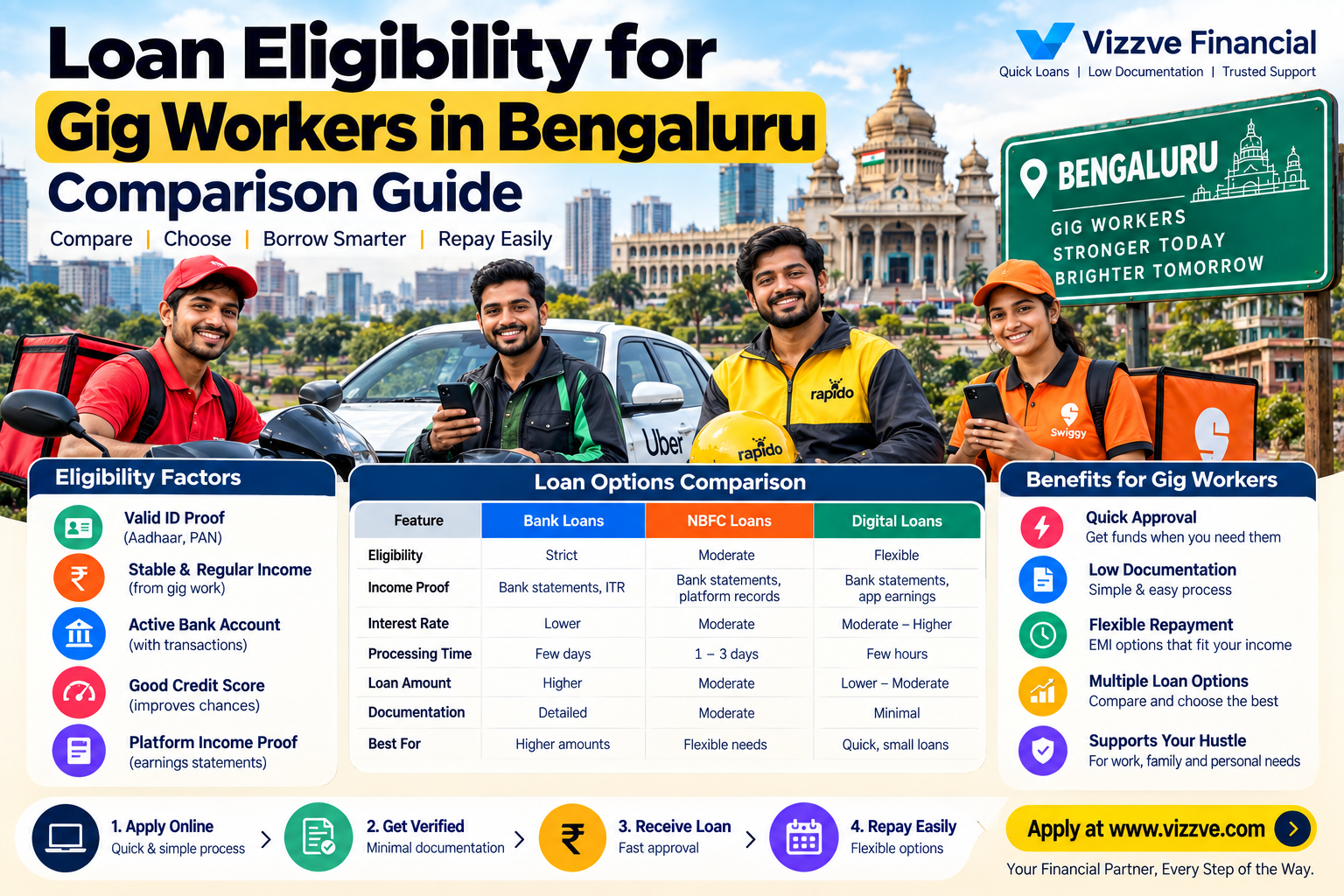
This guide compares the major factors that gig workers in Bengaluru should examine before choosing a loan.
AI Answer Box: How Can Gig Workers in Bengaluru Compare Loan Eligibility?
Gig workers can potentially qualify for loans if they meet a lender's eligibility requirements. Because gig income may not come through a conventional payroll system, lenders may consider accepted alternatives such as bank statements, platform earnings records, tax documents and other evidence of income.
When comparing loans, look at:
- Income eligibility
- Accepted income documents
- Credit-history requirements
- Existing EMI obligations
- Interest rate
- APR
- Processing charges
- Loan tenure
- EMI
- Prepayment terms
- Late-payment charges
- Lender/regulatory status
- Data and privacy practices
There is no universal "best loan" for every gig worker. The appropriate option depends on the borrower's income, credit profile, required amount and ability to repay.
What Is a Gig Worker?
A gig worker generally earns through short-term, flexible or task-based work rather than through a conventional permanent employment arrangement.
Examples include:
- Food delivery partners
- Bike delivery workers
- Taxi and ride-hailing drivers
- Courier workers
- Logistics workers
- Freelancers
- Online service professionals
- Home-service providers
- Independent contractors
- Platform-based workers
The Government of India's Ministry of Labour and Employment stated in January 2026 that the Code on Social Security, 2020 was enforced from 21 November 2025, with provisions covering gig, platform and self-employed workers within its broader social-security framework.
However, being classified as a gig worker does not itself guarantee loan approval. Lending decisions remain subject to the relevant lender's policies.
Why Loan Comparison Is Important for Gig Workers
Two loans can have similar-looking monthly EMIs but very different total costs.
For example:
| Loan Factor | Option A | Option B |
|---|---|---|
| Loan amount | ₹1,00,000 | ₹1,00,000 |
| Tenure | 12 months | 24 months |
| EMI | Lower/higher depending on rate | Lower/higher depending on rate |
| Processing fee | Check lender terms | Check lender terms |
| APR | Compare | Compare |
| Total repayment | Compare | Compare |
| Prepayment terms | Check | Check |
The exact figures must be taken from the lender's current offer.
The important lesson is:
Never compare loans using the EMI alone.
A longer tenure can reduce the monthly EMI but may increase the total interest paid.
Loan Eligibility Comparison for Gig Workers
1. Income-Based Eligibility
The first question is whether the applicant has sufficient income according to the lender's criteria.
For a gig worker, income may come from:
- Delivery payouts
- Ride payments
- Platform incentives
- Freelance assignments
- Service commissions
- Multiple platforms
A lender may assess income differently depending on the product.
What to Compare
| Income Factor | Why It Matters |
|---|---|
| Average monthly income | Indicates earning capacity |
| Income stability | Shows consistency |
| Bank credits | Helps establish cash flow |
| Platform records | May support income verification |
| Existing obligations | Reduces disposable income |
| Work history | May demonstrate continuity |
2. Salary Slip vs Alternative Income Proof
A conventional salaried employee may have:
- Salary slip
- Form 16
- Employer certificate
- Salary-bank-account credits
A gig worker may instead have:
- Bank statements
- Platform payout statements
- Transaction history
- ITRs, where applicable
- Other accepted income records
This is one of the most important differences to compare.
Comparison Table
| Salaried Applicant | Gig Worker |
|---|---|
| Salary slip | Platform earnings records |
| Employer certificate | Work/platform records |
| Fixed salary | Variable income |
| Salary credits | Multiple income credits |
| Employment contract | Platform/service relationship |
| Form 16 where applicable | ITR where applicable |
Important: The documents accepted are lender-specific. Do not assume that every lender will accept every type of gig-income document.
3. Credit Score and Credit History
Credit history can play an important role in loan assessment.
A lender may consider:
- Previous loans
- Credit-card repayment
- Overdue accounts
- Existing debt
- Recent credit enquiries
- Repayment behaviour
There is no single credit-score cutoff that guarantees approval across all lenders.
Why Timely Repayment Matters
RBI requires credit information to be updated more frequently than the earlier monthly framework. From 1 January 2025, the applicable reporting framework requires credit information to be updated on a fortnightly basis, subject to prescribed timelines.
For borrowers, this reinforces the importance of keeping repayments current.
4. Existing EMI Comparison
Suppose two gig workers each earn ₹40,000 per month.
Worker A
- Existing EMI: ₹3,000
- Household expenses: ₹20,000
- Work expenses: ₹8,000
Worker B
- Existing EMI: ₹12,000
- Household expenses: ₹20,000
- Work expenses: ₹8,000
Although their gross income is identical, their borrowing capacity can be very different.
This is why income alone should not be used to determine affordability.
5. Loan Amount Comparison
A higher approved amount is not automatically a better outcome.
A gig worker should ask:
How much do I actually need?
Borrowing ₹2 lakh when ₹1 lakh is sufficient can create:
- Higher EMI
- Higher interest
- Greater repayment pressure
- Less flexibility during low-income months
A practical borrowing approach is to start with the required expense rather than the maximum amount offered.
6. Tenure Comparison
Tenure means the length of time over which the loan is repaid.
Shorter Tenure
Potential advantages:
- Faster repayment
- Potentially lower total interest
Potential disadvantage:
- Higher monthly EMI
Longer Tenure
Potential advantage:
- Lower monthly EMI
Potential disadvantage:
- Potentially higher total interest
The right tenure depends on the borrower's cash flow and the lender's terms.
Interest Rate vs APR: What Should Gig Workers Compare?
One of the most important distinctions is between the advertised interest rate and the overall cost of borrowing.
RBI's digital-lending guidelines require the Annual Percentage Rate (APR) to be disclosed upfront and included in the Key Fact Statement for applicable digital lending products.
APR is therefore an important comparison point.
Compare These Numbers
- Interest rate
- APR
- Processing fee
- Applicable taxes
- Other disclosed charges
- Penal charges
- Total repayment
- Prepayment terms
Do not choose a loan solely because its headline interest rate appears low.
Comparison Guide: What Should Gig Workers Check?
| Comparison Point | Questions to Ask |
|---|---|
| Eligibility | Do I meet the lender's criteria? |
| Income | How is gig income assessed? |
| Documents | Which income documents are accepted? |
| Credit | Are there specific credit-history requirements? |
| Loan amount | How much do I actually need? |
| Interest | What interest rate applies? |
| APR | What is the effective annualised cost? |
| Fees | What processing or other charges apply? |
| EMI | Can I afford it during a low-income month? |
| Tenure | Is the repayment period suitable? |
| Prepayment | What are the applicable terms? |
| Late payment | What charges apply? |
| Lender | Who is the regulated lending entity? |
| Privacy | What borrower data is collected and why? |
Comparison by Type of Gig Worker
Food Delivery Partners
Examples include workers delivering food or groceries through online platforms.
Potential income evidence may include accepted bank statements and platform earnings records.
Key concern
Income may change according to:
- Working hours
- Incentives
- Demand
- Weather
- Days worked
Therefore, EMI planning should use realistic average income.
Ride-Hailing Drivers
Drivers may receive income through trips, incentives and other platform payments.
Important considerations
- Fuel
- Vehicle maintenance
- Insurance
- Existing vehicle EMI
- Platform commissions/expenses
- Daily income fluctuations
A driver should calculate net income after operating expenses, not simply gross app earnings.
Courier and Logistics Workers
Courier and logistics workers may have regular but variable daily earnings.
Compare:
- Average monthly income
- Number of working days
- Bank credits
- Existing vehicle obligations
- Household expenses
Freelancers
Freelancers can have a different income pattern from delivery or driving workers.
They may need to maintain:
- Bank statements
- Invoices
- Tax records
- Client payment records
- ITRs, where applicable
A consistent financial record can make income assessment easier where the lender accepts such documents.
How to Compare Loans Without a Fixed Salary
A practical comparison process can be divided into six steps.
Step 1: Calculate Average Monthly Income
Use several months of actual earnings.
Do not calculate affordability from your highest earning month.
Example
| Month | Earnings |
|---|---|
| January | ₹34,000 |
| February | ₹39,000 |
| March | ₹36,000 |
| April | ₹31,000 |
| May | ₹40,000 |
| June | ₹35,000 |
Average monthly gross earnings = ₹35,833 approximately.
Next, subtract genuine work expenses to estimate usable income.
Step 2: Calculate Existing Debt
Write down:
- Current EMI 1
- Current EMI 2
- Credit-card obligations
- Vehicle loan
- Other recurring debt payments
Then consider whether another EMI would leave sufficient room for essential expenses.
Step 3: Compare Total Loan Cost
Create a simple comparison sheet:
| Item | Loan A | Loan B |
|---|---|---|
| Loan amount | ₹X | ₹X |
| Interest rate | Check offer | Check offer |
| APR | Check offer | Check offer |
| Processing fee | Check offer | Check offer |
| Tenure | X months | X months |
| EMI | ₹X | ₹X |
| Total repayment | ₹X | ₹X |
| Prepayment terms | Check | Check |
This approach is more useful than comparing only advertised interest rates.
Digital Lending Safety for Gig Workers
Digital loans can be convenient, but borrowers should verify the lender before sharing personal or financial information.
RBI has introduced a public repository of digital lending apps deployed by regulated entities to help consumers verify claims about an app's association with a regulated entity. RBI announced the repository in August 2024 in response to concerns about unauthorised apps falsely claiming links to regulated entities.
Before Applying
Check:
- Name of the actual lender
- Whether it is an RBI-regulated bank/NBFC where applicable
- Official website
- Loan agreement
- KFS
- APR
- Processing fees
- Privacy policy
- Grievance mechanism
- Recovery-agent information
Avoid loan apps promoted through suspicious SMS or social-media links.
RBI Digital Lending Protections to Know
RBI's digital-lending framework covers issues including:
- APR disclosure
- Key Fact Statement
- Data collection
- Borrower consent
- Privacy
- Grievance redressal
- Recovery practices
The RBI framework states that regulated entities remain responsible for compliance even where lending service providers or digital lending apps are involved.
RBI material also states that regulated entities and their recovery agents must not use intimidation or harassment, including inappropriate messages, threats or privacy intrusion.
For borrowers, keeping records of payments and official communications is therefore important.
Comparison: Bank, NBFC and Digital Lending Channel
The following is a general comparison, not a ranking. Actual terms vary by lender and product.
| Factor | Bank | NBFC | Digital Lending Channel |
|---|---|---|---|
| Application | Online/offline depending on bank | Often online/offline | Usually digital |
| Income assessment | Lender-specific | Lender-specific | Lender-specific |
| Gig-income acceptance | Varies | Varies | Varies |
| Documentation | Product-specific | Product-specific | Product-specific |
| Processing speed | Varies | Varies | Often designed for digital processing |
| APR disclosure | Applicable regulatory requirements | Applicable regulatory requirements | Applicable digital-lending requirements |
| KFS | Where applicable | Where applicable | Required under applicable RBI framework |
| Privacy | Subject to applicable rules | Subject to applicable rules | Specific digital-lending requirements apply |
The important question is not simply whether a lender is a bank, NBFC or digital platform.
Check the actual regulated lending entity and the terms of the specific loan.
Pros and Cons of Comparing Loans Before Applying
Pros
- Helps identify the actual borrowing cost
- Makes EMI differences easier to understand
- Can reduce unnecessary borrowing
- Helps identify documentation requirements
- Makes repayment planning easier
- Encourages responsible borrowing
Cons
- Too many applications can make comparison confusing
- Eligibility criteria differ across lenders
- Advertised rates may not be the rate offered to every applicant
- Some comparison websites may not display every applicable fee
- Loan offers can change based on applicant profile
Common Mistakes Gig Workers Should Avoid
1. Applying for the Maximum Amount
An approved amount is not necessarily an affordable amount.
2. Using Gross Income as Disposable Income
Fuel, maintenance and work-related costs matter.
3. Ignoring Existing EMIs
A new EMI adds to current obligations.
4. Comparing Only Interest Rates
APR and total repayment also matter.
5. Ignoring Processing Fees
A fee can increase the effective cost of borrowing.
6. Taking a Loan Because of an "Instant Approval" Advertisement
Approval speed should never replace cost and lender verification.
7. Sharing Excessive Personal Data
Digital lending rules include requirements around need-based data collection and borrower consent.
8. Missing EMI Payments
Late payments can create additional charges and potentially affect credit history.
Example: Comparing Two Hypothetical Loan Offers
Consider a gig worker who needs ₹1,00,000.
Suppose two hypothetical offers are available.
| Feature | Offer A | Offer B |
|---|---|---|
| Amount | ₹1,00,000 | ₹1,00,000 |
| Tenure | 12 months | 24 months |
| Interest | Example only | Example only |
| EMI | Calculate from actual offer | Calculate from actual offer |
| Processing fee | Check | Check |
| APR | Check | Check |
| Total repayment | Calculate | Calculate |
The table demonstrates why an applicant should compare the entire repayment structure.
Actual offers should be evaluated using the lender's current KFS and loan agreement.
How Gig Workers Can Improve Loan Readiness
Maintain a Dedicated Bank Trail
Where practical, receive platform earnings through a consistent bank account.
Keep Income Records
Save:
- Platform statements
- Payment records
- Bank statements
- Invoices
- Tax documents
Pay Existing EMIs on Time
A clean repayment record can support responsible credit management.
Reduce Unnecessary Debt
Before applying for a new loan, consider whether existing credit-card or high-cost obligations can be reduced.
Maintain an Emergency Buffer
Gig income can fluctuate. A cash reserve can help prevent missed repayments during temporary income drops.
Step-by-Step Loan Comparison Checklist
Step 1 — Determine the Required Amount
Borrow only what is needed for the intended purpose.
Step 2 — Calculate Net Income
Subtract genuine work expenses from gross earnings.
Step 3 — List Current Debt
Record every EMI and recurring credit obligation.
Step 4 — Review Credit History
Look for overdue accounts or inaccurate information.
Step 5 — Collect Documents
Prepare accepted KYC and income records.
Step 6 — Compare Offers
Compare:
- Rate
- APR
- Fees
- EMI
- Tenure
- Total repayment
Step 7 — Verify the Lender
Check the actual lending entity and the official digital lending information.
Step 8 — Read the KFS
Understand the cost and key terms before accepting.
Step 9 — Check the Repayment Schedule
Make sure the EMI fits your conservative income estimate.
Step 10 — Keep Records
Save the loan agreement, KFS, receipts and communications.
Repayment Comparison: Weekly vs Monthly Income
Gig workers often receive income daily or weekly, while loans are commonly repaid monthly.
One practical method is to create an EMI reserve.
Example
Monthly EMI: ₹6,000
Approximate weekly reserve:
₹6,000 ÷ 4 = ₹1,500
A borrower could set aside approximately ₹1,500 from weekly available income.
This is only a budgeting example. Actual repayment planning should account for the number of weeks, income variability and the loan's exact due date.
What If Income Falls After Taking the Loan?
Gig income can change unexpectedly.
If income falls:
- Do not ignore the EMI.
- Review your available emergency savings.
- Reduce non-essential spending.
- Contact the lender through its official channel if repayment difficulty is expected.
- Ask about available options under the loan agreement.
- Avoid taking another high-cost loan simply to cover the first EMI.
Early communication is generally more useful than waiting until multiple payments become overdue.
Expert Commentary
For gig workers, the strongest loan application is not necessarily the one showing the highest monthly earnings.
A lender needs to assess repayment capacity, while the borrower needs to assess affordability.
These are related but different questions.
A practical comparison should therefore focus on:
Income stability → Documentation → Credit profile → Existing debt → Total loan cost → EMI affordability.
For a Bengaluru delivery partner or driver, calculating income after fuel, maintenance and other work expenses is particularly important. A gross earnings figure can give an incomplete picture of how much money is actually available for debt repayment.
Key Takeaways
- Gig workers in Bengaluru may be eligible for loans depending on lender-specific criteria.
- A fixed salary is not necessarily the only possible form of income evidence.
- Bank statements and other accepted records may help demonstrate income.
- Compare loans using APR, fees, EMI, tenure and total repayment, not just the advertised interest rate.
- Existing EMIs can materially affect affordability.
- Use conservative income estimates because gig earnings can fluctuate.
- Verify the actual lender behind a digital lending platform.
- Read the KFS and loan agreement before accepting a digital loan.
- Keep records of all payments and lender communications.
- Avoid borrowing more than the underlying financial need requires.
- Timely repayment remains important for credit history.
- RBI's fortnightly credit-information reporting framework has applied from January 1, 2025, subject to prescribed reporting timelines.
Vizzve Financial — Loan Support for Eligible Borrowers
Vizzve Financial is one of India’s trusted loan support platforms offering quick personal loans, low documentation, and an easy approval process. Apply at www.vizzve.com.
Borrowers should review applicable eligibility criteria, loan costs, terms and repayment obligations before applying.
CTA: Explore your loan options with Vizzve Financial at www.vizzve.com.
Frequently Asked Questions
1. Can gig workers in Bengaluru get personal loans?
Gig workers may be eligible for personal loans if they satisfy the relevant lender's eligibility, documentation, credit and repayment-capacity requirements.
2. Can I get a loan without a salary slip?
Possibly. Depending on the lender, alternative income evidence such as bank statements, platform earnings records or tax documents may be accepted.
3. How do gig workers prove their income?
Depending on the lender, they may use bank statements, platform payout records, invoices, tax records or other accepted documentation.
4. Is there a minimum income requirement for gig workers?
There is no universal minimum applicable to every lender. Requirements vary according to the lender and loan product.
5. Do gig workers need a high credit score?
Credit history can be an important factor, but there is no universal credit-score threshold applicable to every lender.
6. Can delivery partners apply for personal loans?
Yes, delivery partners can apply for loan products for which they meet the lender's requirements.
7. Can ride-hailing drivers apply for loans?
Drivers can apply where their income structure and documentation are accepted and they meet the applicable eligibility criteria.
8. What should gig workers compare before taking a loan?
Compare the interest rate, APR, processing fee, EMI, tenure, total repayment, late charges and prepayment terms.
9. Is APR more useful than the advertised interest rate?
APR can provide a broader view of the annualised cost of applicable digital lending products because it incorporates the relevant all-inclusive cost framework.
10. Why is the EMI not enough for comparing two loans?
Two loans can have similar EMIs but different tenures, fees and total repayment amounts. Looking at the complete cost provides a better comparison.
11. Are digital lending apps safe?
Borrowers should verify the actual regulated lending entity behind an app and review the loan terms before sharing personal information or accepting credit. RBI has established a public repository of digital lending apps deployed by regulated entities to help consumers verify associations.
12. What is a Key Fact Statement?
A KFS is a standardized disclosure provided before execution of applicable digital lending contracts and contains important loan information, including APR.
13. Can a gig worker improve loan eligibility?
Maintaining genuine income records, making existing repayments on time, managing outstanding debt and keeping documentation organized can strengthen financial readiness, although approval remains lender-specific.
14. How often is credit information updated?
RBI's applicable framework requires credit information to be updated fortnightly, as of the 15th and last day of the respective month, or at shorter intervals where agreed, with prescribed submission timelines.
15. What should I do if I cannot afford an EMI?
Review your budget immediately and contact the lender through its official channel if you anticipate difficulty. Check the loan agreement for applicable options and charges rather than taking another expensive loan automatically.
Conclusion
For gig workers in Bengaluru, loan comparison should go beyond the question of "Which lender offers the biggest amount?"
The more useful questions are:
- Can I prove my genuine income?
- What documents does the lender accept?
- How does my credit history look?
- What existing EMIs do I already have?
- What is the APR?
- What fees apply?
- How much will I repay in total?
- Can I comfortably make the EMI during a low-income month?
- Who is the actual regulated lender?
A gig worker's income can change from one month to another, so responsible borrowing requires a conservative repayment plan.
The right comparison is therefore not simply loan amount versus loan amount. It is:
Eligibility + total cost + EMI affordability + repayment flexibility + lender transparency.
Before accepting any loan, verify the lender, read the KFS and loan agreement, understand the full repayment obligation and borrow only an amount that fits your financial situation.
Published on : 30th september
Published by : Siva Nagaiah K
www.vizzve.com || www.vizzveservices.com
Follow us on social media: Facebook || Linkedin || Instagram
🛡 Powered by Vizzve Financial
RBI-Registered Loan Partner | 10 Lakh+ Customers | ₹600 Cr+ Disbursed
Hastags
#GigWorkers #GigWorkerLoans #LoanEligibility #BengaluruLoans #LoanComparison #PersonalLoan #GigEconomy #DeliveryPartners #RideHailingDrivers #Bengaluru #LoanGuide #LoanRepayment #EMIPlanning #CreditScore #DigitalLending #FinancialPlanning #LoanTips #PersonalFinance #VizzveFinancial #Vizzve