

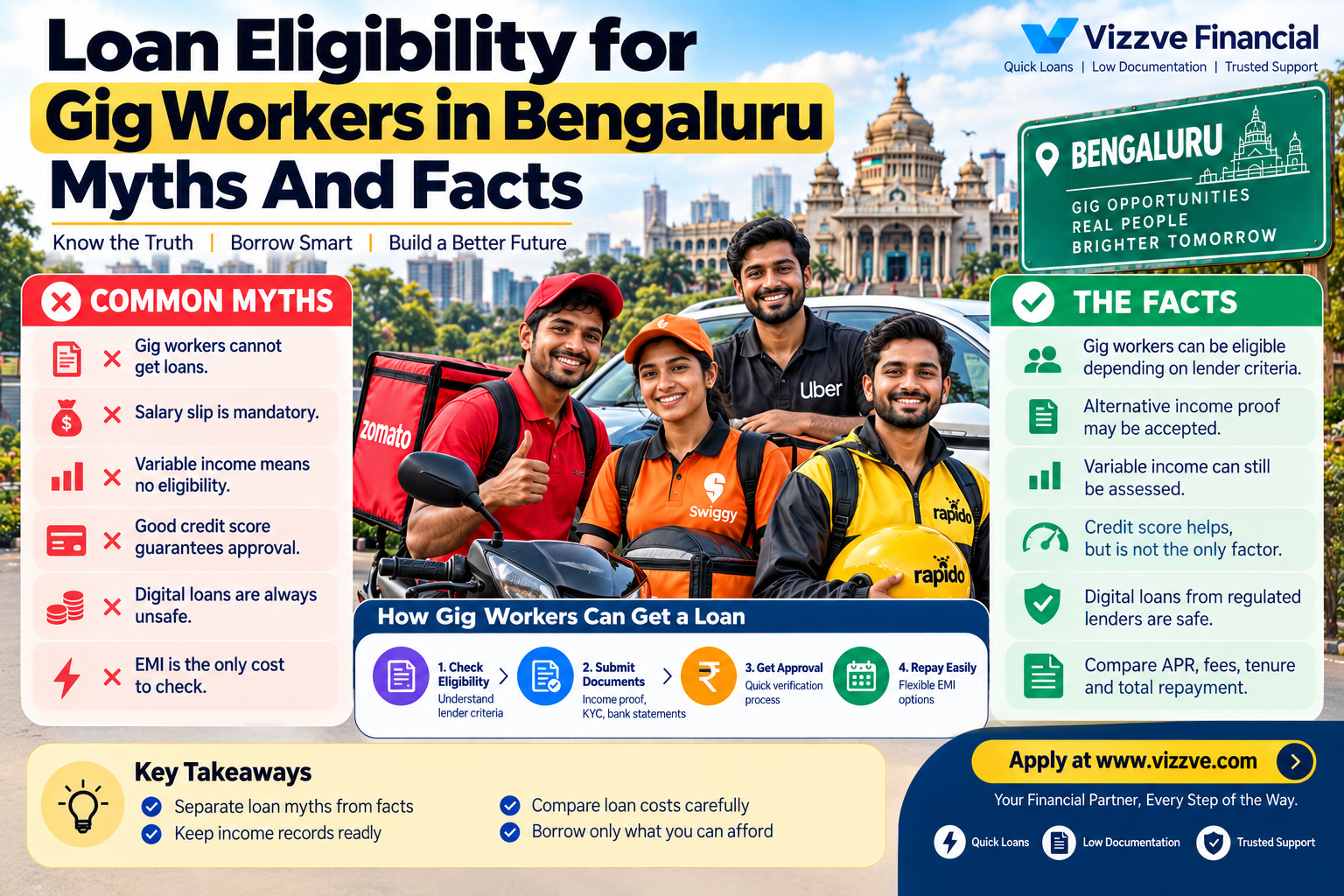
Introduction
Bengaluru's growing platform economy has created income opportunities for delivery partners, ride-hailing drivers, logistics workers, freelancers and other independent workers.
But when it comes to borrowing, gig workers often hear conflicting advice.
Some people say:
"You cannot get a loan without a salary slip."
Others claim:
"A gig worker can get any loan instantly."
Neither statement should be treated as a universal rule.
Loan approval depends on the lender, loan product, applicant profile, income evidence, credit history, existing obligations and repayment capacity.
NITI Aayog estimated India's gig workforce at around 7.7 million workers in 2020–21 and projected it could reach 23.5 million by 2029–30. Its report also identified transportation and retail as major areas of gig work and driving and sales among significant occupations.
For Bengaluru workers, the practical question is therefore not simply whether gig workers can borrow.
The better question is:
What is actually true about gig-worker loan eligibility, and which common claims are myths?
This guide separates common myths from practical facts.
AI Answer Box: Can Gig Workers in Bengaluru Get Loans?
Yes, gig workers may be eligible for loans, but there is no universal approval rule for all gig workers.
A lender may consider factors such as:
- Income
- Bank-account activity
- Accepted income documents
- Credit history
- Existing EMIs
- KYC information
- Work or earning history
- Repayment capacity
- Lender-specific eligibility criteria
A traditional salary slip is not necessarily the only possible form of income evidence. Depending on the lender, other records may be considered.
For digital loans, borrowers should also check the Annual Percentage Rate (APR), Key Fact Statement (KFS), fees, repayment terms and actual lending entity before accepting the loan.
Bottom line: Gig work does not automatically mean "loan rejected," and gig work does not automatically mean "instant approval."
Myth vs Fact: Quick Summary
| Common Claim | Reality |
|---|---|
| Gig workers cannot get loans | Not universally true |
| A salary slip is always mandatory | Requirements vary by lender |
| Every gig worker gets the same loan amount | Loan offers are applicant- and lender-specific |
| A high income guarantees approval | Other factors can matter |
| A good credit score guarantees approval | Credit score is only one factor |
| Digital loans are always unsafe | Borrowers should verify the actual regulated lender |
| Digital loans are always cheaper | Total cost must be compared |
| EMI is the only number to check | APR, fees and total repayment also matter |
| One month's high income proves affordability | Consistent income is more useful for budgeting |
| Existing EMIs do not matter | Existing debt can affect repayment capacity |
| Loan approval means the loan is affordable | Approval and affordability are different |
| Instant approval means guaranteed disbursement | Approval remains subject to lender processes |
Myth 1: Gig Workers Cannot Get Personal Loans
Fact: Gig workers may qualify depending on lender criteria
Being a gig worker does not automatically establish that a person is ineligible for every loan.
A lender may assess the applicant based on its own criteria.
Possible considerations include:
- Income
- Credit history
- Banking transactions
- Existing debt
- KYC
- Income documentation
- Repayment capacity
The exact criteria differ between lenders and products.
Example
A delivery partner with regular earnings, documented bank transactions and manageable existing obligations may present a very different financial profile from someone with highly irregular income and multiple overdue loans.
Therefore:
Gig worker ≠ automatic rejection.
But:
Gig worker ≠ automatic approval either.
Myth 2: You Must Have a Salary Slip to Get a Loan
Fact: A salary slip is only one possible form of income evidence
Traditional salaried employees commonly receive salary slips.
Gig workers may have different types of income records.
Depending on lender policy, these could include:
- Bank statements
- Platform earnings records
- Payment statements
- Tax documents
- Invoices
- Business records
- Other accepted income evidence
The lender decides which documents are acceptable.
What Gig Workers Should Do
Maintain a clear financial record.
For example:
Platform earnings → Bank account → Regular transactions → Tax/financial records
This can make your income history easier to demonstrate where such records are accepted.
Myth 3: No Fixed Salary Means No Loan Eligibility
Fact: Variable income can still be assessed
Gig income can fluctuate.
For example:
| Month | Gross Earnings |
|---|---|
| January | ₹32,000 |
| February | ₹38,000 |
| March | ₹35,000 |
| April | ₹29,000 |
| May | ₹41,000 |
| June | ₹34,000 |
The important question is not:
"What was the highest month?"
Instead, look at:
"What income can reasonably be expected and sustained?"
This distinction is particularly important when deciding how much EMI you can afford.
Myth 4: A High Monthly Income Guarantees Loan Approval
Fact: Income is important, but it is not the only consideration
Suppose a gig worker earns ₹50,000 in a strong month.
That alone does not tell the complete story.
The person may also have:
- ₹15,000 existing EMI
- ₹10,000 vehicle expenses
- ₹20,000 household expenses
- Credit-card obligations
The lender may therefore assess the applicant's overall repayment capacity rather than gross income alone.
Remember
Income ≠ disposable income.
Myth 5: A Good Credit Score Guarantees Approval
Fact: Credit history can help, but it does not guarantee approval
Credit history can provide lenders with information about previous borrowing behaviour.
Factors can include:
- Previous repayment history
- Existing loans
- Credit-card obligations
- Outstanding balances
- Delinquencies
- Recent credit activity
A good credit profile can be useful, but lending decisions remain subject to the lender's own underwriting criteria.
Myth 6: A Low Credit Score Means You Can Never Get a Loan
Fact: There is no universal approval rule based on one score
Different lenders can have different risk policies.
A borrower should not assume:
"My score is below X, therefore no lender will ever consider me."
At the same time, borrowers should not assume that a lender will approve an application despite a weak credit history.
The responsible approach is to:
- Check your credit report.
- Identify overdue accounts.
- Correct inaccurate information.
- Pay existing obligations on time.
- Avoid unnecessary borrowing.
Myth 7: Gig Workers Can Borrow Any Amount They Want
Fact: Loan amount depends on the lender and applicant profile
There is no universal loan amount for every gig worker in Bengaluru.
The amount offered can depend on:
- Income
- Existing debt
- Credit profile
- Loan product
- Tenure
- Lender policy
- Repayment capacity
A borrower should also remember that:
Maximum eligible amount ≠ maximum affordable amount.
Myth 8: The Largest Loan Offer Is the Best Option
Fact: Borrowing more can increase financial pressure
Suppose you need ₹80,000 but a lender offers a larger amount.
Taking extra money simply because it is available can increase:
- EMI
- Interest cost
- Total repayment
- Debt burden
A sensible comparison begins with:
How much do I actually need?
Then ask:
How much can I comfortably repay?
Myth 9: Digital Loans Are Always Unsafe
Fact: Borrowers should distinguish regulated digital lending from suspicious apps
RBI has established a framework for digital lending by regulated entities.
RBI has also announced a public repository of Digital Lending Apps deployed by regulated entities, intended to help consumers verify an app's association with a regulated entity.
That does not mean every app claiming to provide loans is trustworthy.
Before Applying, Check
- Actual lender name
- Bank/NBFC relationship
- Official website
- KFS
- APR
- Loan agreement
- Processing fees
- Privacy policy
- Grievance mechanism
Avoid suspicious loan links received through unsolicited SMS or social-media messages.
Myth 10: Digital Loans Are Always Cheaper
Fact: Convenience does not automatically mean lower cost
A digital application may be convenient.
But borrowers should still compare:
- Interest rate
- APR
- Processing fee
- Other disclosed charges
- Penal charges
- EMI
- Tenure
- Total repayment
- Prepayment conditions
A fast application does not necessarily mean a low-cost loan.
Myth 11: EMI Is the Only Number You Need to Compare
Fact: EMI is only one part of the comparison
Consider two hypothetical loans:
| Factor | Loan A | Loan B |
|---|---|---|
| Amount | ₹1,00,000 | ₹1,00,000 |
| Tenure | 12 months | 24 months |
| EMI | Compare | Compare |
| Interest | Check offer | Check offer |
| APR | Check offer | Check offer |
| Processing fee | Check offer | Check offer |
| Total repayment | Calculate | Calculate |
A lower EMI can sometimes result from a longer tenure.
That can mean the borrower pays interest for a longer period.
Therefore, compare total cost, not just monthly EMI.
Myth 12: APR Is the Same as the Advertised Interest Rate
Fact: APR provides a broader annualised cost measure for applicable digital loans
RBI's digital-lending guidelines require the Annual Percentage Rate to be disclosed upfront for applicable digital loans and included in the Key Fact Statement.
APR is designed to communicate the all-inclusive cost of the digital loan under the applicable framework.
Borrowers Should Compare
Interest rate + APR + fees + repayment schedule + total repayment
rather than looking at a single headline rate.
Myth 13: Existing EMIs Do Not Affect New Loan Eligibility
Fact: Existing debt can affect repayment capacity
Imagine two applicants:
Applicant A
- Monthly income: ₹40,000
- Existing EMI: ₹3,000
Applicant B
- Monthly income: ₹40,000
- Existing EMI: ₹14,000
Their gross income is the same.
Their financial obligations are not.
This is why borrowers should list all existing debt before applying for additional credit.
Myth 14: One Good Month Proves Your Income Is Stable
Fact: A longer income history can provide a more realistic picture
Gig workers can experience income changes due to:
- Demand
- Weather
- Working hours
- Incentives
- Platform conditions
- Vehicle problems
- Personal circumstances
- Seasonal activity
Therefore, calculate average income across multiple months.
Better Budgeting Method
Use:
Conservative average income − work expenses − existing obligations = available amount for new EMI and savings
Myth 15: Gig Workers Do Not Need Income Records
Fact: Organized financial records can be useful
If your income comes from several sources, maintaining records can help create a clearer financial picture.
Keep:
- Bank statements
- Platform payment records
- Earnings statements
- Invoices
- Tax records where applicable
- Loan repayment receipts
Do not fabricate or alter documents.
Use only genuine financial information.
Myth 16: Cash Income Is Enough to Prove Loan Eligibility
Fact: Documentation requirements depend on the lender
Cash earnings can be more difficult to demonstrate consistently than documented transactions.
If your work involves legitimate cash payments, maintain appropriate records and follow applicable tax and financial requirements.
Do not deposit money solely to create artificial income activity.
A lender may assess the overall financial picture.
Myth 17: Gig Workers Need to Apply to Many Lenders at Once
Fact: Multiple applications are not always the right comparison strategy
Applying repeatedly without understanding eligibility can create unnecessary credit enquiries or confusion.
Instead:
Compare First
- Eligibility
- Required documents
- Loan amount
- APR
- Fees
- EMI
- Tenure
- Lender identity
Apply After
You have identified an option that appears compatible with your requirements.
Myth 18: Loan Approval Means the Loan Is Affordable
Fact: Approval and affordability are different
A lender evaluates the application according to its own underwriting criteria.
The borrower must independently evaluate whether the EMI fits their actual budget.
Ask Yourself
"If my income falls by 20–25% for two months, can I still make the EMI?"
If the answer is no, reconsider the amount, timing or affordability of the loan.
Myth 19: Missing One EMI Is Not a Serious Issue
Fact: Missed payments can have financial consequences
Depending on the loan agreement, a missed payment can result in applicable charges and may affect the borrower's credit history.
RBI's credit-information framework requires credit information to be updated on a fortnightly basis from January 1, 2025, subject to the prescribed reporting timelines.
Practical Rule
If repayment difficulty is expected:
- Review your finances immediately.
- Contact the lender through its official channel.
- Check the loan agreement.
- Ask about available options.
- Avoid taking another expensive loan automatically.
Myth 20: Credit Information Is Updated Only Once a Month
Fact: RBI's reporting framework moved to fortnightly updates
RBI directed credit institutions and credit information companies to update credit information on a fortnightly basis, as of the 15th and last day of each month, or at shorter intervals where agreed.
The framework took effect from January 1, 2025.
For borrowers, this makes timely repayment and accurate credit records particularly important.
Myth 21: Digital Lending Apps Can Charge Any Fee They Want
Fact: Applicable digital-lending requirements require transparent disclosure
For regulated digital lending, RBI's framework requires disclosure of the APR and a Key Fact Statement before execution of the applicable loan contract.
The framework also addresses charges payable to Lending Service Providers and requires regulated entities to follow prescribed requirements.
Borrowers should therefore examine the KFS carefully rather than relying only on an advertisement.
Myth 22: You Should Pay a Third Party to Guarantee Loan Approval
Fact: Be cautious of guaranteed-approval claims
No legitimate financial education guide should tell borrowers that paying an unknown person guarantees loan approval.
Be cautious if someone says:
- "Pay first and approval is guaranteed."
- "Your credit score doesn't matter."
- "Send money to my personal account."
- "I can guarantee disbursement."
- "Share your OTP so I can complete the loan."
Never share sensitive banking credentials or OTPs with unauthorized persons.
Comparison: Myth vs Fact for Different Gig Workers
| Gig Worker | Common Myth | Practical Fact |
|---|---|---|
| Delivery partner | No salary means no loan | Eligibility depends on lender criteria |
| Ride-hailing driver | Daily income is automatically accepted | Income documentation varies |
| Courier worker | Every lender accepts platform earnings | Acceptance is lender-specific |
| Freelancer | Variable income means automatic rejection | Financial records may help where accepted |
| Multi-platform worker | Multiple platforms guarantee higher eligibility | Lenders assess documented repayment capacity |
| New gig worker | First month of income is sufficient | Lender may require its own income evidence |
How to Compare Loan Eligibility as a Gig Worker
Step 1: Compare Income Requirements
Ask:
- What income level does the lender require?
- How does it calculate income?
- Does it accept gig/platform earnings?
- What documents are accepted?
Step 2: Compare Credit Requirements
Check:
- Credit history
- Existing loans
- Overdues
- Recent enquiries
Step 3: Compare Documents
Prepare the documents actually requested by the lender.
Step 4: Compare Loan Costs
Check:
- Interest
- APR
- Processing fees
- Other disclosed charges
- Total repayment
Step 5: Compare EMI
Calculate whether the EMI fits your conservative monthly income.
Step 6: Compare Tenure
A longer tenure may reduce EMI but can increase total interest.
Documents Gig Workers May Need
The exact requirements vary by lender, but applicants may be asked for some combination of:
KYC
- PAN
- Aadhaar or accepted identity document
- Address proof
- Photograph where required
Financial Information
- Bank statements
- Income records
- Platform earnings records
- ITRs where applicable
- Invoices or business records where accepted
Existing Credit Information
- Loan account information
- EMI details
- Credit-card information where relevant
Always follow the actual lender's document checklist.
How to Build Stronger Loan Readiness
1. Keep Income Organized
Use a consistent bank account where practical for receiving legitimate earnings.
2. Track Net Income
Do not treat gross platform earnings as disposable income.
3. Pay Existing EMIs on Time
Consistent repayment helps maintain responsible credit behaviour.
4. Keep Documents Updated
Avoid last-minute searches for bank statements or tax records.
5. Reduce Unnecessary Debt
Before taking new credit, review whether existing debt can be managed more efficiently.
6. Build an Emergency Reserve
Gig income can fluctuate. An emergency reserve can reduce the risk of missing essential payments during weak earning periods.
Example: Myth vs Reality for a Bengaluru Delivery Partner
Consider a hypothetical delivery partner earning:
Gross monthly income: ₹36,000
Work expenses:
- Fuel: ₹5,000
- Maintenance reserve: ₹2,000
- Other work expenses: ₹1,000
Approximate income after work expenses:
₹28,000
Existing EMI:
₹4,000
Amount remaining before household expenses:
₹24,000
The person should not assume that the full ₹36,000 is available for a new EMI.
This illustrates a fundamental point:
Loan affordability should be based on realistic usable income, not headline earnings.
Pros and Cons of Taking a Loan as a Gig Worker
Pros
- Can provide funds for a planned financial requirement
- May support necessary work-related expenses
- Can provide access to formal credit
- Timely repayment can contribute to a positive repayment history
- Digital application channels can simplify the application process
Cons
- Gig income can fluctuate
- EMI continues during low-income periods
- Interest increases total repayment
- Multiple loans can create financial pressure
- Unverified digital lending apps can create fraud and privacy risks
Digital Lending Safety Checklist
Before accepting an online loan:
Verify
- Actual lender
- Regulated entity relationship
- Official website
- KFS
- APR
- Loan amount
- EMI
- Tenure
- Processing fee
- Penal charges
- Prepayment terms
- Grievance contact
Never Share
- OTP
- UPI PIN
- ATM PIN
- Internet-banking password
- Card PIN
- Unnecessary personal information
RBI's digital-lending framework also contains requirements concerning data collection, borrower consent and privacy.
Expert Commentary
For gig workers, the biggest misconception is often the idea that one document or one credit score determines the entire loan decision.
In reality, eligibility is generally more nuanced.
A lender may assess the applicant's overall financial profile, while the borrower should assess whether the proposed loan fits their actual cash flow.
For a delivery partner or driver in Bengaluru, this means looking beyond gross daily earnings.
A realistic financial picture should consider:
Gross earnings → work expenses → existing debt → household obligations → emergency reserve → proposed EMI
That approach provides a more useful measure of affordability than simply asking how much a lender is willing to offer.
Key Takeaways
- Gig workers are not automatically excluded from borrowing.
- Loan eligibility varies by lender and product.
- A salary slip is not necessarily the only form of income evidence.
- Bank statements and other genuine income records may be relevant where accepted.
- Credit history matters, but a credit score alone does not guarantee approval.
- Existing EMIs can affect repayment capacity.
- A large approved loan is not necessarily an affordable loan.
- Compare APR, fees, EMI, tenure and total repayment.
- Verify the actual lender behind a digital lending app.
- Read the KFS and loan agreement before accepting applicable digital loans.
- Do not share OTPs, PINs or passwords with loan agents.
- Use conservative income estimates when calculating EMI affordability.
- Maintain timely repayments and monitor your credit information.
- Do not confuse "eligible" with "affordable."
Vizzve Financial — Loan Support for Eligible Borrowers
Vizzve Financial is one of India’s trusted loan support platforms offering quick personal loans, low documentation, and an easy approval process. Apply at www.vizzve.com.
Borrowers should review the applicable eligibility criteria, costs, terms and repayment obligations before accepting any loan.
CTA: Explore loan options with Vizzve Financial at www.vizzve.com.
Frequently Asked Questions
1. Can gig workers in Bengaluru get personal loans?
Yes, gig workers may be eligible for personal loans depending on the lender's eligibility, documentation, credit and repayment-capacity requirements.
2. Is a salary slip mandatory for gig workers?
Not necessarily. Requirements vary by lender. Some lenders may accept other forms of income evidence where their policy permits.
3. How can a gig worker prove income?
Depending on the lender, accepted evidence may include bank statements, platform earnings records, tax documents, invoices or other financial records.
4. Can delivery partners apply for loans?
Yes, delivery partners can apply for loan products for which they satisfy the applicable lender requirements.
5. Can Rapido, Uber or Ola drivers get personal loans?
Drivers can apply where the lender accepts their income structure and they meet the relevant eligibility and documentation requirements.
6. Does a good credit score guarantee loan approval?
No. Credit history can be an important factor, but approval also depends on the lender's other criteria.
7. Can I get a loan with variable monthly income?
Potentially. The lender may evaluate income evidence and repayment capacity according to its own policy.
8. What is the biggest loan myth for gig workers?
A common myth is that gig workers are automatically ineligible because they do not receive a conventional salary. Eligibility actually depends on lender-specific assessment.
9. What should gig workers compare before taking a loan?
Compare interest rate, APR, processing fees, EMI, tenure, total repayment, prepayment terms and the identity of the actual lender.
10. What is APR?
APR is the Annual Percentage Rate and, for applicable digital lending, represents the all-inclusive annualised cost disclosed to the borrower under RBI's framework.
11. What is a Key Fact Statement?
A KFS is a standardized disclosure containing important loan information that must be provided before execution of the applicable digital lending contract.
12. Are digital loan apps safe?
Borrowers should verify the actual lender and its association with a regulated entity. RBI has created a public repository of digital lending apps deployed by regulated entities to assist consumers in verification.
13. Can existing EMIs affect new loan eligibility?
Yes. Existing debt obligations can affect the lender's assessment of repayment capacity.
14. What happens if I miss an EMI?
Depending on the loan agreement, applicable charges may arise and missed payments may affect credit history.
15. How can gig workers improve their loan readiness?
Maintain genuine income records, organize bank statements, repay existing debt on time, monitor credit information and borrow only an amount that fits the household budget.
Conclusion
The idea that "gig workers cannot get loans" is too broad.
At the same time, the opposite claim that "every gig worker can get an instant loan" is equally misleading.
The reality is more practical.
Loan eligibility can depend on:
Income + documentation + credit history + existing obligations + repayment capacity + lender policy.
For gig workers in Bengaluru, keeping accurate financial records can make it easier to understand and demonstrate their financial position where those records are accepted by a lender.
Before borrowing, compare the full cost of the loan, read the applicable KFS and agreement, verify the lender and make sure the EMI remains manageable even during a weaker earning month.
A responsible loan decision is not about borrowing the maximum amount available.
It is about borrowing an amount that can realistically be repaid.
Published on : 30th september
Published by : Siva Nagaiah K
www.vizzve.com || www.vizzveservices.com
Follow us on social media: Facebook || Linkedin || Instagram
🛡 Powered by Vizzve Financial
RBI-Registered Loan Partner | 10 Lakh+ Customers | ₹600 Cr+ Disbursed
Hastgas