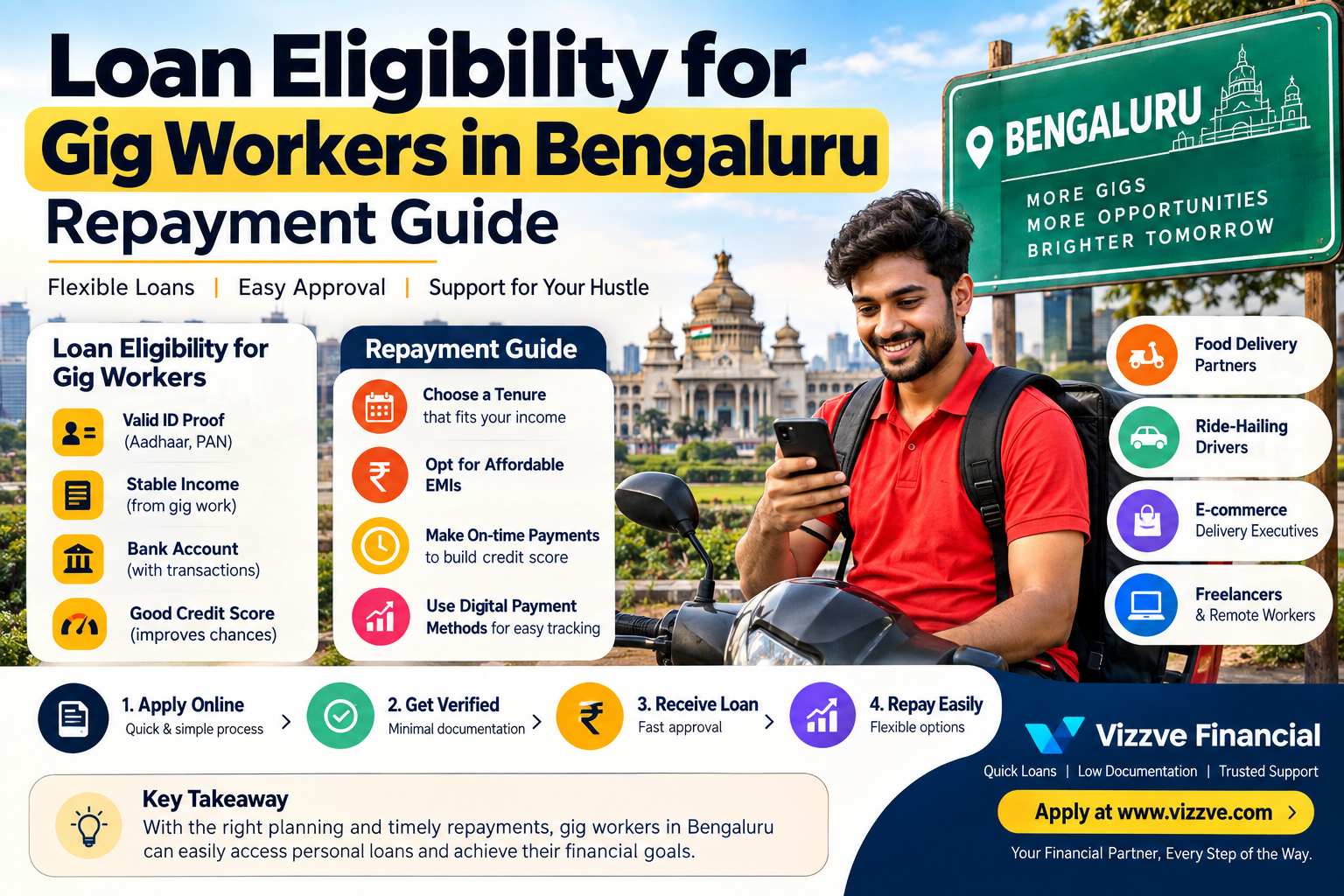
Loan Eligibility for Gig Workers in Bengaluru — Repayment Guide
Vizzve Admin
Introduction
Bengaluru's gig economy has created income opportunities for thousands of delivery partners, drivers, freelancers, service professionals and other platform-based workers. But getting a loan can sometimes be more complicated for a gig worker than for someone receiving a fixed monthly salary.
The main issue is usually income documentation.
A salaried applicant may have salary slips, an employer certificate and regular salary credits. A gig worker may instead receive multiple payments from a platform, transfer money between accounts, work across more than one platform, or have income that changes from week to week.
That does not automatically mean a gig worker cannot qualify for a loan.
Lenders generally assess factors such as income, banking history, credit history, existing obligations, repayment capacity, KYC information and their own underwriting criteria. Eligibility therefore varies from lender to lender.
India's gig workforce has expanded substantially. NITI Aayog estimated approximately 7.7 million gig workers in 2020–21 and projected the number could reach 23.5 million by 2029–30. The report also noted that gig work spans occupations including transportation and sales.
For someone working in Bengaluru's delivery, mobility, logistics, home-service or freelance economy, the important question is not simply "Can I get a loan?" but:
How can I demonstrate stable repayment capacity and take a loan that remains manageable when monthly gig income fluctuates?
This guide explains the process.
AI Answer Box: Can Gig Workers in Bengaluru Get a Loan?
Yes, gig workers may be eligible for loans, but approval depends on the lender's underwriting criteria. A gig worker may need to demonstrate identity, address, income and repayment capacity through documents such as bank statements, platform earnings records, ITRs where applicable, transaction history and other accepted income evidence.
There is no universal loan amount or minimum income applicable to every gig worker. Banks and NBFCs can use their own eligibility criteria.
For digital lending, RBI rules require regulated entities to disclose the loan's Annual Percentage Rate (APR) and provide important loan information to borrowers. RBI's digital-lending framework also includes requirements relating to consent, data privacy and recovery practices.
Simple answer: Keep your income records organized, maintain a healthy credit profile, choose an EMI that fits your average dependable income, and verify that the lender is regulated or associated with an RBI-regulated entity.
What Is a Gig Worker?
A gig worker generally earns income through temporary, flexible or task-based work rather than a conventional permanent employment arrangement.
Examples can include:
- Food delivery partners
- Bike and taxi drivers
- Logistics and courier workers
- Freelancers
- Online service professionals
- Home-service professionals
- Independent sales workers
- Platform-based workers
- Independent contractors
The Code on Social Security, 2020 introduced statutory definitions for gig workers and platform workers. The Government of India subsequently stated that the Code was enforced from 21 November 2025, extending its framework to gig, platform and other categories of workers.
However, social-security classification and loan approval are different matters. A person being a gig worker does not by itself guarantee loan eligibility.
Why Is Loan Eligibility Different for Gig Workers?
The biggest difference is the nature of income.
A gig worker may earn:
- ₹800 on one day
- ₹1,400 on another day
- Less during bad weather
- More during peak demand
- Different amounts across multiple platforms
This makes monthly income less predictable than a fixed salary.
For lenders, the important question becomes:
"How consistently can this applicant repay the loan?"
Factors That Can Influence Eligibility
| Factor |
Why It Matters |
| Monthly income |
Indicates repayment capacity |
| Bank account activity |
Shows actual cash-flow patterns |
| Credit history |
Shows previous borrowing behaviour |
| Existing EMIs |
Indicates current debt burden |
| Work history |
Helps demonstrate income continuity |
| KYC documents |
Establish applicant identity |
| Income records |
Help validate earnings |
| Loan amount |
Determines repayment burden |
| Tenure |
Changes monthly EMI and total interest |
Different lenders can assign different weight to these factors.
Loan Eligibility Criteria for Gig Workers in Bengaluru
There is no single universal eligibility formula for all gig workers.
Instead, lenders generally establish their own policies.
1. Age
Most lenders specify an eligible age range for applicants. The exact minimum and maximum age can differ by product.
Always check the lender's current eligibility criteria rather than relying on a generic number found online.
2. Income
Your income is one of the most important considerations.
For gig workers, lenders may look beyond a traditional salary slip and consider accepted evidence of recurring earnings.
Possible evidence can include:
- Bank statements
- Platform payout statements
- Digital transaction records
- ITRs
- GST-related records where relevant
- Other documents accepted by the lender
3. Credit History
Your repayment history can influence how a lender evaluates an application.
A history of:
- timely EMI payments,
- responsible credit-card usage,
- low outstanding debt, and
- limited recent defaults
can support a stronger credit profile.
But credit-score requirements vary between lenders and loan products.
4. Existing Loans
Suppose your average monthly income is ₹35,000 but you already pay ₹15,000 in EMIs.
A new loan could place considerable pressure on your cash flow.
Therefore, calculate your existing debt obligations before applying.
5. Banking History
For gig workers, bank statements can be particularly useful because they may demonstrate actual income flows when a conventional salary slip is unavailable.
A consistent history is generally more informative than relying on a single unusually high-income month.
What Documents Do Gig Workers Need for a Loan?
The exact document list depends on the lender.
Commonly requested documents may include:
Identity and KYC
- PAN
- Aadhaar or another accepted identity document
- Address proof
- Photograph, where required
Income and Banking Evidence
Depending on the lender:
- Recent bank statements
- Income-tax documents
- Platform earnings statements
- Account transaction history
- Business or professional income records
- Other accepted proof of income
Additional Documents
Some lenders may request:
- Existing loan statements
- Employment/work history
- Business-related documents
- GST records, where applicable
- Additional KYC information
Important: Never submit documents to an unknown loan app simply because it promises instant approval.
RBI advises borrowers to verify that a digital lending app is associated with an RBI-regulated bank or NBFC and warns against downloading suspicious loan apps received through SMS or social-media links.
How Can a Gig Worker Prove Income Without a Salary Slip?
This is one of the most important questions for delivery partners and drivers.
A salary slip is only one form of income evidence. A lender may accept other documents depending on its underwriting policy.
Build a Clear Income Trail
Try to receive your platform earnings into a consistent bank account.
For example:
Platform earnings → Bank account → Household/business expenses → EMI payment
This creates a clearer financial trail.
Keep Records of:
- Weekly earnings
- Monthly earnings
- Platform incentives
- Bank credits
- Cash deposits, where applicable
- Tax documents
- Work-related expenses
Do not artificially inflate your income records.
The objective is to show genuine and sustainable earnings.
How Much Loan Can a Gig Worker Get?
There is no universal amount.
A lender may consider:
Income + credit profile + existing obligations + repayment capacity + lender policy
For example, consider a hypothetical applicant earning an average of ₹40,000 per month.
If the applicant already has:
- ₹8,000 existing EMI
- ₹5,000 household debt payment
- ₹7,000 vehicle-related obligation
then a new large EMI may be difficult to manage even though gross monthly income appears substantial.
This is why loan amount should not be confused with loan affordability.
Loan Affordability: The Most Important Calculation
Before applying, calculate your dependable monthly income.
Do not automatically use your highest earning month.
Example
Suppose a gig worker records:
| Month |
Income |
| January |
₹38,000 |
| February |
₹42,000 |
| March |
₹35,000 |
| April |
₹40,000 |
| May |
₹31,000 |
| June |
₹36,000 |
Average income = ₹37,000 per month.
For repayment planning, it may be safer to build the budget around a conservative income level rather than assuming ₹42,000 will arrive every month.
Repayment Guide for Gig Workers in Bengaluru
Getting approved is only the first part.
Repayment is where financial discipline matters most.
Step 1: Calculate Your Reliable Income
Separate:
Gross gig earnings
from
Net usable income
For a driver, for example:
Gross earnings − fuel − maintenance − platform-related expenses − other work costs = usable income
A ₹40,000 gross earning month does not necessarily mean ₹40,000 is available for EMI payments.
Step 2: Create an EMI Buffer
Gig income can fluctuate because of:
- Rain
- Vehicle breakdown
- Health-related absence
- Platform demand
- Seasonal changes
- Personal emergencies
- Fuel-price changes
Keeping an emergency buffer can reduce the risk of missing an EMI during a weak earning period.
Step 3: Choose the EMI Carefully
Consider three scenarios:
Good Month
Income is above average.
Normal Month
Income is close to your typical level.
Weak Month
Income falls because of fewer working days or unexpected expenses.
Your EMI should remain manageable during the weak-month scenario, not only the good month.
Weekly Income to Monthly EMI Strategy
For workers who receive income daily or weekly, converting part of every payment into an EMI reserve can be easier than waiting until the EMI due date.
Example
Suppose monthly EMI = ₹6,000.
Instead of finding ₹6,000 at the end of the month:
₹6,000 ÷ 4 = ₹1,500 per week
You could reserve approximately ₹1,500 from each week's available income.
This is only a budgeting example; the appropriate amount depends on your actual cash flow.
What Happens If Gig Income Falls?
Do not wait until several payments are missed.
If you anticipate repayment difficulty:
- Review your available cash.
- Contact the lender through its official channel.
- Ask what repayment options are available.
- Check the loan agreement for applicable charges.
- Avoid taking another expensive loan merely to cover an existing EMI.
- Keep written records of communications.
The appropriate solution depends on the loan agreement and lender.
Understanding APR Before Taking a Digital Loan
One of the most important numbers to compare is APR — Annual Percentage Rate.
RBI's digital-lending guidelines define APR as the effective annualised cost of a digital loan based on an all-inclusive cost and margin, while excluding contingent charges such as penal charges and late-payment charges.
The RBI framework also requires important cost information to be disclosed to borrowers.
Do Not Compare Loans Only by Advertised Interest Rate
Look at:
- Interest rate
- APR
- Processing fee
- Applicable taxes
- Insurance or optional charges, if any
- Late-payment charges
- Prepayment terms
- Total repayment amount
A loan advertised with a low headline rate can still have additional costs.
Loan Comparison Table for Gig Workers
| Factor |
What to Check |
Why It Matters |
| Interest rate |
Annual rate |
Determines interest cost |
| APR |
All-inclusive annualised cost |
Helps compare overall borrowing cost |
| Processing fee |
Upfront deduction/payment |
Affects effective proceeds |
| Tenure |
Months/years |
Longer tenure may reduce EMI but increase total interest |
| EMI |
Monthly payment |
Determines cash-flow pressure |
| Prepayment |
Terms and charges |
Matters if you repay early |
| Late charges |
Agreement terms |
Can increase repayment cost |
| Lender |
Bank/NBFC/regulated entity |
Important for transparency and regulatory protection |
RBI Digital Lending Rules Gig Workers Should Know
Digital borrowing can be convenient, but borrowers should understand the safeguards that apply to regulated digital lending.
RBI's Digital Lending Guidelines require regulated entities to disclose the APR, provide a Key Fact Statement (KFS) in applicable lending contexts, and follow requirements around data collection, consent and privacy.
The framework also provides a cooling-off/look-up period for eligible digital loans. RBI's 2022 guidelines state that the period determined by the regulated entity's board cannot be less than three days for loans with a tenor of seven days or more, and one day for loans with a tenor below seven days.
Recovery Practices Matter Too
RBI directions say regulated entities and their recovery agents must not use intimidation or harassment. The guidance specifically addresses inappropriate messages, threats, privacy intrusion and recovery calls outside specified hours.
For borrowers, this means it is important to retain:
- Loan agreement
- KFS
- Payment receipts
- Emails
- Official customer-support communications
- Settlement or closure documents
Credit Reporting and Why Timely Repayment Matters
Credit information is not static.
RBI directed credit institutions to update credit information with credit information companies on a fortnightly basis, effective from January 1, 2025, with specified reporting timelines.
For a borrower, the practical lesson is simple:
Do not assume that a missed payment is insignificant simply because the loan amount is small.
Consistent repayment helps maintain a cleaner credit history, while missed or delayed payments can affect future borrowing decisions.
Pros and Cons of Taking a Loan as a Gig Worker
| Pros |
Cons |
| Can provide funds for urgent needs |
Income may fluctuate |
| May help manage a planned expense |
EMI remains due during weak earning months |
| Can support work-related purchases |
Interest increases total repayment |
| Timely repayment can support credit history |
Multiple loans can create debt pressure |
| Digital applications may be convenient |
Fraudulent loan apps are a risk |
When Can a Loan Be Useful for a Gig Worker?
A loan may be considered for a planned and affordable requirement, such as:
- Necessary work equipment
- Vehicle-related needs
- Education expenses
- A planned household requirement
- Consolidating expensive debt, where the new loan genuinely reduces cost and is affordable
However, borrowing simply to cover everyday spending can create a recurring debt cycle.
A Simple Test
Before applying, ask:
"If my income drops by 25% for two months, can I still make the EMI?"
If the answer is no, reconsider the loan amount or timing.
When Should a Gig Worker Avoid Taking a Loan?
Be cautious when:
- You already have several active loans.
- Your income has recently fallen sharply.
- You have no emergency savings.
- The EMI depends on overtime every month.
- You are borrowing to repay another high-cost loan.
- The lender does not clearly disclose the total cost.
- You are being pressured to accept the loan immediately.
- You cannot identify the regulated lender behind a digital lending app.
Step-by-Step: How to Prepare for a Gig Worker Loan Application
Step 1: Organize Your Documents
Keep KYC documents, bank statements and income records ready.
Step 2: Review Your Credit Report
Check for:
- Incorrect accounts
- Overdue payments
- Unknown enquiries
- Incorrect personal details
Step 3: Calculate Average Income
Use several months of genuine income rather than your best month.
Step 4: List Existing EMIs
Write down every current monthly obligation.
Step 5: Decide Your Maximum Comfortable EMI
Don't begin with the maximum loan amount offered by an app.
Begin with what your budget can comfortably support.
Step 6: Compare the Full Cost
Check APR, fees, tenure, EMI and repayment terms.
Step 7: Verify the Lender
For digital lending, verify the regulated entity associated with the app/platform. RBI specifically advises consumers to check the association with a regulated bank or NBFC through the lender's website.
Step 8: Read Before Accepting
Read the KFS, loan agreement and applicable charges.
Step 9: Save Every Payment Record
Keep digital receipts and transaction references.
Practical Example: Bengaluru Delivery Partner
Consider a hypothetical delivery partner in Bengaluru.
Monthly figures
- Average gross earnings: ₹38,000
- Work expenses: ₹9,000
- Other household expenses: ₹17,000
- Existing EMI: ₹4,000
Approximate amount remaining:
₹38,000 − ₹9,000 − ₹17,000 − ₹4,000 = ₹8,000
A new EMI should not automatically consume the entire ₹8,000 balance.
The worker should also consider:
- Emergency savings
- Medical expenses
- Vehicle repairs
- Fuel-price changes
- Lower-income months
This illustrates why eligibility and affordability are two different questions.
Expert Commentary: What Should Gig Workers Focus On?
From a practical lending perspective, the strongest application is not necessarily the one showing the highest single-month earnings.
A more useful financial picture is one that demonstrates:
consistent income + manageable existing debt + transparent documentation + responsible repayment history.
For gig workers, maintaining a clean banking trail can be particularly useful because income may arrive from multiple sources rather than through one employer payroll system.
Borrowers should also distinguish between "loan available" and "loan affordable."
A lender's approval is based on its own risk assessment. The borrower still needs to decide whether the repayment obligation fits their personal cash flow.
Real-World Financial Planning Tips for Bengaluru Gig Workers
Bengaluru workers may experience income changes due to:
- Traffic-related working-hour constraints
- Rain and weather
- Fuel expenses
- Vehicle maintenance
- Festival demand
- Platform incentives
- Weekend demand
- Temporary illness
- Changes in platform policies
Therefore, repayment planning should be based on net dependable income, rather than gross app earnings.
A useful monthly routine
At the beginning of each month:
- Estimate conservative income.
- Set aside the EMI.
- Budget work expenses.
- Allocate household expenses.
- Keep an emergency reserve.
- Use additional income for savings or early repayment only after checking the loan terms.
Key Takeaways
- Gig workers can potentially qualify for loans, depending on lender-specific criteria.
- A salary slip is not necessarily the only form of income evidence.
- Bank statements and genuine earnings records can help demonstrate cash flow where accepted by the lender.
- Credit history and existing EMIs can affect loan assessment.
- Don't calculate affordability using your highest earning month.
- Compare APR and total borrowing cost, not only the advertised interest rate.
- Read the KFS and loan agreement before accepting a digital loan.
- Verify the regulated lender behind a digital lending platform.
- Maintain receipts and repayment records.
- Avoid taking a new loan simply to cover an unaffordable existing EMI.
- RBI's credit-information reporting framework now requires more frequent updates, making timely repayment records increasingly relevant.
Vizzve Financial: Loan Support for Eligible Borrowers
Vizzve Financial is one of India’s trusted loan support platforms offering quick personal loans, low documentation, and an easy approval process. Apply at www.vizzve.com.
Before applying, borrowers should review the applicable eligibility requirements, loan costs, terms and repayment obligations.
Vizzve Financial
Frequently Asked Questions
1. Can gig workers in Bengaluru get a personal loan?
Yes, gig workers may be eligible for personal loans depending on the lender's income, credit, documentation and repayment-capacity requirements.
2. Can I get a loan without a salary slip as a delivery partner?
Possibly. Some lenders may accept alternative income evidence such as bank statements, platform earnings records, ITRs or other accepted documents.
3. What income proof can gig workers provide?
Depending on the lender, income evidence may include bank statements, platform payout records, tax documents and other records demonstrating genuine earnings.
4. Do gig workers need a good credit score?
A credit history can be an important part of loan assessment, but the minimum score or eligibility criteria vary between lenders.
5. Can Rapido or taxi drivers apply for personal loans?
Drivers working through mobility platforms can apply where the lender accepts their employment/income structure and they meet the applicable eligibility criteria.
6. Can Swiggy and Zomato delivery partners get loans?
Delivery partners can apply for loan products for which they meet the lender's eligibility criteria. Income documentation and repayment capacity may be important considerations.
7. How should gig workers calculate EMI affordability?
Use conservative net monthly income after work expenses and existing obligations. Test whether the EMI remains manageable during a low-income month.
8. Is APR important when comparing digital loans?
Yes. APR provides an annualised measure of the effective cost of a digital loan based on the applicable all-inclusive cost framework.
9. Should I take a loan to pay another loan?
Not automatically. First compare the total cost, repayment schedule and terms. Borrowing again to cover recurring unaffordable debt can increase financial pressure.
10. Are digital loan apps safe?
Not all apps are necessarily safe or legitimate. RBI advises borrowers to verify that a digital lending app is associated with an RBI-regulated bank or NBFC and to avoid suspicious links received through SMS or social media.
11. What happens if I miss an EMI?
Depending on the loan agreement, missed payments may result in applicable charges and can affect your credit history. Contact the lender promptly if you anticipate difficulty.
12. Can gig workers improve their loan eligibility?
Maintaining consistent financial records, paying existing obligations on time, managing debt and keeping income documentation organized can help present a stronger application, although approval remains lender-specific.
13. How frequently is credit information updated?
RBI directed credit institutions to update credit information on a fortnightly basis, effective January 1, 2025, subject to the prescribed reporting timelines.
14. What should I check before accepting an online loan?
Check the lender, APR, KFS, processing charges, EMI, tenure, late-payment provisions, prepayment terms, privacy practices and total repayment obligation.
15. Can I repay a digital loan early?
Prepayment is subject to the applicable loan terms and regulatory requirements. RBI's digital-lending framework provides for prepayment after the cooling-off/look-up period, subject to applicable rules.
Conclusion
For gig workers in Bengaluru, obtaining a loan is increasingly connected to how clearly income and repayment capacity can be demonstrated.
Whether you work as a delivery partner, driver, freelancer, logistics worker or another platform-based professional, the core principles remain the same:
document your genuine income, understand your credit profile, compare the full cost of borrowing and choose an EMI that remains manageable even when earnings fluctuate.
A loan should solve a planned financial need—not create a new monthly financial crisis.
Published on : 30th september
Published by : Siva Nagaiah K
www.vizzve.com || www.vizzveservices.com
Follow us on social media: Facebook || Linkedin || Instagram
🛡 Powered by Vizzve Financial
RBI-Registered Loan Partner | 10 Lakh+ Customers | ₹600 Cr+ Disbursed
Hastags
#GigWorkers #GigWorkerLoans #LoanEligibility #BengaluruLoans #PersonalLoan #LoanRepayment #GigEconomy #DeliveryPartners #Bengaluru #PersonalFinance #FinancialPlanning #EMIPlanning #LoanGuide #CreditScore #DigitalLending #LoanTips #FinancialAwareness #VizzveFinancial #Vizzve #MoneyManagement
Disclaimer: This article may include third-party images, videos, or content that belong to their respective owners. Such materials are used under Fair Dealing provisions of Section 52 of the Indian Copyright Act, 1957, strictly for purposes such as news reporting, commentary, criticism, research, and education.
Vizzve and India Dhan do not claim ownership of any third-party content, and no copyright infringement is intended. All proprietary rights remain with the original owners.
Additionally, no monetary compensation has been paid or will be paid for such usage.
If you are a copyright holder and believe your work has been used without appropriate credit or authorization, please contact us at grievance@vizzve.com. We will review your concern and take prompt corrective action in good faith... Read more

