

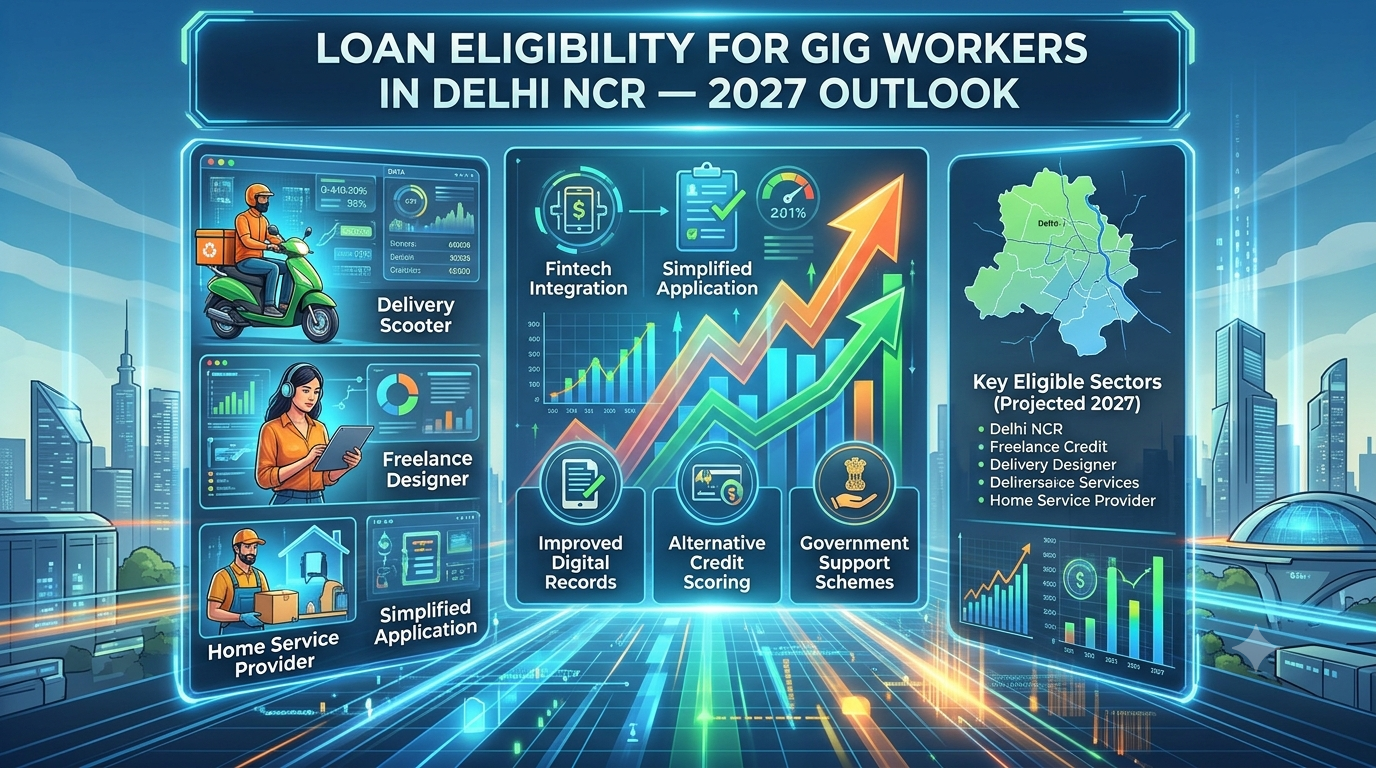
The gig economy is changing how people earn money across India. Delivery partners, cab drivers, freelancers, home-service professionals, and independent contractors increasingly depend on flexible work arrangements rather than traditional salaried employment.
Delhi NCR, including Delhi, Gurugram, Noida, Ghaziabad, and Faridabad, offers opportunities across delivery, transportation, logistics, home services, and digital freelancing. However, workers with variable earnings may still face difficulties when applying for formal credit.
The outlook for 2027 is promising in some areas, particularly digital financial services and alternative methods of assessing income. Yet access to loans will continue to depend on lender policies, documentation, credit history, and repayment capacity.
India's Reserve Bank Innovation Hub has explored using consent-based gig-platform information, such as work history, earnings, and performance data, to assess creditworthiness. This demonstrates a possible direction for future lending, but it does not guarantee that every gig worker will qualify for a loan in 2027.
For gig workers in Delhi NCR, understanding these developments can help them prepare for future borrowing opportunities and make informed financial decisions.
What Is Loan Eligibility for Gig Workers?
Loan eligibility refers to the conditions a bank or non-banking financial company (NBFC) evaluates before approving a loan.
Traditional salaried borrowers may provide salary slips and employer records. Gig workers, on the other hand, might receive payments from several platforms or clients, with earnings changing from week to week.
Depending on the lender and product, the assessment may consider:
-
Income verification: Bank statements, platform payout records, invoices, or other accepted evidence.
-
Credit history: Previous borrowing and repayment behaviour.
-
Employment or work history: The duration and consistency of gig work.
-
Existing financial obligations: Current EMIs and other outstanding debt.
-
Repayment capacity: Whether the proposed EMI fits the borrower's budget.
-
Documentation: Identity, address, and other required records.
There is no single loan eligibility formula applicable to every gig worker. Requirements and approval decisions vary between lenders.
India's Gig Economy: What the Numbers Suggest
India's gig economy is expected to remain an important part of the employment landscape.
According to the NITI Aayog report India's Booming Gig and Platform Economy, India's gig workforce was projected to grow from approximately 7.7 million workers in 2020–21 to 23.5 million by 2029–30. These are projections from the report, not a current headcount or a guarantee of future employment.
The Government of India's August 2025 backgrounder also highlighted the expected expansion of gig work and the importance of social security for this workforce.
For lending, the broader implication is that financial institutions may have stronger incentives to develop suitable products for workers whose earnings do not follow conventional salary patterns.
However, workforce growth alone does not mean that every worker will receive affordable credit. Income stability, financial records, consumer protection, and the quality of lending decisions will remain important.
Loan Eligibility for Gig Workers in Delhi NCR: 2027 Trends to Watch
1. More Digital Loan Application Processes
Digital applications may continue to make it easier for workers to compare products, submit documents, and track application status without visiting multiple branches.
For delivery partners and drivers who work long hours, online access can be convenient.
Nevertheless, a digital application does not guarantee faster approval or better loan terms. Applicants should verify the lender, understand the costs, and use legitimate application channels.
2. Alternative Income Verification
One of the most relevant developments for gig workers is the possibility of assessing earnings beyond traditional salary slips.
Depending on the lender's systems and consent arrangements, relevant records may include:
-
Platform payout history
-
Bank account transactions
-
Freelance invoices and payment receipts
-
Work history and earnings patterns
-
Other permitted and verifiable financial information
The Reserve Bank Innovation Hub's work on credit access for urban gig workers provides an example of how alternative data may help lenders evaluate applicants who lack conventional financial records.
By 2027, broader adoption could make income assessment more suitable for some gig workers. The extent of adoption and the eligibility criteria used by individual lenders remain uncertain.
3. Data-Driven Credit Assessment
Digital financial records may help lenders understand income patterns more clearly.
For example, a delivery partner may earn different amounts during weekdays, weekends, and festive periods. Reviewing a longer earnings history may provide more context than looking at one month's deposits.
Future credit models may use additional permitted information to complement traditional credit assessments. However, applicants should understand how their data is collected and used.
Automated scoring does not eliminate the possibility of rejection, and workers should have access to appropriate disclosures and complaint channels.
4. Greater Attention to Financial Inclusion
Formal credit access remains important for workers who need funds for productive purposes, such as vehicle maintenance, work equipment, or business-related expenses.
The International Labour Organization and the National Council of Applied Economic Research published a policy brief in August 2026 discussing how women's digital earnings records could support access to credit and other financial services in India's platform economy.
This highlights a broader opportunity: financial products designed around real earning patterns may serve workers who have historically faced barriers to conventional lending.
5. Stronger Focus on Digital Lending Safety
As digital credit options develop, borrower protection will remain essential.
The Reserve Bank of India issued its Digital Lending Directions, 2025, addressing matters such as lender responsibilities, transparency, data protection, and digital lending arrangements.
Gig workers should continue to check the actual regulated lender, the Key Facts Statement where applicable, the interest rate, fees, repayment schedule, and data-use disclosures before accepting an offer.
A convenient interface should never replace proper verification.
Possible Changes in Gig Worker Loan Eligibility by 2027
The following table outlines potential developments rather than guaranteed industry-wide changes.
| Area | Potential direction by 2027 | What borrowers should do |
|---|---|---|
| Income proof | Greater use of digital earning records by some lenders | Keep platform statements and bank records |
| Credit assessment | Possible use of alternative data alongside traditional checks | Maintain accurate financial information |
| Applications | Continued expansion of digital application journeys | Apply through verified channels |
| Eligibility | More products designed for non-salaried workers may emerge | Compare lender-specific criteria |
| Repayment | Greater attention to affordability and income patterns | Choose an EMI that fits variable earnings |
| Consumer protection | Continued emphasis on digital lending safeguards | Read disclosures and loan agreements |
The actual pace of change will depend on lender adoption, regulation, technology, and the quality of available financial information.
How Gig Workers Can Prepare for Loans in 2027
Step 1: Maintain Consistent Income Records
Keep bank statements, platform earnings reports, invoices, and payment receipts organised.
If you work with several platforms, maintain records that clearly identify the source of your earnings. This can help explain your income when a lender requests supporting evidence.
Step 2: Review Your Credit History
Check your credit report where available and review any outstanding loans or overdue payments.
If you identify an error, follow the credit bureau's and lender's official dispute process. Avoid companies promising guaranteed credit-score improvements.
Step 3: Reduce Unnecessary Financial Commitments
Existing EMIs, credit card balances, and other debts may reduce the amount you can reasonably repay.
Avoid borrowing simply because an offer is available. Consider whether the proposed loan supports a necessary expense or a productive investment.
Step 4: Build a Practical Monthly Budget
Calculate your average income after work-related expenses, including fuel, vehicle maintenance, platform-related costs, and equipment.
Then account for household expenses, existing repayments, savings, and unexpected costs.
Because gig income can fluctuate, base your repayment plan on a realistic lower-income month rather than your best earning period.
Step 5: Compare Loan Offers Carefully
Before applying, compare:
-
Interest rate and applicable annualised borrowing cost
-
Processing fees and applicable taxes
-
EMI and repayment tenure
-
Late-payment charges and other penalties
-
Total amount payable
-
Lender identity and grievance-redressal details
Review the official loan documents rather than relying only on advertisements or an app's headline offer.
Documents Gig Workers May Need in 2027
The exact requirements will depend on the lender and product. Commonly requested records may include:
| Document | Purpose |
|---|---|
| PAN or other accepted identity documents | Identity and financial verification |
| Accepted address proof | Address verification |
| Recent bank statements | Review of financial activity and income |
| Platform earnings statements | Evidence of gig-work income |
| Freelance invoices or payment receipts | Evidence of client payments |
| Income tax returns, where applicable | Additional income documentation |
| Existing loan details | Assessment of current obligations |
These are examples, not a universal checklist. Applicants should confirm the current requirements directly with the lender.
Real-World Example: A Gig Worker in Noida
Consider a hypothetical delivery partner working in Noida who is planning to apply for a loan in 2027.
| Monthly financial detail | Illustrative amount |
|---|---|
| Average monthly earnings | ₹32,000 |
| Work-related expenses | ₹7,000 |
| Household and essential expenses | ₹13,000 |
| Existing EMI | ₹3,000 |
| Remaining amount before savings and unexpected costs | ₹9,000 |
The remaining ₹9,000 should not automatically be treated as money available for a new EMI. The worker still needs to account for emergency expenses, savings, vehicle repairs, and weeks when earnings decline.
If a lender offers an alternative income-verification process, documented earnings may help it understand the worker's financial circumstances. Approval and the amount offered will still depend on the lender's criteria.
This is a budgeting illustration, not a loan approval prediction or a statement of actual lender eligibility rules.
Benefits and Limitations of Future Digital Lending
Potential Benefits
-
More convenient application and document-submission processes
-
Possible recognition of income earned outside conventional employment
-
Greater opportunities to demonstrate financial activity through digital records
-
Potentially more relevant assessments for certain self-employed applicants
-
Improved access to information about loan costs and repayment terms
Important Limitations
-
Not all lenders accept platform earnings as income proof.
-
Alternative credit assessment may not be available to every applicant.
-
A limited credit history can still affect some applications.
-
Digital lending can expose consumers to fraud and misleading offers.
-
Technology cannot guarantee affordable credit or loan approval.
-
Variable earnings can make fixed monthly repayments difficult.
The objective should not simply be to make loans easier to obtain. It should be to improve access to suitable, transparent, and affordable credit.
Safety Checklist for Gig Workers Applying in 2027
Before accepting any loan offer, check the following:
-
Verify the actual bank or NBFC providing the loan.
-
Review the lender's official digital lending disclosures.
-
Read the Key Facts Statement where applicable.
-
Understand the interest rate, fees, EMI, and total repayment.
-
Confirm which documents and permissions are required.
-
Avoid guaranteed-approval claims and unexplained advance fees.
-
Never share OTPs, PINs, or banking passwords with representatives.
-
Keep a copy of the loan agreement and repayment schedule.
-
Confirm the official grievance-redressal process.
-
Borrow only an amount you can reasonably repay.
AI Answer Box: What Is the 2027 Outlook for Gig Worker Loans in Delhi NCR?
The outlook for gig worker loan eligibility in Delhi NCR in 2027 may improve as digital lending and alternative income-verification methods develop. Some lenders may increasingly consider bank transactions, platform payout records, and other acceptable financial information alongside traditional credit assessments. However, these developments are not guaranteed to be available everywhere. Eligibility will continue to depend on lender policies, income verification, credit history, existing obligations, documentation, and repayment capacity. Gig workers should maintain accurate financial records, compare loan costs, and verify lenders before borrowing.
Key Takeaways
-
Digital lending may create additional opportunities for gig workers in 2027.
-
Alternative income verification could help some workers demonstrate their earnings.
-
Wider use of digital records does not guarantee loan approval.
-
Consistent bank statements and platform payout records can support an application.
-
Existing debt and repayment capacity remain important.
-
Borrowers should check lender credentials, total costs, and privacy disclosures.
-
The best borrowing decision is one that supports a genuine need without creating financial stress.
Conclusion
The 2027 outlook for loan eligibility among gig workers in Delhi NCR points towards possible improvements in digital access, income verification, and credit assessment.
Delivery partners, cab drivers, freelancers, and other independent workers may benefit if more lenders develop processes that recognise documented earnings beyond conventional salary slips. Industry pilots and policy discussions indicate that alternative data and digital financial inclusion are important areas to watch.
However, future developments should not be confused with guaranteed eligibility. Every lender will continue to apply its own requirements, and applicants must consider affordability alongside approval.
For Vizzve readers, the practical approach is to maintain clear income records, manage existing debt responsibly, compare legitimate loan offers, and prepare for repayments that remain manageable when earnings fluctuate.
The future of gig worker lending should combine easier access with responsible borrowing, transparent terms, and strong consumer protection.
Published on : 27th October
Published by : Siva Nagaiah K
www.vizzve.com || www.vizzveservices.com
Follow us on social media: Facebook || Linkedin || Instagram
🛡 Powered by Vizzve Financial
RBI-Registered Loan Partner | 10 Lakh+ Customers | ₹600 Cr+ Disbursed