

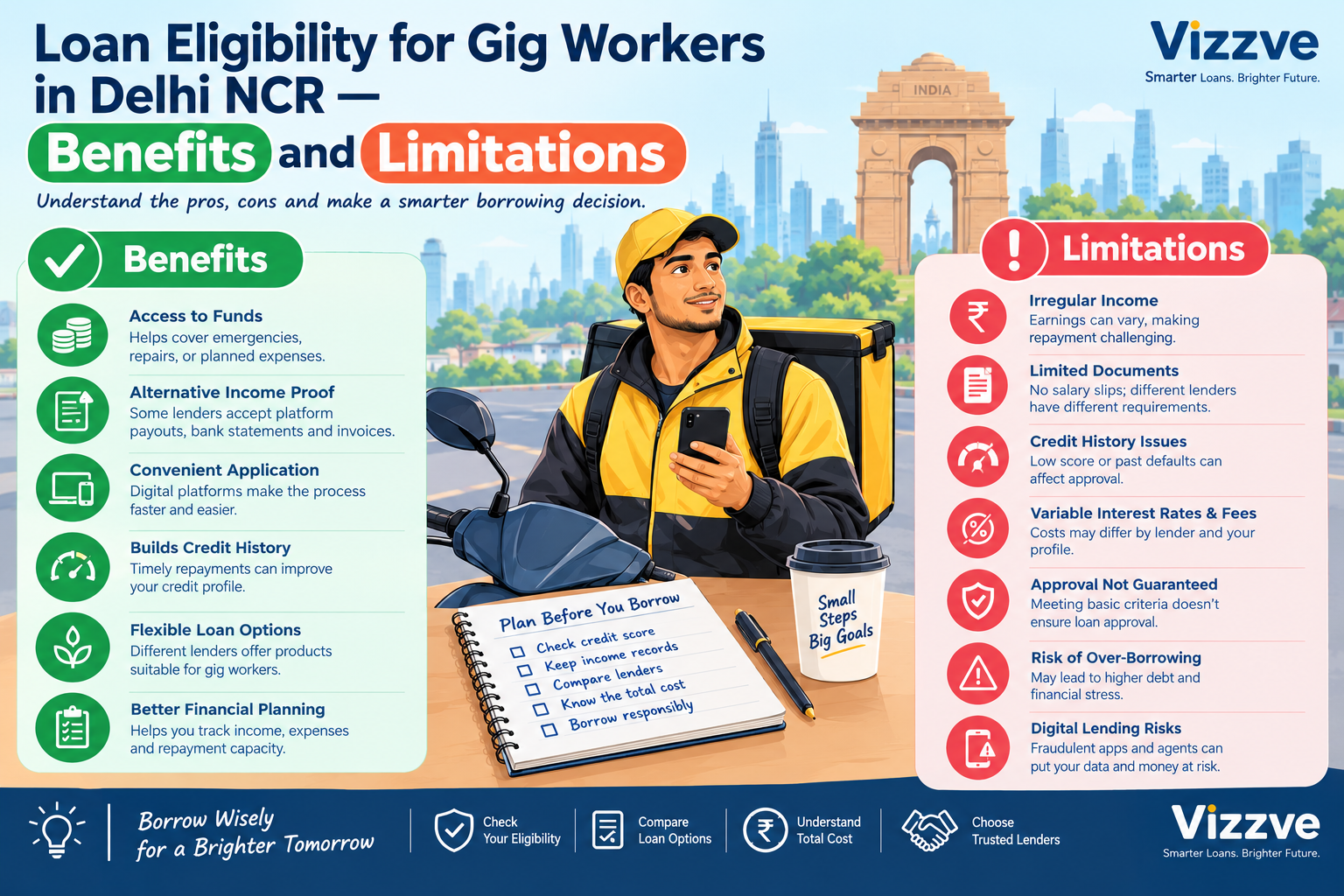
Gig work has become an important source of income for people across Delhi NCR. Delivery partners, ride-hailing drivers, freelance professionals, e-commerce workers, and other platform-based workers often value the flexibility these jobs offer. However, when they need funds for medical expenses, vehicle repairs, education, household costs, or emergencies, accessing credit can sometimes be challenging.
Traditional loan applications often rely on salary slips, employer certificates, and predictable monthly income. Gig workers may receive payments from different platforms, work irregular hours, and experience income fluctuations. As a result, lenders may assess their eligibility using bank statements, platform payout records, credit history, existing financial obligations, and repayment capacity.
Loan eligibility for gig workers in Delhi NCR has potential benefits, but it also comes with limitations. Understanding both sides can help borrowers compare available options, prepare documents, and decide whether taking a loan is financially appropriate.
Quick Answer: What Are the Benefits and Limitations?
Benefits
-
Access to funds for planned expenses or emergencies.
-
Potential eligibility through alternative income documentation.
-
Flexible loan products from some lenders.
-
Opportunity to build a positive credit history through timely repayment.
-
Convenient digital application processes where offered by legitimate lenders.
Limitations
-
Not every lender accepts gig workers.
-
Irregular earnings can make repayment difficult.
-
Limited income records may delay verification.
-
Interest rates and fees vary by lender and borrower profile.
-
Approval and loan amounts are never guaranteed.
Eligibility depends on the lender, loan product, income evidence, credit history, existing debt, and other underwriting criteria.
Who Is Considered a Gig Worker?
Gig workers typically earn through short-term assignments, freelance projects, platform-based services, or flexible work arrangements rather than a conventional salaried position.
In Delhi NCR, this may include:
-
Food delivery partners.
-
Ride-hailing and taxi drivers.
-
E-commerce delivery workers.
-
Freelancers and independent consultants.
-
Home-service professionals.
-
Online sellers and platform-based service providers.
Some workers have a single source of income, while others earn through multiple platforms or clients. The documents accepted to verify these earnings depend on the lender.
Benefits of Loan Eligibility for Gig Workers
1. Access to Funds When Needed
An eligible borrower may use a suitable loan to cover an urgent expense or a planned purchase. For example, a delivery partner may need money for a vehicle repair that affects their ability to earn.
A loan can provide funds when savings are insufficient, but borrowing should be considered only after assessing the urgency of the expense and the ability to repay.
2. Alternative Income Proof May Be Accepted
Some lenders may consider gig workers without traditional salary slips. Depending on their policies, they may accept:
-
Bank statements showing regular deposits.
-
Platform payout reports.
-
Payment summaries from clients.
-
Invoices and freelance earnings records.
-
Income tax returns, where applicable.
-
Other accepted self-employment documents.
Keeping accurate financial records can make it easier to demonstrate income consistency. Acceptance of these documents is not universal, so applicants should confirm the requirements before applying.
3. Convenient Application Options
Some banks and regulated non-banking financial companies (NBFCs) offer online application processes. Where available, these can help applicants review requirements, submit documents, and track application progress without repeated branch visits.
Digital convenience does not mean every app is trustworthy. Applicants should verify the actual lender, understand data permissions, and read all loan disclosures before proceeding.
4. Opportunity to Build Credit History
Taking a suitable loan and repaying it on time can contribute positively to a borrower's credit history, provided the lender reports the account to a credit bureau and the information is reported correctly.
A stronger credit history may help with future credit applications. However, a loan is not necessary solely to build credit, and missed payments or excessive borrowing can harm financial standing.
5. Potential Flexibility in Loan Products
Depending on eligibility, gig workers may be able to compare personal loans or other suitable credit products offered by lenders that accept their employment and income profile.
The best option depends on the purpose of borrowing, total cost, repayment terms, and financial circumstances—not simply the speed of approval.
6. Better Financial Planning
The loan application process can encourage workers to organize income records, review expenses, check credit history, and calculate how much they can reasonably repay.
These habits are useful even when a loan application is declined or the borrower decides not to proceed.
Limitations of Loan Eligibility for Gig Workers
1. Irregular Monthly Income
Gig earnings can change with customer demand, platform incentives, weather, working hours, fuel prices, and vehicle maintenance.
A borrower who earns well in one month may earn considerably less in another. This makes it important to estimate take-home income after work-related costs rather than relying on the highest-earning month.
Practical tip: Test whether you can afford the EMI during a slower month before accepting the loan.
2. Limited Traditional Employment Documents
Many gig workers do not receive salary slips or employment letters. If a lender requires these documents, an applicant may not meet that product's requirements.
Other lenders may accept alternative income evidence, but the format, duration, and type of documentation required can vary.
Applicants should ask what is accepted before submitting an application or paying any fee.
3. Credit History Can Affect Approval
A limited credit history, previous missed payments, high outstanding debt, or errors in a credit report may affect a lender's assessment.
Before applying, review your credit report, check for unfamiliar accounts, and dispute inaccurate information with the relevant credit bureau or lender.
A good credit score can help, but it does not guarantee approval. Lenders consider multiple factors.
4. Interest Rates and Fees May Vary
The borrowing cost may depend on the lender, product, credit profile, loan amount, tenure, and other factors.
Review the interest rate, Annual Percentage Rate (APR) where disclosed, processing fees, applicable taxes, late-payment charges, and prepayment conditions. Read the Key Facts Statement (KFS) when applicable.
Do not compare offers using EMI alone. A longer tenure may reduce the monthly payment but increase the total amount repaid.
5. Approval Is Not Guaranteed
Meeting basic eligibility criteria does not mean a lender must approve the application. Lenders may assess income stability, repayment capacity, credit history, identity verification, existing obligations, and internal risk policies.
Avoid advertisements or agents that promise guaranteed approval regardless of your financial profile.
6. Risk of Over-Borrowing
Easy access to credit can lead to taking a larger loan than necessary. Multiple EMIs can reduce the money available for rent, food, family expenses, vehicle upkeep, and emergency savings.
Borrow only the amount needed and avoid taking a new loan to manage existing repayments unless a carefully assessed alternative genuinely improves your financial position.
7. Digital Lending Risks
Fake loan apps, impersonation, misleading advertisements, and unauthorized agents can expose applicants to financial or privacy risks.
Before applying:
-
Verify the lender through official sources.
-
Identify the regulated bank or NBFC providing the loan, where applicable.
-
Read the privacy policy and requested permissions.
-
Never share banking PINs, passwords, or OTPs.
-
Do not pay unexplained fees to individuals promising guaranteed approval.
-
Save the KFS, loan agreement, and repayment schedule.
Benefits vs. Limitations: At a Glance
| Factor | Potential benefit | Possible limitation |
|---|---|---|
| Access to funds | Can help cover eligible planned or urgent expenses | Creates a repayment obligation |
| Income documentation | Some lenders may accept platform payouts and bank statements | Requirements differ by lender |
| Application process | Digital applications may be convenient | Digital channels can also be used by scammers |
| Credit history | Timely repayments may support a positive credit record | Missed payments may damage credit standing |
| Loan options | Some products may suit self-employed borrowers | Eligibility and pricing can vary |
| Repayment | A suitable EMI may fit the budget | Fluctuating earnings can make payments difficult |
| Financial planning | Encourages tracking income and expenses | Borrowing without budgeting can worsen financial pressure |
How Gig Workers in Delhi NCR Can Improve Their Loan Readiness
Step 1: Organize Income Records
Keep recent bank statements, platform payout summaries, invoices, and other accepted income documents. Ensure the information is accurate and consistent.
Step 2: Check Your Credit Report
Review your credit history for errors, overdue accounts, or unfamiliar activity. Resolve inaccuracies through the appropriate lender or credit bureau process.
Step 3: Calculate a Realistic EMI
Estimate average take-home earnings after fuel, maintenance, platform-related costs, and other work expenses. Deduct essential household costs and existing debt payments before considering a new EMI.
Step 4: Compare Suitable Lenders
Check whether the lender accepts gig workers, what documentation it requires, and whether the loan is available in your part of Delhi NCR.
Step 5: Compare the Total Cost
Review the interest rate, APR where available, fees, tenure, repayment schedule, and conditions for missed payments or early repayment.
Step 6: Read the Loan Agreement
Understand the amount disbursed, total repayment amount, due dates, fees, and complaint-resolution process before signing.
Step 7: Borrow Only If Repayment Is Manageable
If the EMI would leave too little money for essentials or emergency savings, consider a smaller amount, a different option, or postponing the borrowing.
Illustrative Example: A Delivery Partner in Delhi NCR
Suppose a delivery partner earns an average of ₹28,000 per month. After fuel and maintenance costs, approximately ₹23,000 remains before household expenses and existing obligations.
The worker reviews bank statements, organizes platform payout records, and checks their credit report. They then compare suitable lenders and estimate the EMI for different loan amounts.
During the comparison, the worker discovers that a larger loan would leave very little money for essential expenses during a slow month. Instead of accepting the maximum amount offered, they consider a smaller loan and a repayment schedule that better fits their budget.
This is an illustrative example, not a prediction of approval or an offer of specific loan terms. Actual eligibility and costs depend on the lender and the applicant's circumstances.
When Might a Loan Be Suitable?
A loan may be worth considering when:
-
The expense is necessary and cannot reasonably be covered through savings.
-
The borrower has a clear repayment plan.
-
The EMI remains affordable during lower-income periods.
-
The lender is verified and the terms are transparent.
-
The total borrowing cost is understood.
A loan may be unsuitable when income is already insufficient for essentials, existing debt is difficult to manage, or the borrower depends on another loan to make repayments.
Frequently Asked Questions (FAQs)
1. Can gig workers in Delhi NCR get personal loans?
Some lenders accept eligible gig workers and self-employed applicants. Approval depends on the lender's requirements, income evidence, credit history, repayment capacity, and other factors.
2. What are the main benefits of a gig worker loan?
Potential benefits include access to funds, the possibility of using alternative income documents, convenient application options, and an opportunity to build credit through timely repayment.
3. What are the main limitations?
Common limitations include variable income, differing documentation requirements, credit-history concerns, varying fees and interest rates, and the risk of taking on unaffordable repayments.
4. Can I apply without a salary slip?
Possibly. Some lenders may accept bank statements, platform payout reports, invoices, or other income documents. Check the requirements of the specific lender.
5. Does a good credit score guarantee approval?
No. Lenders may also assess income, existing debt, documentation, repayment capacity, and internal underwriting rules.
6. What income proof should gig workers maintain?
Depending on the work and lender, useful records may include bank statements, platform payout summaries, invoices, client payment records, and income tax returns where applicable.
7. Are digital loan apps safe?
Some digital channels are operated by legitimate lenders, but applicants should verify the actual lender, read disclosures, review permissions, and avoid suspicious offers or unauthorized agents.
8. Can a gig worker with existing EMIs apply?
Possibly, but existing obligations can affect the lender's assessment and the applicant's ability to repay. Calculate the total monthly debt burden before applying.
9. How can I avoid borrowing too much?
Work out the amount you actually need, compare total repayment costs, and calculate an affordable EMI using realistic take-home income rather than your best earning month.
10. Will a loan improve my credit score?
Timely repayments on an account reported to a credit bureau may support a positive credit history. However, the effect depends on your overall credit profile, and missed payments can have negative consequences.
11. Can freelancers and delivery partners use the same loan product?
Not necessarily. Different lenders and products have different eligibility criteria. Applicants should confirm that their type of work and income documentation are accepted.
12. What should I check before accepting a loan?
Check the lender's authenticity, sanctioned amount, interest rate, APR where disclosed, fees, EMI, tenure, KFS where applicable, and all contractual conditions.
13. Can loan eligibility differ across Delhi NCR?
Yes. Lender service areas, product availability, documentation rules, and eligibility criteria may differ. Confirm availability for your specific location.
14. What if I cannot afford the EMI during a slow month?
Do not assume future earnings will always cover the payment. Consider a smaller loan or delaying the application. If you already have difficulty paying, contact the lender through official channels to discuss available options.
15. Is borrowing always better than using savings?
No. The right choice depends on emergency needs, available savings, borrowing costs, and your financial situation. Compare alternatives before committing to a repayment obligation.
Key Takeaways
-
Some lenders offer credit options for eligible gig workers, but not every lender accepts irregular income.
-
Alternative income records may help demonstrate earnings where the lender accepts them.
-
Variable income makes realistic repayment planning especially important.
-
Compare the total borrowing cost, not just the EMI or advertised interest rate.
-
Verify the lender and understand all loan documents before accepting an offer.
-
Responsible borrowing requires considering both the benefits and the limitations.
Conclusion
Loan eligibility can create opportunities for gig workers in Delhi NCR who need funds for essential expenses or planned financial goals. However, access to credit also brings responsibilities, including managing fluctuating income, understanding fees, and meeting repayment deadlines.
Before applying, organize your income documents, review your credit history, compare lenders, and calculate an EMI that remains manageable during slower earning periods. Never rely solely on a promise of fast or guaranteed approval.
The best borrowing decision is not simply getting a loan—it is choosing credit that suits your needs and repayment capacity. Vizzve encourages gig workers to compare options carefully, verify lenders, and prioritize long-term financial stability.
Published on : 24th October
Published by : Siva Nagaiah K
www.vizzve.com || www.vizzveservices.com
Follow us on social media: Facebook || Linkedin || Instagram
🛡 Powered by Vizzve Financial
RBI-Registered Loan Partner | 10 Lakh+ Customers | ₹600 Cr+ Disbursed