

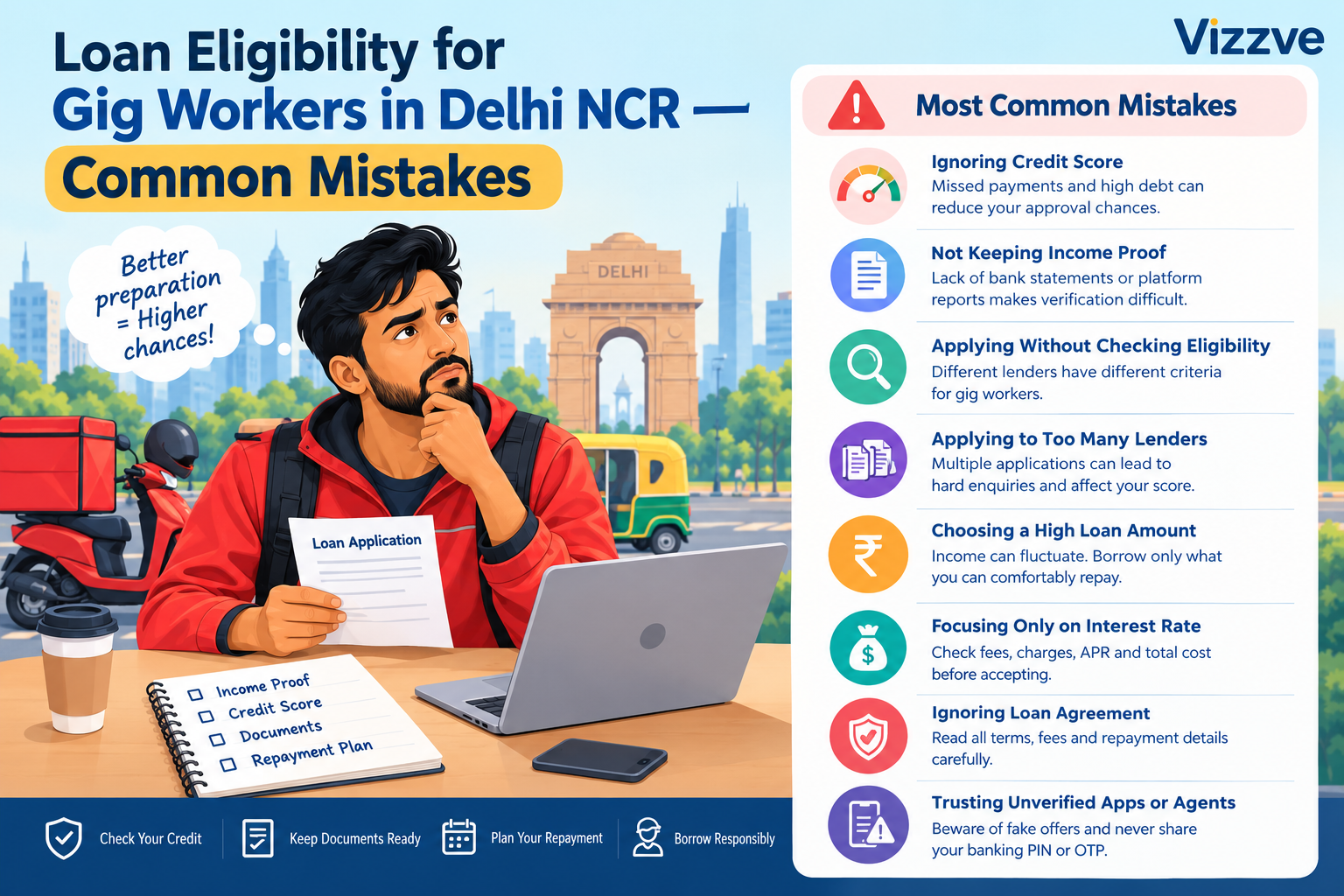
-
k statements.
-
Failing to save platform payout reports.
-
Mixing business and personal transactions without clear records.
-
Reporting income that cannot be verified.
Solution: Keep recent bank statements, invoices, platform earnings reports, payment receipts, and applicable tax documents ready before applying.
3. Applying Without Checking Eligibility Criteria
Different lenders have different requirements for income, age, credit history, work experience, and documentation. Applying without checking these conditions may lead to avoidable rejections.
Before applying, review the lender's minimum income requirements, accepted proof of gig income, credit criteria, and existing debt obligations.
4. Applying to Too Many Lenders at Once
Submitting multiple applications within a short period can result in several hard credit enquiries, depending on the application process.
Instead of applying everywhere, compare lenders first, check their eligibility conditions, and shortlist options that match your financial profile.
5. Choosing a Loan Amount That Is Too High
Gig income may fluctuate due to demand, working hours, fuel prices, and seasonal changes. Choosing a loan based on your highest earning month can make repayments difficult during slower periods.
Example: If you earn ₹28,000 in a busy month but ₹22,000 in a slower month, plan repayments around a conservative income estimate rather than the higher figure.
Calculate essential expenses, existing EMIs, savings needs, and emergency costs before deciding on a loan amount.
6. Submitting Incomplete or Incorrect Documents
Incorrect PAN details, outdated KYC information, inconsistent addresses, or incomplete bank statements can delay loan processing.
Prepare your identity proof, address proof, bank statements, and income documents. Confirm the exact requirements with the lender because documentation rules vary.
7. Ignoring Existing EMIs and Monthly Expenses
Your repayment capacity depends on more than your income. Rent, household expenses, vehicle maintenance, fuel, insurance, and existing loan payments all affect the amount you can comfortably repay.
Prepare a monthly budget and disclose existing obligations accurately. Avoid taking another loan if your current financial commitments already stretch your budget.
8. Focusing Only on the Interest Rate
A low advertised interest rate does not necessarily mean a loan is inexpensive. Processing fees, applicable penalties, repayment tenure, and other charges can increase the overall cost.
Before accepting an offer, compare:
-
Interest rate and Annual Percentage Rate (APR).
-
Processing fees and other disclosed charges.
-
Monthly EMI and total repayment.
-
Repayment tenure.
-
Prepayment and foreclosure conditions.
Read the Key Fact Statement (KFS) and loan agreement carefully before accepting a digital loan.
9. Trusting Unverified Loan Apps or Agents
Some fraudulent loan offers promise guaranteed approval or demand unexplained upfront payments.
Always verify the actual lender, read the loan terms, and check the app's privacy practices. Never share your banking PIN, password, or OTP with an agent claiming to guarantee approval.
10. Failing to Plan for Irregular Income
Loan instalments generally follow a fixed schedule even when gig earnings change from week to week.
To reduce repayment risks, set aside money for upcoming EMIs, build an emergency reserve, and avoid borrowing more than you can repay during low-income months.
11. Providing False Income Information
Inflating income, changing bank statements, or submitting inaccurate employment details can result in rejection and potentially more serious consequences.
Use genuine documents and provide accurate information. If your income records are weak, improve your documentation rather than misrepresenting your earnings.
12. Ignoring the Loan Agreement
Before accepting a loan, check the approved amount, net disbursal, interest rate, APR, repayment dates, fees, applicable penalties, and grievance-redressal details.
Keep a copy of the KFS, sanction letter, and signed agreement for your records.
Practical Checklist Before Applying
-
Review your credit report.
-
Collect bank statements and platform payout records.
-
Verify your identity and address documents.
-
Calculate average monthly income and essential expenses.
-
List all existing loans and EMIs.
-
Compare interest rates, APR, fees, and repayment terms.
-
Verify the lender's identity and read the KFS.
-
Ensure repayments remain affordable during slower months.
Frequently Asked Questions
1. Can gig workers in Delhi NCR get personal loans?
Yes. Some lenders consider gig workers, delivery partners, cab drivers, and freelancers. Eligibility depends on income proof, credit history, repayment capacity, and lender policies.
2. Is a salary slip mandatory for gig workers?
Not always. Some lenders accept bank statements, platform payout reports, invoices, and other income documents.
3. Does a low credit score guarantee rejection?
No, but it may reduce approval chances or affect the terms offered. Each lender follows its own assessment criteria.
4. Can multiple loan applications affect my credit score?
Multiple hard enquiries over a short period may affect your credit score. Check eligibility and understand the enquiry type before applying.
5. How can delivery partners prove their income?
They can maintain bank statements, delivery-platform payout summaries, invoices, and applicable tax records, subject to lender requirements.
6. Should gig workers apply for the maximum eligible loan amount?
No. Borrow only what you need and can comfortably repay after accounting for essential expenses and existing obligations.
7. What should I do if my loan application is rejected?
Review the stated rejection reason, check your credit report, correct documentation gaps, and reassess affordability before applying again.
8. Are instant loan apps safe?
Some are associated with legitimate regulated lenders, while others may be fraudulent. Verify the lender and review the loan terms before sharing personal information.
9. Can gig workers apply if they already have a loan?
Possibly. Lenders may consider existing EMIs, income, credit history, and remaining repayment capacity.
10. How can gig workers improve loan eligibility?
Maintain clear income records, pay existing obligations on time, limit unnecessary applications, manage debt responsibly, and select a realistic loan amount.
Conclusion
Avoiding common loan eligibility mistakes can help gig workers in Delhi NCR prepare a stronger loan application. Maintaining proper income records, checking credit history, submitting accurate documents, and choosing an affordable loan amount are important steps toward responsible borrowing.
Before applying, compare lenders, review the interest rate and additional charges, and carefully read the loan agreement. Since gig income can fluctuate from month to month, always choose an EMI that fits your budget, even during slower earning periods.
With proper financial planning and the right documentation, gig workers can make more informed borrowing decisions and improve their readiness for loan approval. Vizzve encourages gig workers to understand their eligibility, compare available options, and borrow responsibly.
Published on : 24th October
Published by : Siva Nagaiah K
www.vizzve.com || www.vizzveservices.com
Follow us on social media: Facebook || Linkedin || Instagram
🛡 Powered by Vizzve Financial
RBI-Registered Loan Partner | 10 Lakh+ Customers | ₹600 Cr+ Disbursed