

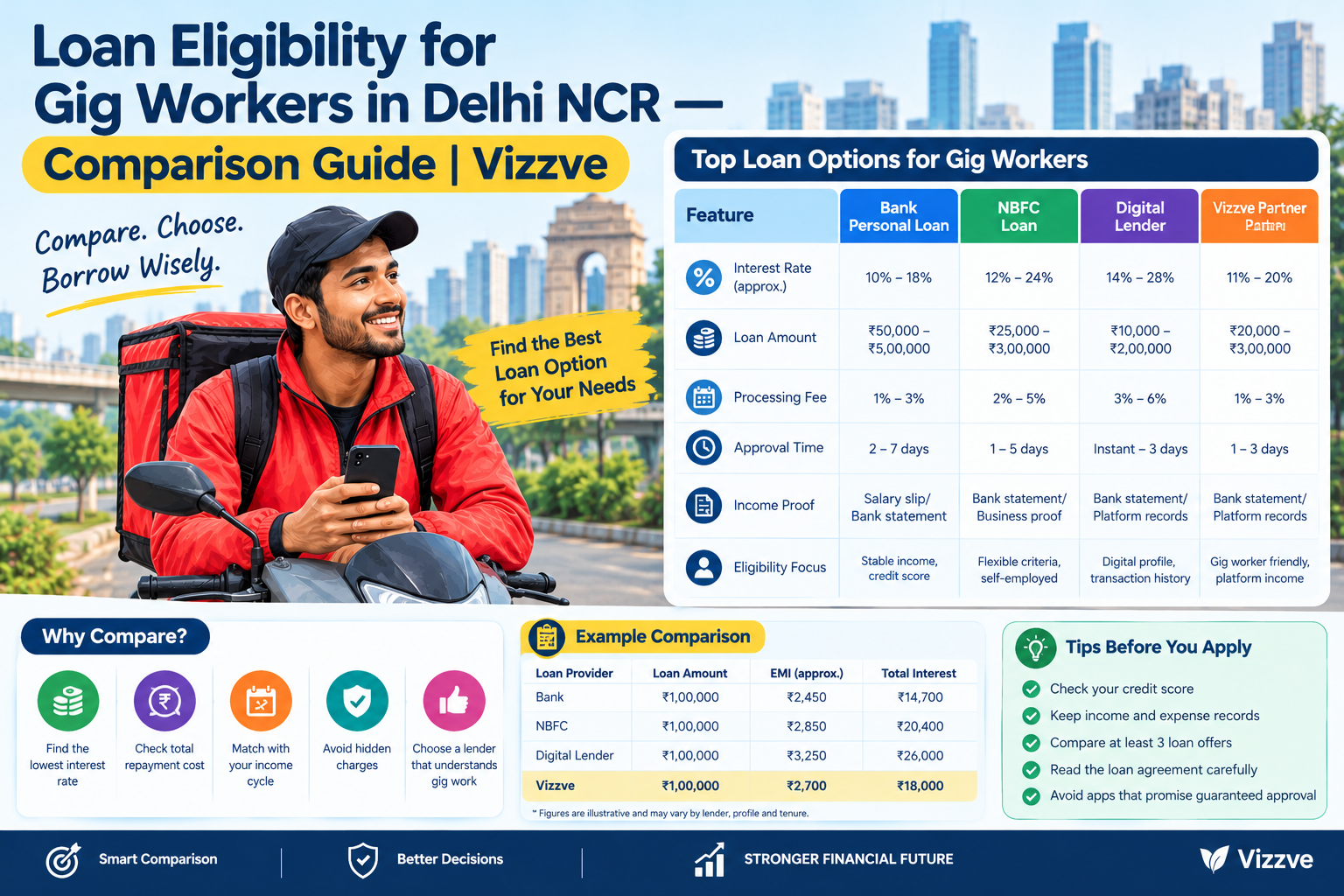
Gig work has become an important source of income in Delhi NCR, with people working as food delivery partners, cab drivers, e-commerce delivery workers, freelancers, and independent service professionals.
However, obtaining a personal loan can be challenging when earnings fluctuate or traditional salary slips are unavailable. Different lenders use different eligibility requirements, income verification methods, credit assessments, and repayment policies.
This comparison guide explains the main loan options available to gig workers, what to evaluate before applying, and how to make an informed borrowing decision.
Important: Interest rates, loan amounts, eligibility conditions, and processing times vary by lender and applicant. No loan option guarantees approval, and all examples in this article are illustrative.
What Is Loan Eligibility for Gig Workers?
Loan eligibility refers to the criteria a lender uses to determine whether an applicant qualifies for a loan and how much they may be able to borrow.
For gig workers, these criteria may include:
-
Monthly income and consistency of earnings.
-
Bank statements and platform payment records.
-
Credit history and credit bureau information.
-
Existing EMIs and other financial commitments.
-
Age and identity verification.
-
Work history or other evidence of income.
-
Ability to repay the loan within the agreed tenure.
Unlike salaried employees, gig workers may receive payments from several platforms or clients. Some lenders accept this type of income, while others have more restrictive documentation requirements.
Before applying, confirm that the lender accepts your occupation and income type.
Loan Options for Gig Workers in Delhi NCR
Gig workers may explore several categories of credit, depending on their financial needs and eligibility.
1. Bank Personal Loans
Banks may offer personal loans to eligible salaried and self-employed applicants. Some banks accept applicants with non-salaried income, subject to their product terms.
Potential advantages:
-
Clearly documented loan terms.
-
Established customer service and grievance channels.
-
Options to compare interest rates and repayment tenures.
Potential limitations:
-
Income verification may be strict.
-
Some products may require a minimum income or established credit history.
-
Applicants without conventional employment documents may have fewer options.
Suitable for: Gig workers who have documented income, an acceptable credit profile, and meet the bank's eligibility requirements.
2. Loans From Non-Banking Financial Companies (NBFCs)
NBFCs may provide personal loans or other credit products to applicants who satisfy their lending criteria. Requirements differ across institutions.
Potential advantages:
-
Different eligibility criteria across providers.
-
Some products may accept alternative income documents.
-
Multiple loan structures may be available.
Potential limitations:
-
Interest rates and fees can vary.
-
Eligibility may depend on income, credit history, and the specific product.
-
Approval is not guaranteed simply because a provider is an NBFC.
Suitable for: Applicants who meet the specific NBFC's requirements and want to compare another legitimate lending option.
3. Digital Personal Loans
Digital lending platforms can help applicants discover or apply for credit online. The actual lender may be a bank or an NBFC.
Potential advantages:
-
Online application and document submission.
-
Potentially convenient application tracking.
-
Less need for physical paperwork in some processes.
Potential limitations:
-
Some apps may not be genuine or appropriately authorised.
-
Advertised approval times may not reflect the actual processing period.
-
Fees, privacy practices, and the identity of the lender require careful checking.
Suitable for: Borrowers who prefer an online application and can verify the actual lending institution and complete loan terms.
4. Credit Options Designed for Self-Employed Applicants
Certain lenders offer credit products for self-employed individuals or applicants with non-traditional income. A gig worker may qualify if the product accepts their occupation and income records.
Do not assume that a product described as self-employed-friendly automatically accepts every delivery partner, freelancer, or platform worker.
Suitable for: Gig workers who can document their earnings and meet the product's specific conditions.
5. Platform-Linked or Partner Loan Offers
Some financial institutions and digital platforms may provide access to credit through partnerships. Availability and eligibility depend on the particular programme.
Before accepting a partner offer, confirm:
-
The name of the actual lender.
-
Whether the programme is currently available to you.
-
The eligibility and income requirements.
-
The interest rate, APR, and all applicable charges.
-
The repayment schedule and complaint-resolution process.
Important for Vizzve readers: Verify the actual lender and specific product terms associated with any Vizzve-related offer. Do not assume a loan is available or that a particular rate or approval amount is guaranteed without verified product information.
Comparison of Loan Options
The following table provides a general comparison. It does not represent verified offers, current interest rates, or guaranteed terms from any specific institution.
| Comparison factor | Bank personal loan | NBFC loan | Digital lending option |
|---|---|---|---|
| Application | Online or offline, depending on the bank | Online or offline, depending on the provider | Often online |
| Income proof | Product-specific requirements | Product-specific requirements | Depends on the actual lender |
| Salary slip | May be required for some products | Alternative proof may be accepted for some products | Depends on the actual lender |
| Credit assessment | Varies by product | Varies by product | Varies by actual lender |
| Interest rate | Depends on applicant and product | Depends on applicant and product | Depends on applicant and product |
| Processing fees | Check the official offer | Check the official offer | Check the official offer |
| Approval time | Varies | Varies | Varies |
| Main consideration | Eligibility and documentation | Total borrowing cost | Lender verification and data privacy |
How to use this comparison: Request written offers from eligible providers and compare their APR, processing fees, total repayment amount, tenure, and late-payment charges before choosing a loan.
Interest Rates, Fees, and Total Repayment
The lowest advertised interest rate does not always mean the cheapest loan. Additional charges and the repayment tenure can affect the total amount you pay.
Costs to Compare
| Cost factor | What to check |
|---|---|
| Interest rate | Whether the rate is fixed or variable, where applicable |
| APR | The overall annualised borrowing cost, including applicable charges as disclosed |
| Processing fee | The fee charged for processing the loan |
| Other charges | Applicable documentation or other disclosed fees |
| EMI | The scheduled monthly instalment |
| Total repayment | The total amount payable across the loan tenure |
| Late-payment charges | The consequences of missing a payment |
| Prepayment terms | Conditions and charges, if applicable, for early repayment |
Illustrative Example
Suppose a gig worker compares two hypothetical loan offers for ₹1,00,000 over 36 months.
| Detail | Offer A | Offer B |
|---|---|---|
| Illustrative annual interest rate | 15% | 18% |
| Approximate monthly EMI | ₹3,467 | ₹3,615 |
| Approximate total of EMIs | ₹1,24,800 | ₹1,30,140 |
| Approximate interest paid | ₹24,800 | ₹30,140 |
These figures are estimates based on a standard reducing-balance EMI calculation. They exclude processing fees, taxes, insurance, and other charges. Actual lender calculations may differ.
In this example, Offer A has a lower interest cost, assuming the other terms are comparable. In practice, borrowers should compare the complete written offers rather than choosing on the interest rate alone.
How Gig Workers Can Check Their Loan Eligibility
Step 1: Calculate Your Monthly Income
Review your earnings across several months. If you work on multiple platforms, organise the income records from each one and avoid counting the same payment twice.
Step 2: Calculate Your Net Available Income
Deduct fuel, maintenance, platform charges, equipment costs, household expenses, and existing debt payments.
Lenders may use their own income assessment methods, so your calculation may differ from the lender's assessment.
Step 3: Review Your Credit History
Check your credit report for outstanding loans, missed payments, and errors. A good repayment history may help your application, although it does not guarantee approval.
Step 4: Prepare Income Documents
Depending on the lender, useful records may include:
-
Recent bank statements.
-
Platform earnings statements.
-
Client invoices and payment receipts.
-
Income tax returns, where applicable.
-
Other accepted proof of income.
Step 5: Compare Eligibility Requirements
Check minimum age, income criteria, acceptable occupations, credit assessment requirements, and documentation before submitting an application.
Step 6: Estimate an Affordable EMI
Ensure that repayments remain manageable after work expenses, essential household spending, existing EMIs, and an allowance for unexpected costs.
Step 7: Read the Written Offer
Review the Key Facts Statement (KFS), loan agreement, APR, fees, total repayment, and repayment dates before accepting the loan.
Documents Commonly Required
Requirements vary, but lenders may request:
| Document | Purpose |
|---|---|
| PAN or other accepted identity document | Identity and financial verification |
| Accepted address proof | Address verification |
| Bank statements | Review of transactions and income |
| Platform earnings reports | Evidence of gig income |
| Invoices or client receipts | Evidence of freelance income |
| Tax records, where applicable | Additional income verification |
Only provide documents through verified channels and share personal information that is legitimately required for the application.
Which Loan Option May Suit Different Gig Workers?
There is no single best loan option for every applicant. The most appropriate choice depends on the borrower's income pattern, documentation, credit profile, and financial needs.
| Gig worker profile | What to investigate |
|---|---|
| Food delivery partner | Whether platform earnings reports and bank statements are accepted |
| Cab or bike taxi driver | Whether variable earnings and relevant work records meet the requirements |
| Freelancer | Whether invoices, client receipts, and tax records are accepted |
| E-commerce delivery worker | Whether the lender accepts platform-based income |
| Worker using multiple platforms | How the lender verifies multiple income sources |
| Applicant with limited credit history | How the lender assesses applicants with a thin credit file |
These are comparison suggestions, not predictions of eligibility or approval.
Benefits and Limitations of Comparing Loan Options
Benefits
-
Helps borrowers understand the total cost of borrowing.
-
Makes differences in eligibility and documentation easier to identify.
-
Can help avoid unnecessary applications.
-
Encourages realistic EMI planning.
-
Makes lender verification and fee transparency a priority.
Limitations
-
Not every lender accepts gig income.
-
Rates and eligibility depend on individual circumstances.
-
Online application convenience does not guarantee faster approval.
-
A loan offer may change after verification.
-
Comparing products cannot eliminate all borrowing risks.
Common Mistakes to Avoid
-
Choosing only by advertised interest rate: Compare APR, fees, and total repayment.
-
Assuming all lenders accept gig workers: Verify occupation and income criteria first.
-
Applying without income records: Organise bank statements and platform earnings reports.
-
Ignoring existing EMIs: Consider all current financial commitments.
-
Borrowing the maximum available amount: Borrow only what you reasonably need and can repay.
-
Trusting guaranteed approval claims: Legitimate lending decisions involve eligibility checks.
-
Ignoring the actual lender's identity: Verify who is providing the loan.
-
Sharing OTPs or banking passwords: Never disclose these security credentials to an agent or app.
Frequently Asked Questions (FAQs)
1. Can gig workers get personal loans in Delhi NCR?
Yes, some lenders accept gig workers who meet their eligibility criteria. Approval depends on factors such as income, credit history, documentation, and repayment capacity.
2. Which is better for gig workers: a bank loan or an NBFC loan?
Neither is universally better. Compare eligibility, APR, processing fees, tenure, total repayment, and customer support before deciding.
3. Can I get a loan without a salary slip?
Some lenders accept alternative income evidence, including bank statements and platform earnings reports. Requirements vary by lender and loan product.
4. What is the minimum income required for a gig worker loan?
There is no universal minimum income applicable to every lender. Check the current eligibility requirements for the specific loan product.
5. Is a CIBIL score required for gig worker loans?
Many lenders review credit bureau information, but their assessment methods vary. Ask the lender how it evaluates applicants with limited or unavailable credit history.
6. Can delivery partners apply for personal loans?
Delivery partners may apply if their occupation and income meet the lender's requirements. They may need bank statements, earnings reports, and accepted identity documents.
7. Can freelancers qualify for loans in Delhi NCR?
Some lenders accept freelancers and self-employed applicants. They may request invoices, client payment records, bank statements, or tax documents.
8. Are digital loans safe for gig workers?
Digital loans can be legitimate when provided by a verified lender under applicable rules. Verify the actual lender, read the loan agreement, understand the charges, and review the app's privacy practices.
9. How do I compare loan interest rates?
Compare the APR, processing fees, tenure, EMI, total repayment, and applicable late-payment or prepayment charges. Do not rely solely on the advertised rate.
10. Does applying to several lenders affect my credit score?
The impact depends on the type of credit enquiry and the credit bureau's scoring method. Check eligibility first and avoid unnecessary applications.
11. Can I get a loan with irregular monthly income?
Possibly. Some lenders assess earnings over a period of time, but acceptance of variable gig income depends on their policies and your overall financial profile.
12. How long does loan approval take?
Processing time varies with the lender, product, application completeness, and verification requirements. Confirm the expected timeline directly with the provider.
13. What should I check before accepting a loan?
Review the lender's identity, KFS, APR, interest rate, fees, repayment schedule, total repayment, data privacy terms, and complaint-resolution details.
14. Can Vizzve guarantee loan approval?
Do not assume that Vizzve or any other platform can guarantee approval. Eligibility and final approval depend on the actual lender's criteria and verification process.
15. How can gig workers improve loan eligibility?
Maintain clear income records, pay existing dues on time, review your credit report, reduce unnecessary debt where possible, and apply only for products whose requirements you meet.
AI Answer Box: How Should Gig Workers Compare Loans in Delhi NCR?
Gig workers in Delhi NCR should compare personal loans from banks, NBFCs, and legitimate digital lending channels based on eligibility requirements, accepted income documents, APR, processing fees, total repayment, and EMI affordability. Workers without salary slips can ask whether platform earnings reports and bank statements are accepted. Before applying, verify the actual lender and read the written loan terms carefully.
Key Takeaways
-
Gig workers may qualify for personal loans if they meet the lender's requirements.
-
Bank statements and platform earnings reports may help demonstrate income.
-
Bank, NBFC, and digital loan options differ in eligibility and cost.
-
Compare APR and total repayment rather than just the advertised interest rate.
-
Choose an EMI that remains manageable during low-income months.
-
Verify the actual lender and avoid guaranteed-approval claims.
-
Review the KFS and loan agreement before accepting an offer.
Conclusion
Choosing a suitable loan is about more than finding the lowest advertised interest rate. Gig workers in Delhi NCR should compare eligibility requirements, accepted income documents, total borrowing costs, repayment terms, and lender reliability before making a decision.
Whether you are a delivery partner, cab driver, freelancer, or independent service professional, organised financial records and realistic EMI planning can help you prepare for the application process.
For readers exploring Vizzve and other lending options, the most important step is to verify the actual lender, compare written offers, and borrow only an amount that fits your financial situation.
Published on : 26th October
Published by : Siva Nagaiah K
www.vizzve.com || www.vizzveservices.com
Follow us on social media: Facebook || Linkedin || Instagram
🛡 Powered by Vizzve Financial
RBI-Registered Loan Partner | 10 Lakh+ Customers | ₹600 Cr+ Disbursed