

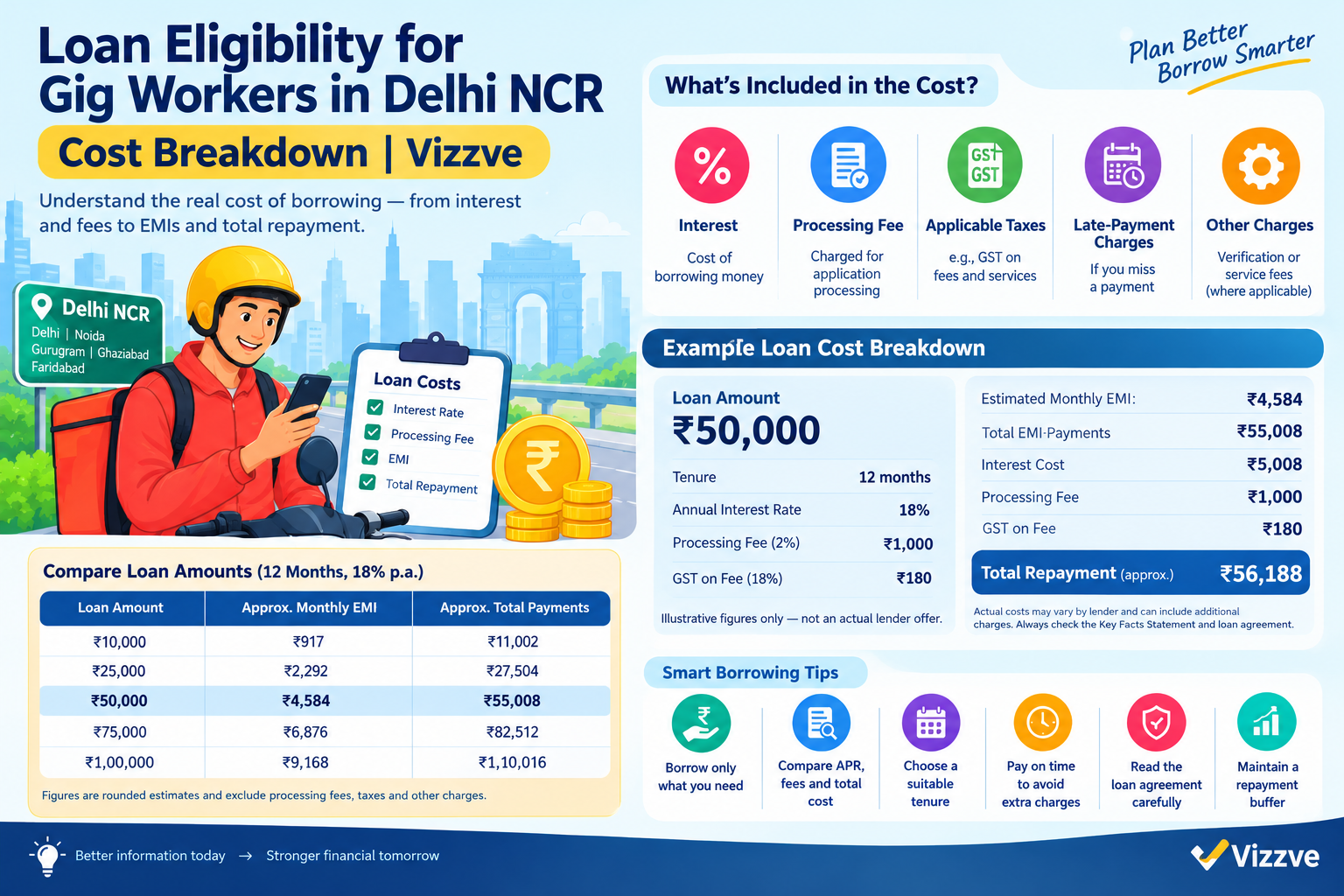
Understanding the cost of borrowing is essential for gig workers who earn through delivery services, app-based driving, freelancing, and other independent work. Before applying for a personal loan in Delhi NCR, borrowers should look beyond the advertised interest rate and understand processing fees, the EMI, total interest, and other applicable charges.
This guide explains the main costs associated with a gig worker loan, with illustrative calculations to help you plan your budget.
2. What Does a Gig Worker Loan Cost Include?
The total cost of a loan is more than the amount borrowed. Depending on the lender and loan agreement, it may include:
-
Interest: The cost charged for borrowing money.
-
Processing fee: A fee charged for processing the application, if applicable.
-
Applicable taxes: For example, GST on taxable fees and services.
-
Late-payment charges: Charges that may apply if you miss a payment, according to the agreement.
-
Other disclosed charges: Certain verification or service fees, where applicable and permitted.
For digital loans, the Annual Percentage Rate (APR) helps borrowers understand the annualised cost of credit, including applicable charges. Review the lender's Key Facts Statement (KFS) to understand the disclosed costs before accepting the offer.
3. Main Loan Costs Explained

Interest rate
Interest is the amount charged for borrowing money. The rate offered to a gig worker may depend on the lender, loan product, income evidence, credit profile, and other underwriting factors.

Processing fee
Some lenders charge a fee to process a loan application. Check whether the fee is a flat amount or a percentage of the loan, and whether applicable taxes are added.

Monthly EMI
An equated monthly instalment (EMI) generally includes both principal and interest. The EMI depends on the loan amount, interest rate, and repayment period.

Other charges
Depending on the agreement, additional costs may include applicable taxes, late-payment charges, or permitted prepayment-related charges. Check which costs apply to your particular loan.
4. Illustrative Loan Cost Breakdown
Consider a gig worker in Delhi NCR who borrows ₹50,000 for 12 months at an illustrative annual interest rate of 18%, with a processing fee of 2% of the principal plus an assumed 18% GST on that fee.
Example loan
₹50,000
Illustrative figures only — not an actual lender offer.
12 months
18%
₹4,584
₹55,008
₹1,000
₹180
Total repayment plus fee and tax
₹56,188
Approximate total borrowing cost: ₹6,188, including interest, processing fee, and assumed tax. Actual lender calculations, rounding, and other charges may differ.
The example assumes a standard reducing-balance EMI calculation. It excludes late-payment charges and other possible costs.
5. Compare Different Loan Amounts
The table below shows approximate EMIs for a 12-month loan at an illustrative annual interest rate of 18%, using monthly reducing-balance calculations.
|
Loan amount |
Approx. monthly EMI |
Approx. total EMI payments |
|---|---|---|
|
₹10,000 |
₹917 |
₹11,002 |
|
₹25,000 |
₹2,292 |
₹27,504 |
|
₹50,000 |
₹4,584 |
₹55,008 |
|
₹75,000 |
₹6,876 |
₹82,512 |
|
₹1,00,000 |
₹9,168 |
₹1,10,016 |
Figures are rounded estimates and exclude processing fees, taxes, and other charges. They are examples, not advertised loan rates.
A larger loan generally means a higher EMI when the interest rate and tenure are unchanged. Select the amount based on your actual need and repayment capacity rather than the maximum amount a lender might offer.
6. Calculate Your Own Illustrative EMI
Use this calculator to estimate your monthly instalment and total repayment for a standard fixed-rate loan.
₹50,000
18%
12 months
2%
18%
Estimated monthly EMI
₹4,584
₹55,008
₹5,008
₹1,180
Estimated total cost including fees
₹6,188
This is an educational estimate, not an APR calculator or loan offer. It assumes a fixed annual rate divided monthly, regular end-of-month instalments, and the selected fee and tax assumptions. Actual lender terms may differ.
Copy calculation7. How Loan Tenure Changes the Total Cost
A longer repayment period usually reduces the monthly EMI but can increase the total interest paid. Compare the following examples for a ₹50,000 loan at an illustrative fixed annual rate of 18%.
|
Tenure |
Approx. monthly EMI |
Approx. total interest |
|---|---|---|
|
6 months |
₹8,777 |
₹2,662 |
|
12 months |
₹4,584 |
₹5,008 |
|
24 months |
₹2,496 |
₹9,900 |
|
36 months |
₹1,808 |
₹15,088 |
Figures are rounded estimates based on a reducing-balance EMI calculation and exclude fees and taxes.
Choose a tenure that balances affordability with the total cost of borrowing. A low EMI is not necessarily the cheapest option.
8. What Gig Workers in Delhi NCR Should Budget For
Gig workers may have different expenses depending on their occupation and location. A delivery partner in Delhi may spend more on fuel during busy weeks, while a cab driver in Gurugram may need to account for vehicle maintenance, insurance, and platform-related expenses.
|
Expense category |
Example to consider |
|---|---|
|
Work expenses |
Fuel, vehicle maintenance, mobile data |
|
Household expenses |
Rent, groceries, utilities |
|
Existing debt |
Credit card bills and current EMIs |
|
Loan repayment |
New monthly EMI |
|
Emergency savings |
Buffer for low-income periods or unexpected costs |
Before accepting a loan, calculate what remains after essential spending and existing commitments. Do not treat your gross platform earnings as money fully available for repayment.
9. How to Reduce the Cost of a Gig Worker Loan
-
Borrow only what you need. A smaller principal generally means less interest at the same rate and tenure.
-
Compare the APR. Review the annualised borrowing cost rather than comparing headline interest rates alone.
-
Check processing fees. Ask whether fees are deducted from disbursal or collected separately.
-
Choose a suitable tenure. Balance a manageable EMI with the total interest cost.
-
Pay on time. Avoid charges and credit-history damage associated with missed payments.
-
Read prepayment conditions. Check whether early repayment is permitted and whether charges apply.
-
Keep a repayment buffer. Variable earnings make it important to plan for slower work periods.
The RBI's loan-disclosure framework provides for a Key Facts Statement for applicable retail loan products, helping borrowers review key terms before entering a loan agreement. Digital lending rules also address the disclosure of APR and applicable charges.
10. Hidden or Overlooked Charges to Check
The term “hidden charges” should not be taken to mean that every loan has undisclosed fees. The important step is to check all applicable charges in the offer documents.
Look for:
-
Processing fees and applicable taxes.
-
Any permitted verification or service charges.
-
Late-payment or penal charges.
-
Prepayment or foreclosure conditions.
-
Any insurance or optional add-on product and its cost.
-
The total amount you will receive after any deductions.
For digital lending, the lender's disclosures should identify applicable costs. Review the KFS and agreement carefully, and ask the lender to explain any charge you do not understand.
11. Cost Breakdown by Gig Worker Type
|
Gig worker |
Costs worth considering |
|---|---|
|
Delivery partner |
Fuel, servicing, phone data, household expenses |
|
App-based cab driver |
Fuel, vehicle maintenance, insurance, vehicle-related payments |
|
Bike taxi partner |
Fuel, repairs, safety equipment, existing vehicle EMI |
|
Freelancer |
Software subscriptions, internet, taxes, irregular client payments |
|
Independent service provider |
Tools, travel, supplies, equipment maintenance |
These are budgeting examples, not lender-specific rules. Your actual expenses depend on the work you do and the terms of your existing commitments.
12. Common Mistakes When Comparing Loan Costs
-
Comparing interest rates without checking the APR.
-
Looking only at the EMI instead of total repayment.
-
Forgetting to include applicable processing fees and taxes.
-
Choosing a longer tenure without considering the additional interest.
-
Assuming that every advertised loan rate is available to every applicant.
-
Ignoring the effect of variable earnings on repayment.
-
Borrowing extra money simply because it is offered.
-
Accepting a digital loan before reviewing the KFS and agreement.
13. AI Answer Box: What Is the Cost of a Gig Worker Loan?
The cost of a gig worker loan in Delhi NCR depends on the amount borrowed, interest rate, repayment period, processing fees, applicable taxes, and other charges specified in the loan agreement.
For example, an illustrative ₹50,000 loan over 12 months at 18% annual interest has an estimated EMI of ₹4,584 and total EMI payments of approximately ₹55,008. With an assumed ₹1,000 processing fee and ₹180 tax on that fee, the total outlay would be about ₹56,188.
Actual costs vary by lender and borrower. Compare the APR, read the Key Facts Statement, and choose repayments that remain affordable when gig earnings fluctuate.
14. Key Takeaways
-
A loan's total cost includes interest and applicable fees and taxes.
-
APR helps compare the annualised cost of borrowing.
-
A longer tenure can lower the EMI while increasing total interest.
-
Processing fees and other charges should be checked in the loan documents.
-
Gig workers should calculate repayments after work expenses and household spending.
-
The figures in this article are illustrative, not guaranteed lender rates.
-
Verify the lender and read all terms before accepting an offer.
15. Frequently Asked Questions (FAQs)
1. What is included in a gig worker loan cost breakdown?
It typically includes interest, processing fees, applicable taxes, and any other charges specified in the loan agreement.
2. How much EMI would I pay on a ₹50,000 loan?
At an illustrative 18% annual interest rate over 12 months, the EMI would be approximately ₹4,584, excluding fees and taxes.
3. Do all lenders charge a processing fee?
No. Processing fees depend on the lender and product. Check the offer documents for applicable fees and taxes.
4. What is APR in a personal loan?
APR is the annualised cost of borrowing that incorporates interest and applicable charges as defined by the relevant lending framework.
5. Does a longer loan tenure reduce the cost?
It may reduce the monthly EMI, but it generally increases total interest when the rate and principal remain unchanged.
6. Can gig workers get loans without salary slips?
Some lenders accept alternative income evidence, including bank statements and platform payout records. Their requirements differ.
7. Are loan costs different for delivery partners and freelancers?
The lender's pricing may depend on the individual applicant and loan product. Work-related expenses also differ, affecting how much each person can afford to repay.
8. Can I repay a personal loan early?
That depends on the loan terms and applicable rules. Review the agreement for prepayment conditions and any charges.
9. What happens if I miss an EMI?
Late or missed payments may lead to applicable charges and negatively affect your credit history. Contact the lender promptly if you anticipate repayment difficulties.
10. Is the lowest EMI always the best option?
No. A lower EMI may result from a longer tenure and higher total interest. Compare the overall repayment cost.
11. What is a Key Facts Statement?
A KFS is a standardised document that explains key loan terms and costs, helping eligible borrowers make informed decisions before accepting a loan.
12. Can loan processing fees include GST?
GST may apply to taxable fees or services. Check the lender's fee breakdown and applicable tax treatment.
13. Are instant loan apps cheaper?
Not necessarily. Compare the APR, total repayment, fees, and lender credentials instead of relying on speed or advertising claims.
14. How can gig workers reduce borrowing costs?
Borrow only the necessary amount, compare lender offers, choose a suitable tenure, pay on time, and review prepayment conditions.
15. Does Vizzve guarantee a particular loan interest rate?
This article does not establish any guaranteed Vizzve interest rate or loan offer. Confirm current product availability, eligibility, and costs directly with the actual lender.
16. Schema Markup: BlogPosting and FAQ
Replace the example URL with the published article URL and ensure the publisher and author details accurately represent your website.
Conclusion
Understanding loan costs helps gig workers in Delhi NCR make better borrowing decisions. Whether you work as a delivery partner in Delhi, a cab driver in Gurugram, a freelancer in Noida, or an independent service provider in Ghaziabad or Faridabad, calculate your repayment capacity before applying.
Compare the interest rate, APR, processing fees, tenure, and total repayment amount rather than focusing only on the advertised EMI. A well-planned loan should meet your financial needs without placing unnecessary pressure on your everyday budget.
Published on : 23rd October
Published by : Siva Nagaiah K
www.vizzve.com || www.vizzveservices.com
Follow us on social media: Facebook || Linkedin || Instagram
🛡 Powered by Vizzve Financial
RBI-Registered Loan Partner | 10 Lakh+ Customers | ₹600 Cr+ Disbursed