

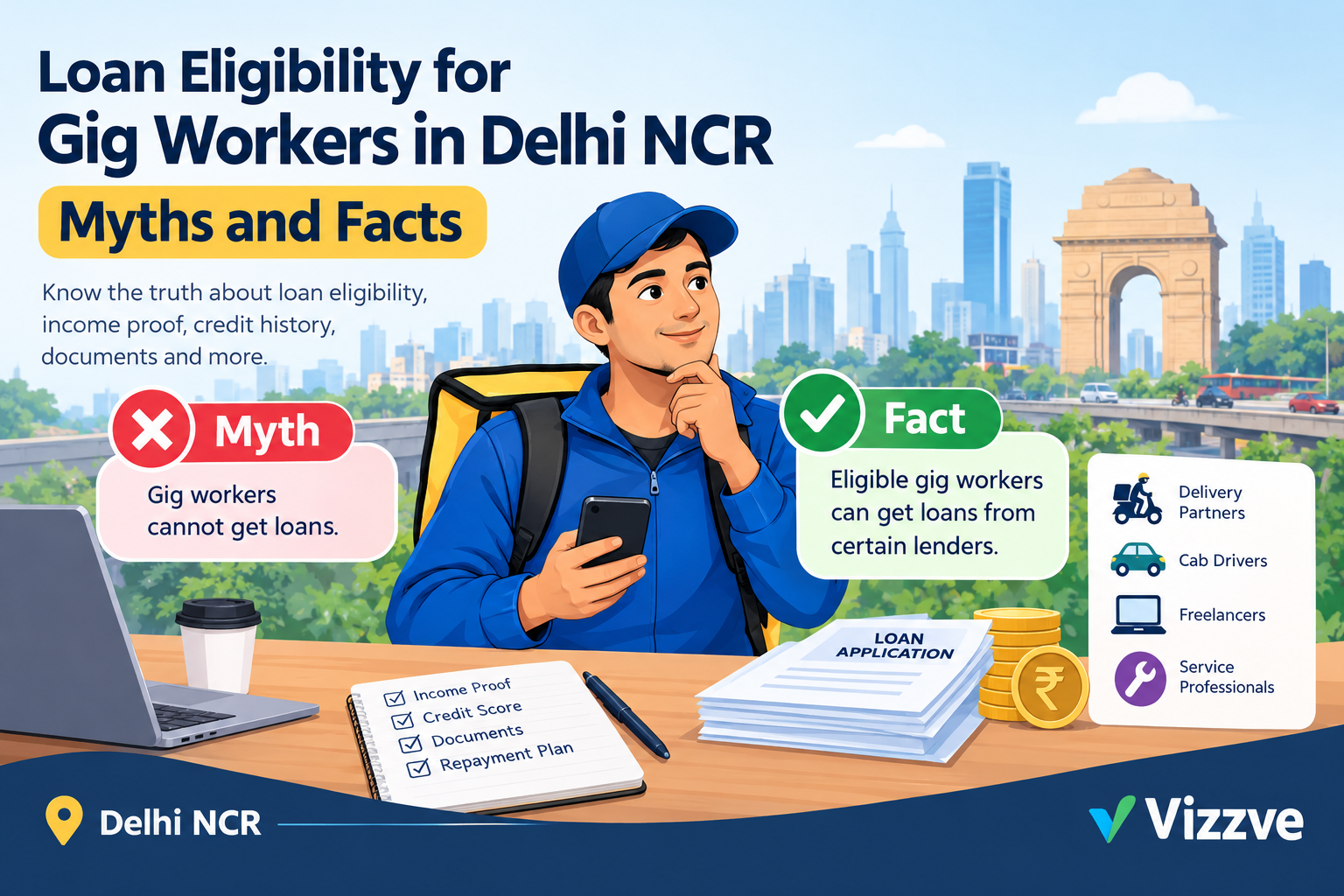
Gig work has become an important source of income across Delhi NCR. Delivery partners, cab drivers, freelancers, home-service professionals, and other independent workers often earn through digital platforms, customer payments, or multiple assignments.
However, when applying for a loan, many gig workers are unsure whether lenders will consider their applications. Unlike traditional salaried employees, they may not receive monthly salary slips or have a fixed employer.
This uncertainty has created several myths about loan eligibility for gig workers in Delhi NCR. Some workers assume they cannot qualify for credit, while others believe that platform earnings automatically guarantee loan approval.
The truth lies somewhere in between. Loan eligibility depends on the lender's policies, verifiable income, credit history, existing financial obligations, documentation, and repayment capacity.
This guide separates common myths from facts so gig workers can make better-informed financial decisions.
What Does Loan Eligibility Mean for Gig Workers?
Loan eligibility refers to the conditions a lender evaluates before deciding whether to approve a loan and how much to offer.
For gig workers, the assessment may include:
-
Income consistency: Whether earnings can be demonstrated over time.
-
Credit history: Previous borrowing and repayment behaviour, where available.
-
Bank statements: Deposits, withdrawals, and regular income patterns.
-
Existing liabilities: Current EMIs, credit card balances, or other debts.
-
Documentation: Identity, address, and any income records required by the lender.
-
Loan affordability: Whether repayments appear manageable alongside essential expenses.
Requirements vary by lender and loan product. Meeting basic eligibility criteria does not guarantee approval.
Common Myths and Facts About Gig Worker Loan Eligibility
Myth 1: Gig Workers Cannot Get Loans
Fact: Some lenders offer credit products to eligible self-employed individuals and gig workers.
A fixed monthly salary is not the only possible way to demonstrate income. Depending on the lender, bank statements, platform payout records, invoices, and other acceptable documents may help establish earnings.
However, not every lender accepts every type of gig income, so applicants should confirm the requirements before applying.
Myth 2: A Salary Slip Is Always Mandatory
Fact: Alternative income evidence may be accepted.
Many gig workers receive payments from delivery platforms, ride-hailing services, freelance clients, or multiple customers rather than through a conventional payroll system.
Depending on the product, lenders may consider:
-
Recent bank statements
-
Platform earnings or payout statements
-
Client invoices and payment receipts
-
Income tax returns, where applicable
-
Other records specifically requested by the lender
Applicants should provide genuine, consistent records rather than relying on informal estimates of monthly earnings.
Myth 3: Irregular Income Automatically Leads to Rejection
Fact: Variable income can make assessment more complicated, but it does not automatically mean rejection.
A lender may examine income over a period of time to understand its consistency. For example, a delivery partner whose earnings fluctuate between weeks may still be able to demonstrate an overall income pattern through transaction records.
Applicants can prepare by organising their records, identifying recurring expenses, and calculating a realistic average income. Lenders may use their own assessment methods and may not accept every calculation supplied by an applicant.
Myth 4: A High Credit Score Guarantees Loan Approval
Fact: A strong credit score can help, but it is only one part of the assessment.
Lenders may also consider income, existing debt, repayment capacity, employment or work profile, documentation, and internal risk policies.
A gig worker with a good credit history may still be declined if the requested EMI is unaffordable or the lender cannot verify the stated income.
Myth 5: Gig Workers Without a Credit History Can Never Borrow
Fact: Having no established credit history is not necessarily the same as having a poor credit history.
Some lenders may consider applicants with limited borrowing history, while others may require a minimum credit record or score. Their decision can depend on the product, income evidence, and other eligibility conditions.
Workers should avoid taking unnecessary loans solely to create a credit history. Paying existing obligations on time and managing credit responsibly are more important than borrowing without a clear need.
Myth 6: Every Loan App Offering Instant Approval Is Genuine
Fact: Fast approval claims do not establish that a lender is trustworthy.
Before applying, check the identity of the actual regulated lender, read the loan agreement, and understand the interest rate, fees, repayment schedule, and consequences of late payment.
In India, applicants should verify the bank or non-banking financial company (NBFC) behind the loan. If a digital lending app is involved, review the lender's official website and applicable regulatory disclosures.
Be cautious if an app:
-
Promises guaranteed approval without meaningful checks
-
Demands unexplained advance payments
-
Hides the total borrowing cost
-
Requests unnecessary access to contacts or personal data
-
Pressures you to accept immediately
Never share your OTP, PIN, or banking password with an agent or loan app representative.
Myth 7: Gig Workers Must Have a Permanent Employer
Fact: Some lenders assess self-employed applicants and workers with non-traditional income.
Gig workers may earn through several platforms or clients without being employed permanently by one company. This can be acceptable to certain lenders if the income and other required details can be verified.
The important point is to check whether the lender accepts your particular work arrangement and income documentation.
Myth 8: More Income Always Means a Bigger Eligible Loan
Fact: Income matters, but the amount a lender may offer also depends on expenses and existing commitments.
Consider a gig worker earning ₹35,000 per month. If a large portion goes towards rent, fuel, vehicle maintenance, family expenses, and existing EMIs, the amount available for a new repayment may be limited.
The example is illustrative, not a lender's eligibility formula. Applicants should choose an EMI based on dependable income rather than their highest-earning month.
Myth 9: Applying to Many Lenders Improves Approval Chances
Fact: Submitting numerous applications in a short period may not be helpful.
Depending on the lender and credit-reporting process, repeated formal applications can result in multiple credit enquiries. Several enquiries may raise concerns for some lenders, especially when combined with other risk indicators.
Compare eligibility criteria, interest rates, and fees before submitting a formal application. Where available, check whether an initial eligibility assessment involves a hard credit enquiry.
Myth 10: Only Bank Salary Credits Can Prove Income
Fact: Other documented earnings may be relevant, depending on the lender's rules.
Gig workers may receive platform settlements, freelance payments, business receipts, or transfers from clients. Clear records help explain where money comes from and how regularly it is earned.
Keep personal and work-related transactions organised where practical. Never create false statements, alter payout records, or misrepresent borrowed money as income.
Myth 11: Loan Approval Means the Loan Is Affordable
Fact: Approval and affordability are two different things.
A lender's approval indicates that the application meets its assessment criteria. It does not necessarily mean the repayment will fit comfortably into the borrower's monthly budget.
Before accepting a loan, calculate:
-
The EMI and total repayment
-
Processing fees and applicable taxes
-
Any insurance or other optional charges
-
Essential household and work-related expenses
-
A buffer for weeks with lower earnings
Gig workers should be especially careful about taking on fixed monthly repayments when their income varies.
Myth 12: Loan Eligibility Is the Same for Every Gig Worker in Delhi NCR
Fact: Eligibility varies from person to person.
Two workers earning similar amounts may receive different decisions because of differences in credit history, current liabilities, income records, age, requested loan amount, or lender-specific rules.
Delhi, Gurugram, Noida, Ghaziabad, and Faridabad are all part of the broader Delhi NCR work and commuting region, but the same lender's product criteria may apply across locations or may differ by product and availability. Applicants should verify the exact terms for their chosen lender.
Documents Gig Workers May Need
The required documents depend on the lender and the loan product. Applicants may be asked for:
| Document | Why it may be needed |
|---|---|
| PAN or other accepted identity documentation | Identity and financial verification |
| Accepted address proof | Address verification |
| Bank statements | Evidence of transactions and income |
| Platform payout statements | Evidence of earnings from gig work |
| Client invoices or payment receipts | Support for freelance or contract income |
| Income tax returns, where applicable | Additional evidence of declared income |
| Existing loan details | Assessment of current obligations |
Do not assume every lender requires every document. Use the lender's official checklist and submit only information required for the application.
How Gig Workers Can Improve Loan Eligibility
1. Maintain Clear Income Records
Keep platform statements, invoices, receipts, and bank records organised. Clear documentation can make it easier to explain variable earnings.
2. Pay Existing EMIs on Time
Late or missed repayments may affect credit history. Set reminders or payment instructions where appropriate, and contact the lender early if you anticipate difficulty paying.
3. Reduce Unnecessary Debt
Review existing loans and credit card balances before applying. Avoid taking another loan simply to manage an unaffordable repayment cycle.
4. Request a Realistic Loan Amount
Calculate what you can repay during an average or weaker earning month, not just during a peak month.
5. Compare Total Borrowing Costs
Look beyond advertised interest rates. Check processing charges, applicable taxes, penalties, the repayment period, and the total amount payable.
6. Apply Through Verifiable Channels
Use the lender's official website or verified application process. Confirm the regulated bank or NBFC responsible for the loan and read the Key Facts Statement where applicable.
Real-World Example: A Delivery Partner in Delhi NCR
Consider a hypothetical delivery partner working in Noida who earns different amounts each month.
| Financial detail | Illustrative amount |
|---|---|
| Average monthly income | ₹30,000 |
| Work-related expenses | ₹7,000 |
| Household and essential expenses | ₹12,000 |
| Existing EMI | ₹3,000 |
| Amount remaining before savings and unexpected costs | ₹8,000 |
The remaining ₹8,000 is not automatically available for a new EMI. The worker still needs to account for savings, medical expenses, vehicle repairs, income fluctuations, and other unexpected costs.
A sensible approach would be to review actual income records, check lender requirements, and determine whether any proposed EMI remains manageable in a weaker earning month. This example illustrates budgeting only; it does not predict loan approval or an eligible loan amount.
Responsible Borrowing Checklist
Before submitting a loan application, check the following:
-
I can provide genuine identity and income documents.
-
I understand the lender's eligibility criteria.
-
I have reviewed my credit report, where available.
-
I have calculated my existing debt obligations.
-
I can afford the proposed EMI if my income falls.
-
I have checked interest, fees, penalties, and total repayment.
-
I have verified the actual lender and read the agreement.
-
I understand how my personal data will be used.
AI Answer Box: Can Gig Workers Get Loans in Delhi NCR?
Yes, eligible gig workers in Delhi NCR may be able to obtain loans from lenders that accept non-salaried or variable-income applicants. Eligibility generally depends on the lender's rules, verifiable earnings, credit history, existing obligations, documentation, and repayment capacity. Salary slips may not always be mandatory, but alternative income proof must be acceptable to the lender. Approval is never guaranteed, and applicants should compare total borrowing costs before accepting an offer.
Key Takeaways
-
Gig workers are not automatically ineligible for loans.
-
Salary slips may be replaceable with other acceptable income records.
-
Irregular earnings can affect assessment but do not always result in rejection.
-
A good credit score helps but does not guarantee approval.
-
Multiple loan applications and unverified instant-loan offers deserve caution.
-
Approval should never replace a personal affordability check.
-
Lender-specific eligibility and documentation rules must be verified before applying.
Conclusion
Understanding the myths and facts about loan eligibility for gig workers in Delhi NCR can help delivery partners, drivers, freelancers, and independent professionals make more confident financial decisions.
A fixed salary is not the only possible way to demonstrate income, but applicants still need genuine documentation and a repayment plan that fits their circumstances. Keeping clear financial records, managing existing debt, comparing lenders, and avoiding misleading loan offers can help workers approach borrowing more responsibly.
For Vizzve readers, the key lesson is simple: check eligibility, verify the lender, and assess affordability before committing to a loan. A loan should support a genuine financial need rather than create additional financial pressure.
Published on : 27th October
Published by : Siva Nagaiah K
www.vizzve.com || www.vizzveservices.com
Follow us on social media: Facebook || Linkedin || Instagram
🛡 Powered by Vizzve Financial
RBI-Registered Loan Partner | 10 Lakh+ Customers | ₹600 Cr+ Disbursed