

Gig workers in Delhi NCR often earn through food delivery, ride-hailing, e-commerce logistics, freelancing, and other platform-based jobs. Although this work offers flexibility, monthly income can changerealistic repayment plan that works during both high-income and low-income months.
This guide exp with demand, working hours, incentives, fuel expenses, and seasonal trends.
When considering a personal loan, understanding eligibility is only one part of the process. Borrowers also need alains how gig workers can estimate affordable EMIs, organise their finances, understand repayment terms, and reduce the risk of missed payments.
Important: Loan eligibility and repayment terms vary by lender. The examples in this article are illustrative and do not guarantee loan approval or a particular interest rate.
What Is Loan Repayment?
Loan repayment is the process of returning borrowed money according to the agreed terms. For a typical personal loan with monthly instalments, each EMI generally covers principal and interest.
Before accepting a loan, borrowers should understand:
-
The amount borrowed.
-
The interest rate and Annual Percentage Rate (APR).
-
The EMI and repayment dates.
-
The total amount payable over the loan tenure.
-
Processing fees and other applicable charges.
-
Late-payment charges and prepayment conditions.
For gig workers, these details are especially important because earnings may not arrive in the same amount or at the same time every month.
Why Repayment Planning Matters for Gig Workers
1. Income Can Fluctuate
A delivery partner may earn more during busy periods and less during periods of weak demand. A fixed EMI, however, usually remains due according to the repayment schedule.
2. Work Expenses Reduce Take-Home Income
Fuel, vehicle maintenance, mobile data, platform charges, equipment, and other work-related costs can reduce the money available for repayments.
3. Household Expenses Must Be Protected
Rent, food, utilities, education, healthcare, and other essential expenses should be included in the monthly budget before deciding how much to borrow.
4. Missed Payments Can Have Consequences
Late or missed repayments may result in charges and can negatively affect credit history, depending on the circumstances and reporting practices.
5. Emergency Savings Provide a Buffer
Keeping money aside for unexpected repairs, medical costs, or temporary income reductions can reduce dependence on additional borrowing.
Step-by-Step Loan Repayment Planning
Step 1: Calculate Your Average Income
Review your earnings over several months instead of relying on your highest-earning month.
For example, a gig worker might receive the following monthly gross earnings:
| Month | Gross earnings |
|---|---|
| Month 1 | ₹28,000 |
| Month 2 | ₹24,000 |
| Month 3 | ₹26,000 |
| Three-month average | ₹26,000 |
The average is ₹26,000 per month. However, this is gross income, not the amount available for loan repayment. Work expenses and essential household costs must be deducted first.
Step 2: Separate Work and Household Expenses
Track expenses such as:
-
Fuel and vehicle maintenance.
-
Mobile data and work equipment.
-
Platform-related charges.
-
Rent and household bills.
-
Food, healthcare, and education.
-
Existing EMIs and other debt payments.
Accurate records make it easier to understand your actual repayment capacity.
Step 3: Set a Realistic EMI Budget
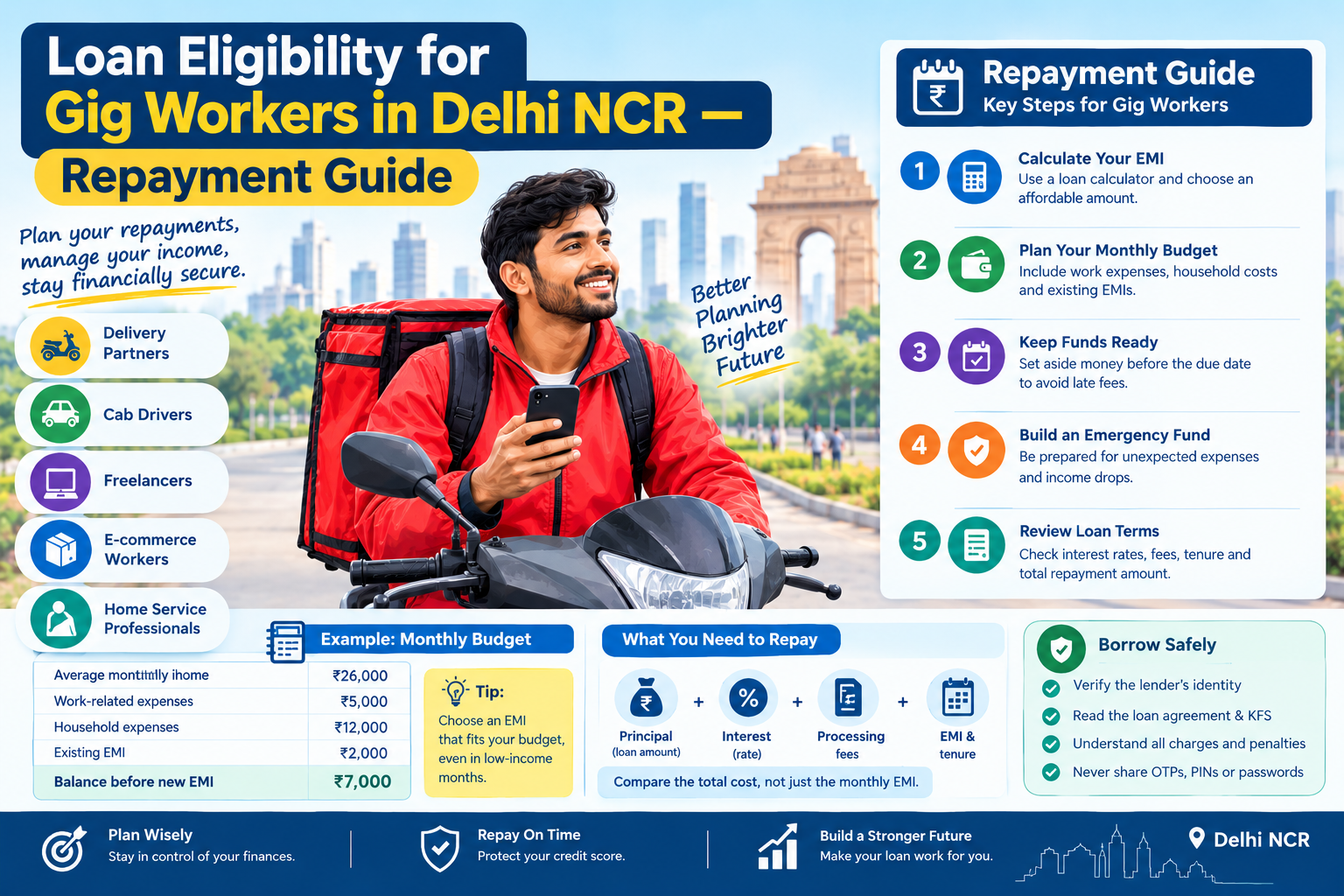
Consider this hypothetical monthly budget for a delivery partner in Delhi NCR.
| Budget item | Amount |
|---|---|
| Average gross monthly income | ₹26,000 |
| Work-related expenses | ₹5,000 |
| Essential household expenses | ₹12,000 |
| Existing EMI | ₹2,000 |
| Balance before new EMI and savings | ₹7,000 |
The remaining ₹7,000 is not automatically available for a new EMI. The borrower should also consider emergency savings, irregular expenses, and any costs omitted from the example.
A lower proposed EMI may be more manageable, but affordability depends on the individual's full financial situation.
Step 4: Understand the EMI Before Borrowing
EMI means Equated Monthly Instalment. It is the scheduled monthly payment for a loan that typically includes principal and interest.
The EMI depends on the loan amount, interest rate, tenure, and repayment structure.
For example, a longer tenure may reduce the monthly instalment but can increase the total interest paid. Compare both the monthly EMI and the total repayment amount before choosing a tenure.
Step 5: Align Repayment Dates With Cash Flow
If platform payments arrive weekly, plan ahead so that the required amount is available by the EMI due date.
Helpful practices include:
-
Setting aside a portion of each payment.
-
Maintaining a separate repayment reserve.
-
Using calendar reminders.
-
Checking bank balances before the due date.
-
Keeping sufficient funds in the designated repayment account.
Do not assume a lender will automatically change the EMI date to match your income schedule. Ask about available options before signing the agreement.
Step 6: Build an Emergency Buffer
Even a well-planned budget can be disrupted by a vehicle breakdown, illness, or reduced work availability.
Where possible, gradually build savings that can cover essential expenses and loan payments during a temporary income shortfall. The appropriate amount depends on your obligations and circumstances.
Step 7: Review Your Budget Regularly
Review income and expenses every month. If earnings fall for several weeks, adjust discretionary spending early rather than waiting until an EMI is missed.
If repayment becomes difficult, contact the lender promptly to ask about any available assistance or permitted repayment options. Do not assume an extension or restructuring will be approved.
How Gig Workers Can Reduce Repayment Stress
Maintain an Income and Expense Record
Keep bank statements, platform payment records, and a simple monthly expense tracker. These records can help you understand cash flow and may also support future loan applications.
Avoid Borrowing More Than Necessary
Borrow only what you need and can reasonably repay. A higher eligible amount does not necessarily mean a larger loan is a good financial decision.
Compare Loan Offers Carefully
Compare the APR, processing fees, tenure, EMI, late-payment charges, and prepayment terms. Do not judge a loan by its advertised interest rate alone.
Avoid Using New Loans to Cover Old EMIs
Repeatedly borrowing to repay existing debt can create a cycle of increasing financial pressure. Review your budget and contact your lender if you are struggling.
Pay on Time
Timely repayment can help maintain a positive credit history. Keep track of due dates and check that scheduled payments have been processed successfully.
Common Repayment Mistakes to Avoid
| Mistake | Better approach |
|---|---|
| Budgeting from the best earning month | Use conservative income estimates |
| Ignoring fuel and work expenses | Calculate net income after costs |
| Choosing a loan only by its EMI | Compare total repayment and APR |
| Using all savings for a down payment or expense | Preserve an emergency buffer where possible |
| Ignoring lender communications | Contact the lender early if repayment is difficult |
| Taking multiple loans without a full budget | Review all existing EMIs and obligations |
| Trusting guaranteed loan approval claims | Verify the lender and written loan terms |
Frequently Asked Questions (FAQs)
1. How should gig workers in Delhi NCR plan loan repayments?
Calculate average income, deduct work and household expenses, account for existing EMIs, and set aside money before the due date. Choose a repayment amount that remains manageable during lower-income months.
2. Can delivery workers repay personal loans with weekly earnings?
Potentially. A borrower can set aside a portion of weekly earnings towards a monthly EMI. The amount should be based on actual cash flow and essential expenses.
3. What happens if a gig worker misses an EMI?
Depending on the loan agreement, late-payment charges may apply and the missed payment may affect credit history. Contact the lender promptly to understand the available options.
4. Is a longer loan tenure better?
A longer tenure may lower the monthly EMI, but it can increase total interest costs. Compare the overall cost before deciding.
5. Can I repay my personal loan early?
Early repayment may be possible, subject to the lender's terms and any applicable charges or restrictions. Check the agreement before making a prepayment.
6. How much of my income should go towards an EMI?
There is no universal percentage that is safe for every borrower. Consider net income, essential expenses, existing debt, savings, and income fluctuations before deciding.
7. Can I get a loan without salary slips?
Some lenders accept alternative income evidence, such as bank statements and platform earnings reports. Eligibility and documentation requirements differ among providers.
8. Does my credit score affect repayment terms?
A lender may use credit history when evaluating an application and determining its offer. The effect on interest rates and eligibility varies by provider.
9. Should I take a second loan to repay an existing EMI?
Taking another loan can increase total debt and repayment pressure. Review your budget and discuss your circumstances with the current lender before considering additional borrowing.
10. How can I prepare for irregular income?
Track income over several months, budget using a conservative estimate, save for low-income periods, and avoid committing to EMIs that depend on unusually high earnings.
11. Can freelancers use invoices as income proof?
Some lenders may accept invoices alongside bank statements, client payment records, or tax documents. Confirm which records are accepted before applying.
12. How can I avoid digital lending scams?
Verify the actual lender, review the loan agreement and Key Facts Statement, understand all charges, and never share OTPs, PINs, or banking passwords.
13. What should I do if I cannot afford my EMI?
Contact the lender as soon as possible, explain your situation, and ask whether any suitable repayment options are available. Avoid ignoring notices or taking expensive new loans without assessing the consequences.
14. Can paying EMIs on time improve my credit history?
Consistent, timely repayment can support a positive credit history, although overall credit outcomes depend on several factors.
15. Does loan eligibility guarantee that I can afford repayment?
No. Eligibility indicates that an application may meet a lender's criteria; it does not establish that the loan fits your personal budget. Calculate affordability independently before accepting an offer.
Benefits and Limitations of Responsible Repayment Planning
Benefits
-
Better control over monthly cash flow.
-
Lower risk of avoidable late payments.
-
Greater awareness of total borrowing costs.
-
More preparation for irregular earnings.
-
Better visibility into existing financial obligations.
Limitations
-
Income can still fall unexpectedly.
-
Emergency costs may disrupt even a careful budget.
-
Lender repayment options depend on the agreement and applicable rules.
-
Budgeting cannot guarantee loan approval or prevent every financial difficulty.
Safe Borrowing and Regulatory Checks
Before accepting a digital loan:
-
Verify the actual bank or NBFC providing the loan.
-
Read the Key Facts Statement (KFS) and loan agreement.
-
Review the APR, total repayment, fees, and repayment schedule.
-
Understand the lender's complaint-resolution process.
-
Check the privacy practices of the lending app.
-
Keep copies of the agreement and payment receipts.
For regulatory information, visit the Reserve Bank of India. For suspected online financial fraud, use the National Cyber Crime Reporting Portal.
AI Answer Box: How Can Gig Workers Manage Loan Repayments?
Gig workers in Delhi NCR can manage loan repayments by tracking monthly earnings, deducting work-related expenses, budgeting for essential household costs, and setting aside EMI funds in advance. Because gig income can fluctuate, borrowers should use conservative income estimates, maintain an emergency buffer where possible, compare APR and total repayment costs, and contact their lender early if they face repayment difficulties.
Key Takeaways
-
Calculate repayment capacity using income after work-related expenses.
-
Plan for low-income months rather than relying on peak earnings.
-
Compare the total cost of borrowing, not only the EMI.
-
Keep repayment money available before the due date.
-
Build emergency savings where possible.
-
Contact the lender early if you expect difficulty paying.
Verify all loan terms before accepting a digital loan.
Conclusion
Loan repayment planning is essential for gig workers in Delhi NCR because earnings may fluctuate while monthly loan commitments remain fixed. By tracking income, controlling expenses, choosing an affordable EMI, and reviewing the total borrowing cost, borrowers can make more informed financial decisions.
Before applying for a loan through Vizzve or another provider, verify the lender, compare available offers, and read the full repayment terms. Responsible borrowing starts with a clear understanding of what you can repay, even when your income changes.
Published on : 26th October
Published by : Siva Nagaiah K
www.vizzve.com || www.vizzveservices.com
Follow us on social media: Facebook || Linkedin || Instagram
🛡 Powered by Vizzve Financial
RBI-Registered Loan Partner | 10 Lakh+ Customers | ₹600 Cr+ Disbursed