

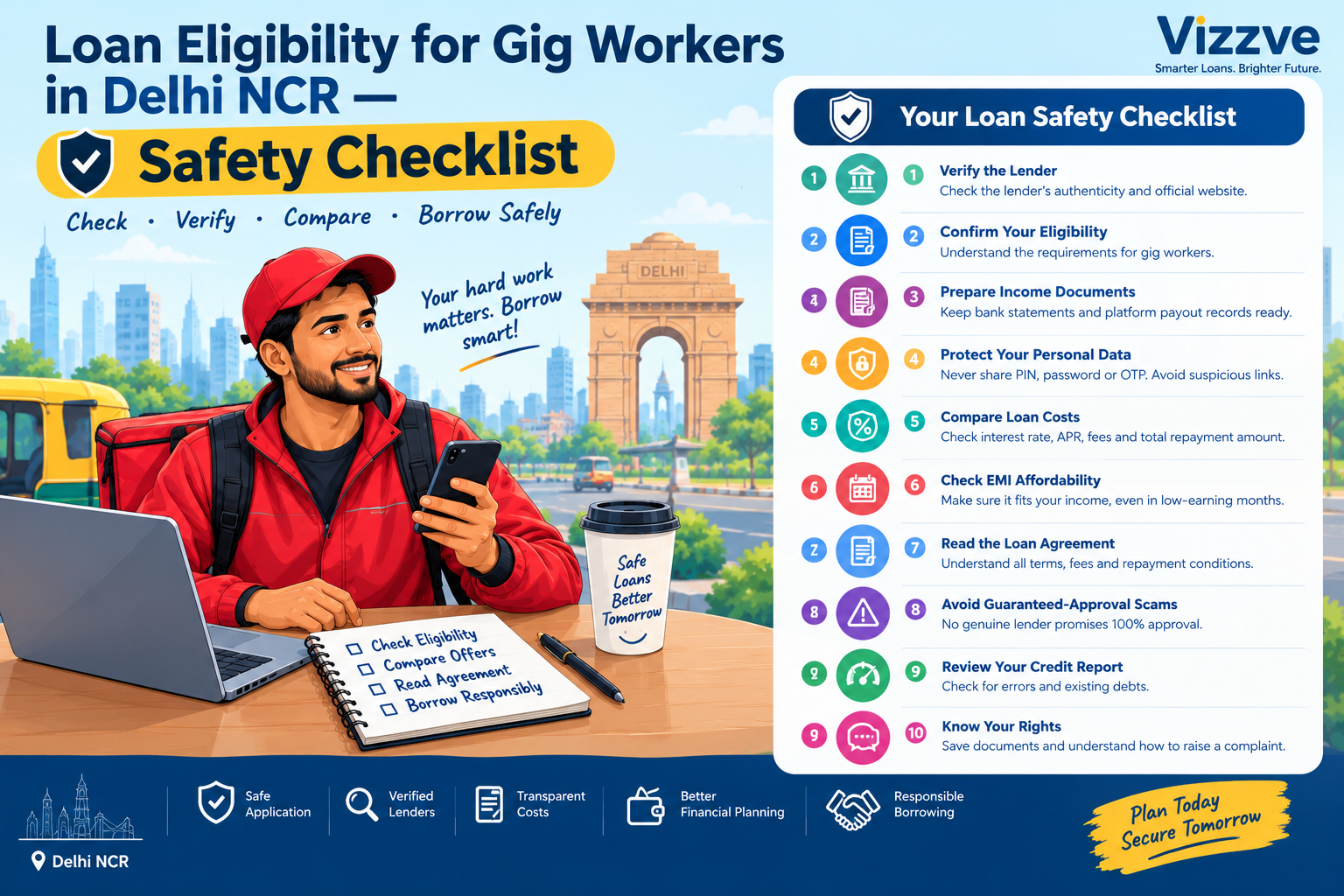
Gig workers in Delhi NCR often depend on flexible earnings from food delivery, ride-hailing, e-commerce deliveries, freelancing, and other platform-based work. When they need money for vehicle repairs, medical expenses, household needs, or emergencies, a personal loan may be one option to consider.
However, applying for a loan without checking the lender, documentation requirements, interest rate, and repayment conditions can expose borrowers to financial risks. Gig workers may also face additional challenges because their earnings can fluctuate and they may not have traditional salary slips.
A loan safety checklist helps gig workers in Delhi NCR review eligibility, verify lenders, protect personal information, and assess repayment affordability before applying.
This Vizzve guide explains the essential checks to complete before submitting a loan application or accepting a loan offer.
Quick Answer: Loan Safety Checklist for Gig Workers
Before applying for a loan, make sure you:
-
Check your credit report and existing financial obligations.
-
Organize bank statements and gig-platform income records.
-
Confirm that the lender accepts gig workers.
-
Verify the bank or NBFC providing the loan.
-
Compare the interest rate, APR, fees, and total repayment amount.
-
Review the Key Facts Statement (KFS), where applicable.
-
Calculate whether the EMI is affordable during low-income months.
-
Never share your banking PIN, password, or OTP.
-
Avoid suspicious apps and guaranteed-approval promises.
-
Read and save the loan agreement before accepting the offer.
These checks can help reduce avoidable risks, but they cannot guarantee loan approval or eliminate every financial risk.
1. Verify the Lender Before Applying
The first safety check is confirming who is actually offering the loan. Online advertisements, messaging apps, and social media can sometimes be used by fraudulent agents or impersonators.
Before applying:
-
Visit the lender's official website independently.
-
Verify the lender's name, contact information, and registered details.
-
If the lender is a bank or non-banking financial company (NBFC), check relevant information through official regulatory sources.
-
For a digital loan app, identify the actual regulated lender behind the offer.
-
Confirm that the loan product and contact details are genuine.
-
Avoid sending money to personal accounts for unexplained processing or approval fees.
The Reserve Bank of India (RBI) provides official information about regulated entities and digital lending. Do not rely only on an app's branding or an agent's claims.
2. Check Your Loan Eligibility Honestly
Gig workers may have different eligibility requirements depending on the lender and loan product. Some lenders accept self-employed applicants and platform workers, while others may require conventional employment documents.
Check the following before applying:
-
Minimum and maximum age requirements.
-
Minimum income or earnings history.
-
Accepted types of employment.
-
Required credit history or credit score.
-
Existing loan and EMI obligations.
-
Identity and address verification requirements.
-
Service availability in your part of Delhi NCR.
Never change income figures or provide false employment details to meet a lender's criteria. Inaccurate information may lead to rejection and other consequences.
3. Prepare Genuine Income Documents
Many gig workers do not receive a traditional salary slip. Some lenders may accept alternative evidence to verify income.
Depending on the lender's rules, this may include:
-
Recent bank statements.
-
Delivery or ride-hailing platform payout statements.
-
Freelance invoices and client payment records.
-
Earnings summaries from digital platforms.
-
Income tax returns, where applicable.
-
Other documents requested by the lender.
Ensure that documents are accurate, current, and consistent with the information in your application.
Safety tip: Submit documents only through verified lender channels. Avoid sending identity documents or bank statements to unknown agents through personal messaging accounts.
4. Protect Your Personal and Financial Information
Loan applications may require sensitive information, including identity details, contact information, income documents, and bank account details. Sharing these with an unverified service can expose you to fraud or privacy risks.
Follow these precautions:
-
Never share your banking PIN, password, or OTP with an agent.
-
Do not disclose card security codes or internet banking credentials.
-
Use official websites or verified application channels.
-
Check the app publisher and privacy policy before installation.
-
Review permissions and question requests that appear unrelated to the loan.
-
Avoid clicking suspicious loan links sent by unknown numbers.
-
Use strong passwords and secure your phone with a screen lock.
-
Report suspicious activity to your bank promptly.
A legitimate loan process should not require you to reveal your secret banking credentials to an agent.
5. Compare Interest Rates and All Loan Charges
A loan with an attractive advertised interest rate may still have other costs. Before choosing an offer, compare the complete cost of borrowing.
Check:
-
Interest rate and whether it is fixed or variable.
-
Annual Percentage Rate (APR), where disclosed.
-
Processing fees and applicable taxes.
-
Total repayment amount.
-
EMI and loan tenure.
-
Late-payment and default charges.
-
Prepayment or foreclosure conditions.
-
Optional insurance or add-on costs, if offered.
Request and review the Key Facts Statement (KFS) where applicable under the relevant lending rules. Make sure the costs and repayment schedule are clear before accepting the offer.
Do not choose a loan based only on a low EMI. A longer tenure can reduce monthly payments while increasing the total interest paid.
6. Check Whether the EMI Fits Your Income
Gig earnings may change due to platform demand, incentives, fuel expenses, vehicle maintenance, weather, and the number of hours worked.
Before accepting a loan, calculate your average take-home income after work-related expenses. Then subtract essential household spending and existing debt payments.
For example, consider this illustrative monthly budget:
| Budget item | Example amount |
|---|---|
| Average gig earnings | ₹30,000 |
| Fuel and work-related expenses | ₹5,000 |
| Household essentials | ₹14,000 |
| Existing EMIs | ₹2,000 |
| Remaining before new savings and unexpected expenses | ₹9,000 |
The remaining ₹9,000 should not automatically be treated as an affordable EMI. You still need to account for emergencies, savings, and possible drops in income.
Choose a repayment amount that remains manageable during a slower earning month. If the loan leaves too little money for essential expenses, consider borrowing less or postponing the application.
7. Read the Loan Agreement Before Signing
Never accept a loan without understanding the terms. Read the agreement and required disclosures carefully.
Confirm:
-
The approved loan amount.
-
The amount that will actually be disbursed.
-
The interest rate and applicable APR.
-
The EMI amount and payment dates.
-
The total repayment amount.
-
All disclosed fees and charges.
-
Late-payment consequences.
-
Prepayment and foreclosure terms.
-
The lender's grievance-redressal process.
Keep a copy of the agreement, KFS where applicable, repayment schedule, and important communications.
If a term is unclear, ask the lender for an explanation in writing before proceeding.
8. Avoid Guaranteed-Approval Scams
Be cautious if someone promises a loan regardless of your income, credit history, or eligibility.
Warning signs include:
-
Guaranteed approval without any verification.
-
Pressure to pay an advance fee to a personal account.
-
Requests for OTPs, PINs, or passwords.
-
Fake websites that imitate established lenders.
-
Threats or pressure to accept an offer immediately.
-
No clear lender name or loan agreement.
-
Unexplained charges before disbursement.
Do not make a payment merely because an agent claims it will unlock a loan. Verify every charge and instruction through the lender's official contact channels.
9. Review Your Credit Report and Existing Debts
Your credit history may influence the lender's decision and the terms offered. Check your credit report before applying to identify incorrect information, unfamiliar accounts, or overdue payments.
Also list all current EMIs, credit-card balances, and other recurring debt obligations.
Applying for a new loan when existing repayments are already difficult can increase financial pressure. A loan should not be treated as a simple solution to an ongoing inability to meet essential expenses.
10. Understand Your Rights and Complaint Options
Before borrowing, understand how to contact the lender if you have a billing dispute, unauthorized transaction, suspected fraud, or concern about loan terms.
Keep records of:
-
The lender's official customer-support details.
-
The signed loan agreement.
-
KFS and other disclosures, where applicable.
-
Payment receipts and account statements.
-
Emails and complaint reference numbers.
First contact the lender through its official grievance-redressal process. If the matter remains unresolved, check the appropriate complaint route through official regulatory resources, including the RBI's Complaint Management System where applicable.
For suspected cybercrime or financial fraud in India, contact your bank immediately and report the incident through official cybercrime reporting channels. Prompt reporting may help limit further losses.
Loan Safety Checklist: Before You Apply
Use this checklist to review your readiness before proceeding.
-
I have checked the lender's authenticity.
-
I have confirmed that the lender accepts gig workers.
-
My identity, address, and income documents are accurate.
-
I have reviewed my credit report and existing debt.
-
I have compared interest rates, APR, fees, and total repayment.
-
I understand the EMI and loan tenure.
-
I can afford repayments during lower-income months.
-
I have reviewed the KFS and loan agreement, where applicable.
-
I have not shared my PIN, password, or OTP.
-
I know how to contact the lender and raise a complaint.
-
I have saved copies of the loan documents.
If several checks remain incomplete, pause and resolve them before submitting the application or accepting the loan.
Common Loan Safety Mistakes to Avoid
| Mistake | Safer approach |
|---|---|
| Trusting an unknown loan agent | Verify the lender through official channels |
| Sharing OTPs or banking credentials | Keep PINs, passwords, and OTPs private |
| Ignoring fees | Review the full cost and applicable disclosures |
| Borrowing more than necessary | Calculate the amount actually needed |
| Assuming approval is guaranteed | Confirm eligibility and understand underwriting |
| Submitting inconsistent income details | Provide accurate, verifiable records |
| Skipping the loan agreement | Read and save the final documents |
| Ignoring repayment affordability | Budget for low-income months and emergencies |
Frequently Asked Questions (FAQs)
1. Can gig workers in Delhi NCR apply for personal loans?
Some lenders accept eligible gig workers and self-employed applicants. Approval depends on the lender's eligibility rules, income evidence, credit history, repayment capacity, and other factors.
2. What is the first safety check before applying?
Verify the lender's identity and confirm that the loan offer is genuine. Do not share documents or pay fees through unverified channels.
3. Can I apply without a salary slip?
Possibly. Some lenders may accept bank statements, platform payout reports, invoices, or other income records. Requirements differ by lender.
4. How can I check whether a lender is genuine?
Use official lender websites and relevant regulatory resources. Confirm the identity of the bank or NBFC providing the loan and verify contact information independently.
5. Is it safe to share my OTP with a loan agent?
No. Never disclose your banking PIN, password, or OTP to an agent. If you suspect your information has been compromised, contact your bank immediately.
6. What documents should gig workers prepare?
Depending on the lender, these may include identity and address proof, bank statements, platform payout records, invoices, and other accepted income documents.
7. What is a Key Facts Statement?
A KFS is a standardized loan disclosure that presents important information about a loan, including key costs and repayment details, where required under applicable rules. Review it before accepting an eligible offer.
8. How can I identify a fake loan app?
Be cautious of unclear lender details, suspicious links, unexplained advance fees, excessive permissions, and guaranteed-approval claims. Verify the actual lender before sharing information.
9. Should I pay an advance fee to guarantee loan approval?
Do not trust a fee request simply because an agent promises approval. Verify whether any charge is legitimate, disclosed, and payable through official lender channels.
10. Can a good credit score guarantee loan approval?
No. Lenders may also consider income stability, existing obligations, documentation, and internal risk policies.
11. How much EMI can a gig worker afford?
There is no universal safe EMI. Calculate take-home income after work expenses, essential household costs, existing debts, and savings needs. Account for lower-income months before deciding.
12. What should I do if I suspect loan fraud?
Contact your bank immediately if financial information or funds are at risk. Preserve messages and transaction records, report the incident through official channels, and avoid further payments to the suspected fraudster.
13. Can I apply through a digital lending app?
You may apply through a legitimate digital lending service, but verify the actual lender, review disclosures and permissions, and understand the loan agreement before proceeding.
14. Why should I read the loan agreement?
It explains your repayment obligations, fees, due dates, default consequences, and other contractual terms. Reading it helps you understand what you are accepting.
15. Where can I find official loan safety information?
Start with the Reserve Bank of India website at https://www.rbi.org.in/ and your lender's official website. Use official government cybercrime reporting channels if you suspect fraud.
Key Takeaways
-
Verify the lender before sharing information or accepting an offer.
-
Prepare accurate income documents and confirm eligibility requirements.
-
Compare APR, interest, fees, EMI, and total repayment cost.
-
Protect banking credentials and avoid suspicious loan apps.
-
Review the KFS and agreement before signing.
-
Choose a repayment amount that fits fluctuating gig income.
-
Keep all loan documents and know how to raise a complaint.
Conclusion
For gig workers in Delhi NCR, loan safety starts with careful preparation and verification. Checking eligibility, organizing income records, protecting personal information, and comparing loan costs can help reduce avoidable problems.
Never rush into a loan because of a guaranteed-approval promise or pressure from an agent. Confirm who is lending the money, understand every disclosed charge, and make sure the repayment schedule fits your budget—even when earnings are lower than usual.
A safe borrowing decision means understanding both the loan offer and your ability to repay it. Vizzve encourages gig workers to verify lenders, read loan terms carefully, and borrow responsibly.
Published on : 24th October
Published by : Siva Nagaiah K
www.vizzve.com || www.vizzveservices.com
Follow us on social media: Facebook || Linkedin || Instagram
🛡 Powered by Vizzve Financial
RBI-Registered Loan Partner | 10 Lakh+ Customers | ₹600 Cr+ Disbursed