

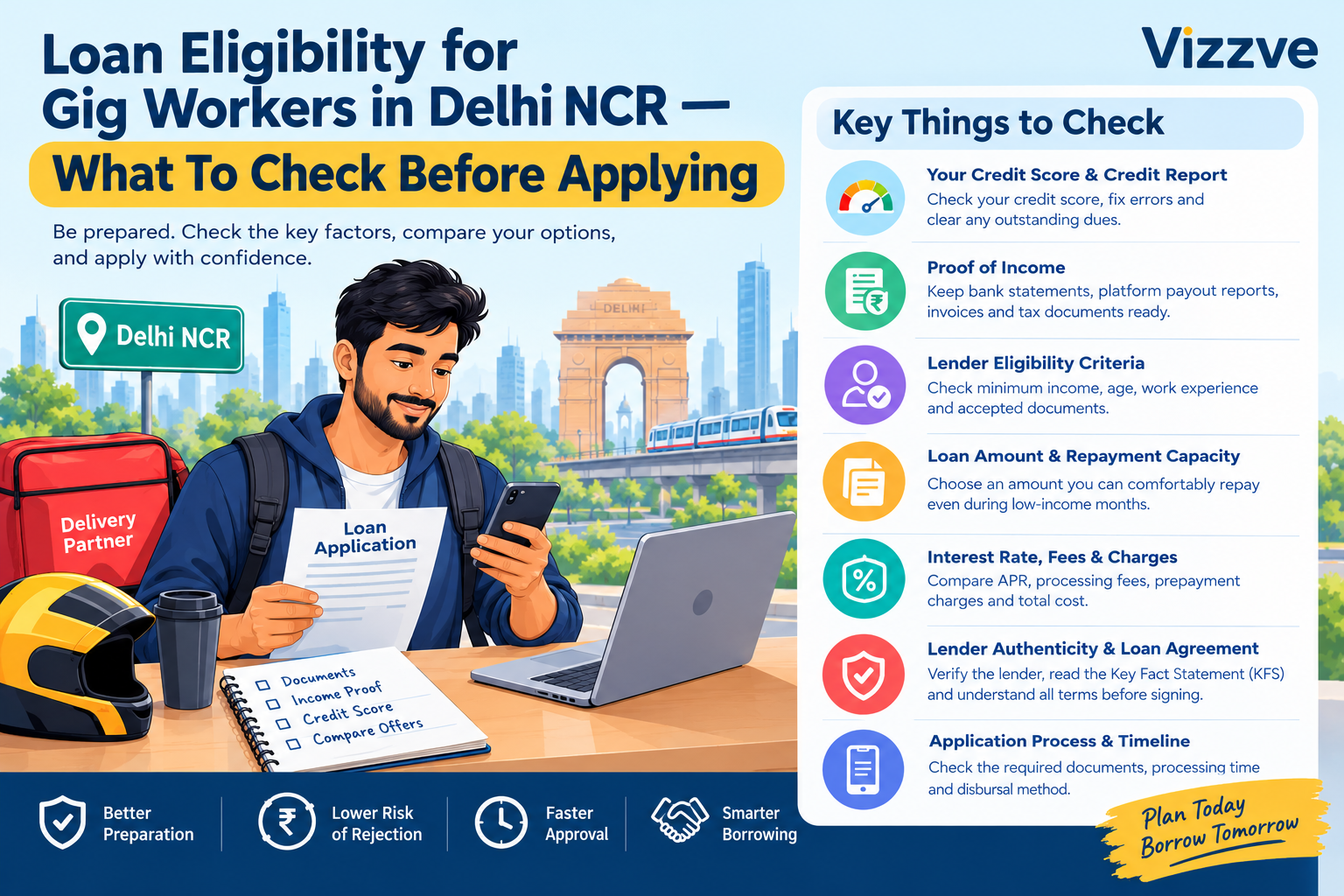
Gig workers in Delhi NCR often depend on flexible income from food delivery, ride-hailing, e-commerce deliveries, freelancing, and other platform-based jobs. When they need money for emergencies, vehicle repairs, medical expenses, or personal needs, a loan may be one option to consider.
However, gig workers may not have a traditional salary slip or permanent employment letter. Lenders may instead evaluate bank transactions, platform payout statements, credit history, work consistency, and repayment capacity.
Before applying for a loan, gig workers in Delhi NCR should check their credit report, income documents, lender eligibility criteria, repayment capacity, interest rate, additional charges, and the lender’s authenticity. Preparing these details can help applicants make informed decisions and avoid preventable application problems.
Quick Answer: What Should Gig Workers Check Before Applying?
Before submitting a loan application, review these key factors:
-
Credit score and credit report: Check your credit history and correct any errors.
-
Income proof: Keep bank statements, platform payout records, invoices, or other accepted income documents ready.
-
Eligibility requirements: Confirm the lender accepts gig workers and understand its minimum income and age requirements.
-
Repayment capacity: Choose an EMI that remains manageable when earnings fluctuate.
-
Interest rate and fees: Compare the total borrowing cost, not just the advertised interest rate.
-
Lender verification: Confirm that the lender is legitimate and understand who is actually providing the loan.
-
Loan terms: Read the Key Facts Statement (KFS), repayment schedule, penalties, and other contractual terms.
1. Check Your Credit Score and Credit Report
Your credit history can influence a lender’s decision. A credit report may contain information about previous loans, credit cards, repayment patterns, outstanding balances, and missed payments.
Before applying:
-
Review your credit report from a credit bureau.
-
Check for incorrect personal details or unfamiliar accounts.
-
Verify that completed loan repayments are reflected accurately.
-
Pay overdue amounts where possible and appropriate.
-
Avoid submitting multiple applications without researching lender requirements.
A strong credit history may improve your application profile, but no particular score guarantees loan approval. Each lender follows its own eligibility and underwriting criteria.
2. Prepare Proof of Income
Gig workers often receive payments from multiple platforms or clients. This can make income verification different from that of salaried employees.
Depending on the lender, useful documents may include:
-
Recent bank statements.
-
Food delivery, ride-hailing, or e-commerce platform payout statements.
-
Payment summaries from freelance platforms.
-
Invoices and client payment records.
-
Income tax returns, if applicable.
-
Other documents specifically accepted by the lender.
Keep records organized and ensure the income information in your application matches the supporting documents.
Tip: Route earnings through a bank account where practical and maintain clear transaction records. This may make income verification easier, although acceptance depends on the lender.
3. Confirm the Lender Accepts Gig Workers
Not every loan product has the same employment requirements. Some lenders may consider gig workers and self-employed applicants, while others may require salaried employment or specific income documentation.
Before applying, ask:
-
Does the lender accept delivery partners, drivers, freelancers, and other gig workers?
-
Is a salary slip mandatory?
-
What minimum income or work history is required?
-
Are bank statements or platform payout records accepted?
-
Is the applicant required to live or work in a specific service area?
-
Are there requirements related to age, credit history, or existing debt?
Do not assume that eligibility in Delhi also means eligibility in every part of the National Capital Region. Confirm the lender’s service coverage and documentation rules for your location.
4. Calculate Your Repayment Capacity
Gig income can vary because of demand, incentives, fuel expenses, vehicle maintenance, seasonal trends, and the number of hours worked.
Before borrowing, estimate your average take-home income after work-related expenses. Then subtract essential household spending, existing EMIs, insurance, and other recurring commitments.
For example, consider an illustrative monthly budget:
| Budget item | Example amount |
|---|---|
| Average monthly gig earnings | ₹30,000 |
| Work-related expenses | ₹5,000 |
| Household and essential expenses | ₹14,000 |
| Existing EMI payments | ₹2,000 |
| Amount remaining before new savings and unexpected costs | ₹9,000 |
The ₹9,000 remaining is not automatically a safe EMI budget. You should also allow for savings, emergencies, and lower-income months before deciding what you can afford.
Choose a repayment amount that remains manageable when earnings fall. A lender’s maximum eligible amount may be higher than the amount that is sensible for your budget.
5. Compare Interest Rates, Fees, and Total Cost
A loan’s cost includes more than its interest rate. Depending on the product, you may also pay processing fees, applicable taxes, late-payment charges, and other disclosed costs.
Compare these details across suitable offers:
-
Interest rate and whether it is fixed or variable.
-
Annual Percentage Rate (APR), where disclosed.
-
Processing fees and applicable taxes.
-
Total repayment amount over the loan term.
-
EMI amount and repayment frequency.
-
Late-payment charges and default consequences.
-
Prepayment or foreclosure conditions.
-
Any insurance or optional add-on costs.
Ask for the Key Facts Statement (KFS) when applicable and review the disclosed APR and repayment schedule before accepting the offer.
A lower monthly EMI does not necessarily mean a cheaper loan. A longer tenure may reduce the EMI while increasing the total interest paid.
6. Verify the Lender and Loan Application
Online loan applications can be convenient, but applicants should be cautious about fake offers, impersonation, and unauthorized agents.
Before sharing financial information:
-
Verify the lender’s official website and contact details.
-
If a bank or NBFC is involved, check the relevant regulatory information.
-
If a digital lending app is used, identify the actual regulated lender behind the loan.
-
Read the privacy policy and understand why permissions are requested.
-
Never share your banking PIN, password, or OTP with an agent.
-
Avoid paying unexplained advance fees to individuals promising guaranteed approval.
-
Save copies of the application, disclosures, and loan agreement.
The Reserve Bank of India (RBI) publishes information and guidance on regulated entities and digital lending. Use official sources rather than relying solely on advertisements or social media messages.
7. Check the Required Documents Before Applying
Missing or inconsistent documents can delay verification. Prepare a folder containing the documents requested by the lender.
Commonly requested documents may include:
-
PAN and an accepted identity document.
-
Address proof.
-
Bank statements.
-
Platform income or payout records.
-
Self-employment or business information, where relevant.
-
Photographs or other application details, if required.
Requirements vary by lender and product. Submit only documents requested through verified channels, and ensure that the information is accurate and up to date.
8. Review Existing Loans and Financial Commitments
Before taking another loan, list your current EMIs, credit-card obligations, outstanding balances, and recurring expenses.
Consider whether a new EMI would leave enough money for rent, food, fuel, family needs, and emergency savings. Avoid taking fresh credit simply to cover routine expenses if the underlying budget remains unsustainable.
If you already have multiple debts, compare the total cost and terms carefully before considering refinancing or consolidation. A new loan is not automatically a cheaper or safer solution.
9. Apply for the Right Loan Amount
Borrow only what you need and can reasonably repay. Applying for a much larger amount than necessary may increase the EMI and overall cost.
Before deciding:
-
Identify the actual expense.
-
Check whether savings or a lower-cost alternative could cover part of it.
-
Estimate the EMI for different loan amounts and tenures.
-
Include fees and total interest in your comparison.
-
Choose a repayment schedule that allows for fluctuating income.
Remember that the final loan amount and terms depend on the lender’s assessment. Eligibility calculators provide estimates, not a guarantee of approval.
10. Understand the Loan Agreement Before Signing
Read the loan agreement and all important disclosures before accepting the loan. Check the sanctioned amount, amount disbursed, interest rate, APR, tenure, repayment dates, fees, and consequences of missed payments.
For digital loans, review the applicable KFS and other required disclosures. Save the final agreement and repayment schedule for future reference.
If any term is unclear, ask the lender for written clarification before proceeding.
Benefits of Checking Everything in Advance
Preparing before applying can help gig workers:
-
Reduce avoidable documentation errors.
-
Identify suitable loan products.
-
Compare the actual cost of borrowing.
-
Understand repayment obligations.
-
Avoid suspicious offers and unauthorized agents.
-
Make more confident, informed financial decisions.
These steps can improve application readiness, but they cannot guarantee approval. Lenders may decline applications based on their own policies and risk assessments.
Common Mistakes to Avoid
| Mistake | Better approach |
|---|---|
| Applying without checking credit history | Review the credit report first |
| Having no income records | Organize bank and platform payout statements |
| Assuming every lender accepts gig workers | Confirm eligibility before applying |
| Choosing a loan only by EMI | Compare APR and total repayment cost |
| Borrowing the maximum offered | Calculate a realistic repayment budget |
| Ignoring fees and penalties | Review the KFS and loan agreement |
| Trusting guaranteed-approval messages | Verify the lender through official sources |
| Applying repeatedly without research | Shortlist suitable lenders and understand their criteria |
Frequently Asked Questions (FAQs)
1. Can gig workers in Delhi NCR apply for personal loans?
Yes, some lenders offer loans to eligible gig workers and self-employed applicants. Approval depends on the lender’s criteria, income evidence, credit history, repayment capacity, and other factors.
2. Is a salary slip necessary for gig workers?
Not always. Some lenders may accept bank statements, platform payout records, invoices, or other proof of earnings. Check the specific lender’s documentation requirements.
3. What income documents should delivery partners keep?
Useful records may include platform payout statements, bank statements, earnings summaries, and other accepted documents showing regular income.
4. Does a good credit score guarantee loan approval?
No. A credit score is only one factor. Lenders may also assess income stability, existing obligations, documentation, and internal eligibility requirements.
5. Should I check my credit report before applying?
Yes. Reviewing your credit report can help you identify errors, unfamiliar accounts, and outstanding obligations before submitting an application.
6. How much loan can a gig worker get?
There is no universal loan amount for gig workers. The amount depends on the lender’s product, eligibility rules, income, existing debt, credit history, and repayment capacity.
7. Can gig workers without ITR apply?
Some lenders may accept other income documents, while others may require income tax returns or additional evidence. Confirm the requirements before applying.
8. How can I compare two loan offers?
Compare the APR where available, processing fees, total repayment amount, EMI, tenure, late charges, and prepayment conditions—not just the advertised interest rate.
9. Is it safe to apply through a loan app?
It can be safe to use a legitimate lending service, but verify the actual lender, review disclosures and permissions, and avoid suspicious apps or agents promising guaranteed approval.
10. Can I apply if I already have another EMI?
Possibly. The lender will assess your existing financial commitments and ability to repay. Calculate your budget carefully before taking on additional debt.
11. What should I do if my gig income changes every month?
Use a realistic estimate of your take-home income, account for work expenses, and test whether the EMI remains affordable during slower months.
12. Does living in Delhi NCR guarantee loan eligibility?
No. Location alone does not determine eligibility. The lender’s service area, documentation rules, income criteria, credit assessment, and repayment capacity also matter.
13. What is a Key Facts Statement (KFS)?
A KFS is a standardized disclosure that provides important information about a loan, including key costs and repayment details, where required under applicable RBI rules. Read it before accepting an eligible loan offer.
14. Should I pay an agent to guarantee approval?
Be cautious. No genuine intermediary should be trusted solely because they promise guaranteed approval. Verify the lender and any fee through official channels before paying.
15. What is the most important step before applying?
Confirm that the lender accepts gig workers, prepare reliable income documents, and calculate an affordable repayment amount. Then compare the full loan cost and verify the lender before signing.
Key Takeaways
-
Check your credit report and correct errors before applying.
-
Keep bank statements and gig-platform income records organized.
-
Confirm the lender’s eligibility criteria for gig workers.
-
Calculate your repayment capacity using realistic take-home earnings.
-
Compare interest rates, APR, fees, and total repayment costs.
-
Verify the lender and read the KFS and loan agreement.
-
Borrow responsibly and avoid relying on guaranteed-approval claims.
Conclusion
For gig workers in Delhi NCR, checking loan eligibility before applying can make the borrowing process more organized and informed. Credit history, income proof, existing obligations, repayment capacity, lender requirements, and total loan costs are all important considerations.
Take time to compare suitable options, verify the lender, and read the loan documents carefully. Since gig earnings may fluctuate, choose a repayment plan that fits your actual budget rather than simply accepting the highest amount offered.
With careful preparation and responsible borrowing, gig workers can make better-informed loan decisions. Vizzve encourages borrowers to understand their eligibility, compare available options, and prioritize financial stability before taking on new debt.
Published on : 24th October
Published by : Siva Nagaiah K
www.vizzve.com || www.vizzveservices.com
Follow us on social media: Facebook || Linkedin || Instagram
🛡 Powered by Vizzve Financial
RBI-Registered Loan Partner | 10 Lakh+ Customers | ₹600 Cr+ Disbursed