

Introduction
The gig economy is growing rapidly in India, with many people earning through food delivery, ride-hailing, freelance services, e-commerce deliveries, and other platform-based jobs. Unlike traditional salaried employees, gig workers may receive payments daily, weekly, or based on completed tasks.
Accessing personal loans can sometimes be challenging for these workers because they may not have a fixed monthly salary, traditional salary slips, or long-term employment records.
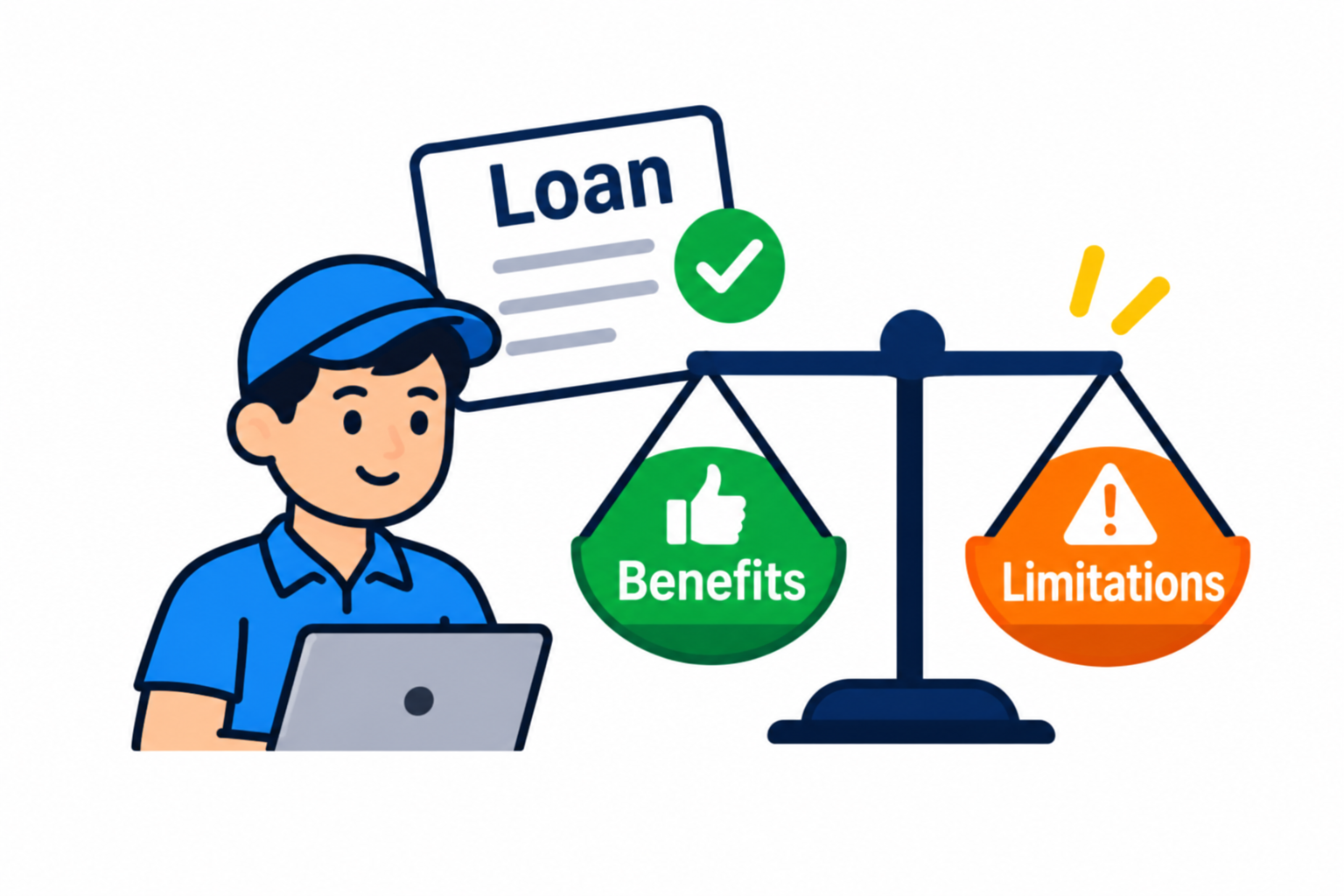
Digital lending has created new opportunities for gig workers to explore credit options through online applications and alternative income verification methods. However, digital borrowing also comes with certain benefits and limitations that borrowers should understand before applying.
In this guide, we explain the major advantages, possible challenges, eligibility considerations, and precautions gig workers should know before choosing a digital loan.
What Is Digital Borrowing for Gig Workers?
Digital borrowing refers to applying for and managing loans through online platforms, mobile applications, or digital lending services.
For gig workers, digital borrowing may provide access to credit based on factors such as:
-
Bank account transaction history.
-
Regularity of income deposits.
-
UPI and digital payment records, where accepted with appropriate consent.
-
Work history and platform earnings.
-
Credit score and repayment history.
-
Existing financial obligations.
Unlike conventional lending, some lenders may consider alternative income evidence instead of relying only on salary slips.
However, approval is not guaranteed. Every lender follows its own eligibility requirements, risk assessment process, and applicable regulatory guidelines.
Key Benefits of Digital Borrowing for Gig Workers
1. Easy and Convenient Loan Application
Digital lending platforms allow gig workers to apply for loans online without visiting multiple bank branches.
Benefits:
-
Apply using a smartphone.
-
Submit documents digitally.
-
Track application status online.
-
Access loan information from home.
-
Reduce paperwork compared with traditional application processes.
The actual processing time depends on the lender's verification and approval process.
2. Flexible Income Assessment
One major advantage is that some lenders may consider income patterns rather than depending entirely on fixed monthly salary slips.
For example, a delivery partner may receive different payments every week depending on completed orders, incentives, and working hours.
Lenders may evaluate:
-
Monthly bank credits.
-
Platform earnings.
-
Work consistency.
-
Previous income records.
-
Existing loan repayments.
This can help eligible gig workers demonstrate their repayment capacity.
3. Opportunity to Build a Credit History
Responsible borrowing and timely EMI payments can help gig workers establish or strengthen their credit history.
Potential benefits include:
-
Building a formal repayment record.
-
Demonstrating financial discipline.
-
Improving future access to suitable credit products.
-
Developing better financial management habits.
However, loan approval and credit-score improvement are not guaranteed. Credit outcomes depend on reporting, repayment behaviour, and the credit bureau's assessment.
4. Access to Formal Credit
Gig workers who do not have conventional employment documents may find it difficult to qualify for certain traditional loan products.
Digital lending can provide another route to formal credit when a regulated lender accepts alternative income evidence.
The Reserve Bank of India's 2024–25 Annual Report discusses a pilot involving gig platforms such as Rapido, Namma Yatri, and Uber, where consent-based alternative data, including work history and earnings, was explored for assessing creditworthiness.
5. Better Application Tracking
Digital platforms can make it easier for borrowers to monitor their loan applications and repayment details.
Depending on the lender, borrowers may be able to:
-
View loan application updates.
-
Check EMI due dates.
-
Access repayment schedules.
-
Download loan statements.
-
Receive payment reminders.
6. Multiple Loan Options
Some digital lending service providers work with multiple regulated lenders. This may allow borrowers to compare different loan offers.
Before selecting an option, compare:
-
Interest rates.
-
Annual Percentage Rate (APR).
-
Processing fees.
-
Loan tenure.
-
Total repayment amount.
-
Late payment charges.
Always choose a loan based on affordability rather than the maximum amount offered.
Major Limitations of Digital Borrowing for Gig Workers
Digital borrowing offers convenience, but it also has limitations that gig workers should consider.
1. Irregular Monthly Income
Gig workers may not earn the same amount every month.
Income can change because of:
-
Fewer delivery orders.
-
Reduced customer demand.
-
Platform incentives changing.
-
Seasonal fluctuations.
-
Vehicle maintenance or personal emergencies.
-
Temporary breaks from work.
This makes fixed monthly EMI payments challenging.
Example:
A delivery partner may earn ₹25,000 in one month but only ₹17,000 in the following month. A fixed EMI can become difficult to manage when earnings decrease.
2. Loan Approval Is Not Guaranteed
Having a digital income record does not automatically make someone eligible for a loan.
Lenders may consider several factors, including:
-
Age and occupation.
-
Income consistency.
-
Credit history.
-
Existing EMIs.
-
Repayment capacity.
-
Internal lending policies.
Some lenders may also require a minimum income level or a particular work history.
3. Higher Borrowing Costs
Some loan products available to borrowers with limited credit history or irregular income may carry higher interest rates or fees.
Borrowers should carefully examine the complete cost of borrowing instead of focusing only on the advertised interest rate.
4. Limited Loan Amounts
Gig workers with inconsistent earnings or limited credit history may receive a lower eligible loan amount than expected.
The approved amount depends on the lender's credit assessment and repayment-capacity evaluation.
5. Risk of Digital Loan Scams
Fake loan applications and unauthorised lending services can expose borrowers to financial fraud and privacy risks.
Warning signs include:
-
Guaranteed loan approval without verification.
-
Upfront payment demands.
-
Unclear lender details.
-
Requests for unnecessary phone permissions.
-
Threatening recovery messages.
-
No proper loan agreement.
Always verify the actual regulated lender before applying.
6. Risk of EMI Defaults
If a gig worker experiences reduced earnings, missing an EMI can lead to additional charges and may negatively affect their credit history.
Repeated defaults can make future borrowing more difficult.
Benefits vs Limitations: Quick Comparison
|
Benefits |
Limitations |
|---|---|
|
Online application convenience |
Approval is not guaranteed |
|
Alternative income assessment may be available |
Income verification requirements vary |
|
Opportunity to build credit history |
Defaults can damage credit history |
|
Access to formal credit options |
Interest rates may be higher |
|
Easy repayment tracking |
Fixed EMIs can be difficult with irregular income |
|
Multiple offers may be available |
Comparing loan costs requires care |
Who Can Benefit from Digital Borrowing?
Digital borrowing may be useful for gig workers who:
-
Have a consistent history of platform earnings.
-
Maintain regular bank transactions.
-
Can provide acceptable income documentation.
-
Have manageable existing financial commitments.
-
Need credit for a genuine financial requirement.
-
Can comfortably manage the repayment schedule.
Potential borrowers include:
-
Food delivery partners.
-
Cab and bike taxi drivers.
-
Freelancers.
-
E-commerce delivery executives.
-
Independent service providers.
-
Part-time platform workers.
Eligibility requirements differ from lender to lender.
Documents That May Help Gig Workers Apply
Depending on the lender's policy, the following documents may support an application:
|
Document |
Purpose |
|---|---|
|
Aadhaar |
Identity and KYC verification |
|
PAN card |
Financial identity verification |
|
Bank statements |
Income and transaction assessment |
|
Platform earnings statements |
Evidence of gig income |
|
Work history |
Understanding income consistency |
|
Address proof |
Address verification |
|
Existing loan details |
Evaluating repayment obligations |
Not every lender requires all these documents. Submit information only through verified channels and with appropriate consent.
How to Borrow Responsibly as a Gig Worker
-
Calculate average income: Review earnings over the previous three to six months rather than relying on your best earning month.
-
Check existing EMIs: Include all current loan obligations in your monthly budget.
-
Choose an affordable EMI: Make sure you can repay even during a low-income month.
-
Compare loan costs: Check APR, processing fees, penalties, and total repayment.
-
Verify the lender: Confirm that the actual lender is an RBI-regulated bank or NBFC.
-
Read the Key Facts Statement: Understand the loan terms before accepting the offer.
-
Protect personal information: Provide only necessary information with informed consent.
-
Maintain repayment discipline: Pay EMIs on time and retain payment confirmations.
RBI Guidelines and Digital Borrower Protection
The Reserve Bank of India introduced the Reserve Bank of India (Digital Lending) Directions, 2025 on May 8, 2025.
These directions strengthen transparency and borrower protection in digital lending. Important provisions include:
-
Assessment of the borrower's creditworthiness.
-
Disclosure of loan information through a Key Facts Statement (KFS).
-
Transparency regarding loan costs and APR.
-
Requirements relating to borrower data collection and consent.
-
Cooling-off period for eligible digital loans.
-
Grievance redressal arrangements.
-
A public directory of Digital Lending Apps associated with regulated entities.
The directions also address risks involving data privacy, misleading practices, and unfair recovery methods.
Borrowers can refer to the official RBI website to understand the applicable rules and verify a lending app's association with a regulated entity.
Real-World Example: Understanding the Benefits and Limitations
Consider a food delivery partner who earns different amounts every month.
|
Particulars |
Amount |
|---|---|
|
Average monthly income |
₹22,000 |
|
Monthly household expenses |
₹11,000 |
|
Existing EMI |
₹2,000 |
|
Remaining amount |
₹9,000 |
Suppose the worker is considering a new loan with a monthly EMI of ₹3,000.
After the new EMI, the remaining amount would be ₹6,000.
Although the EMI may appear affordable based on average income, the worker should also consider fuel expenses, vehicle repairs, medical emergencies, and months with lower earnings.
Key lesson: Loan eligibility and actual repayment affordability are two different things. Borrowers should evaluate both before accepting a loan.
Key Takeaways
-
Digital borrowing can create additional credit opportunities for gig workers.
-
Alternative income assessment may help workers without traditional salary slips.
-
Regular bank transactions and platform earnings can support income verification.
-
Loan approval depends on the lender's eligibility and credit assessment.
-
Irregular income can make fixed EMI payments difficult.
-
Interest rates, processing fees, and repayment terms must be checked carefully.
-
Borrowers should choose verified lending platforms and maintain repayment discipline.
Frequently Asked Questions (FAQs)
1. Can gig workers apply for personal loans online?
Yes. Gig workers can apply through digital lending platforms if they meet the lender's eligibility requirements.
2. Can I get a loan without a salary slip?
Some lenders accept bank statements, platform earnings records, or other alternative income documents instead of traditional salary slips.
3. Does irregular income affect loan eligibility?
Yes. Irregular income may affect the lender's assessment of repayment capacity and the approved loan amount.
4. Can delivery partners qualify for digital loans?
Yes. Delivery partners may qualify depending on their income records, credit profile, documentation, and lender policies.
5. Does digital borrowing improve my CIBIL score?
Responsible repayment of loans reported to credit bureaus can help build a positive credit history. However, improvement is not guaranteed.
6. Are digital loans safe for gig workers?
They can be safe when borrowers use verified platforms associated with regulated lenders and carefully review loan terms.
7. What happens if I miss an EMI?
Missing an EMI may result in additional charges and negative credit reporting, depending on the loan agreement and applicable rules.
8. Can gig workers with low credit scores apply for loans?
They can apply, but approval depends on the lender's credit assessment and eligibility requirements.
9. What income documents should gig workers maintain?
Bank statements, platform earnings statements, payment records, and relevant work history can help demonstrate income.
10. Should gig workers choose short-term or long-term loans?
The right tenure depends on income stability, EMI affordability, interest costs, and financial requirements.
11. Can freelancers apply for digital personal loans?
Yes. Freelancers may apply using accepted income records and financial documents, subject to lender policies.
12. How can gig workers avoid loan scams?
Verify the lender, check the RBI's Digital Lending App directory, avoid upfront payment demands, and never share OTPs or passwords.
Conclusion
Digital borrowing can offer gig workers an additional opportunity to access formal credit without depending entirely on traditional salary documentation. Online applications, alternative income assessment, and repayment tracking can make borrowing more accessible and convenient.
However, irregular earnings, higher borrowing costs, limited loan amounts, and EMI repayment challenges remain important limitations.
Gig workers should carefully evaluate their income stability, compare loan offers, understand the total borrowing cost, and select an EMI that remains affordable even during low-income months.
At Vizzve, responsible borrowing starts with understanding your eligibility, evaluating your repayment capacity, and making informed financial decisions.
Published on : 10th November
Published by : monisha
www.vizzve.com || www.vizzveservices.com
Follow us on social media: Facebook || Linkedin || Instagram
🛡 Powered by Vizzve Financial
RBI-Registered Loan Partner | 10 Lakh+ Customers | ₹600 Cr+ Disbursed