

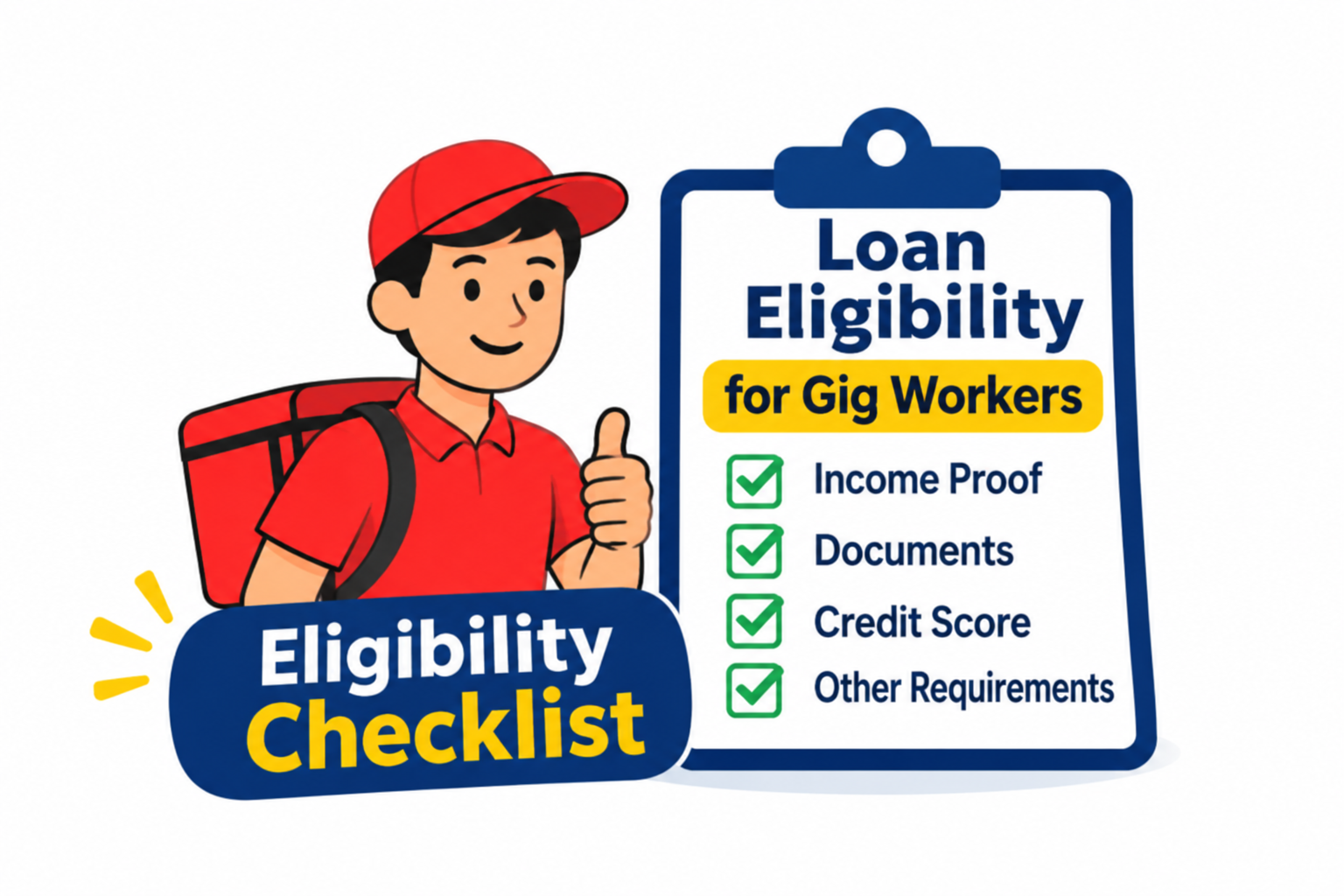
Introduction
Gig workers are an important part of India's growing digital economy. Delivery partners, cab drivers, freelancers, online sellers, and independent service providers earn money through flexible work opportunities. However, getting a personal loan can sometimes be challenging because their income may not be fixed every month.
Unlike salaried employees, gig workers may not have traditional salary slips or employer-issued income certificates. This does not automatically make them ineligible for loans. Many lenders consider alternative income documents, bank statements, transaction history, and repayment capacity.
Understanding the eligibility requirements before applying can help gig workers choose suitable borrowing options and avoid unnecessary loan rejections.
This eligibility checklist for gig workers in digital borrowing explains the important documents, income conditions, credit factors, and other requirements borrowers should check before submitting a loan application.
1. Who Are Gig Workers?
Gig workers are individuals who earn money by completing short-term, flexible, freelance, or task-based work instead of working in a traditional full-time salaried job.
Common examples include:
-
Food and grocery delivery partners.
-
Cab and bike taxi drivers.
-
Freelancers and independent consultants.
-
Online service providers.
-
E-commerce delivery agents.
-
Independent technicians and repair professionals.
-
Part-time digital workers.
Their income may depend on the number of tasks completed, working hours, customer demand, and platform incentives.
2. Why Is Loan Eligibility Important for Gig Workers?
Loan eligibility helps lenders understand whether a borrower can repay the loan within the agreed period.
For gig workers, checking eligibility is especially important because:
-
Monthly income may fluctuate.
-
Traditional salary slips may not be available.
-
Employment arrangements can change frequently.
-
Income may come from multiple platforms.
-
Repayment capacity may vary between months.
Checking eligibility before applying helps borrowers understand their financial position and select a loan amount they can comfortably repay.
3. Eligibility Checklist for Gig Workers
Before applying for a digital loan, gig workers should review the following eligibility factors.
1. Age Requirement
Most lenders have minimum and maximum age criteria for personal loan applicants.
-
Check the lender's minimum age requirement.
-
Ensure you meet the age criteria at the time of application.
-
Check whether the lender has a maximum age limit for repayment completion.
2. Regular Income
A fixed monthly salary is not always necessary. However, lenders generally need evidence that the applicant earns enough to repay the loan.
Gig workers can prepare:
-
Monthly earnings statements.
-
Bank account statements.
-
Delivery or ride payment records.
-
Freelance payment receipts.
-
Platform transaction history.
-
Income records from multiple work platforms.
Tip: Maintain clear records of your earnings, even if your income changes every month.
3. Bank Account Activity
An active bank account helps demonstrate income flow and financial transactions.
Check whether:
-
Your bank account is active.
-
Your earnings are regularly credited.
-
Your bank statements are available.
-
Your account details match your loan application.
-
You have sufficient funds to manage upcoming EMI payments.
4. Credit Score and Credit History
Your credit profile can influence loan approval and the interest rate offered by a lender.
Before applying:
-
Check your credit report.
-
Review your existing loan balances.
-
Pay current EMIs on time.
-
Clear overdue payments where possible.
-
Correct inaccurate information in your credit report.
A low or limited credit history does not automatically mean rejection. However, approval depends on the lender's internal credit assessment.
5. Identity and Address Verification
Applicants generally need to complete identity and address verification.
Commonly requested documents include:
-
PAN card.
-
Aadhaar or another accepted identity document.
-
Address proof, where required.
-
Recent photograph, if requested.
-
Active mobile number.
The exact KYC documents depend on the lender's verification process.
6. Employment or Gig Work Proof
Gig workers should be ready to demonstrate their work activity.
Examples include:
-
Delivery partner ID.
-
Cab or bike taxi platform ID.
-
Freelance contracts.
-
Client payment records.
-
Platform earnings reports.
-
Business or service-related payment receipts.
7. Existing Loan Obligations
Lenders may review your current financial commitments before approving another loan.
Check:
-
Existing personal loan EMIs.
-
Credit card outstanding balances.
-
Other monthly repayment obligations.
-
Any overdue loan payments.
-
Your remaining monthly income after expenses.
Avoid borrowing more than you can comfortably repay.
4. Documents Required for Digital Loan Applications
The following table provides a simple document checklist for gig workers.
|
Document |
Why It Is Needed |
|---|---|
|
PAN card |
Identity and financial verification |
|
Aadhaar or accepted KYC document |
Identity verification |
|
Bank statements |
Income and transaction verification |
|
Platform earnings report |
Proof of gig income |
|
Freelance payment records |
Proof of independent earnings |
|
Address proof |
Address verification, if required |
|
Active mobile number |
OTP and communication |
|
Credit report |
Credit history assessment |
Note: Requirements vary by lender and loan product. Not every applicant will need every document.
5. How Do Lenders Evaluate Gig Workers?
Lenders may consider several factors when assessing a gig worker's loan application.
|
Evaluation Factor |
What Lenders May Check |
|---|---|
|
Monthly income |
Average earnings and consistency |
|
Work history |
Duration of gig activity |
|
Bank transactions |
Regular income credits |
|
Credit history |
Previous repayment behaviour |
|
Existing EMIs |
Current debt obligations |
|
Loan amount |
Whether repayment is affordable |
|
KYC details |
Identity and address verification |
According to the RBI's Digital Lending Directions, 2025, regulated lenders must obtain information about a borrower's economic profile, including age, occupation, and income, to assess creditworthiness.
6. Step-by-Step Eligibility Self-Check
Gig workers can follow these simple steps before applying for a digital loan.
-
Check your age: Confirm that you meet the lender's age requirements.
-
Calculate your income: Review your average earnings over recent months.
-
Collect income proof: Download platform statements and payment records.
-
Review your bank statements: Make sure your income transactions are clear.
-
Check your credit report: Look for overdue payments or incorrect details.
-
Calculate existing EMIs: Understand your current repayment commitments.
-
Choose a suitable loan amount: Borrow only what your income can support.
-
Verify the lender: Check the actual bank or NBFC providing the loan.
-
Review loan charges: Read the interest rate, APR, fees, and repayment terms.
-
Submit your application: Complete the application using accurate information.
7. Monthly Income Checklist for Gig Workers
Income stability is an important consideration when planning loan repayment.
Here is an illustrative example:
|
Income Source |
Monthly Earnings |
|---|---|
|
Food delivery work |
₹12,000 |
|
Weekend freelance work |
₹5,000 |
|
Other platform incentives |
₹3,000 |
|
Total income |
₹20,000 |
If monthly earnings are ₹20,000, the borrower should first account for rent, food, travel, household expenses, and existing EMIs before deciding on a new loan.
This example is for financial planning only. It does not represent a lender's minimum income requirement or guarantee loan approval.
8. Common Eligibility Mistakes to Avoid
Gig workers should avoid these mistakes while applying for digital loans:
-
Providing incorrect income information.
-
Submitting incomplete KYC documents.
-
Ignoring existing loan obligations.
-
Applying to several lenders without comparing their terms.
-
Using unclear or outdated bank statements.
-
Hiding overdue payments.
-
Choosing an unnecessarily high loan amount.
-
Ignoring processing fees and other charges.
-
Accepting loan offers without reading the Key Facts Statement.
9. Important Digital Lending Safety Checks
Eligibility is only one part of responsible borrowing. Applicants should also check whether the loan is safe and transparent.
Before accepting a loan:
-
Confirm the name of the regulated bank or NBFC.
-
Check the lender's official website.
-
Review the loan agreement.
-
Read the Key Facts Statement (KFS).
-
Compare the Annual Percentage Rate (APR).
-
Understand late payment charges.
-
Check the privacy policy.
-
Never share your OTP, PIN, or banking password.
The RBI's Digital Lending Directions, 2025, include requirements for creditworthiness assessment, borrower disclosures, data protection, and grievance redressal.
10. Tips to Improve Loan Eligibility
Gig workers can improve their financial profile by following these practices:
-
Maintain a separate bank account for work-related earnings.
-
Keep monthly income records updated.
-
Build a positive credit repayment history.
-
Avoid unnecessary borrowing.
-
Pay existing EMIs before their due dates.
-
Maintain accurate KYC information.
-
Choose a loan amount based on actual repayment capacity.
-
Keep sufficient financial savings for low-income months.
11. Benefits of Checking Eligibility Before Applying
|
Benefit |
How It Helps |
|---|---|
|
Better preparation |
Helps organise documents |
|
Financial awareness |
Provides clarity about repayment capacity |
|
Fewer application errors |
Reduces mistakes in submitted information |
|
Better loan comparison |
Helps evaluate different loan offers |
|
Responsible borrowing |
Prevents unnecessary debt |
12. Frequently Asked Questions (FAQs)
1. Can gig workers apply for personal loans?
Yes. Gig workers can apply for personal loans if they meet the lender's eligibility requirements.
2. Can I get a loan without a salary slip?
Yes. Some lenders accept bank statements, platform earnings reports, and other alternative income documents.
3. Is a fixed monthly income compulsory?
Not necessarily. Some lenders consider average monthly earnings and income consistency.
4. Which documents are required for gig worker loans?
Common documents include PAN, accepted KYC documents, bank statements, and proof of gig income.
5. Can delivery partners apply for digital loans?
Yes. Delivery partners can apply if they satisfy the lender's eligibility and verification requirements.
6. Does a low credit score affect loan eligibility?
Yes. A low credit score may affect approval chances or loan terms, depending on the lender's policy.
7. Can freelancers apply for digital personal loans?
Yes. Freelancers may use payment receipts, client records, bank statements, and other accepted income documents.
8. How can I prove my gig income?
You can provide platform earnings statements, bank credits, payment receipts, and freelance income records.
9. Can I apply if I work on multiple platforms?
Yes. You may provide income records from multiple platforms if the lender accepts them.
10. Does an existing EMI affect loan eligibility?
Yes. Existing EMIs reduce the amount of income available for additional repayments.
11. Can a gig worker with no credit history get a loan?
Some lenders may consider applicants with limited credit history, but approval depends on their overall assessment.
12. How do digital lenders verify gig worker income?
They may examine bank statements, earnings reports, transaction records, and other permitted income documents.
13. Is Aadhaar compulsory for every digital loan?
Not necessarily in every case. Lenders must follow applicable KYC requirements and accept permitted identity verification methods.
14. Can irregular income lead to loan rejection?
It may affect eligibility if the lender cannot establish sufficient repayment capacity. However, irregular income does not automatically mean rejection.
15. How can gig workers avoid loan rejection?
Maintain accurate documents, provide genuine income information, review your credit report, and choose an affordable loan amount.
13. Key Takeaways
-
Gig workers can apply for digital personal loans.
-
A traditional salary slip may not always be necessary.
-
Bank statements and platform earnings reports can help demonstrate income.
-
Credit history and existing EMIs may influence eligibility.
-
Every lender has its own eligibility requirements.
-
Always review the KFS, APR, and repayment conditions before accepting a loan.
-
Borrow responsibly and choose an affordable EMI.
Conclusion
Loan eligibility for gig workers in digital borrowing depends on several factors, including income consistency, bank account activity, credit history, KYC verification, and repayment capacity. Although gig workers may not have traditional salary documents, alternative income records can help demonstrate their financial position.
By following this eligibility checklist, gig workers can prepare their documents, understand lender requirements, and make better borrowing decisions.
At Vizzve, we believe responsible borrowing starts with financial awareness, proper documentation, and a clear understanding of loan terms.
Published on : 10th November
Published by : monisha
www.vizzve.com || www.vizzveservices.com
Follow us on social media: Facebook || Linkedin || Instagram
🛡 Powered by Vizzve Financial
RBI-Registered Loan Partner | 10 Lakh+ Customers | ₹600 Cr+ Disbursed