

1. Introduction
Gig workers play an important role in India's growing digital economy. Delivery partners, cab drivers, freelancers, online sellers, and independent service providers often depend on flexible income rather than a fixed monthly salary.
However, applying for a personal loan can sometimes be challenging because their earnings may change from week to week. Lenders may evaluate their income consistency, bank statements, repayment history, existing EMIs, and overall financial stability before approving a loan.
A safety checklist can help gig workers understand loan eligibility requirements and avoid unsafe digital borrowing practices.
In this guide, Vizzve explains the important safety checks gig workers should complete before applying for a digital loan.
2. What Is Loan Eligibility for Gig Workers?
Loan eligibility refers to the financial and personal conditions a lender considers before approving a loan application.
For gig workers, lenders may examine:
-
Monthly or weekly income.
-
Bank account transaction history.
-
Work consistency and platform earnings.
-
Existing loans and EMI commitments.
-
Credit score and repayment history.
-
Age and identity verification.
-
Ability to repay the requested loan.
Unlike salaried employees, gig workers may need to provide alternative income evidence because they might not receive traditional salary slips.
Important: Eligibility requirements differ between banks and NBFCs. There is no single universal income or credit score requirement for all gig workers.
3. Safety Checklist Before Applying for a Digital Loan
Gig workers should follow these important safety checks before submitting a loan application.
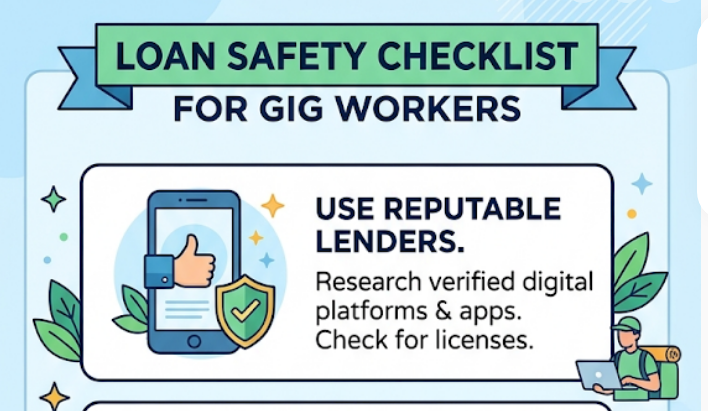
3.1 Verify the Lender's Registration
Before applying, confirm whether the actual lender is a legitimate bank or RBI-regulated NBFC.
-
Check the lender's official website.
-
Verify the bank or NBFC details.
-
Check whether the digital lending app is associated with the stated lender.
-
Avoid unknown apps promising guaranteed loans.
-
Do not trust lenders based only on advertisements.
3.2 Check Your Income Documents
Income verification is an important part of loan eligibility assessment.
Keep the following documents ready:
-
Bank statements.
-
UPI transaction records.
-
Delivery or ride earnings statements.
-
Freelance payment records.
-
Platform payout history.
-
Other valid income proofs.
Consistent financial records can help demonstrate your earning capacity even without a fixed salary.
3.3 Review Your Credit Score
Your credit history can influence the lender's decision.
Before applying:
-
Check your latest credit report.
-
Review previous loan repayment records.
-
Identify overdue payments.
-
Correct any inaccurate credit report information.
-
Avoid submitting multiple unnecessary loan applications.
A good credit history may improve your chances of approval, but approval is never guaranteed.
3.4 Calculate Your EMI Affordability
Never select a loan amount simply because a lender offers it.
Calculate whether you can manage the EMI after paying essential expenses.
Consider:
-
Monthly household expenses.
-
Fuel and vehicle maintenance.
-
Rent and utility bills.
-
Existing loan EMIs.
-
Emergency savings.
-
Changes in gig-work income.
Choose a repayment amount that remains manageable even during low-income weeks.
3.5 Understand the Interest Rate and APR
Before accepting a loan, check the interest rate and Annual Percentage Rate (APR).
APR helps borrowers understand the overall annual cost of borrowing, including applicable charges.
Compare:
-
Interest rate.
-
Processing fees.
-
Applicable taxes.
-
Late payment charges.
-
Other applicable fees.
-
Total repayment amount.
3.6 Read the Key Facts Statement (KFS)
The RBI's Digital Lending Directions, 2025 require regulated lenders to provide a Key Facts Statement for applicable digital loans.
Before accepting the offer, carefully review:
-
Loan amount.
-
Interest rate.
-
APR.
-
EMI amount.
-
Repayment tenure.
-
Applicable charges.
-
Penal charges.
-
Important loan conditions.
Never accept a loan without understanding its repayment obligations.
3.7 Protect Your Personal Information
Digital loan applications may request personal and financial information.
Follow these precautions:
-
Download apps from trusted sources.
-
Read the privacy policy.
-
Provide only necessary information.
-
Review consent requests carefully.
-
Avoid sharing OTPs and passwords.
-
Never share banking credentials with unknown agents.
-
Avoid apps requesting unnecessary access to personal data.
3.8 Check Repayment Terms
Before accepting a loan, understand exactly how repayment works.
Check:
-
EMI due dates.
-
Repayment method.
-
Automatic debit instructions.
-
Late payment penalties.
-
Loan prepayment conditions.
-
Foreclosure charges, if applicable.
Keep sufficient funds in your repayment account before the due date.
4. Gig Worker Digital Loan Safety Checklist
Use this checklist before submitting your application.
|
Safety check |
What to verify |
|---|---|
|
Lender verification |
Genuine bank or RBI-regulated NBFC |
|
Income proof |
Bank statements and payout records |
|
Credit history |
Check credit report |
|
EMI affordability |
Calculate monthly repayment capacity |
|
Interest rate |
Understand the borrowing cost |
|
KFS |
Read all important loan details |
|
Privacy policy |
Understand data collection |
|
App permissions |
Avoid unnecessary access |
|
Repayment terms |
Check due dates and penalties |
|
Loan agreement |
Read before accepting |
5. Common Digital Lending Risks Gig Workers Should Avoid
Gig workers should be careful about the following risks.
Fake Loan Applications
Fraudulent applications may promise instant approval without proper verification.
Safety tip: Verify the actual lender before sharing personal information.
Advance Fee Scams
Some fraudsters demand upfront payments for guaranteed loan approval.
Safety tip: Do not transfer money to unknown individuals claiming to arrange a loan.
Hidden Charges
Some borrowers may overlook processing fees and other applicable charges.
Safety tip: Review the KFS and understand the total repayment obligation.
Unnecessary Data Collection
Untrusted applications may request excessive access to personal information.
Safety tip: Review app permissions and provide consent only for necessary data collection.
Unaffordable EMIs
Irregular earnings can make fixed monthly repayments difficult.
Safety tip: Select a loan amount based on realistic income rather than your highest earning month.
6. Documents Gig Workers Should Keep Ready
|
Document |
Purpose |
|---|---|
|
Aadhaar or other accepted identity proof |
Identity verification |
|
PAN card |
Financial verification |
|
Bank statements |
Income assessment |
|
Platform payout records |
Earnings verification |
|
UPI transaction history |
Additional income evidence |
|
Address proof |
Address verification |
|
Existing loan details |
Repayment assessment |
The exact document requirements depend on the lender and loan product.
7. RBI Digital Lending Guidelines: What Borrowers Should Know
The Reserve Bank of India introduced the Reserve Bank of India (Digital Lending) Directions, 2025 to strengthen borrower protection and improve transparency in digital lending.
Some important protections include:
-
Lenders must assess the borrower's creditworthiness, including age, occupation, and income details.
-
Borrowers must receive applicable loan disclosures through a Key Facts Statement.
-
Loan-related documents must be provided through registered and verified communication channels.
-
Digital lending must follow applicable borrower data protection requirements.
-
Lenders must provide a grievance redressal mechanism.
These requirements help improve transparency and accountability in digital borrowing.
8. Practical Example: Safety Checks for a Delivery Partner
Consider a delivery partner earning approximately ₹25,000 per month through different delivery assignments.
Before applying for a personal loan, the worker:
-
Reviews the last six months of bank transactions.
-
Collects delivery platform payout statements.
-
Checks the existing credit report.
-
Calculates monthly household expenses.
-
Evaluates whether the proposed EMI is affordable.
-
Verifies the lender's identity.
-
Reads the KFS and loan agreement.
-
Checks repayment dates and applicable charges.
By completing these steps, the borrower can make a more informed borrowing decision.
This is an illustrative example, not a guaranteed eligibility or loan approval assessment.
9. Tips to Improve Loan Eligibility for Gig Workers
Gig workers can strengthen their financial profile through responsible financial habits.
-
Maintain consistent bank transactions.
-
Keep accurate records of gig earnings.
-
Pay existing EMIs on time.
-
Avoid unnecessary borrowing.
-
Reduce outstanding debt where possible.
-
Maintain a healthy credit history.
-
Choose realistic loan amounts.
-
Avoid multiple loan applications within a short period.
Financial discipline can help demonstrate repayment capacity to potential lenders.
10. Key Takeaways
-
Verify the lender before applying for a digital loan.
-
Maintain proper income and payout records.
-
Check your credit report before borrowing.
-
Calculate EMI affordability carefully.
-
Understand interest rates, APR, and applicable charges.
-
Read the KFS and loan agreement.
-
Protect personal and banking information.
-
Avoid fake loan apps and advance fee scams.
-
Borrow only what you can comfortably repay.
11. Frequently Asked Questions (FAQs)
1. Can gig workers apply for digital loans in India?
Yes. Gig workers can apply for digital loans if they meet the lender's eligibility requirements.
2. Do gig workers need salary slips to apply for loans?
Not necessarily. Some lenders may accept bank statements, platform payout records, and other valid income documents.
3. Is a credit score important for gig workers?
Yes. Credit history may influence loan eligibility, interest rates, and approval decisions.
4. How can gig workers prove their income?
They can use bank statements, UPI records, delivery earnings reports, and freelance payment records.
5. Are digital loans safe for gig workers?
They can be safe when borrowers use legitimate lenders and carefully review loan terms.
6. What is the biggest risk of digital borrowing?
Fraudulent applications, hidden charges, excessive borrowing, and data misuse are some important risks.
7. Should gig workers check their EMI before applying?
Yes. EMI affordability should be evaluated against actual income and essential expenses.
8. Can gig workers get loans without a fixed salary?
Some lenders consider alternative income documents instead of traditional salary slips.
9. What is a KFS in digital lending?
A Key Facts Statement provides important information about the loan, including APR, repayment details, and applicable charges.
10. Can a low credit score affect loan approval?
Yes. A low credit score may reduce approval chances, although lender policies differ.
11. Should gig workers apply through unknown loan apps?
No. Always verify the lender and its relationship with the digital lending application.
12. How can gig workers avoid loan scams?
Verify the lender, avoid advance fee scams, protect OTPs, and read the loan agreement.
13. Can irregular income affect loan eligibility?
Yes. Income fluctuations may affect how lenders evaluate repayment capacity.
14. What documents should gig workers prepare?
Identity proof, PAN, bank statements, income records, and other documents requested by the lender.
15. What should borrowers check before accepting a digital loan?
Check the lender, interest rate, APR, EMI, KFS, privacy policy, and repayment conditions.
12. Conclusion
Digital borrowing can provide financial support to gig workers when unexpected expenses arise. However, flexible income requires careful financial planning before taking on repayment commitments.
By verifying lenders, maintaining income records, checking credit history, understanding loan costs, and protecting personal information, gig workers can make safer borrowing decisions.
A proper safety checklist helps borrowers avoid unnecessary risks and build responsible financial habits.
Vizzve encourages gig workers to understand their financial responsibilities, compare loan options, and borrow only according to their repayment capacity.
Published on : 10th November
Published by : monisha
www.vizzve.com || www.vizzveservices.com
Follow us on social media: Facebook || Linkedin || Instagram
🛡 Powered by Vizzve Financial
RBI-Registered Loan Partner | 10 Lakh+ Customers | ₹600 Cr+ Disbursed