

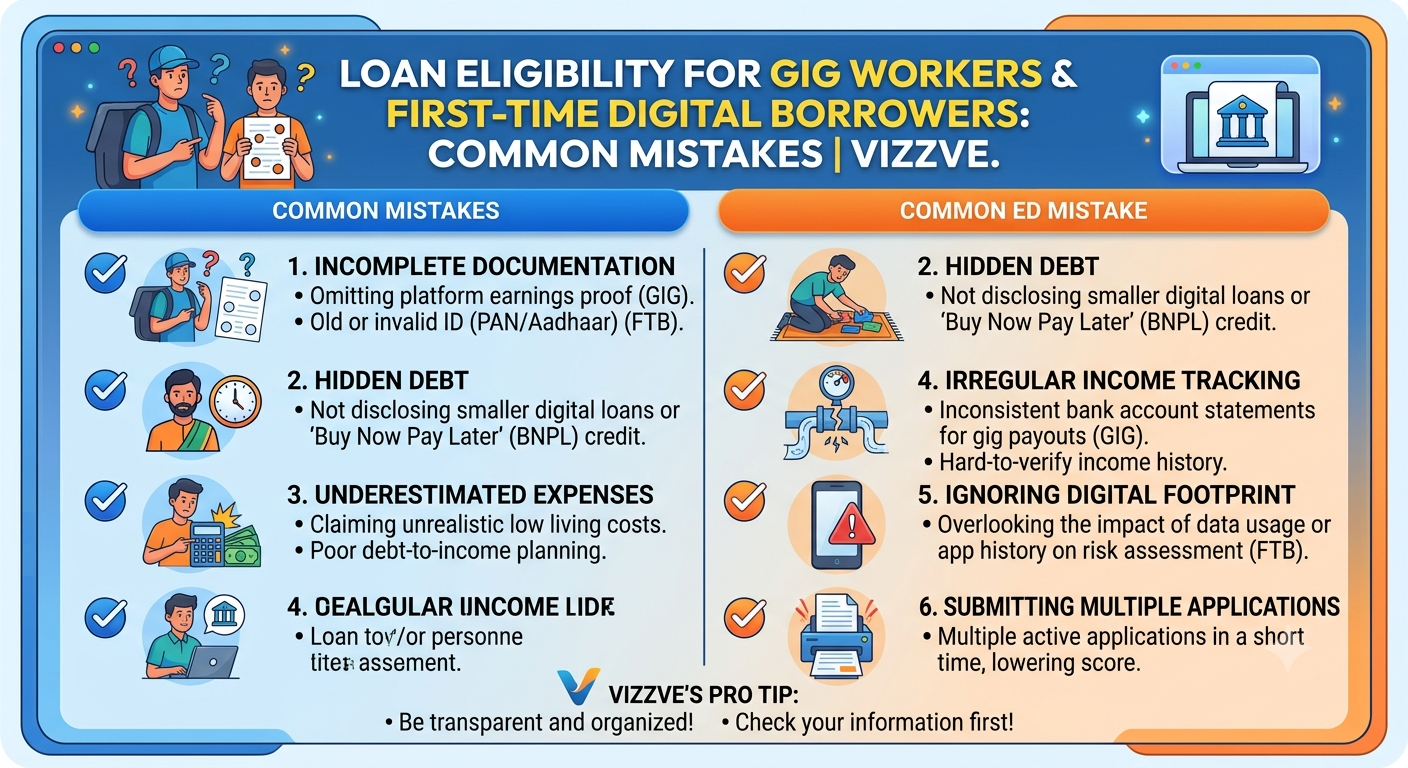
First-time digital borrowers working in the gig economy often make mistakes when applying for personal loans. Many applicants focus only on loan approval but overlook important factors such as income documentation, credit history, repayment capacity and lender verification.
Gig workers, including delivery partners, cab drivers, freelancers and independent service providers, may have irregular monthly earnings. This can make the loan application process different from that of traditional salaried employees.
Understanding common loan eligibility mistakes can help first-time digital borrowers prepare better applications, avoid unnecessary rejections and make responsible borrowing decisions.
This guide explains the most common mistakes gig workers should avoid while checking loan eligibility and applying for digital loans in India.
1. Understanding Loan Eligibility for Gig Workers
Loan eligibility refers to the financial and personal conditions that lenders evaluate before approving a loan application.
For gig workers, lenders may consider:
-
Monthly and annual income.
-
Consistency of earnings.
-
Bank account transaction history.
-
Credit history and repayment behaviour.
-
Existing loans and EMI obligations.
-
Identity and address verification.
-
Overall repayment capacity.
Unlike salaried employees, gig workers may receive payments from multiple platforms or clients. Therefore, maintaining clear income records is important when applying for credit.
2. Why Do First-Time Digital Borrowers Make Loan Eligibility Mistakes?
First-time borrowers may not understand how digital lending and loan eligibility assessments work.
Some common reasons include:
-
Limited knowledge of credit scores.
-
Lack of previous borrowing experience.
-
Incomplete income documentation.
-
Confusion about interest rates and charges.
-
Unfamiliarity with digital loan applications.
-
Poor financial planning.
-
Choosing lenders without checking their credibility.
Avoiding these mistakes can help borrowers make more informed financial decisions.
3. Top 15 Common Loan Eligibility Mistakes Gig Workers Should Avoid
Mistake 1: Applying Without Checking Loan Eligibility
One common mistake is submitting a loan application without understanding the lender's requirements.
Different banks and NBFCs may have different eligibility conditions.
How to avoid it:
-
Review the lender's eligibility criteria.
-
Understand minimum age requirements.
-
Check income documentation requirements.
-
Review repayment conditions.
-
Apply only when you meet the relevant requirements.
Mistake 2: Not Maintaining Proper Income Records
Gig workers may receive payments from several platforms or clients.
Without organised income records, demonstrating monthly earnings can become difficult.
How to avoid it:
-
Maintain bank statements.
-
Download platform earnings reports.
-
Save freelance invoices.
-
Keep digital payment receipts.
-
Track monthly income.
Mistake 3: Ignoring Credit History
First-time borrowers sometimes assume that credit history is not important.
Although having no previous credit history does not automatically disqualify an applicant, lenders may still evaluate available credit information.
How to avoid it:
-
Check your credit report.
-
Review existing credit accounts.
-
Identify incorrect information.
-
Pay existing credit obligations on time.
-
Avoid unnecessary credit applications.
Mistake 4: Providing Incorrect Personal Information
Incorrect details can create problems during KYC and application verification.
Examples include:
-
Incorrect name spelling.
-
Wrong date of birth.
-
Outdated address.
-
Incorrect PAN information.
-
Mismatched mobile number details.
How to avoid it:
Verify all personal information before submitting the application.
Mistake 5: Choosing a Loan Amount Beyond Repayment Capacity
Some gig workers apply for larger loan amounts without calculating their monthly expenses.
This can create financial pressure, particularly when gig income fluctuates.
How to avoid it:
-
Calculate average monthly earnings.
-
Review household expenses.
-
Consider existing EMIs.
-
Maintain emergency savings.
-
Select a manageable loan amount.
Mistake 6: Applying to Multiple Lenders Without Research
Submitting multiple loan applications within a short period can result in several formal credit enquiries.
This may affect your credit profile.
How to avoid it:
Compare lender requirements, interest rates and loan terms before submitting an application.
Mistake 7: Ignoring Bank Statement Requirements
Bank statements help demonstrate income and financial transactions.
Not maintaining accessible bank statements may make the application process difficult.
How to avoid it:
Keep recent bank statements and ensure that your income-related transactions are properly recorded.
Mistake 8: Not Understanding Interest Rates
Some first-time borrowers focus only on the loan amount and ignore the interest rate.
This can lead to unexpected repayment expenses.
How to avoid it:
-
Compare annual interest rates.
-
Understand the reducing-balance method.
-
Check APR.
-
Calculate total repayment.
-
Read the KFS before accepting the loan.
Mistake 9: Ignoring Processing Fees and Other Charges
Loan-related costs may include processing fees, applicable taxes and disclosed additional charges.
Ignoring these costs can lead to an inaccurate understanding of the actual borrowing expense.
How to avoid it:
Review the Key Fact Statement and loan agreement for all applicable charges.
Mistake 10: Not Comparing Loan Repayment Tenures
Choosing an unsuitable repayment tenure can affect monthly financial planning.
A longer tenure may reduce EMI but increase total interest.
How to avoid it:
Compare different repayment periods and choose one that suits your income pattern.
Mistake 11: Using Unverified Digital Loan Applications
Some borrowers download unknown loan applications without checking the actual lending institution.
This can expose personal and financial information to unnecessary risks.
How to avoid it:
-
Verify the bank or NBFC behind the loan.
-
Use official websites or trusted app stores.
-
Check the lender's digital lending disclosures.
-
Read the privacy policy.
-
Avoid suspicious upfront payment demands.
Mistake 12: Ignoring Existing Financial Obligations
Existing loans and EMIs can reduce the amount a borrower can comfortably repay.
How to avoid it:
Calculate your current financial commitments before choosing another loan.
Mistake 13: Submitting Incomplete Documents
Missing documents can delay verification and application processing.
How to avoid it:
Prepare PAN, accepted identity proof, address proof, bank statements and income records before applying.
Mistake 14: Ignoring EMI Due Dates
Missing EMI payments can result in disclosed penal charges and may negatively affect credit history.
How to avoid it:
-
Set payment reminders.
-
Maintain sufficient bank balance.
-
Track repayment dates.
-
Contact the lender if repayment difficulties arise.
Mistake 15: Accepting a Loan Without Reading the Agreement
Some first-time borrowers accept loan offers without reviewing the complete terms.
This can lead to misunderstandings about repayment conditions and applicable charges.
How to avoid it:
Read the loan agreement, KFS, APR, EMI schedule, fees and grievance redressal information before accepting the offer.
4. Common Mistakes and Their Solutions
| Common mistake | Recommended solution |
|---|---|
| No income documentation | Maintain bank and platform records |
| Ignoring credit history | Review your credit report |
| Applying without research | Compare lender requirements |
| Choosing excessive loan amounts | Calculate repayment capacity |
| Ignoring processing fees | Review the KFS |
| Incorrect KYC information | Verify personal details |
| Multiple loan applications | Apply selectively |
| Using unknown loan apps | Verify the regulated lender |
| Missing EMI payments | Set repayment reminders |
| Ignoring loan agreements | Read all terms carefully |
5. How Can Gig Workers Improve Their Loan Eligibility?
Gig workers can follow these practical steps to strengthen their financial profile.
Maintain Consistent Income Records
Keep bank statements, platform payment summaries and freelance invoices organised.
Build Responsible Credit Habits
Pay existing credit obligations on time and review your credit report periodically.
Manage Monthly Expenses
Prepare a monthly budget that includes household expenses, savings and existing EMIs.
Avoid Unnecessary Borrowing
Apply only for the amount you genuinely need.
Keep Documents Updated
Ensure your identity, address and banking details are accurate.
Compare Lending Options
Review interest rates, APR, repayment tenure and applicable fees before accepting a loan.
6. Loan Application Checklist for First-Time Digital Borrowers
Before submitting an application, review the following:
-
My personal information is correct.
-
My identity documents are valid.
-
My bank account is active.
-
My recent bank statements are available.
-
My gig income records are organised.
-
I have reviewed my credit report, if available.
-
I have calculated my monthly expenses.
-
I understand my existing EMI obligations.
-
I have compared available loan options.
-
I understand the interest rate and APR.
-
I have reviewed the KFS.
-
I can comfortably manage the repayment schedule.
-
I have verified the lending institution.
7. Real-World Example: Common Loan Application Mistakes
Consider Arjun, a delivery partner who earns an average of ₹24,000 per month.
He decides to apply for his first personal loan of ₹60,000.
Initially, Arjun makes several mistakes:
-
He does not review his credit report.
-
He applies to multiple lenders.
-
He does not organise his platform earnings statements.
-
He ignores processing fees.
-
He does not calculate his affordable EMI.
Before proceeding further, Arjun reviews his financial position, organises his income records and compares lender terms.
He also checks the APR, KFS and repayment schedule before considering a loan offer.
This preparation helps Arjun understand his borrowing capacity and make a more informed decision.
This example is illustrative and does not guarantee loan approval.
8. Digital Lending Safety: Mistakes Borrowers Should Avoid
Digital loan applications offer convenience, but borrowers should remain careful.
Avoid these practices:
-
Sharing OTPs with unknown individuals.
-
Providing banking passwords to third parties.
-
Paying suspicious advance charges.
-
Downloading applications from unknown websites.
-
Ignoring privacy permissions.
-
Accepting loans without reviewing the KFS.
-
Sending money to personal accounts claiming to represent a lender.
The Reserve Bank of India's Digital Lending Directions, 2025 provide requirements for regulated lenders concerning creditworthiness assessment, borrower disclosures and digital lending practices.
Borrowers should verify the actual regulated lender and review the loan documentation before proceeding.
9. AI Answer Box: What Are the Common Loan Eligibility Mistakes for Gig Workers?
Common loan eligibility mistakes for gig workers include applying without checking lender requirements, failing to maintain income records, ignoring credit history, choosing excessive loan amounts and overlooking repayment charges. First-time digital borrowers should organise bank statements, maintain platform earnings records, calculate their repayment capacity and compare loan offers. They should also verify the lender, review the APR and read the Key Fact Statement before accepting a loan.
10. Frequently Asked Questions (FAQs)
1. What are the common loan eligibility mistakes made by gig workers?
Common mistakes include incomplete documentation, poor financial planning, ignoring credit reports and applying without checking lender requirements.
2. Can first-time digital borrowers apply for personal loans?
Yes. They can apply if they meet the applicable lender eligibility and verification requirements.
3. Does having no credit history lead to loan rejection?
Not automatically. Lenders may consider other financial information when assessing first-time borrowers.
4. Why is income documentation important for gig workers?
It helps demonstrate earnings and financial activity to lenders.
5. Can irregular income affect loan eligibility?
Yes. Income fluctuations may influence a lender's assessment of repayment capacity.
6. Is a salary slip compulsory for gig workers?
Not necessarily. Depending on lender policy, bank statements and platform earnings records may be accepted.
7. Does applying for multiple loans affect credit scores?
Multiple formal credit enquiries may affect a credit profile. Borrowers should apply selectively.
8. How can delivery partners improve loan eligibility?
They can maintain platform earnings records, organise bank statements and manage existing financial obligations responsibly.
9. What documents should first-time borrowers prepare?
Common documents include PAN, accepted identity proof, address proof, bank statements and income records.
10. Why should borrowers check APR before accepting a loan?
APR helps borrowers understand the overall annual cost of credit, including applicable charges.
11. Can existing EMIs affect loan eligibility?
Yes. Existing financial obligations may reduce repayment capacity.
12. What happens if I miss an EMI payment?
The lender may apply disclosed penal charges and report the repayment status to credit information companies, as applicable.
13. How can I identify an unsafe digital loan application?
Check the actual bank or NBFC, official lender website, privacy policy and digital lending disclosures.
14. Should gig workers borrow the maximum eligible loan amount?
No. They should borrow only what they need and can comfortably repay.
15. Does completing all loan eligibility checks guarantee approval?
No. The lender makes the final decision based on its credit assessment and lending policy.
11. Key Takeaways
-
Check loan eligibility before applying.
-
Maintain proper income documentation.
-
Review your credit history.
-
Avoid unnecessary loan applications.
-
Calculate your repayment capacity.
-
Compare interest rates and APR.
-
Understand processing fees and other charges.
-
Keep KYC documents updated.
-
Verify digital lending applications.
-
Read the KFS and loan agreement.
-
Borrow responsibly and avoid excessive debt.
12. Conclusion
Avoiding common loan eligibility mistakes can help gig workers approach digital borrowing with greater financial awareness. First-time digital borrowers should understand that loan approval depends on more than monthly income or a credit score.
Proper documentation, accurate personal information, consistent income records and responsible financial planning can help lenders evaluate loan applications.
Whether you work as a delivery partner, cab driver, freelancer or independent service provider, take time to understand your eligibility and repayment capacity before applying.
Vizzve encourages responsible borrowing, financial awareness and informed digital lending decisions for gig workers and first-time borrowers.
Published on : 6th November
Published by : Siva Nagaiah K
www.vizzve.com || www.vizzveservices.com
Follow us on social media: Facebook || Linkedin || Instagram
🛡 Powered by Vizzve Financial
RBI-Registered Loan Partner | 10 Lakh+ Customers | ₹600 Cr+ Disbursed