

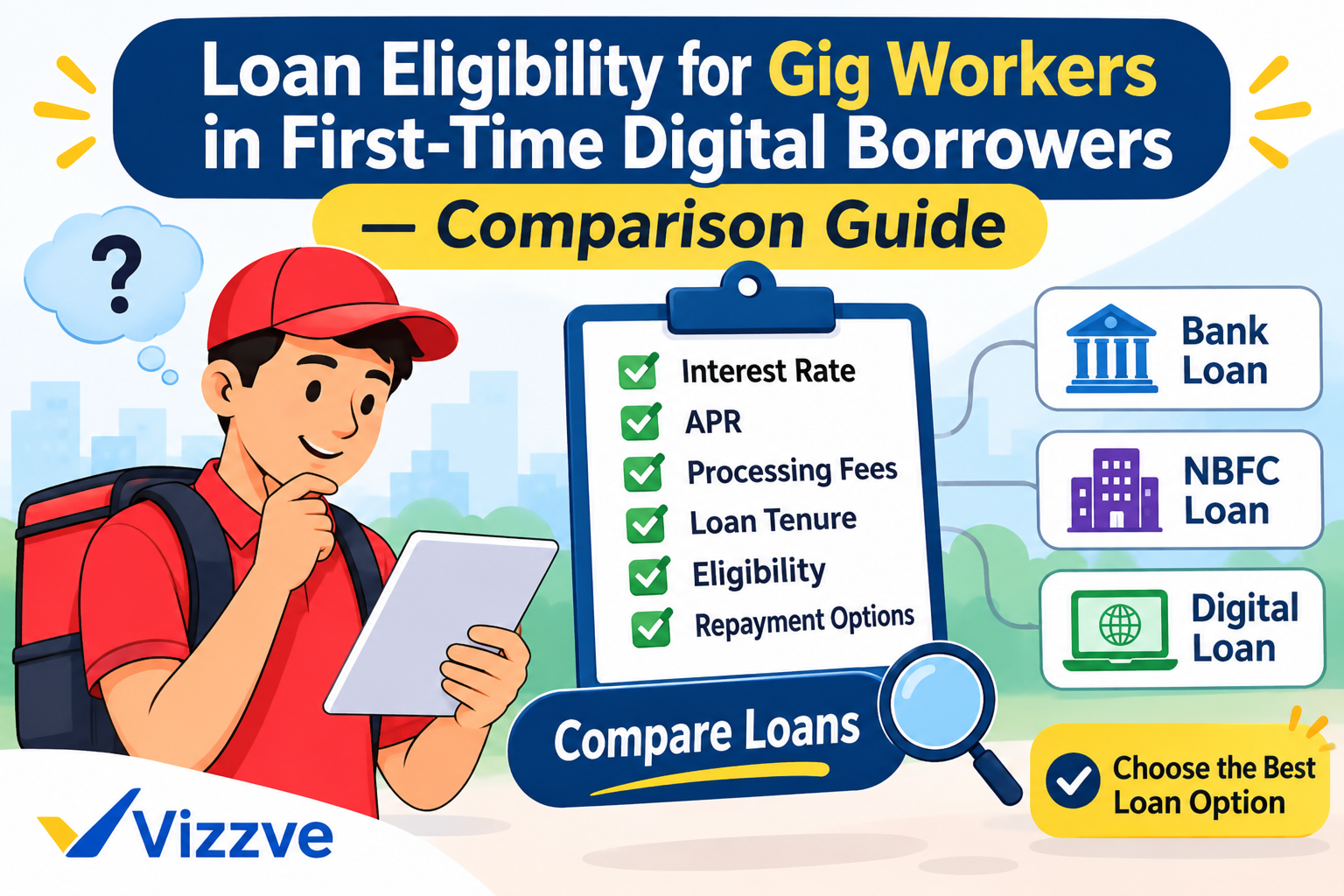
Getting a loan for the first time can be challenging for gig workers and digital borrowers, especially when they do not have a fixed monthly salary. Delivery partners, cab drivers, freelancers, online service providers, and other platform-based workers often earn through multiple sources.
However, different lenders offer different loan options, interest rates, repayment periods, eligibility requirements, and charges. Choosing the right loan requires more than simply comparing the amount offered.
A proper loan comparison helps first-time digital borrowers understand their options, identify affordable repayment plans, and avoid unnecessary financial risks.
In this guide, we explain how gig workers can compare loan options, understand eligibility requirements, evaluate interest rates, and choose suitable borrowing options in India.
1. What Is Loan Eligibility for Gig Workers?
Loan eligibility refers to the conditions a lender considers before approving a loan application.
Unlike traditional salaried employees, gig workers may not receive a fixed monthly salary. Their earnings can depend on the number of deliveries, completed rides, freelance projects, or working hours.
Lenders may evaluate several factors, including:
-
Age and identity verification.
-
Monthly or average income.
-
Bank account statements.
-
Earnings from gig platforms.
-
Existing loans and financial commitments.
-
Credit history and repayment behaviour.
-
Employment or occupation details.
Meeting the eligibility requirements does not guarantee loan approval. Final approval depends on the lender's assessment and applicable policies.
2. Why Is Loan Comparison Important for First-Time Digital Borrowers?
First-time borrowers may not have enough experience evaluating loan offers. Comparing different options before applying can help them make informed decisions.
Major benefits of loan comparison:
-
Understand different interest rates.
-
Identify affordable EMI options.
-
Compare loan repayment periods.
-
Check processing fees and additional charges.
-
Understand eligibility requirements.
-
Avoid unsuitable loan products.
-
Choose transparent and reliable lenders.
A lower advertised interest rate does not always mean a cheaper loan. Borrowers should compare the complete borrowing cost.
3. Different Loan Options Available for Gig Workers
Gig workers may explore different types of formal credit options depending on their income, financial requirements, and eligibility.
A. Personal Loans
Personal loans are generally unsecured loans that can be used for eligible personal expenses.
Suitable for:
-
Emergency expenses.
-
Household requirements.
-
Medical expenses.
-
Other permitted personal needs.
Things to check:
-
Interest rate and APR.
-
Processing charges.
-
Repayment tenure.
-
Credit score requirements.
B. Bank Loans
Banks offer different loan products based on their lending policies and borrower profiles.
Potential advantages:
-
Established lending institutions.
-
Clearly documented loan terms.
-
Multiple repayment options, depending on the product.
Things to check:
-
Income documentation.
-
Minimum eligibility criteria.
-
Credit history requirements.
-
Processing time.
C. NBFC Loans
Non-Banking Financial Companies (NBFCs) provide different types of credit products to eligible borrowers.
Some NBFCs may consider alternative income documentation, depending on their underwriting policies.
Potential advantages:
-
Different loan products.
-
Digital application facilities.
-
Alternative assessment methods offered by some lenders.
Things to check:
-
Total borrowing cost.
-
Lender registration and credentials.
-
Repayment conditions.
-
Applicable fees and penalties.
D. Digital Loans
Digital loans allow eligible borrowers to apply through online platforms or mobile applications.
Potential advantages:
-
Online application process.
-
Digital document submission.
-
Convenient application tracking.
-
Access to loan information online.
Things to check:
-
Actual regulated lender.
-
Privacy and data permissions.
-
APR and loan agreement.
-
Official repayment channels.
4. Comparison of Loan Options for Gig Workers
The following table provides a general comparison. Actual features, eligibility, rates, and approval conditions vary by lender and loan product.
|
Comparison factor |
Bank loans |
NBFC loans |
Digital loans |
|---|---|---|---|
|
Application |
Branch or online |
Online or offline |
Mostly online |
|
Income assessment |
Lender-specific |
Lender-specific |
Lender-specific |
|
Documentation |
Varies |
Varies |
Digital or electronic |
|
Processing |
Varies |
Varies |
Often digitally managed |
|
Interest rate |
Offer-specific |
Offer-specific |
Offer-specific |
|
Repayment |
As agreed |
As agreed |
As agreed |
|
Eligibility |
Policy-based |
Policy-based |
Policy-based |
Important: Digital lending describes a method of delivering credit, not a separate category of regulated lender. A digital loan may be offered by a bank or an NBFC.
5. Important Factors to Compare Before Applying
1. Interest Rate
Check the interest rate offered by each lender. Understand whether it is fixed or variable, where applicable.
2. Annual Percentage Rate (APR)
APR represents the annual cost of borrowing, including interest and applicable charges covered under the calculation.
Comparing APR is generally more useful than comparing only the advertised interest rate.
3. Processing Fees
Check whether the lender charges a processing fee or other upfront costs.
4. Loan Tenure
A longer repayment period may reduce the EMI but can increase the overall interest paid.
5. EMI Amount
Select an instalment that you can comfortably pay even during months when gig earnings are lower.
6. Prepayment Conditions
Check whether early repayment is allowed and whether any applicable charges or conditions apply.
7. Late Payment Charges
Understand the consequences of delayed payments before accepting the offer.
8. Customer Support
Check whether the lender provides accessible customer service and a grievance redressal mechanism.
6. Documents Required for Gig Worker Loan Applications
First-time digital borrowers should prepare their basic financial and identity documents before applying.
Commonly requested documents may include:
-
Aadhaar card or another accepted identity document.
-
PAN card.
-
Bank account details.
-
Recent bank statements.
-
Address proof, where required.
-
Income proof or gig platform earning statements.
-
Recent photographs, if requested.
Document requirements differ between lenders. Some may accept digital income records or bank transaction histories as supporting evidence.
7. How Gig Workers Can Improve Loan Eligibility
Gig workers can improve their financial profile by following responsible financial practices.
Step 1: Maintain Consistent Income Records
Keep records of earnings received from delivery applications, ride-sharing platforms, freelance work, and other sources.
Step 2: Use a Bank Account Regularly
Receive your earnings through a bank account wherever possible. Regular transaction records can help demonstrate income activity.
Step 3: Maintain a Good Credit History
Pay existing EMIs and credit card bills on time. Avoid unnecessary defaults.
Step 4: Reduce Existing Debt
Review your outstanding loans before applying for another credit facility.
Step 5: Provide Accurate Information
Submit genuine identity, income, and banking details. Incorrect information may delay or affect the application.
Step 6: Choose an Affordable Loan Amount
Avoid applying for a larger amount than your actual financial requirement.
8. How to Compare Loan Offers: A Practical Example
Suppose a gig worker wants to borrow ₹50,000 for personal expenses and receives two hypothetical loan offers.
Illustrative comparison only. These are not actual lender offers or current market rates.
|
Particulars |
Offer A |
Offer B |
|---|---|---|
|
Loan amount |
₹50,000 |
₹50,000 |
|
Annual interest rate |
14% |
18% |
|
Repayment tenure |
12 months |
12 months |
|
Approx. monthly EMI |
₹4,488 |
₹4,584 |
|
Total repayment |
₹53,856 |
₹55,008 |
|
Approx. interest |
₹3,856 |
₹5,008 |
Approximate figures using standard monthly reducing-balance EMI calculations, excluding additional charges.
What does this comparison show?
-
Offer A has a lower interest rate.
-
Offer B has a higher estimated repayment amount.
-
Additional fees and APR must also be checked.
-
The borrower should review the KFS before selecting an offer.
This example demonstrates why borrowers should compare the total cost rather than choosing a loan based only on the advertised amount.
9. Loan Eligibility Comparison: Salaried Employees vs Gig Workers
|
Eligibility factor |
Salaried employees |
Gig workers |
|---|---|---|
|
Income source |
Monthly salary |
Platform or freelance earnings |
|
Income pattern |
Often regular |
May fluctuate |
|
Income proof |
Salary slips |
Bank statements and earning records |
|
Employment proof |
Employer documents |
Platform or work records |
|
Credit history |
Considered |
Considered |
|
Repayment capacity |
Income and expenses |
Average earnings and expenses |
Gig workers may need alternative income documentation because they do not always receive traditional salary slips.
However, lenders assess every application according to their own credit policies.
10. RBI Guidelines for Comparing Digital Loan Offers
The Reserve Bank of India (RBI) introduced the Digital Lending Directions, 2025, which include important borrower protection and transparency requirements.
Some important points are:
-
Regulated lenders must assess the borrower's creditworthiness.
-
Borrowers must receive a Key Facts Statement (KFS).
-
The KFS should disclose important loan details, including APR.
-
Digital loan offers facilitated through applicable multi-lender arrangements must provide transparent information for comparison.
-
Loan terms and applicable charges should be communicated clearly.
-
Borrowers must have access to grievance redressal information.
-
Applicable cooling-off requirements must be followed.
These requirements help borrowers understand the terms before accepting digital credit.
Read the official RBI Digital Lending Directions, 2025 for details.
11. Common Mistakes to Avoid While Comparing Loans
|
Common mistake |
Better approach |
|---|---|
|
Choosing the first loan offer |
Compare multiple suitable offers |
|
Looking only at interest rates |
Compare APR and total cost |
|
Ignoring processing fees |
Review the KFS |
|
Applying to too many lenders |
Research before applying |
|
Selecting an unaffordable EMI |
Calculate repayment capacity |
|
Ignoring lender credentials |
Verify the regulated lender |
|
Sharing OTPs with strangers |
Never share confidential banking credentials |
|
Ignoring loan agreements |
Read all terms before acceptance |
12. How Vizzve Helps First-Time Digital Borrowers
Vizzve focuses on providing useful financial information to help borrowers understand digital lending and loan-related decisions.
For gig workers, understanding loan eligibility and comparing available financial options can make the borrowing process easier to navigate.
Before applying, borrowers should:
-
Understand the eligibility requirements.
-
Compare interest rates and APR.
-
Review repayment conditions.
-
Check lender credentials.
-
Understand all applicable charges.
-
Choose a loan based on actual repayment capacity.
Vizzve encourages informed financial decisions and responsible borrowing practices.
13. Key Takeaways
-
Gig workers can explore different formal loan options depending on lender eligibility policies.
-
Bank, NBFC, and digital loan offers should be compared carefully.
-
APR provides a more complete view of borrowing costs than the interest rate alone.
-
Bank statements and platform earning records may support income verification.
-
A good credit history can strengthen a borrower's financial profile.
-
First-time borrowers should read the KFS and loan agreement.
-
Always select an affordable loan amount and repayment schedule.
14. Frequently Asked Questions (FAQs)
1. Can gig workers apply for personal loans in India?
Yes. Gig workers can apply for personal loans if they meet the lender's eligibility, income verification, and credit assessment requirements.
2. Can first-time digital borrowers get loans without salary slips?
Some lenders may accept bank statements, gig platform earnings, and other alternative income records instead of traditional salary slips.
3. Which loan option is better for gig workers?
The best option depends on the interest rate, APR, repayment tenure, eligibility conditions, and total borrowing cost.
4. Are digital loans suitable for first-time borrowers?
Digital loans can offer convenient applications, but borrowers should verify the regulated lender and carefully review the loan terms.
5. What documents are required for gig worker loans?
Common documents include PAN, Aadhaar or other accepted identity proof, bank statements, and income records.
6. Does credit score affect gig worker loan eligibility?
Yes. Credit history and repayment behaviour may influence loan eligibility, interest rates, and approval decisions.
7. Can delivery partners apply for loans?
Yes. Delivery partners may apply if they satisfy the lender's income, identity, and other eligibility requirements.
8. What is APR in a loan comparison?
APR represents the annual cost of borrowing, including interest and applicable charges covered under its calculation.
9. Is a lower EMI always a better loan option?
No. A lower EMI may result from a longer repayment tenure, which can increase the total interest paid.
10. Can gig workers compare bank and NBFC loans?
Yes. They can compare available offers based on interest rates, APR, fees, repayment conditions, and eligibility requirements.
11. How can first-time borrowers improve their loan eligibility?
They can maintain consistent income records, pay existing debts on time, reduce outstanding obligations, and provide accurate documents.
12. Do gig workers need a credit score to apply for a loan?
Requirements vary by lender. Some lenders may consider alternative financial information, but approval is never guaranteed.
13. What is a Key Facts Statement (KFS)?
A KFS is a standardised document that explains important loan details, including APR, repayment obligations, and applicable charges.
14. Can gig workers apply for digital loans using mobile applications?
Yes. Eligible borrowers can apply through digital lending applications associated with regulated lenders.
15. How can borrowers avoid choosing the wrong loan?
Compare multiple suitable offers, check the total borrowing cost, verify lender credentials, and select an affordable repayment schedule.
15. Conclusion
Choosing the right loan is an important financial decision for gig workers and first-time digital borrowers. Since gig workers often have changing income patterns, comparing different loan options can help them identify suitable borrowing arrangements.
Before applying, borrowers should evaluate interest rates, APR, processing fees, repayment tenure, and eligibility requirements. They should also maintain proper income records and understand their repayment responsibilities.
With careful comparison and responsible financial planning, gig workers can make informed borrowing decisions and manage their financial needs more confidently.
Vizzve encourages every first-time borrower to compare wisely, understand loan terms, and borrow responsibly.
Published on : 11th November
Published by : Siva Nagaiah K
www.vizzve.com || www.vizzveservices.com
Follow us on social media: Facebook || Linkedin || Instagram
🛡 Powered by Vizzve Financial
RBI-Registered Loan Partner | 10 Lakh+ Customers | ₹600 Cr+ Disbursed