

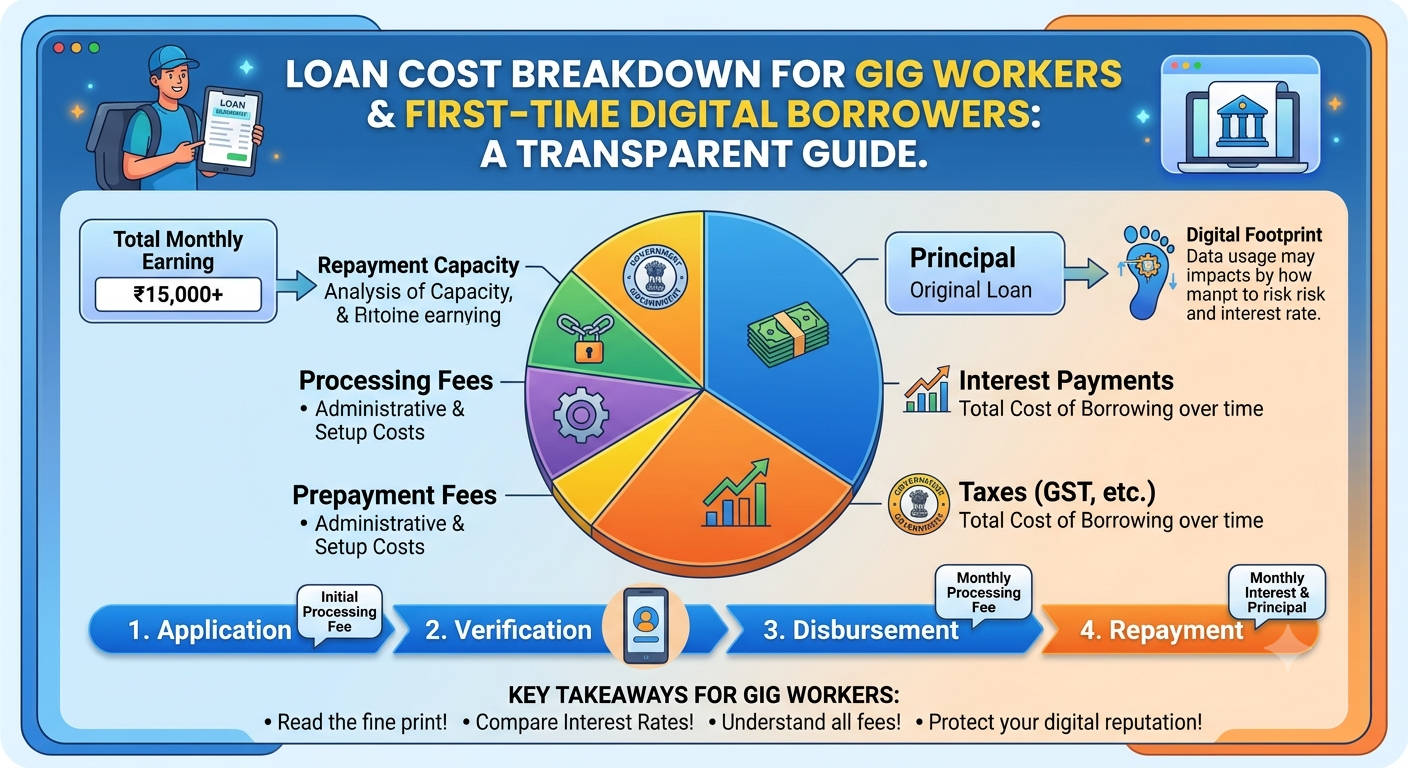
Understanding the cost of borrowing is an important step for gig workers applying for their first digital loan. First-time digital borrowers may focus mainly on loan amounts and interest rates, but the actual cost of a loan includes several other charges.
Delivery partners, cab drivers, freelancers and independent service providers should understand these costs before accepting a loan offer. Knowing the interest rate, processing fee, GST, EMI and late payment charges can help borrowers make better financial decisions.
This guide explains the different costs associated with personal loans for gig workers, how lenders calculate repayment amounts and what first-time digital borrowers should check before applying for a loan in India.
1. What Is the Cost Breakdown of a Loan?
Loan cost breakdown refers to the complete amount a borrower may need to pay when taking and repaying a loan.
It includes more than the principal amount borrowed.
Common loan-related costs include:
-
Interest charges.
-
Loan processing fees.
-
GST on applicable services.
-
Documentation or verification charges, if applicable.
-
Late payment charges.
-
Penal charges for non-compliance with loan terms.
-
Foreclosure or prepayment charges, where permitted.
Understanding these expenses helps gig workers calculate the actual cost of borrowing rather than focusing only on the advertised interest rate.
2. Why Should First-Time Digital Borrowers Understand Loan Costs?
First-time borrowers may have limited experience with loan agreements and repayment schedules.
Understanding loan costs helps them:
-
Calculate the total repayment amount.
-
Compare different loan offers.
-
Identify additional charges.
-
Understand monthly EMI obligations.
-
Avoid unexpected financial expenses.
-
Choose a suitable repayment tenure.
-
Borrow according to their income.
For gig workers with fluctuating monthly earnings, understanding the complete repayment obligation is particularly important.
3. Different Types of Costs Associated With Gig Worker Loans
A. Interest Rate
Interest is the amount charged by a lender for providing a loan.
The interest rate may depend on factors such as:
-
Loan amount.
-
Repayment tenure.
-
Credit history.
-
Income profile.
-
Lender's credit assessment.
-
Applicable loan product.
For example, if a gig worker borrows ₹50,000, interest will be calculated according to the agreed interest rate and repayment structure.
Always check whether the lender quotes a reducing-balance rate or another interest calculation method.
B. Processing Fee
A processing fee is a charge that a lender may collect for processing a loan application.
It may depend on:
-
Loan amount.
-
Lender's pricing policy.
-
Loan product.
-
Applicable promotional offers.
For example, if a lender charges a processing fee of 2% on a ₹50,000 loan:
₹50,000 × 2% = ₹1,000
The processing fee in this illustration is ₹1,000 before applicable taxes.
C. GST on Applicable Charges
GST may apply to certain loan-related services and fees.
For example, if a processing fee is ₹1,000 and GST is charged at an illustrative rate of 18%:
₹1,000 × 18% = ₹180
Total processing fee including illustrative GST:
₹1,000 + ₹180 = ₹1,180
GST applicability and treatment should be checked against the lender's invoice and applicable tax rules. GST is not simply an additional tax on the loan principal.
D. EMI (Equated Monthly Instalment)
EMI is the scheduled periodic payment a borrower makes towards loan repayment.
It generally includes:
-
Principal repayment.
-
Interest repayment.
The EMI depends on the loan amount, interest rate and repayment tenure.
A longer tenure may reduce the monthly EMI but can increase the total interest paid.
E. Late Payment Charges
Late payment charges may apply when borrowers fail to pay their EMIs by the due date.
Gig workers should understand:
-
EMI due dates.
-
Applicable overdue charges.
-
Penal charge conditions.
-
Payment grace periods, if offered.
-
The lender's collection and recovery policy.
Do not assume that all lenders have identical late payment policies.
F. Foreclosure and Prepayment Charges
Some borrowers may want to repay their loans before the scheduled end date.
Depending on the loan type, lender and applicable RBI regulations, foreclosure or prepayment charges may be restricted or permitted.
Always review the loan agreement and applicable rules before making an early repayment.
4. Example of a Personal Loan Cost Breakdown
Consider a first-time gig worker who borrows ₹50,000 for 12 months.
The following is an illustrative calculation, not an actual lender offer.
| Particulars | Example amount |
|---|---|
| Loan principal | ₹50,000 |
| Annual interest rate | 18% |
| Repayment tenure | 12 months |
| Approximate monthly EMI | ₹4,584 |
| Total EMI repayment | ₹55,008 |
| Total interest | ₹5,008 |
| Processing fee (2%) | ₹1,000 |
| Illustrative GST (18% on fee) | ₹180 |
| Total processing-related charges | ₹1,180 |
Estimated total repayment and charges: ₹56,188.
If the processing fee and GST are deducted upfront from the disbursement, the borrower may receive approximately ₹48,820 in their bank account while still repaying approximately ₹55,008 through EMIs.
The actual APR and total cost must be checked in the lender's Key Fact Statement (KFS).
5. How Does Loan Tenure Affect the Total Cost?
Loan tenure determines how long a borrower takes to repay the loan.
A shorter tenure generally means higher monthly EMIs but lower total interest. A longer tenure generally means lower monthly EMIs but higher total interest.
For example:
| Factor | Short tenure | Long tenure |
|---|---|---|
| Monthly EMI | Usually higher | Usually lower |
| Total interest | Usually lower | Usually higher |
| Repayment duration | Shorter | Longer |
| Monthly budget pressure | Higher | Lower |
Gig workers should select a repayment period according to their average income, monthly expenses and savings.
6. Important Factors That Affect Loan Costs for Gig Workers
Several factors can influence the cost of borrowing.
Income Consistency
Lenders may evaluate income patterns and repayment capacity before deciding the applicable loan terms.
Credit History
An established credit history may influence the lender's assessment. First-time borrowers without a credit history may be assessed using other financial information.
Loan Amount
A higher principal generally results in a higher EMI or longer repayment requirement, depending on the selected tenure.
Interest Rate
The applicable interest rate directly influences the interest component of repayment.
Processing Charges
Different lenders may have different processing fee structures.
Existing Financial Obligations
Existing EMIs and other commitments affect how much a borrower can comfortably repay.
7. Cost Comparison: What Should First-Time Borrowers Check?
Before selecting a loan, compare the following details:
| Cost factor | What to understand |
|---|---|
| Interest rate | Annual rate and calculation method |
| APR | All-inclusive annual cost of credit |
| Processing fee | Initial application-related charge |
| GST | Tax applicable to relevant services |
| EMI | Regular repayment amount |
| Total interest | Interest payable over the tenure |
| Late payment charges | Charges for payment delays |
| Prepayment terms | Conditions for early repayment |
| Net disbursal | Actual amount received |
Do not compare loans using only their advertised interest rates. APR and the KFS provide a more complete picture of the cost.
8. How Can Gig Workers Manage Loan Costs?
First-time digital borrowers can follow these practical financial habits:
-
Borrow only the amount they actually need.
-
Compare multiple genuine loan offers.
-
Check APR before accepting a loan.
-
Choose an affordable EMI.
-
Maintain emergency savings.
-
Avoid unnecessary processing or add-on services.
-
Set reminders for EMI due dates.
-
Keep digital payment records.
-
Read the loan agreement carefully.
-
Avoid taking another loan just to repay an existing EMI.
9. Common Loan Cost Mistakes to Avoid
-
Ignoring processing fees: Initial charges can increase the effective borrowing cost.
-
Focusing only on EMI: A small EMI may come with a longer tenure and more total interest.
-
Ignoring APR: The advertised interest rate may not represent the complete cost.
-
Missing repayment dates: Delayed payments may attract disclosed penal charges.
-
Not reading the KFS: Important charges and repayment terms may be overlooked.
-
Borrowing beyond repayment capacity: This can create unnecessary financial pressure.
-
Ignoring prepayment conditions: Early repayment terms should be understood in advance.
10. Digital Lending Cost Transparency and Borrower Protection
The Reserve Bank of India has introduced rules to improve transparency in digital lending.
Borrowers should receive relevant loan information, including the Key Fact Statement and Annual Percentage Rate, before entering into the loan agreement.
The KFS helps borrowers understand:
-
Loan amount.
-
Interest rate.
-
Repayment schedule.
-
APR.
-
Applicable fees and charges.
-
Important repayment conditions.
First-time digital borrowers should also verify the regulated lender behind a digital loan application and avoid making payments to unauthorised intermediaries.
11. AI Answer Box: What Is the Cost Breakdown of a Gig Worker Loan?
The cost breakdown of a gig worker loan includes the principal amount, interest, processing fee, applicable GST, EMI and any disclosed additional charges. First-time digital borrowers should compare the Annual Percentage Rate (APR), total repayment amount and repayment tenure before accepting a loan. Understanding the Key Fact Statement helps gig workers identify the actual borrowing cost and choose a repayment plan that suits their income.
12. Frequently Asked Questions (FAQs)
1. What is included in a personal loan cost breakdown?
It generally includes principal, interest, processing fees, applicable taxes and other disclosed loan-related charges.
2. Do gig workers have to pay processing fees?
Some lenders charge processing fees, while others may offer different fee structures or promotions.
3. Is GST applicable to personal loan interest?
GST treatment differs between interest and taxable services. GST generally applies to applicable service fees, not simply to the principal or ordinary loan interest.
4. What is APR in a personal loan?
APR represents the annual cost of credit and includes the interest rate and applicable charges associated with the credit facility.
5. How is EMI calculated?
EMI is calculated using the loan principal, interest rate and repayment tenure.
6. Does a longer loan tenure increase the total cost?
Generally, yes. A longer tenure may reduce monthly EMI but increase the total interest paid.
7. Can first-time borrowers get loans without a credit score?
It may be possible. Lenders may assess income, bank statements and repayment capacity along with other applicable information.
8. Are processing fees deducted from the loan amount?
Depending on the lender's terms, processing fees may be deducted from disbursement or collected separately.
9. What happens if a gig worker misses an EMI?
The lender may apply disclosed penal charges and report repayment information to credit information companies, as applicable.
10. Are late payment charges the same for every lender?
No. Charges depend on the lender's disclosed policy and loan agreement.
11. Can I repay my personal loan before the tenure ends?
Early repayment may be possible, subject to the applicable loan terms and regulatory requirements.
12. How can gig workers reduce loan costs?
They can compare APR, choose suitable tenures, borrow only what they need and make repayments on time.
13. What is the importance of a Key Fact Statement?
The KFS explains important loan terms, APR, fees, charges and repayment details in a standardised format.
14. Does income affect the cost of a personal loan?
Income and repayment capacity may influence the lender's assessment and applicable loan terms.
15. How can first-time digital borrowers avoid hidden charges?
They should review the KFS, loan agreement, APR and all applicable charges before accepting an offer.
13. Key Takeaways
-
Loan costs include more than interest.
-
Processing fees can increase initial borrowing expenses.
-
GST may apply to relevant service charges.
-
EMI depends on principal, interest rate and tenure.
-
Longer tenures can increase total interest.
-
APR helps compare the overall cost of loans.
-
KFS provides important loan-related disclosures.
-
Late payment and other penal charges should be checked.
-
Borrowers should select affordable repayment plans.
14. Conclusion
Understanding the cost breakdown of loans helps gig workers make informed borrowing decisions. First-time digital borrowers should not focus only on loan approval or monthly EMI. They should also understand interest rates, processing fees, applicable taxes, APR and total repayment obligations.
For delivery partners, freelancers, cab drivers and other gig workers, proper financial planning is particularly important because monthly earnings may fluctuate.
Before accepting any digital loan, compare available options, review the Key Fact Statement and verify the lending institution.
Vizzve encourages responsible borrowing, transparent financial decisions and better loan cost awareness among gig workers and first-time digital borrowers.
Published on : 6th November
Published by : Siva Nagaiah K
www.vizzve.com || www.vizzveservices.com
Follow us on social media: Facebook || Linkedin || Instagram
🛡 Powered by Vizzve Financial
RBI-Registered Loan Partner | 10 Lakh+ Customers | ₹600 Cr+ Disbursed