

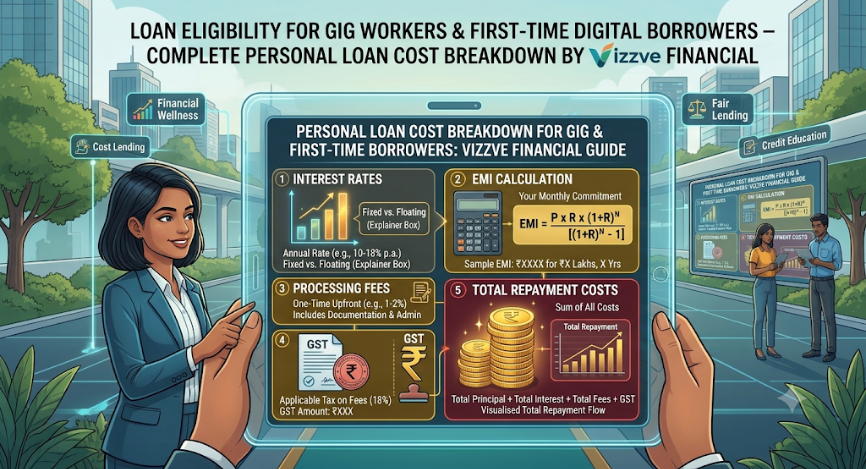
Introduction
Getting a personal loan can be useful when you need money for an emergency, vehicle repair, household expenses or another important financial requirement.
However, understanding the total cost of borrowing is just as important as checking loan eligibility.
For gig workers and first-time digital borrowers, this becomes particularly important. Delivery partners, cab drivers, freelancers and independent professionals may have changing monthly incomes and different documentation requirements.
Before applying, borrowers should understand:
-
Whether their income meets the lender's eligibility criteria.
-
How much interest they may need to pay.
-
What processing fees and other charges apply.
-
How monthly EMI is calculated.
-
How much they will repay over the complete loan tenure.
-
Whether the EMI remains affordable during lower-income months.
A loan should not be judged only by its approved amount or advertised interest rate. The actual borrowing cost includes applicable interest, fees and other charges.
This guide explains the eligibility requirements and complete personal loan cost breakdown in simple language.
3. AI Answer Box – Quick Explanation
What is the cost breakdown of a personal loan for gig workers?
A personal loan cost breakdown explains all the expenses a borrower may incur when taking and repaying a loan.
The main cost components include:
-
Principal loan amount.
-
Interest charges.
-
Processing fees.
-
Applicable GST on taxable charges.
-
Other disclosed lender charges, if applicable.
-
Late-payment or penal charges, if triggered by default.
Gig workers and first-time digital borrowers should compare the Annual Percentage Rate (APR), monthly EMI and total repayment amount before accepting a loan.
Loan eligibility depends on income, age, occupation, credit information, existing obligations and the lender's policies.
4. What Is the Complete Cost Breakdown of a Personal Loan?
A personal loan has more than one cost component. The amount you borrow is called the principal, but the amount you repay may be higher because of interest and applicable charges.
For gig workers and first-time borrowers, understanding each component helps avoid unexpected financial pressure.
Main Components of Personal Loan Costs
|
Cost Component |
Meaning |
|---|---|
|
Principal |
Original amount borrowed |
|
Interest |
Cost charged for borrowing money |
|
Processing Fee |
Fee for processing the loan |
|
GST |
Applicable tax on taxable services and fees |
|
Late Payment Charges |
Charges if payment is delayed, as per loan terms |
|
Foreclosure Charges |
Applicable charges for closing a loan early, if permitted under the contract and regulations |
|
Other Disclosed Charges |
Any additional applicable costs explained by the lender |
Not every loan includes every charge. The actual cost depends on the lender, loan product, agreement and applicable regulations.
5. Principal Amount – How Much Money Are You Borrowing?
The principal is the original loan amount approved by the lender.
For example:
-
Loan amount: ₹50,000
-
Loan purpose: Emergency expenses
-
Repayment period: 12 months
The ₹50,000 is the principal amount. Interest and applicable fees are calculated separately.
Why Is the Principal Important?
A larger loan amount generally results in:
-
Higher monthly EMI.
-
Higher total interest at the same rate and tenure.
-
Greater repayment responsibility.
Expert tip: Borrow only the amount you actually need. A higher loan offer does not mean you should accept a larger loan.
6. Interest Charges – The Main Cost of Borrowing
Interest is the amount charged by the lender for providing credit.
Personal loan interest rates may differ depending on:
-
Applicant's income.
-
Credit history.
-
Existing financial commitments.
-
Loan amount.
-
Repayment tenure.
-
Lender's pricing policy.
Example: Interest Cost at Different Rates
Suppose a gig worker borrows ₹50,000 for 12 months.
|
Annual Interest Rate |
Approximate EMI |
Total Interest |
|---|---|---|
|
12% |
₹4,442 |
₹3,304 |
|
15% |
₹4,513 |
₹4,156 |
|
18% |
₹4,584 |
₹5,008 |
|
21% |
₹4,655 |
₹5,860 |
|
24% |
₹4,728 |
₹6,736 |
Illustrative reducing-balance EMI calculations, rounded to the nearest rupee. Fees and taxes are excluded.
The table shows how the interest rate can affect monthly payments and total borrowing costs.
Flat Interest vs Reducing Balance Interest
|
Flat Interest |
Reducing Balance Interest |
|---|---|
|
Interest calculated on original principal |
Interest calculated on outstanding principal |
|
Principal does not reduce for interest calculation |
Interest generally falls as principal is repaid |
|
Can result in higher effective borrowing costs |
Reflects the declining loan balance |
|
Requires careful cost comparison |
Commonly used for EMI-based personal loans |
Always check the actual method used in the loan agreement.
7. Processing Fees – What Do First-Time Borrowers Pay?
A processing fee is an amount charged by the lender for handling and processing a loan application.
It may be:
-
A fixed amount.
-
A percentage of the approved loan amount.
-
Subject to a minimum or maximum fee.
Processing Fee Example
Suppose:
-
Loan amount: ₹50,000
-
Processing fee: 2%
Calculation:
The processing fee would be ₹1,000 before any applicable tax.
Does Every Lender Charge the Same Processing Fee?
No. Different lenders may have different processing fee structures.
Before accepting a loan, check:
-
Processing fee percentage.
-
Minimum processing fee.
-
Maximum processing fee.
-
Applicable GST.
-
Whether the fee is deducted from disbursement or collected separately.
8. GST and Other Applicable Taxes on Loan Charges
Borrowers should understand that taxes may apply to certain loan-related services and fees.
For example, GST may apply to taxable processing and service charges, depending on the nature of the charge and applicable tax rules.
Example of GST on a Processing Fee
Assume:
|
Particulars |
Amount |
|---|---|
|
Processing fee |
₹1,000 |
|
Illustrative GST at 18% |
₹180 |
|
Total processing cost |
₹1,180 |
This is an illustration, not a universal lender fee or tax quotation.
Important: Do not assume every loan charge attracts the same tax treatment. Check the lender's fee schedule and tax invoice.
9. What Is APR and Why Is It Important?
APR stands for Annual Percentage Rate.
It represents the annualised cost of borrowing and helps borrowers understand the overall cost of credit, including the interest rate and applicable included charges.
For first-time digital borrowers, APR is especially useful because a loan with a lower advertised interest rate may still have additional fees.
Interest Rate vs APR
|
Interest Rate |
APR |
|---|---|
|
Shows the interest charged on the loan |
Shows the annualised cost of credit |
|
May not include all applicable fees |
Includes applicable charges as defined by the APR calculation |
|
Useful for understanding interest |
Useful for comparing overall borrowing costs |
|
Can appear lower |
Gives a broader cost picture |
Example
Consider two hypothetical loan offers:
|
Particulars |
Offer A |
Offer B |
|---|---|---|
|
Advertised Interest Rate |
15% |
14% |
|
Processing Fee |
2% |
4% |
|
Loan Amount |
₹50,000 |
₹50,000 |
Although Offer B has a lower advertised interest rate, its higher processing fee may make the total borrowing cost higher.
The borrower should compare the actual KFS and APR rather than selecting a loan based only on the advertised rate.
Expert insight: APR is one of the most useful numbers to compare before accepting a digital personal loan.
10. Complete Personal Loan Cost Breakdown – Practical Example
Let's understand the actual financial impact through an illustrative example.
Suppose a first-time digital borrower applies for a ₹50,000 personal loan.
Loan Details
|
Particulars |
Amount |
|---|---|
|
Principal Loan Amount |
₹50,000 |
|
Annual Interest Rate |
18% |
|
Loan Tenure |
12 Months |
|
Monthly EMI |
₹4,584 |
|
Total Repayment |
₹55,008 |
|
Total Interest |
₹5,008 |
|
Processing Fee (2%) |
₹1,000 |
|
Illustrative GST (18% on fee) |
₹180 |
Total Borrowing Cost
Illustrative loan cost summary
₹6,188
Interest plus processing fee and illustrative GST
Loan principal
₹50,000
Total interest
₹5,008
Processing fee
₹1,000
Illustrative GST
₹180
Total economic outflow
₹56,188
Assumes the processing fee and tax are paid separately or deducted from disbursement. No other charges are assumed. Rounded EMI figures are illustrative; the lender's KFS provides the actual APR and repayment schedule.
If the processing fee and tax are deducted upfront, the borrower may receive ₹48,820 in their bank account while remaining responsible for repaying the scheduled loan instalments.
This is why borrowers should check both the sanctioned amount and the net disbursed amount.
11. Other Charges That Gig Workers Should Understand
Apart from interest and processing fees, some loans may involve additional charges under the lender's disclosed terms.
A. Late Payment Charges
These may apply when an EMI is not paid by the due date.
Missing payments can also affect your credit history.
B. Penal Charges
Penal charges may apply for specific defaults or non-compliance with material loan terms.
RBI rules require applicable penal charges and their reasons to be disclosed. Penal charges must not be added to the interest rate as penal interest or capitalised for further interest calculation.
C. Foreclosure or Prepayment Charges
Some loan agreements may specify charges for closing a loan before the scheduled tenure.
However, applicable RBI restrictions and the type of loan matter. For example, RBI's 2025 directions restrict prepayment charges on certain floating-rate loans to individuals for non-business purposes, subject to the specified conditions. Always check which rules apply to your loan.
D. Insurance or Other Optional Services
Some loan offers may include insurance or other additional services.
Before agreeing, understand whether they are optional or required, what they cost and whether they are included in the disclosed APR.
12. How Does Loan Tenure Affect the Total Cost?
Loan tenure is the period during which you repay the borrowed amount.
A shorter tenure generally means a higher monthly EMI but lower total interest. A longer tenure generally means a lower EMI but higher total interest.
Example: ₹50,000 Loan at 18% Annual Interest
|
Tenure |
Monthly EMI |
Total Interest |
Total Repayment |
|---|---|---|---|
|
6 Months |
₹8,784 |
₹2,704 |
₹52,704 |
|
12 Months |
₹4,584 |
₹5,008 |
₹55,008 |
|
18 Months |
₹3,193 |
₹7,474 |
₹57,474 |
|
24 Months |
₹2,496 |
₹9,904 |
₹59,904 |
Illustrative reducing-balance calculations. Processing fees, taxes and other charges are excluded.
Which Tenure Should Gig Workers Choose?
Consider your average income rather than your highest monthly earnings.
-
Choose a shorter tenure if you can comfortably afford the higher EMI.
-
Consider a longer tenure if a smaller EMI is necessary to manage cash flow.
-
Avoid a repayment schedule that leaves no money for essential expenses.
-
Keep some savings for periods when work opportunities are limited.
Financial expert tip: For workers with variable earnings, EMI affordability should be tested against a lower-income month, not just an average or peak-income month.
13. Cost Comparison: Gig Workers vs First-Time Salaried Borrowers
The basic loan charges are generally determined by the loan product and lender, not simply by whether someone is a gig worker or salaried employee.
However, income documentation and eligibility assessments may differ.
|
Factor |
Gig Workers |
Salaried First-Time Borrowers |
|---|---|---|
|
Income type |
Variable or task-based |
Usually fixed salary |
|
Salary slips |
May not be available |
Usually available |
|
Income proof |
Platform records and bank statements |
Salary slips and bank statements |
|
Interest rate |
Based on lender assessment |
Based on lender assessment |
|
Processing fee |
Product-specific |
Product-specific |
|
EMI calculation |
Based on loan terms |
Based on loan terms |
|
APR |
Depends on loan costs |
Depends on loan costs |
|
Approval |
Subject to lender criteria |
Subject to lender criteria |
Does Being a Gig Worker Mean Paying Higher Interest?
Not automatically.
The interest rate depends on the lender's pricing model, creditworthiness assessment, income profile, loan amount, tenure and other applicable factors.
Borrowers should compare actual offers instead of assuming that all gig workers receive the same interest rate.
14. How Can First-Time Digital Borrowers Reduce Loan Costs?
Borrowers can take practical steps to avoid unnecessary expenses.
1. Compare APR Before Applying
Do not compare only advertised interest rates. Review the complete borrowing cost.
2. Borrow Only What You Need
A larger loan can increase interest and repayment obligations.
3. Select an Affordable Tenure
Choose a tenure that balances monthly EMI and total interest.
4. Read the Processing Fee Details
Check whether the fee is fixed or percentage-based and whether applicable taxes are added.
5. Avoid Missing EMI Payments
Late payments may lead to additional charges and credit-report consequences.
6. Check Optional Services
Understand the cost and conditions of insurance or other additional products.
7. Review Prepayment Conditions
If you expect to repay early, understand the applicable foreclosure and prepayment rules before signing.
15. Step-by-Step Guide to Calculate Your Total Personal Loan Cost
Here is a simple process that gig workers and first-time borrowers can follow.
Step 1: Identify the Required Loan Amount
Decide how much money you actually need.
Step 2: Check the Interest Rate
Understand whether the interest rate is fixed or floating and how it is calculated.
Step 3: Calculate the EMI
Use the lender's repayment schedule or an EMI calculator.
Step 4: Calculate Total Repayment
Multiply the EMI by the number of instalments, using the actual repayment schedule.
Step 5: Add Applicable Fees
Include processing fees, applicable taxes and other disclosed charges.
Step 6: Check Net Disbursement
Find out how much money will actually reach your bank account after any upfront deductions.
Step 7: Review APR
Compare the annualised borrowing cost of different loan offers.
Step 8: Read the KFS
Verify that the amounts and charges match the lender's official Key Fact Statement.
16. Interactive Personal Loan Cost Calculator
Use this simple calculator to estimate your EMI and total borrowing cost. It is an educational estimate, not a lender quotation.
Personal Loan Cost Estimator
Estimated monthly EMI
₹4,584
Principal
₹50,000
Total interest
₹5,008
Processing fee
₹1,000
Illustrative GST
₹180
Total repayment (EMIs)
₹55,008
Total cost including fees
₹6,188
Net disbursement if fees deducted upfront
₹48,820
Assumes a reducing-balance loan with equal monthly instalments and processing fee/GST deducted upfront for the net disbursement illustration. Actual APR, rounding, taxes and lender charges may differ. Other charges are not included.
17. Pros and Cons of Understanding Loan Costs Before Borrowing
|
Pros |
Cons |
|---|---|
|
Helps compare loan offers |
Requires careful review of documents |
|
Makes repayment planning easier |
Actual lender calculations may differ |
|
Reduces the risk of unexpected charges |
Some charges may be conditional |
|
Helps select a suitable tenure |
Lowest EMI may not mean lowest cost |
|
Encourages responsible borrowing |
APR comparisons require matching loan terms |
18. Important RBI Guidelines on Digital Loan Costs in India
The Reserve Bank of India introduced the Digital Lending Directions, 2025, consolidating its existing digital lending framework and adding further measures relating to lending service providers and digital lending app transparency.
What Should Borrowers Know?
1. Key Fact Statement (KFS)
The KFS should clearly explain important loan terms, including the sanctioned amount, instalments, interest rate and applicable charges.
2. APR Disclosure
The APR helps borrowers understand the annualised cost of credit, including applicable included charges.
3. Transparency in Fees
Applicable charges should be disclosed before the borrower accepts the loan.
4. Digital Lending App Verification
RBI's public directory can help borrowers verify an app's claimed association with a regulated entity. It should be used as a verification aid rather than an RBI endorsement of the app.
5. Borrower Data Protection
Digital lenders must follow applicable requirements concerning consent, data collection and privacy.
6. Penal Charges
Applicable penal charges must be disclosed transparently and cannot be treated as additional penal interest.
For official information, visit the Reserve Bank of India.
19. Latest Information: Growth of India's Gig Economy
Gig workers are becoming an increasingly important part of India's employment landscape.
NITI Aayog's report India's Booming Gig and Platform Economy estimated 7.7 million gig workers in 2020–21 and projected growth to 23.5 million by 2029–30. These are estimates and projections, not a verified 2026 headcount.
The growth of delivery services, ride-hailing, digital platforms and freelance work makes financial documentation increasingly relevant.
Why Does This Matter for Loan Eligibility?
-
Gig workers may have multiple income sources.
-
Digital payouts can provide transaction records.
-
Monthly earnings may fluctuate.
-
Alternative income documents may help explain earnings.
-
Repayment affordability remains essential.
However, employment in the gig economy does not automatically guarantee loan eligibility.
20. Frequently Asked Questions (FAQs)
1. What is the total cost of a personal loan?
The total cost generally includes interest and applicable loan charges, such as processing fees and taxes on taxable services. Conditional charges may apply if the borrower defaults or prepays under applicable terms.
2. Can gig workers get personal loans in India?
Yes. Gig workers may apply through lenders that accept their occupation and income profile, subject to eligibility assessment.
3. What charges are included in a personal loan?
Common charges include interest, processing fees, applicable GST on taxable fees and any other disclosed charges.
4. What is the processing fee for a personal loan?
It is a charge for processing the loan application. The amount may be fixed or calculated as a percentage of the loan amount, depending on the lender.
5. Is GST applicable to personal loan processing fees?
GST may apply to taxable processing and service fees. Check the lender's invoice and applicable tax treatment.
6. What is APR in personal loans?
APR stands for Annual Percentage Rate. It represents the annualised cost of credit, including interest and applicable included charges.
7. How can first-time borrowers calculate their EMI?
They can use the loan amount, annual interest rate and tenure in an EMI calculator or use the lender's official repayment schedule.
8. Do gig workers pay higher personal loan interest rates?
Not automatically. Interest rates depend on the lender's pricing policy and the applicant's financial and credit profile.
9. Can a personal loan processing fee be deducted from disbursement?
Yes. Some lenders deduct applicable upfront charges from the approved amount before transferring the net disbursement.
10. What happens if I miss a personal loan EMI?
The lender may apply disclosed late-payment or penal charges, and missed payments may affect your credit history.
11. Can I repay my personal loan early?
Early repayment may be possible, subject to the loan agreement and applicable RBI rules regarding prepayment charges.
12. Does a longer loan tenure reduce total interest?
No. A longer tenure generally reduces monthly EMI but increases total interest when the rate and principal remain the same.
13. Is the lowest interest rate always the cheapest loan?
No. Processing fees and other charges can increase the overall borrowing cost. Compare APR and total repayment.
14. What is a Key Fact Statement?
A KFS is a standardised document explaining important loan terms, including interest, repayment details, APR and applicable charges.
15. How can gig workers reduce personal loan costs?
They can compare APR, borrow only what they need, choose a suitable tenure, avoid missed payments and review applicable fees before accepting a loan.
21. Key Takeaways
-
Loan eligibility depends on income, occupation, credit profile and repayment capacity.
-
Gig workers may use bank statements and platform payout records as income proof.
-
Principal is the amount borrowed, while interest is the cost of borrowing.
-
Processing fees and applicable GST can increase the overall loan cost.
-
APR is useful for comparing different loan offers.
-
Longer repayment periods generally increase total interest.
-
Late-payment and other conditional charges should be checked in the KFS.
-
First-time borrowers should understand net disbursement and total repayment.
-
RBI's Digital Lending Directions, 2025, provide important digital borrower safeguards.
-
Always choose a loan with an affordable EMI.
22. Vizzve Financial – Explore Personal Loan Options
Vizzve Financial is one of India’s trusted loan support platforms offering quick personal loans, low documentation, and an easy approval process. Apply at www.vizzve.com.
Whether you are a delivery partner, cab driver, freelancer or first-time digital borrower, understanding loan costs can help you make a more informed financial decision.
Visit Vizzve Financial to explore available personal loan options and review the applicable eligibility requirements.
Loan availability, interest rates, processing fees, documentation and approval are subject to the applicable lender's policies and verification. Approval is not guaranteed.
23. Conclusion
Understanding the complete cost breakdown is an important part of responsible borrowing.
For gig workers and first-time digital borrowers, checking loan eligibility is only the beginning. It is equally important to understand interest rates, processing fees, applicable taxes, APR, monthly EMIs and total repayment.
A loan with a low advertised interest rate may not always be the most affordable option once additional charges are considered.
Before applying, compare different offers, read the Key Fact Statement and select a repayment schedule that fits your actual income.
Remember: Borrow responsibly, understand every charge and choose a loan you can comfortably repay.
Explore personal loan options with Vizzve Financial at www.vizzve.com.
Published on : 4th November
Published by : Reddy kumar
www.vizzve.com || www.vizzveservices.com
Follow us on social media: Facebook || Linkedin || Instagram
🛡 Powered by Vizzve Financial
RBI-Registered Loan Partner | 10 Lakh+ Customers | ₹600 Cr+ Disbursed