

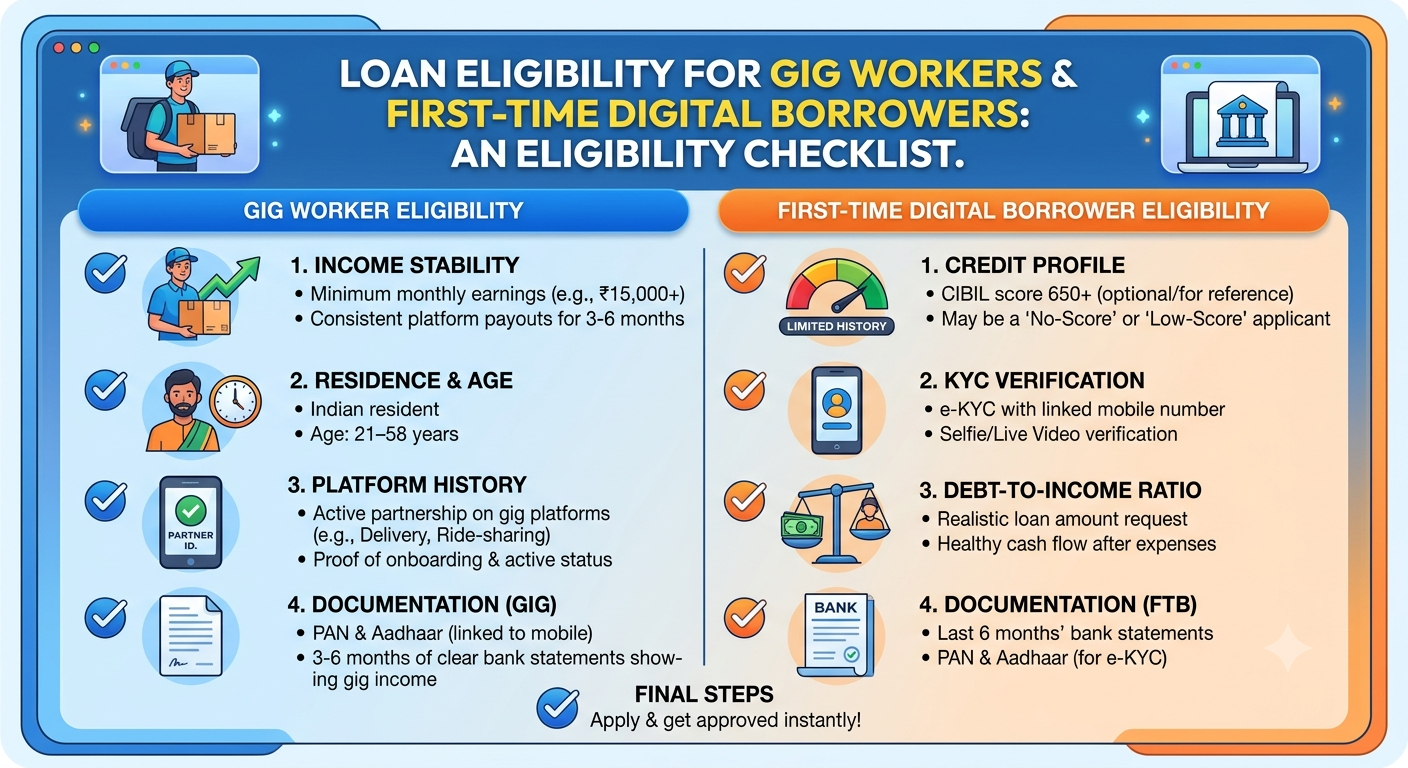
First-time digital borrowers working in the gig economy often find it difficult to understand loan eligibility requirements. Whether you work as a delivery partner, cab driver, freelancer or independent service provider, knowing what lenders check before approving a loan can help you prepare a stronger application.
Unlike salaried employees, gig workers may not receive a fixed monthly salary or traditional salary slips. Their income may come from multiple digital platforms, independent assignments and online services. Therefore, maintaining proper income records and financial documents is important when applying for a loan.
This eligibility checklist explains the important requirements, documents, income factors and financial checks that first-time digital borrowers should consider before applying for a loan in India.
1. What Is Loan Eligibility for Gig Workers?
Loan eligibility refers to the conditions that a bank or Non-Banking Financial Company (NBFC) evaluates before approving a loan application.
For gig workers, lenders may consider several factors, including:
-
Monthly and annual income.
-
Consistency of earnings.
-
Bank account transaction history.
-
Credit history and repayment behaviour.
-
Existing loans and EMIs.
-
Identity and address verification.
-
Overall repayment capacity.
First-time borrowers may not have an established credit history. However, this does not automatically make them ineligible for a loan.
2. Why Is an Eligibility Checklist Important for First-Time Digital Borrowers?
An eligibility checklist helps gig workers understand whether they are financially prepared to apply for a loan.
It is useful because it helps borrowers:
-
Understand lender requirements.
-
Organise income-related documents.
-
Check their financial position.
-
Avoid incomplete applications.
-
Identify potential eligibility issues.
-
Compare suitable loan options.
-
Plan affordable monthly repayments.
Preparing these details before applying can make the application process more organised.
3. Complete Loan Eligibility Checklist for Gig Workers
The following checklist covers the major areas first-time digital borrowers should review.
A. Personal Eligibility Checklist
Personal details are generally the first things lenders verify.
Personal information
B. Income Eligibility Checklist
Income is an important factor in evaluating loan repayment capacity.
Gig workers should review:
Income verification
Important: There is no single minimum monthly income applicable to every gig worker. Income requirements vary between lenders and loan products.
C. Credit History Checklist
First-time digital borrowers may not have previous borrowing experience.
Before applying, consider these points:
-
Check whether you have an existing credit score.
-
Review your credit report for incorrect information.
-
Check outstanding loans, if any.
-
Review previous repayment records.
-
Avoid unnecessary credit applications.
-
Understand that no credit history is different from poor credit history.
The RBI has stated that first-time borrowers should not have their loan applications rejected solely because they lack credit history. However, lenders still assess other eligibility factors.
D. Bank Account Checklist
A bank account provides useful information about income and financial transactions.
Check whether:
-
Your bank account is active.
-
Your gig earnings are properly recorded.
-
Your bank statements are available.
-
Your income deposits can be identified.
-
Your account details are accurate.
-
You can provide statements for the period requested by the lender.
E. Employment and Gig Work Checklist
Gig workers should maintain records that help demonstrate their work and earnings.
Examples include:
-
Delivery partner payment statements.
-
Cab or bike taxi earnings records.
-
Freelance invoices.
-
Client payment receipts.
-
Platform transaction summaries.
-
Independent service payment records.
These documents may help establish your income profile, depending on the lender's requirements.
4. Documents Required for Gig Worker Loan Eligibility
First-time digital borrowers should organise commonly requested documents before submitting an application.
|
Document |
Purpose |
|---|---|
|
PAN card |
Financial and identity verification |
|
Aadhaar or accepted ID |
Identity verification |
|
Address proof |
Address verification |
|
Bank statements |
Income assessment |
|
Platform earnings records |
Gig income verification |
|
Freelance invoices |
Independent income records |
|
Payment receipts |
Supporting income evidence |
The exact document requirements depend on the bank or NBFC.
5. Financial Eligibility Checklist Before Applying
Having the required documents does not automatically mean a borrower can afford a loan.
Evaluate your finances carefully.
|
Financial factor |
What to check |
|---|---|
|
Monthly income |
Average earnings |
|
Household expenses |
Regular living costs |
|
Existing EMI |
Current loan commitments |
|
Savings |
Emergency financial support |
|
Loan amount |
Actual borrowing requirement |
|
Repayment tenure |
Suitable repayment period |
|
EMI |
Affordable monthly payment |
Example:
Suppose a delivery partner earns an average of ₹24,000 per month.
|
Particulars |
Amount |
|---|---|
|
Average monthly income |
₹24,000 |
|
Household expenses |
₹9,000 |
|
Existing EMI |
₹2,000 |
|
Other expenses and savings |
₹6,000 |
|
Remaining amount |
₹7,000 |
The remaining ₹7,000 should not automatically be treated as available EMI capacity. The borrower should account for emergencies and variations in monthly earnings.
6. Loan Eligibility Checklist Based on Gig Worker Category
Different types of gig workers may have different ways of documenting income.
|
Gig worker category |
Useful income evidence |
|---|---|
|
Food delivery partners |
Platform earnings statements |
|
Cab drivers |
Ride earnings and bank credits |
|
Bike taxi partners |
Platform payment records |
|
Freelancers |
Invoices and client payments |
|
Online service providers |
Digital payment records |
|
Independent contractors |
Contracts and payment statements |
Lenders may assess each application according to their individual credit policies.
7. Common Reasons That Can Affect Loan Eligibility
Understanding possible eligibility issues helps borrowers prepare better.
-
Irregular income records: Unclear or incomplete income documentation can make assessment difficult.
-
Insufficient repayment capacity: Existing financial commitments may reduce borrowing capacity.
-
Incorrect KYC details: Mismatched personal information can delay verification.
-
Unclear bank transactions: Unidentified deposits may make income verification harder.
-
Poor repayment history: Missed payments on existing credit accounts may affect assessment.
-
Excessive borrowing: Multiple outstanding loans can increase financial obligations.
-
Incomplete applications: Missing information can delay the loan process.
8. How First-Time Digital Borrowers Can Improve Loan Eligibility
Gig workers can develop a stronger financial profile through responsible financial habits.
-
Maintain consistent bank transactions.
-
Keep digital earnings statements organised.
-
Use an active bank account for receiving income.
-
Pay existing EMIs on time.
-
Review credit reports periodically.
-
Avoid applying for multiple loans unnecessarily.
-
Maintain emergency savings.
-
Select loan amounts according to repayment capacity.
-
Provide accurate information during KYC verification.
Remember that these steps can support financial readiness but cannot guarantee loan approval.
9. Digital Loan Safety Checklist
Before using a digital loan application, verify the lender and understand the terms.
Digital borrowing safety checks
The RBI Digital Lending Directions, 2025 establish requirements concerning borrower creditworthiness, disclosures and customer protection in digital lending.
10. Benefits of Following a Loan Eligibility Checklist
Following an eligibility checklist offers several advantages.
|
Benefit |
How it helps |
|---|---|
|
Better preparation |
Keeps documents organised |
|
Income clarity |
Helps understand earning patterns |
|
Financial awareness |
Identifies existing obligations |
|
Fewer application errors |
Helps prevent missing information |
|
Better loan comparison |
Supports informed decisions |
|
Responsible borrowing |
Encourages affordable repayments |
|
Digital safety |
Helps identify suspicious lending practices |
11. Real-World Example: Eligibility Checklist for a Delivery Partner
Consider Priya, who works as a delivery partner and wants to apply for her first personal loan.
Her financial profile:
|
Particulars |
Details |
|---|---|
|
Average monthly income |
₹22,000 |
|
Work category |
Delivery partner |
|
Credit history |
No previous loan |
|
Bank account |
Active |
|
Income proof |
Platform payment statements |
|
Existing EMI |
None |
Before applying, Priya:
-
Reviews her monthly income.
-
Collects recent bank statements.
-
Downloads her platform earnings records.
-
Checks her credit report.
-
Calculates monthly expenses.
-
Compares available loan offers.
-
Reviews the lender's KFS and repayment conditions.
Priya's organised financial records may help the lender evaluate her application. However, approval depends on the lender's independent assessment.
This example is illustrative and does not represent a guaranteed loan offer.
12. Important Things to Remember Before Applying
First-time gig workers should keep these points in mind:
-
Do not assume that every lender follows the same eligibility criteria.
-
A credit score is not the only information used in every credit assessment.
-
Maintain accurate income and bank records.
-
Never provide false income information.
-
Compare total loan costs rather than only advertised interest rates.
-
Do not borrow more than necessary.
-
Read the loan agreement before accepting an offer.
13. AI Answer Box: What Is the Loan Eligibility Checklist for First-Time Gig Workers?
The loan eligibility checklist for first-time gig workers includes personal identity verification, monthly income assessment, bank statements, platform earnings records, credit history, existing financial obligations and repayment capacity. First-time digital borrowers should also verify the lender, compare interest rates, understand the Key Fact Statement and select an affordable EMI. Having no previous credit history does not automatically disqualify an applicant from obtaining a loan in India.
14. Frequently Asked Questions (FAQs)
1. What is a loan eligibility checklist for gig workers?
It is a list of personal, income, credit and financial requirements that gig workers can review before applying for a loan.
2. Can first-time digital borrowers apply for loans?
Yes. First-time digital borrowers can apply if they satisfy the lender's eligibility and verification requirements.
3. Is a credit score compulsory for gig workers?
Not necessarily. Lenders may consider other financial information when assessing borrowers without an established credit history.
4. What documents are required for gig worker loans?
Common documents include PAN, identity proof, address proof, bank statements and platform income records.
5. Can delivery partners apply for personal loans?
Yes. Delivery partners may apply depending on their income documentation and the lender's eligibility conditions.
6. How can gig workers prove their income?
They may use bank statements, platform payment summaries, invoices and other accepted income records.
7. Does irregular income affect loan eligibility?
It may affect the assessment because lenders consider income consistency and repayment capacity.
8. Is a salary slip necessary for gig workers?
Not always. Some lenders may accept platform earnings statements and bank transaction records instead.
9. Can I apply for a loan without previous borrowing experience?
Yes. Lack of previous borrowing experience does not automatically prevent someone from applying for a loan.
10. How much monthly income is required for loan approval?
There is no universal minimum. Income requirements vary according to the lender and loan product.
11. Can freelancers and delivery partners use the same eligibility checklist?
Yes. The basic financial checks are similar, although the income documents may differ.
12. Why are bank statements important for loan applications?
They help demonstrate income deposits, spending patterns and financial transactions.
13. How can I improve my loan eligibility?
Maintain clear income records, pay existing obligations on time, avoid unnecessary applications and choose affordable borrowing amounts.
14. What should I check before accepting a digital loan?
Check the lender, APR, processing fees, KFS, EMI, repayment tenure and applicable charges.
15. Does completing the eligibility checklist guarantee loan approval?
No. It helps borrowers prepare, but the final decision depends on the lender's credit assessment and lending policy.
15. Key Takeaways
-
First-time gig workers can explore suitable loan options.
-
Personal identity and KYC documents should be ready.
-
Bank statements help demonstrate financial activity.
-
Platform payment records can support income verification.
-
No credit history does not automatically mean loan rejection.
-
Existing financial obligations affect repayment capacity.
-
Compare interest rates, APR and other charges.
-
Verify the lender before sharing personal information.
-
Always select an affordable repayment plan.
16. Conclusion
Understanding loan eligibility is an important step for gig workers entering the digital borrowing ecosystem. First-time digital borrowers may have different income patterns and limited credit histories, but proper financial documentation can help lenders evaluate their applications.
By following a detailed eligibility checklist, gig workers can organise their documents, understand their repayment capacity and identify important requirements before applying.
Responsible borrowing begins with financial awareness, careful loan comparisons and an understanding of repayment obligations.
Published on : 6th November
Published by : Siva Nagaiah K
www.vizzve.com || www.vizzveservices.com
Follow us on social media: Facebook || Linkedin || Instagram
🛡 Powered by Vizzve Financial
RBI-Registered Loan Partner | 10 Lakh+ Customers | ₹600 Cr+ Disbursed